Redefining the Smartphone Arena: Insights from the 'Super Launch Week' of Triple-Folding Phones | Global Smartphone Market Overview & Analysis of Chinese Manufacturers' Global Expansion
 09/11 2026
 399
399
On the afternoon of September 7, Huawei unveiled its second-generation triple-folding phone, the Mate XT2 Extraordinary Master, in Guangzhou, with a starting price of 19,999 yuan. On the same evening, Xiaomi launched its first mid-folding phone, the 18Fold, in Beijing, priced at 10,999 yuan. In the early hours of September 10, Apple released the iPhone Duo, its inaugural foldable iPhone.
Within a mere 72-hour span, three titans of the global smartphone market—Huawei, Xiaomi, and Apple—unleashed a flurry of foldable screen devices.
What does the advent of foldable screens signify? Why are these three industry giants all-in on this technology simultaneously? What shifts are occurring in the global mobile phone landscape? How are Chinese brands carving out new growth opportunities through international expansion? This marks a strategic positioning battle for the next decade of smartphones.
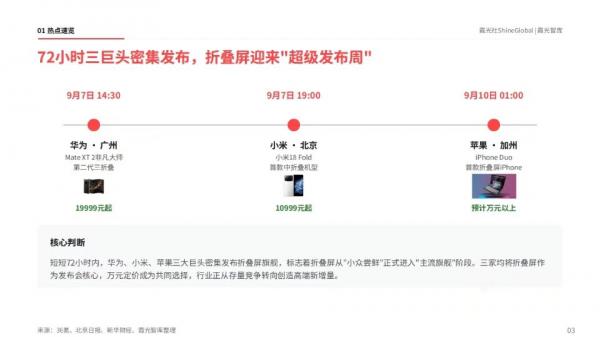
Figure: Timeline of the 72-hour foldable screen launches by the three giants (Source: Xiaguang Think Tank)

The global smartphone market has bid adieu to its era of rapid expansion.
According to IDC data, global smartphone shipments in 2025 reached 1.26 billion units, marking a meager 1.9% year-over-year increase.
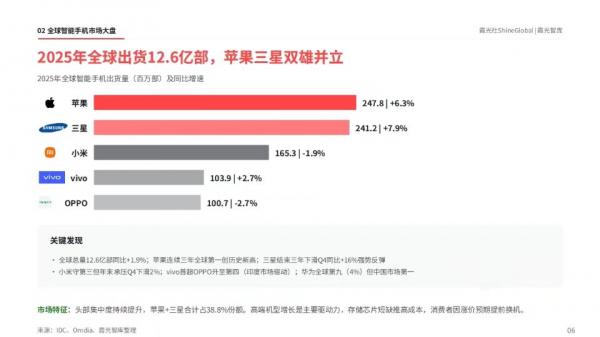
Figure: Ranking of global smartphone shipments in 2025 (Source: IDC, compiled by Xiaguang Think Tank)
A more dire scenario unfolded in 2026. Affected by skyrocketing memory chip prices, global smartphone shipments in the second quarter of 2026 reached 277.5 million units, a 6.7% year-over-year decline. This marked a rare instance of quarterly negative growth in recent years.
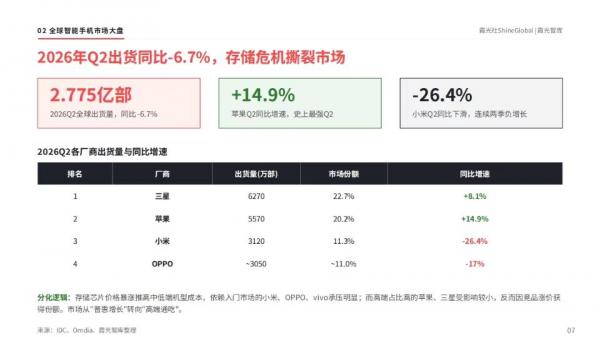
Figure: Market differentiation in the global smartphone market in Q2 2026 (Source: IDC, compiled by Xiaguang Think Tank)
The memory chip crisis has fragmented the market: Premium brands have sustained growth through brand premiums and cost-passing strategies, while mid-to-low-end brands face the dual pressures of shrinking demand and escalating costs.
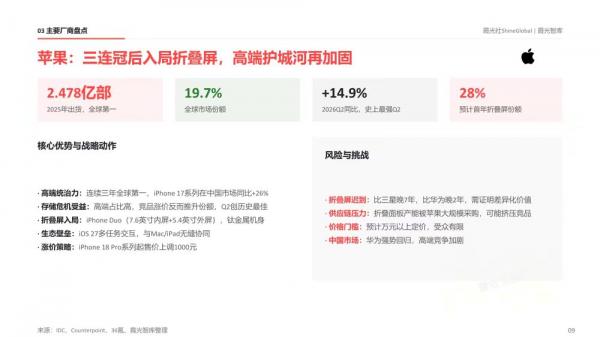
Apple shipped 55.7 million units in Q2 2026, a 14.9% year-over-year increase, marking its strongest Q2 performance to date.
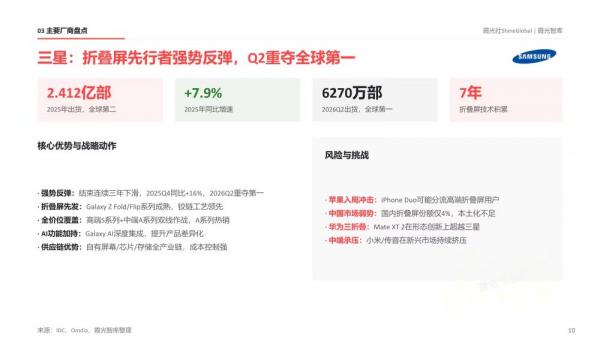
Samsung shipped 62.7 million units, an 8.1% year-over-year increase, reclaiming the top spot.
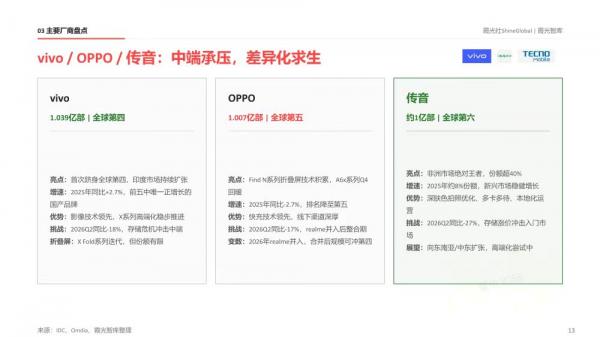
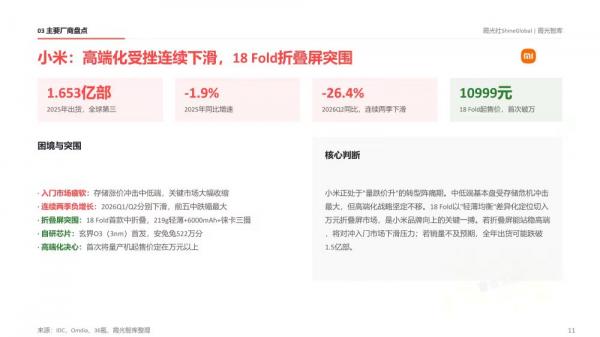
Xiaomi shipped 31.2 million units, a 26.4% year-over-year decline, facing significant pressure.
In a market characterized by intense competition, the innovation space for traditional slab phones is dwindling. Screen size, processor performance, and camera megapixels—marginal improvements in these parameters are increasingly insufficient to entice consumers.
Foldable screens offer a fresh avenue: By innovating in form factor, they create new product categories and price ranges, breaking through the growth bottleneck of the saturated market.
This is the fundamental reason why the three giants are simultaneously betting on foldable screens—not because foldable screens are already a massive market, but because there are no new narratives to tell in the slab phone market.

Rewinding to 2025, the global smartphone market landscape was as follows:
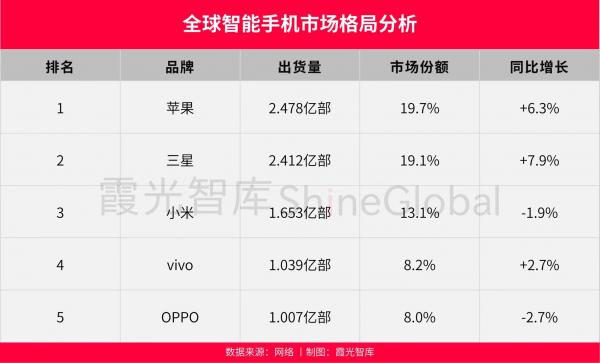
Apple and Samsung formed the first tier, collectively occupying nearly 40% of the market share. Xiaomi, vivo, and OPPO formed the second tier, but their growth had significantly slowed.
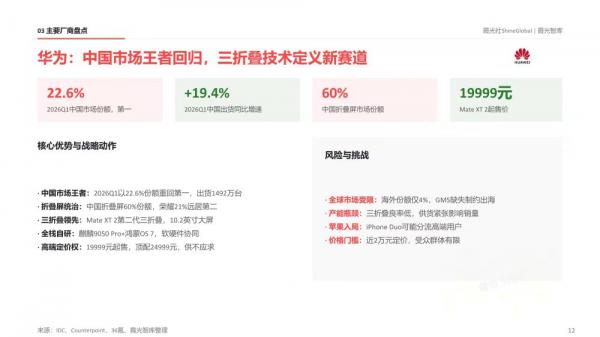
Huawei's return was the biggest variable. In the first quarter of 2026, Huawei's market share in the Chinese smartphone market reached 22.6%, with shipments of 14.92 million units, a 19.4% year-over-year increase, reclaiming the top spot in the Chinese market.
However, Huawei's overseas market remains constrained—overseas sales account for only 6.6%. This means Huawei's growth primarily comes from the domestic market, which has a limited total volume.
For all players: The domestic market has reached its peak, and growth must come from two directions—product upgrades driven by foldable screens and spatial expansion through overseas markets.

The foldable screen market is approaching an inflection point.
According to Omdia data, global foldable smartphone shipments in 2025 reached 18.2 million units, a 6% year-over-year increase—though growth has slowed. In the first half of 2026, shipments reached 5.1 million units, a 21.6% year-over-year decline, facing short-term pressure.
However, a more critical long-term signal is that as of the second quarter of 2026, cumulative global foldable smartphone shipments surpassed 100 million units.
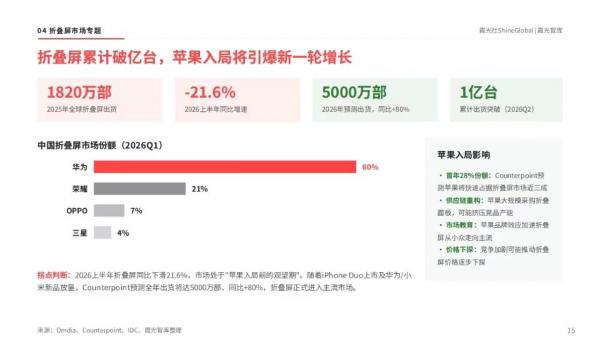
Figure: Global foldable screen market size and competitive landscape (Source: Omdia/Counterpoint, compiled by Xiaguang Think Tank)
100 million units is a psychological threshold, indicating that foldable screens have transitioned from 'novelty products' to 'mature categories with a substantial user base.'
Counterpoint predicts that global foldable screen shipments will grow by 80% year-over-year in 2026, reaching 50 million units. The biggest variable is Apple—the iPhone Duo is expected to capture 28% of the foldable screen market share in its debut year.
Apple's entry will reshape the foldable screen market in three ways:
First, educating the market. Apple's brand appeal will encourage more consumers to try foldable screens for the first time, expanding the overall category.
Second, raising the bar. Apple's entry will accelerate the shift from 'parameter competition' to 'experience competition,' making software ecosystems and app adaptations more important than hardware parameters.
Third, squeezing domestic brands. In the Chinese foldable screen market, Huawei holds a 60% share, followed by Honor at 21%, OPPO at 7%, and Samsung at 4%. After Apple's entry, competition in the premium foldable screen market will intensify.
However, the real challenge for foldable screens lies not in technology but in pricing. Currently, mainstream foldable screens are still priced above 10,000 yuan, limiting their adoption rate. The industry generally expects that by 2027, as costs decline and competition intensifies, foldable screen prices could drop to the 5,000-8,000 yuan range, at which point true mass adoption will occur.

As the domestic market peaks, overseas expansion has become a necessity for Chinese smartphone manufacturers.
Data shows that overseas sales account for over 50% of revenue for domestic brands:
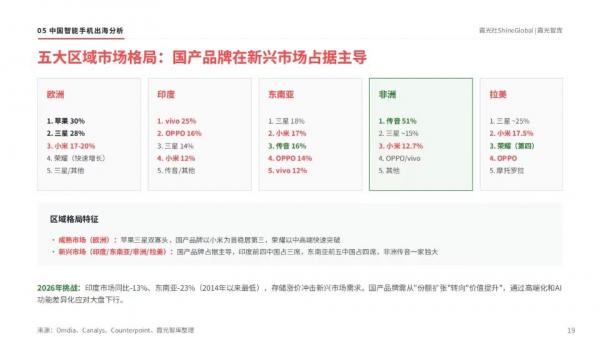
Figure: Regional market landscape of Chinese smartphone brands across five major regions (Source: Omdia/Canalys, compiled by Xiaguang Think Tank)
Xiaomi: 74% overseas sales, ranking in the top three in market share across 58 countries globally.
vivo: 56% overseas sales, ranking first in India with a 25% share.
OPPO: 57% overseas sales, steadily expanding in Southeast Asia and Latin America.
Transsion: Approximately 90% overseas sales, dominating the African market with a 51% share.
Honor: Overseas sales exceed 50% for the first time, with a 47% year-over-year increase in overseas shipments in 2025, making it the fastest-growing brand.
From a regional perspective:
Europe: A duopoly of Apple (30%) and Samsung (28%), with Xiaomi firmly in third place at 17-20% and Honor rapidly breaking through in the mid-to-high-end segment.
India: vivo leads with 25%, followed by OPPO at 16%, with domestic brands dominating.
Southeast Asia: Chinese brands occupy four of the top five spots, with Xiaomi at 17% (second), Transsion at 16% (third), OPPO at 14% (fourth), and vivo at 12% (fifth).
Africa: Transsion dominates with a 51% share.
Latin America: Xiaomi ranks second with 17.5%, while Honor experiences rapid growth.
However, overseas expansion also faces new challenges. In the second quarter of 2026, the Indian market declined by 13% year-over-year, and the Southeast Asian market fell by 23%—the lowest growth rates since 2014. Rising memory prices have impacted demand in emerging markets, requiring domestic brands to shift from 'market share expansion' to 'value enhancement.'
A clear trend is emerging: Chinese brands are transitioning from 'cost-effective overseas expansion' to 'premiumization overseas.'
The Honor Magic6 Pro is priced at 1,299 euros overseas, directly competing with Apple and Samsung. Huawei's foldable screens command a premium of over 20% overseas. vivo's average selling price (ASP) in India has risen by 11%. Mid-to-high-end models priced above $300 are becoming new growth engines for domestic brands overseas.
Foldable screens and AI are two key drivers for Chinese brands' premiumization overseas. Huawei uses triple-folding to establish form factor differentiation, Xiaomi leverages AI features to enhance product experience, and Honor reshapes its brand positioning with 'AI leadership.'
The next decade of smartphones has only just begun.
-
Small Home Appliance Sales Aim for Indonesian Leadership: Can Woke Non-Fantastic Outshine Major E-commerce Platforms?
-
Why Do We Still Refuse to Call It AGI When GPT-6 Is Already This Powerful?
-
![]()
Xiaomi's Response to the 'First Crash' of 'Pengcheng': Can Extended-Range Models Serve as a Remedy for Sluggish Sales?
-
![]()
Redefining the Smartphone Arena: Insights from the 'Super Launch Week' of Triple-Folding Phones | Global Smartphone Market Overview & Analysis of Chinese Manufacturers' Global Expansion
-
From the 48 AI Applications Most Favored by Investors, I Observe These Two Trends
-
![]()
The Ultimate Guide to Buying a New iPhone: Should You Opt for the Duo/Pro/Pro Max or Hold Out for the Standard Version?
-
![]()
Doubao Phones: Sales Aside, ByteDance Is Already Ahead!
-
![]()
Apple's 2026 Autumn Event Unveils Foldable iPhone Duo, Heralding Ternus's Strategic Shift