Guangdong Leads by a Wide Margin, Shanghai Dominates Finance, Beijing Giants Take the Lead
 11/23 2026
 394
Chinese enterprises' "great voyage" has entered deep waters. Overseas expansion is no longer a solo effort by individual companies but a comprehensive contest of cities' overall strength. The "National Provincial and Municipal Overseas Expansion Capability Evaluation Report" quantitatively scores 31 provinces and municipalities nationwide based on six major dimensions: policy support, enterprise quality, logistics infrastructure, foreign trade scale, talent reserves, and financial facilitation.

Guangdong Leads by a Wide Margin; Five Provinces and Municipalities Form the First Tier of Overseas Expansion
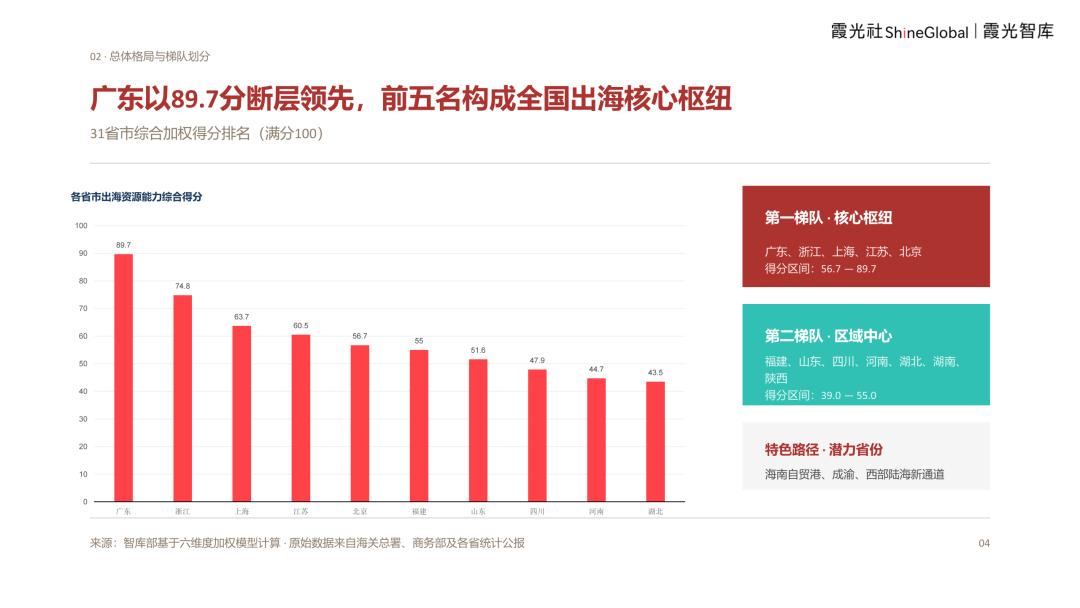
In terms of composite scores, Guangdong leads by a wide margin with 89.7 points, firmly ranking first nationwide in overseas expansion. Zhejiang, Shanghai, Jiangsu, and Beijing follow closely, jointly forming the core hubs of China's first tier of overseas expansion. Fujian, Shandong, Sichuan, and other provinces and municipalities rank as regional centers in the second tier, while the Hainan Free Trade Port and the Chengdu-Chongqing region, relying on unique policy and corridor advantages, have become distinctive provinces with great potential for overseas expansion.

Analysis of Six Major Overseas Expansion Dimensions
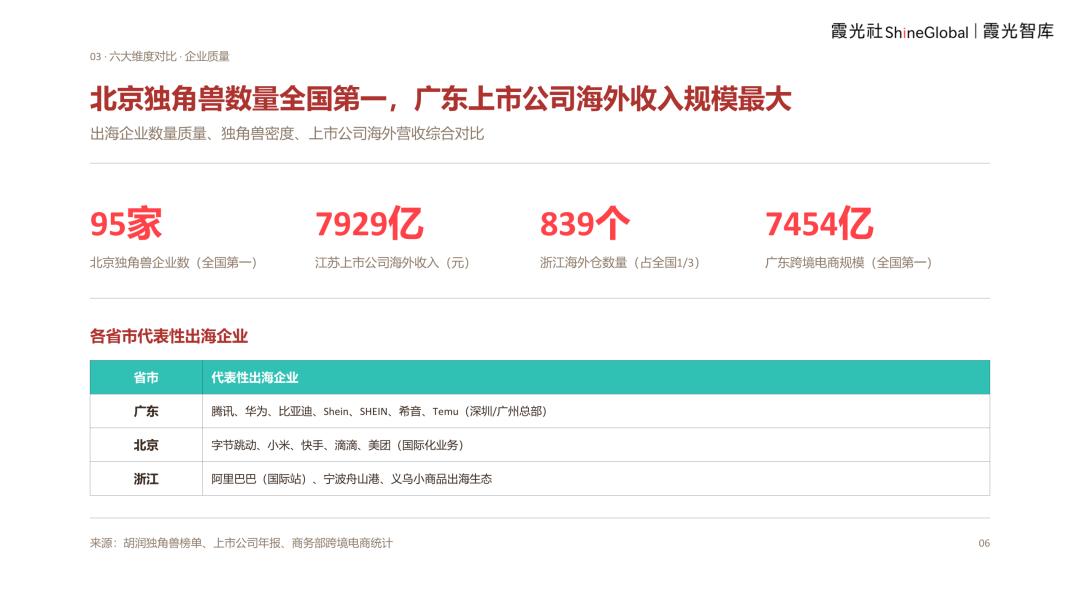
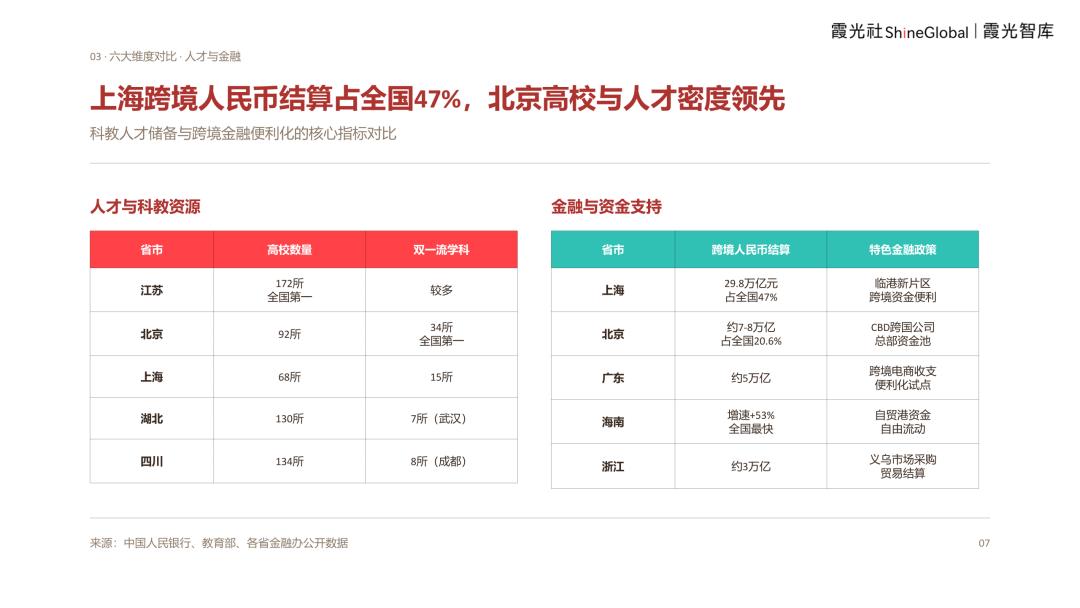
· Enterprise Quality: Beijing leads the nation with 95 unicorn enterprises; the overseas revenue of listed companies in Jiangsu is nearly 800 billion yuan; Zhejiang's overseas warehouses account for one-third of the national total; Guangdong's cross-border e-commerce scale alone exceeds 700 billion yuan, ranking first nationwide. Among representative overseas expansion enterprises, Guangdong gathers Huawei, Tencent, BYD, Shein, and Temu; Beijing has ByteDance, Xiaomi, Didi, and others; Zhejiang is represented by Alibaba International Station and the Yiwu ecosystem.
· Talent and Finance: In terms of talent, Jiangsu has 172 universities, the highest in the country; Beijing is home to 34 Double First-Class universities, with the nation's top high-quality talent reserves. In finance, Shanghai accounts for 47% of cross-border RMB settlement nationwide, while Hainan, with a growth rate of +53%, has become the nation's incremental growth engine.
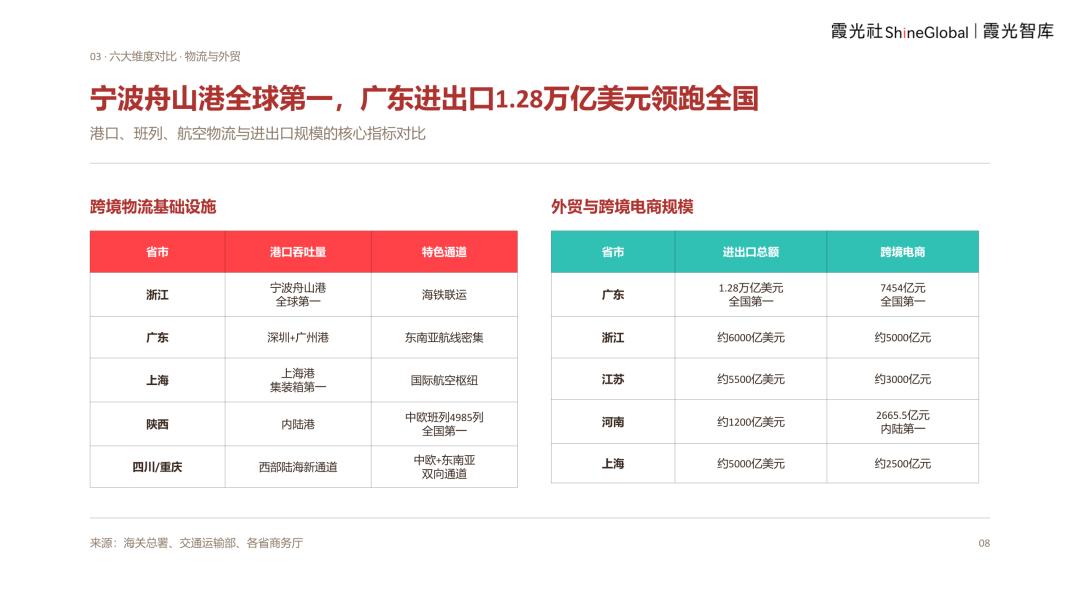
· Logistics and Foreign Trade: In logistics infrastructure, Zhejiang's Ningbo-Zhoushan Port ranks first globally in cargo throughput, Shanghai Port ranks first in container volume, and Shaanxi ranks first nationwide in the number of China-Europe freight trains. In foreign trade, Guangdong leads in import and export volume, followed closely by Zhejiang, while Henan ranks first among inland provinces with a cross-border e-commerce scale of nearly 300 billion yuan.
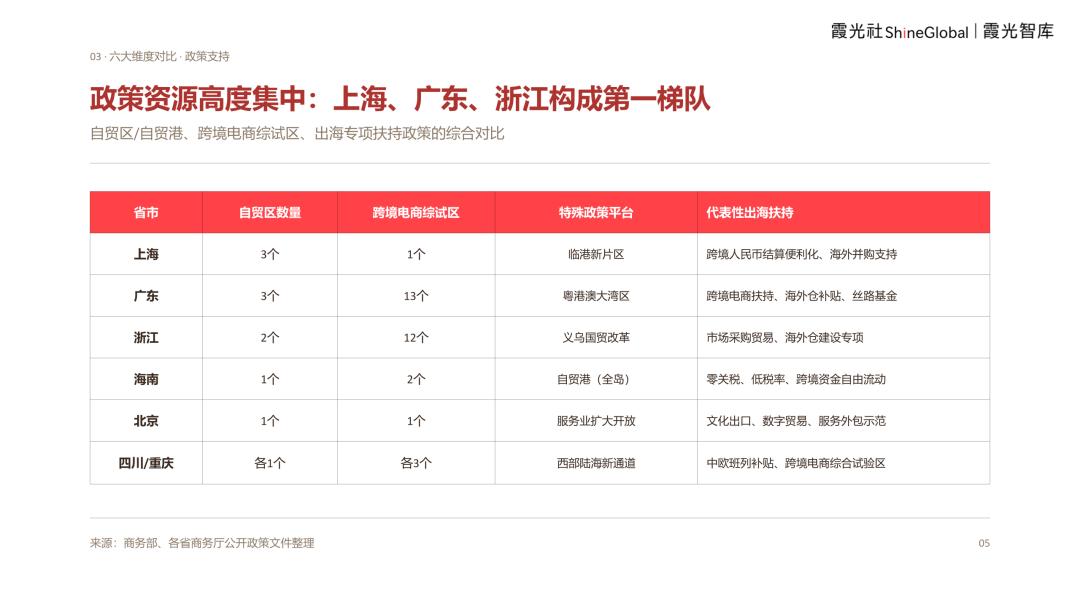
· Policy Resources: Shanghai, Guangdong, and Zhejiang lead in the number of free trade zones. Hainan, relying on the zero-tariff and free flow of capital of its island-wide free trade port, and Sichuan/Chongqing, relying on China-Europe freight train subsidies under the New Western Land-Sea Corridor, have become distinctive policy highlands.

Profiles of Leading Provinces and Municipalities in Overseas Expansion
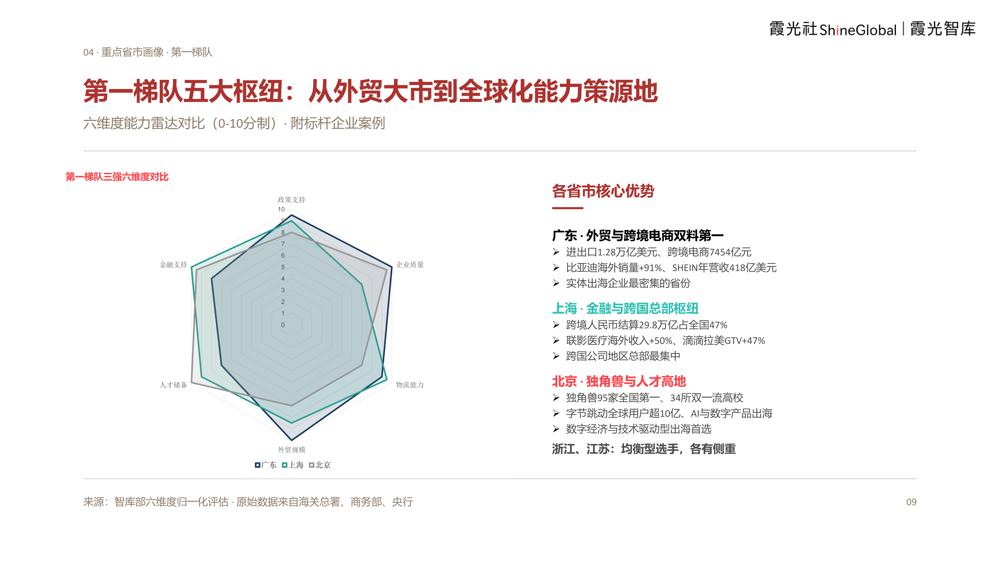
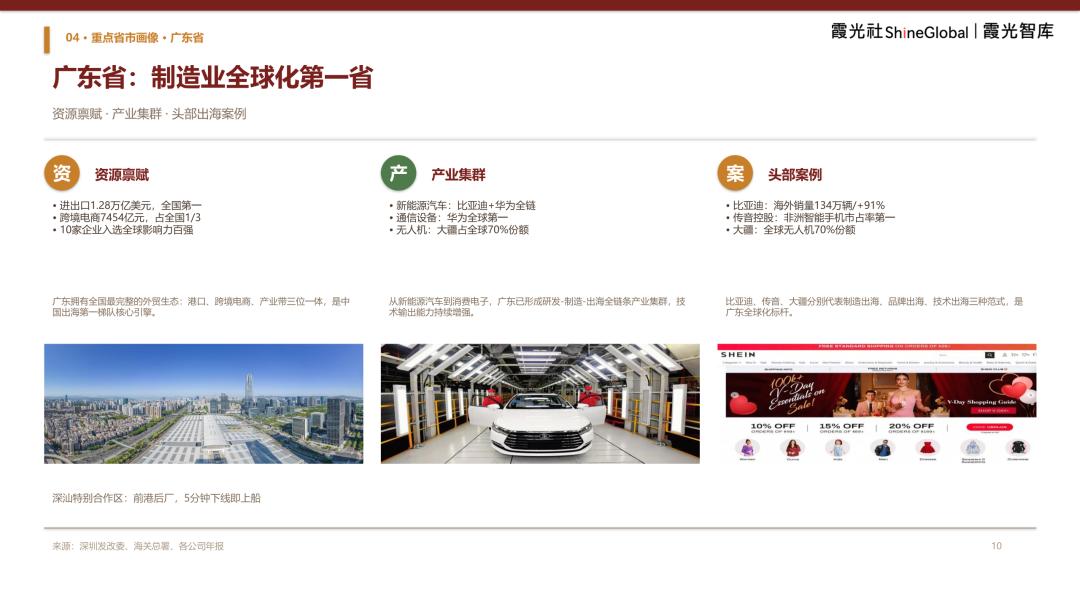
Guangdong: The No. 1 Province in Manufacturing Globalization
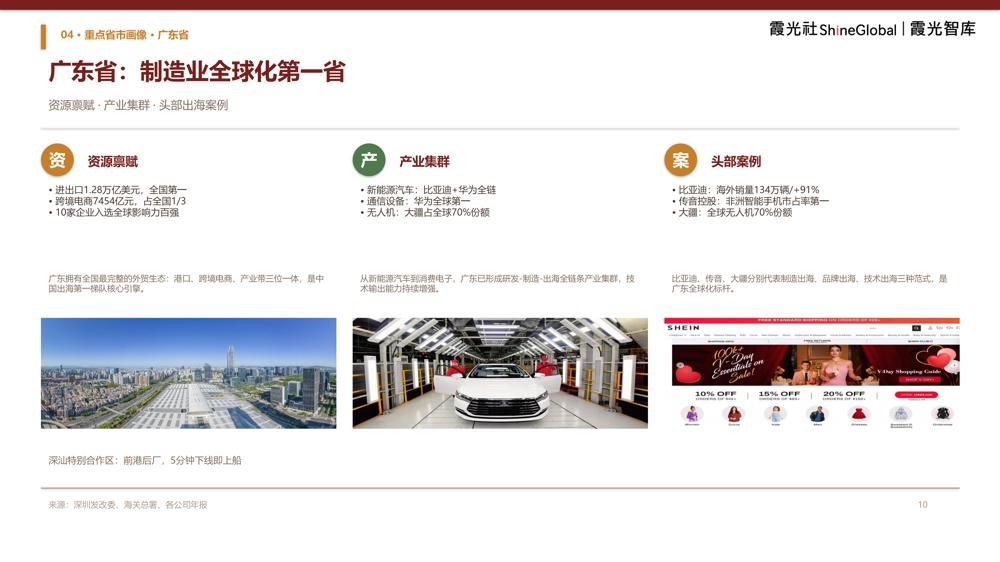
Guangdong has the most complete trade ecosystem in the country, with ports, cross-border e-commerce, and industrial belts integrated into a trinity, forming a full-chain industrial cluster from new energy vehicles to consumer electronics. BYD, Transsion Holdings, and DJI, three benchmarks for overseas expansion, represent the three top paradigms of manufacturing going global, brand going global, and technology going global, respectively, making Guangdong a well-deserved leader in China's first tier of overseas expansion.
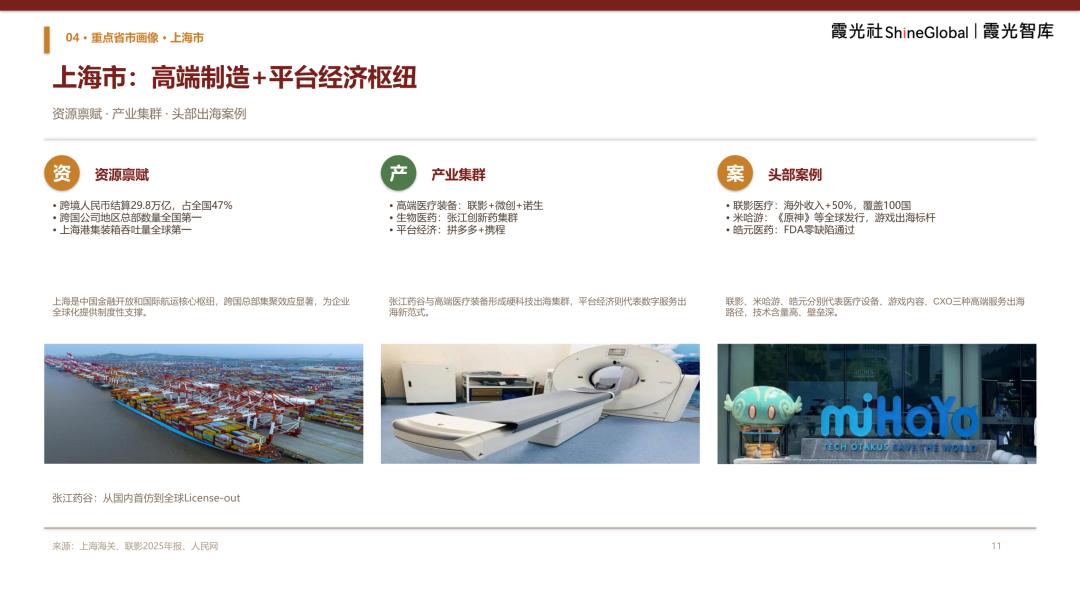
Shanghai: A Hub for High-End Manufacturing and the Platform Economy
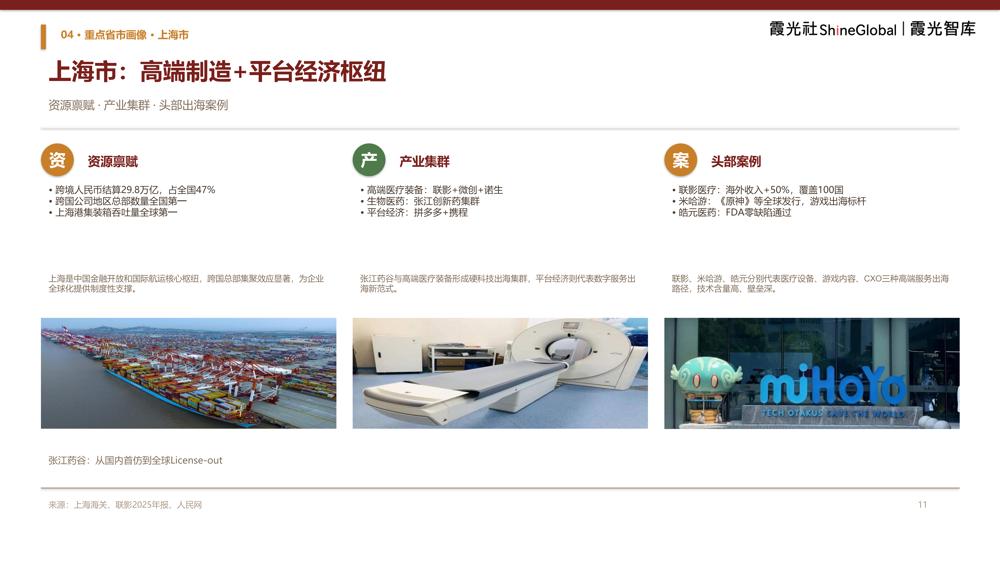
Shanghai is the core hub of China's financial opening-up and international shipping, accounting for nearly 50% of cross-border RMB settlement nationwide, with a significant agglomeration effect of multinational headquarters. Zhangjiang Pharma Valley and high-end medical equipment form a hard-tech overseas expansion cluster. United Imaging Healthcare, miHoYo, and Haoyuan Pharma represent three high-end service overseas expansion paths—medical equipment, gaming and entertainment, and CXO—respectively, with high technological content and deep barriers.
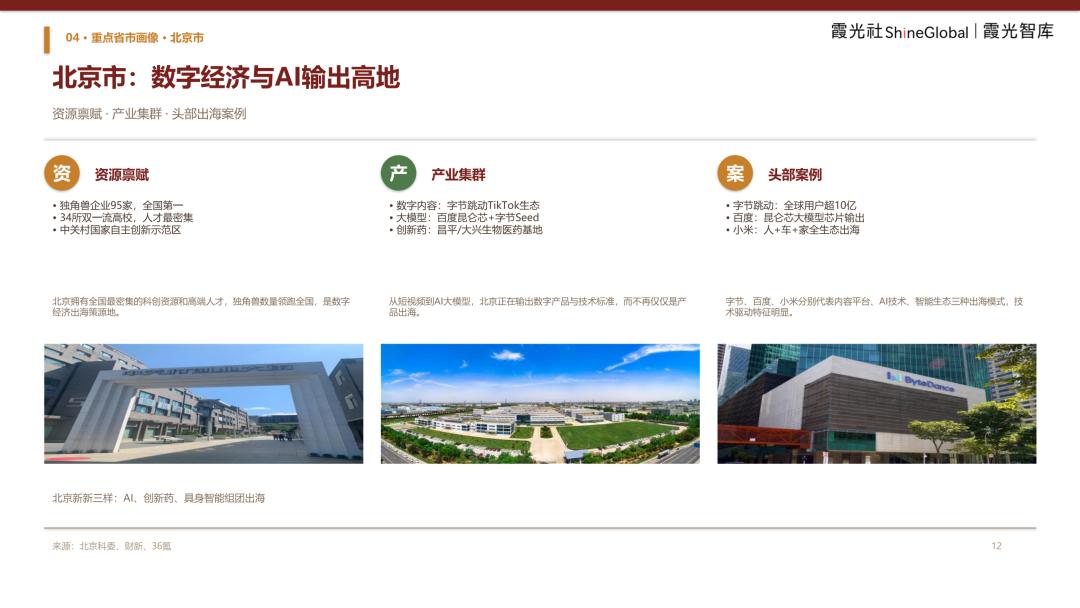
Beijing: A Digital Economy and AI Highland Led by Giants
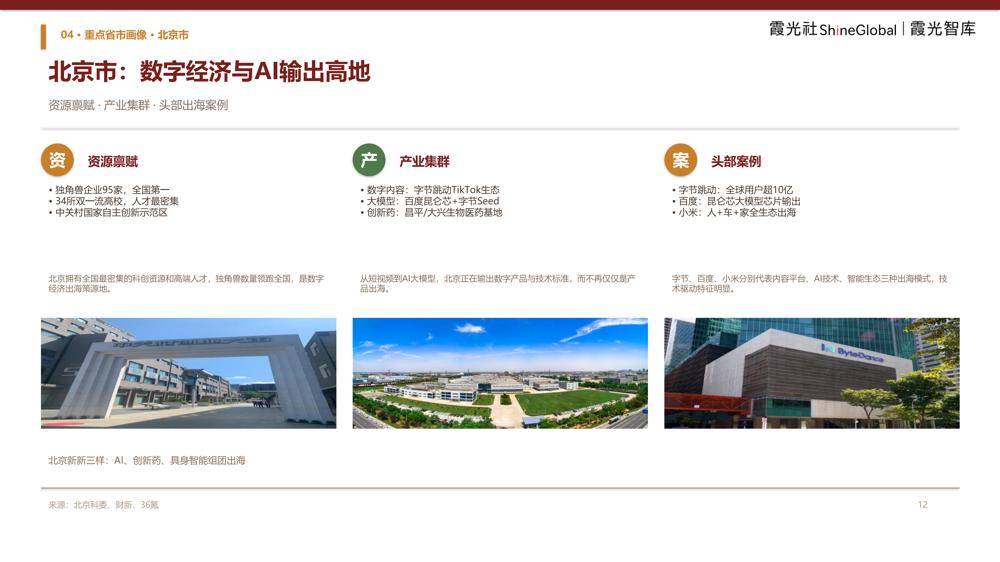
Beijing is the birthplace of the global digital economy's overseas expansion, with its fundamental base strongly dominated by super giants. Relying on the Zhongguancun National Independent Innovation Demonstration Zone and the nation's densest cluster of 34 Double First-Class universities, it has nurtured global giants such as ByteDance, Xiaomi, and Baidu, representing top-tier output capabilities in content platforms, smart ecosystems, and underlying AI technologies. At the same time, Beijing's 95 national unicorn enterprises, relying on technology and capital spillover from the giants, are becoming the backbone of its overseas expansion reserves.
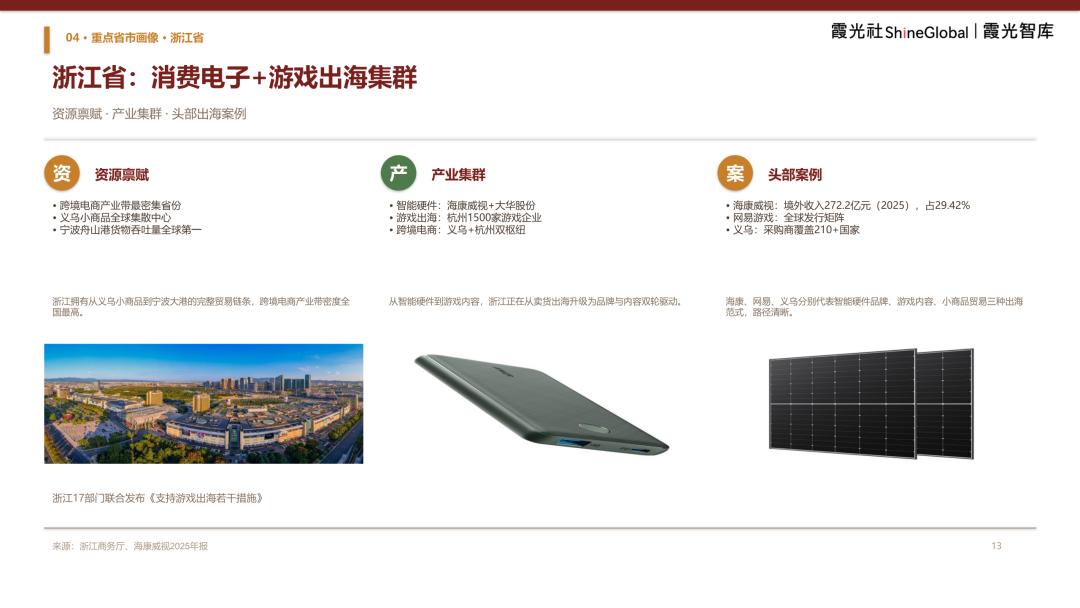
Zhejiang: A Cluster for Consumer Electronics and Gaming Overseas Expansion
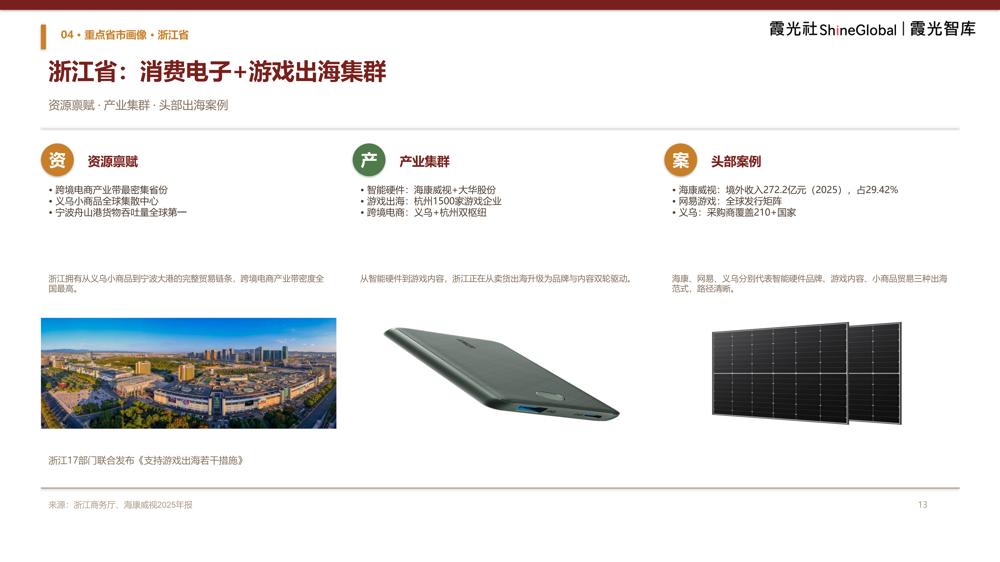
Zhejiang has a complete trade chain from Yiwu small commodities to Ningbo-Zhoushan Port, with the highest density of cross-border e-commerce industrial belts in the country. Today, Zhejiang is upgrading from simply "selling goods overseas" to a dual-driven model of "brand and content." Hikvision, NetEase Games, and Yiwu Commodity City represent three overseas expansion paradigms—smart hardware brands, gaming content, and small commodity trade—respectively, with clear paths and great resilience.
In 2026, China's overseas expansion landscape has moved beyond simple "low-price involution" toward a comprehensive contest of technology, brands, capital, and supply chains. Guangdong's hardcore manufacturing, Shanghai's finance and high-end services, Beijing's giant ecosystem and AI innovation, and Zhejiang's e-commerce and content—different provinces and municipalities are relying on their own endowments to occupy unique ecological niches in the global industrial chain. For enterprises about to expand overseas, choosing where to establish roots means choosing what kind of resource allocation and overseas expansion acceleration they will have.
-
Overseas Revenue Tops 60%: What Is Driving TCL's Global Growth?
-
![]()
500 Yuan Cheaper, Triple the Sales? OSTA Xingmang's Debut—What Is Huawei Really Aiming For?
-
Are Wait-and-See Buyers Missing Out Big? Apple to Launch iPhone 18, 18e, and Air 2 Next Spring
-
![]()
"Cost Killer" Battles Rising Parts Prices: Leapmotor Q3 Revenue Hits 31.7 Billion Yuan, Profit at 40 Million Yuan
-
![]()
Guangdong Leads by a Wide Margin, Shanghai Dominates Finance, Beijing Giants Take the Lead
-
Industry | Space Cloud Industrialization Milestones Unveiled in Quick Succession as China's Space Computing Power Ecosystem Extends Across the Entire Value Chain
-
Alibaba.com's Next Stop: More Than Just Selling Goods
-
China's Smart Driving Crosses Germany's Threshold