Will eSIM Kill the Physical SIM Card? Early Adopters Say: Not So Fast
 11/17 2026
 332
eSIM is better suited as a supplement than a replacement.
In October 2025, the China-market iPhone Air with an all-eSIM design went on sale, finally giving mainland Chinese users access to phone eSIM services. Over the past year or so, China-market eSIM has continued to expand its footprint in the phone sector. Currently, China Mobile, China Unicom and China Telecom all support eSIM, and subscribers can handle eSIM-related services through the carriers' officially designated channels.
As a SIM technology that removes the constraints of a physical card, eSIM carries a lot of expectations. As ordinary users, we all hope eSIM can deliver more convenient communication services and a more differentiated experience than physical SIM cards.
One year after the China-market phone eSIM rollout, Leitech (ID: leitech) spoke with several real users to hear what they had to say about their actual eSIM experience.
Veteran Apple Fan: All-eSIM Really Isn't That Easy to Live With
Xiao Tian was among the earliest China-market eSIM users, and he is also a longtime Apple fan. In 2017, Apple released the cellular version of Apple Watch S3, and the following year China Unicom launched Apple Watch S3 eSIM one-number-multiple-device trials in a handful of cities. He bought the smartwatch right away and activated the service, even getting a dedicated Unicom card for it.
In 2025, when the China-market iPhone Air went on sale, Xiao Tian bought the phone immediately. He wasn't drawn in by eSIM, though—what he valued was the phone's ultra-thin, lightweight design. Since it is an all-eSIM phone, he had to go and set up the eSIM service.
Xiao Tian believes China-market eSIM still comes with plenty of restrictions, the most troublesome being that you have to visit an offline business hall in person. In the early days of the China-market eSIM rollout, carrier training was not quite up to speed: only a few business halls could process it, and some staff, unfamiliar with the procedures, handled eSIM activation haltingly.
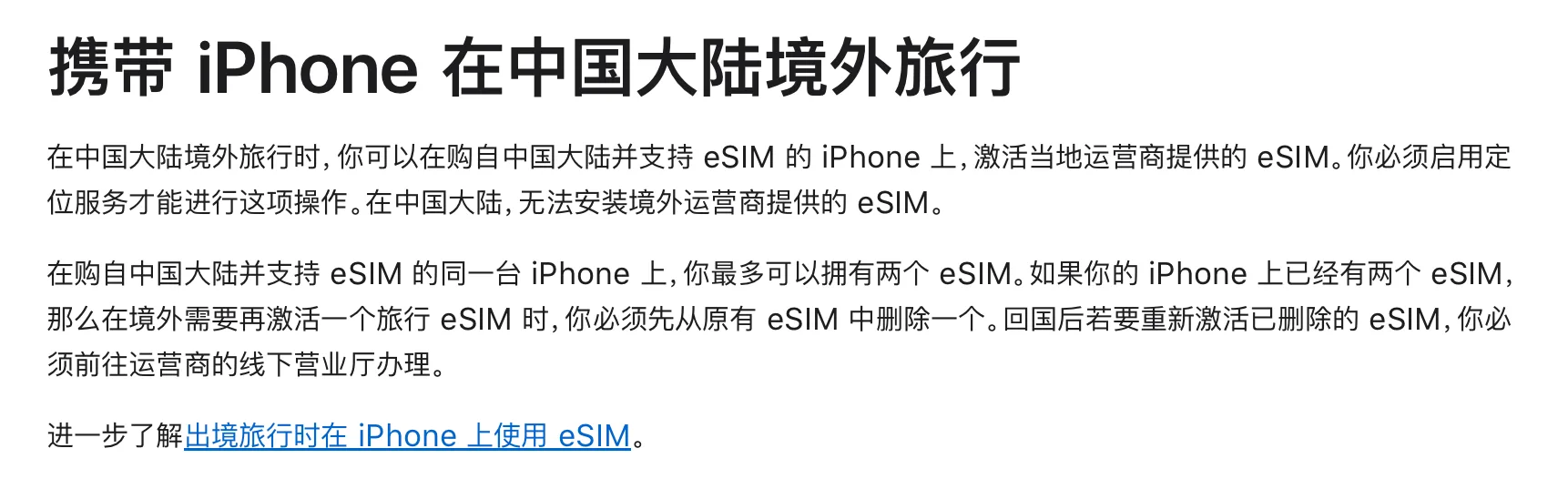
China-market eSIM has another limitation that Xiao Tian finds deeply unsatisfactory: it can store at most two eSIM numbers. He said that when traveling abroad, he often picks up a local data card. In theory, eSIM should be more convenient than physical cards—you just buy an eSIM data package on a travel platform and install it on the phone. But in reality, that is not the case. Since the phone already stores two cards, the overseas data card cannot be installed; he can only delete one of the existing cards and then go back to the business hall after returning home to restore it.
(Image source: Apple)
As a result, eSIM is actually less convenient than a physical card. After all, with a physical SIM you just insert it into the phone when you want to use it, and if you want to change numbers, you simply swap the card. So for Xiao Tian, an all-eSIM phone is actually not that easy to use, and the trouble it brings to daily experience outweighs the convenience.
Dual-Device User: eSIM + Physical SIM Slot Is the Best Solution
Jiajia is also an iPhone Air user, but she does not use this phone as her main device. After all, the camera system is cut down and the speakers aren't great either, so she only used eSIM to activate one card on the iPhone Air, while her main phone is an Android device with two physical cards inserted directly.
She believes the main convenience of the iPhone Air's eSIM function shows up when traveling abroad and activating overseas data cards. Since she reserved one eSIM slot, buying overseas eSIM packages is very convenient. Although China-market eSIM phones currently cannot activate and install overseas eSIM numbers within mainland China, users can buy and download the QR code in advance and scan it to install as soon as they land abroad.
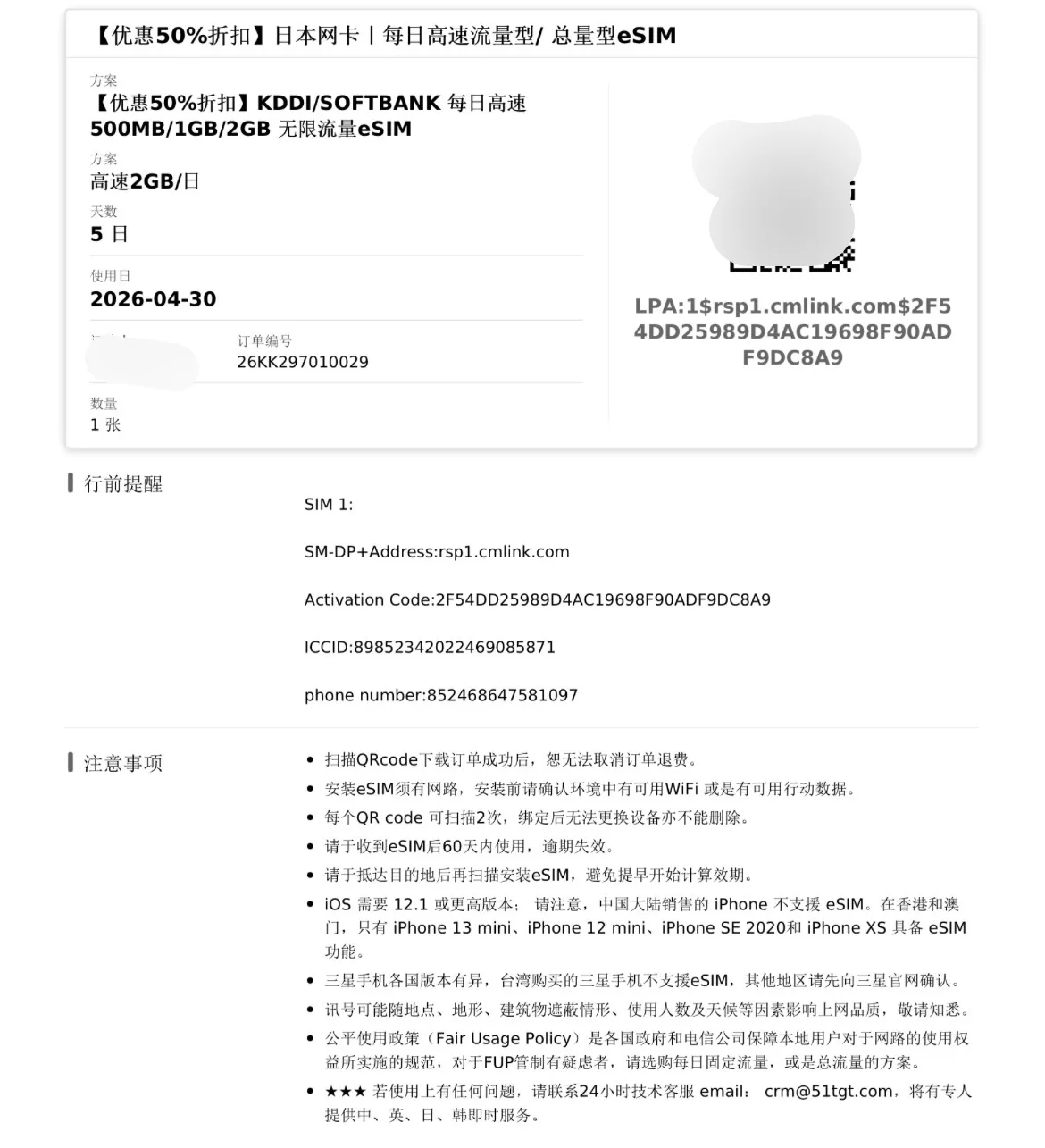
(Image source: Agoda)
She also got an iPhone 18 Pro this year and needed to transfer the number from the iPhone Air to it. At first, she planned to go to the business hall to get a replacement physical card and insert it into the new phone. But she soon discovered that although the China-market iPhone 18 Pro uses a dual physical SIM design, it also supports eSIM, so she could simply go to the business hall and transfer the eSIM number directly.
Now her iPhone 18 Pro has one eSIM number installed and one physical card inserted. Moreover, the iPhone 18 Pro supports dual eSIM, so she can keep one physical card inserted for daily use and use one eSIM number as well. When traveling abroad, she can disable the physical card and swap in an overseas data card.
Jiajia believes that given the current regulatory policy and the realities of China-market eSIM, eSIM + physical SIM slot is the best solution—more convenient and more flexible.
Android User: Just Stick With Physical Cards
The brand most actively promoting phone eSIM is, of course, Apple, but Android manufacturers are taking action too. Although eSIM adoption on Android models is not as strong as on iPhone, it is at least landing. Currently, Samsung, Huawei, OPPO, Honor and Lenovo have all released phones supporting China-market eSIM.
But veteran Android user Xiao Jie says he still prefers physical cards. This year he bought a China-market Samsung S26, which supports eSIM. Eager to try something new, he went to an offline business hall intending to activate an eSIM number. However, the staff at the business hall said Android phones could not activate eSIM, so Xiao Jie had to raise the issue through online customer service. A few days later, the carrier designated a business hall and relevant staff to handle it for him.
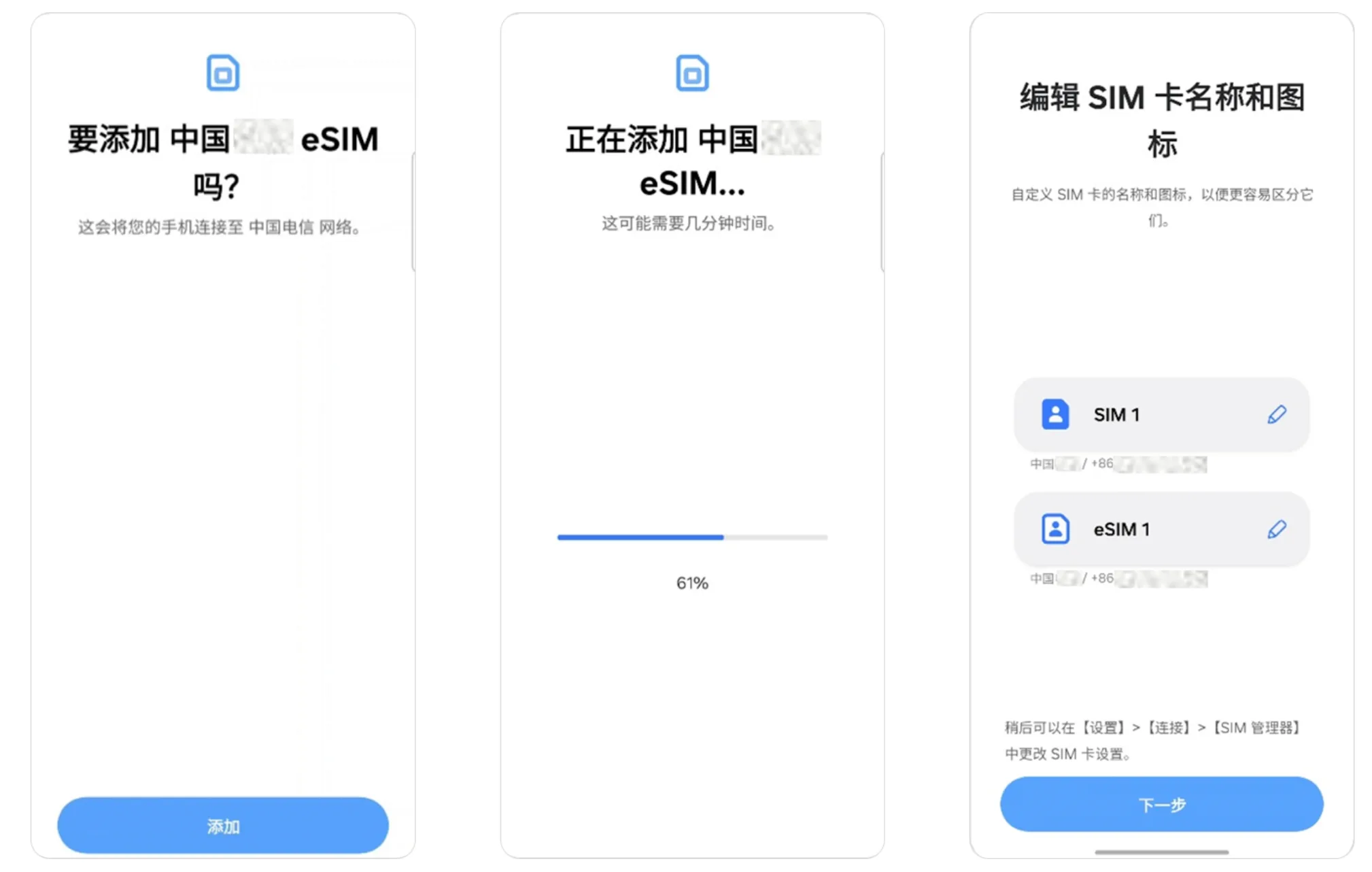
(Image source: Samsung)
From Xiao Jie's experience, current business hall training on eSIM services is concentrated on iPhone products, and many offline staff know nothing about the eSIM processing flow for Android phones.
He believes that even if current Android phones support eSIM, they all retain physical SIM slots. Given the current situation, sticking with physical cards is the most convenient. As for eSIM, it is fine to try it out, but if you activate it with your main number, all related services require offline handling, which is quite a hassle.
One Year After Rollout, China-Market eSIM Adoption Is Accelerating
From the experiences shared by the users above, the optimal eSIM solution on China-market phones is still the physical SIM slot + eSIM combination. Under current regulatory policy, eSIM faces many restrictions. Services such as number activation, card replacement, transfer and cancellation cannot be handled directly online and require a visit to an offline business hall. This largely dissolves eSIM's inherent convenience advantage, and in some scenarios it is even inferior to physical SIM cards.
Therefore, at present eSIM is better suited as an additional feature on smartphones rather than something used to directly eliminate physical SIM slots. If an all-eSIM design like the iPhone Air delivers a poor user experience, it will directly affect sales of the corresponding phone.
Now all three major carriers support eSIM service processing, but relatively speaking, China Unicom is the most proactive. At present, the eSIM function for cellular iPad versions is temporarily supported only by Unicom. Unicom has also stated on multiple occasions that it wants to promote eSIM adoption on phones.
In September this year, Unicom released the eSIM Early Adopter Season 2026 upgrade plan, announcing that it would encourage users to activate eSIM through benefits and entitlement giveaways. Unicom also said that domestic eSIM phone sales reached 1 million units in the first half of 2026 and are expected to exceed 20 million units in the second half.
Currently, Apple has a total of five models supporting China-market eSIM, including the iPhone Air, iPhone 17e, iPhone 18 Pro, iPhone 18 Pro Max and iPhone Duo. Specifically, Apple's SIM solutions fall into three categories: all-eSIM, single physical SIM slot + eSIM, and dual physical SIM slots + eSIM. Except for products with rather special form factors such as the iPhone Air and iPhone Duo, other phones basically still use the physical SIM slot + eSIM combination.
Beyond Apple, Huawei is also pushing eSIM very strongly. Huawei's flagship new phones released this year basically all support eSIM, such as the Mate90 series, Pura X Max, Pura X View and Mate XT 2 Ultimate Design. Huawei phones all adopt a dual physical SIM slot + dual eSIM solution. Most Samsung flagship models support eSIM, including the Galaxy S26 series and Galaxy Z Fold8.
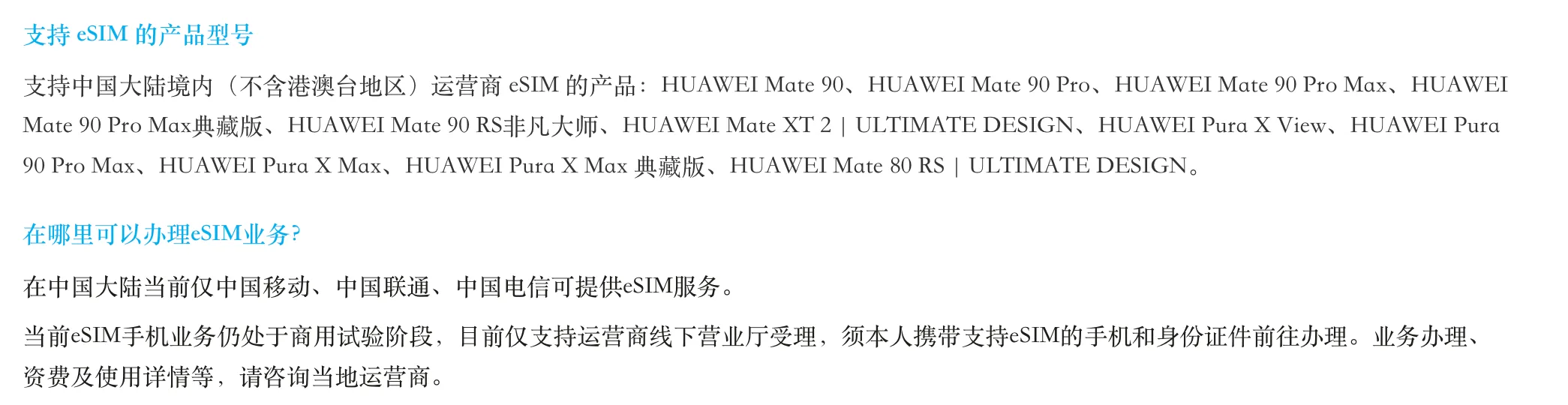
(Image source: Huawei)
By comparison, other Android brands' promotion of China-market eSIM is basically still a matter of releasing one or two phones to test the waters, such as OPPO's Find X9 Pro Satellite Communication Edition released last year and Honor's Magic8 Pro Air released this year.
To be fair, the Android camp's attitude toward eSIM is not that proactive, essentially because the input-output ratio is not high. In our view, the ultimate mission of all-eSIM is to eliminate physical SIM slots to free up more space for phones while bringing users a better experience. But from the user experiences above, if Android phones aggressively cut physical SIM slots like the iPhone Air, the experience actually becomes worse.
This leads most manufacturers to add eSIM while retaining dual physical SIM slots, inevitably increasing hardware costs. For ordinary consumers, most people cannot perceive the benefit of this feature. To put it plainly, except for Huawei and Samsung, which need all-around flagships to maintain high-end positioning and max out every cutting-edge configuration, other domestic brands currently launching one or two eSIM models are mostly following a defensive strategy of "you may not use it, but I can't not have it."
Since most device manufacturers already have the relevant technical reserves, when will the true all-eSIM era arrive?
In fact, the core bottleneck of eSIM adoption lies in the interplay between carrier service systems and current regulatory mechanisms. The original vision of eSIM was to make switching carriers as simple as connecting to WiFi, but under the current real-name registration system and network security requirements, the experience of online card activation and seamless number transfer has not yet been realized.
Barring surprises, for a fairly long period in the future, physical SIM slot + eSIM will remain the eSIM solution for the vast majority of China-market phones: the physical card is responsible for providing stable, hassle-free daily communications, while eSIM serves as a functional supplement for overseas roaming and temporary data packages, making things a bit more convenient for users when traveling abroad—something like an advanced version of "SkyTone" or "Worry-Free Travel."
Source: Leitech
Images in this article are from: 123RF licensed image library Source: Leitech
-
Jet Fuel Price Surge Inflates Costs, Net Profit Falls Over 20%; Spring Airlines Issues 10 Billion Yuan in Bonds to Fund 27.6 Billion Yuan Aircraft Purchase
-
![]()
A $5 Trillion Foreign Trade Hub Hosts a Landmark Gathering of Chinese and Global Titans
-
Baidu's AI Revenue Tops 50% for the First Time, Yet Shares Hit Record Low—Baidu Is Still Essentially Selling Computing Power
-
![]()
China's 6G Communications Breakthrough: Q/V-Band Experiment Hits 27Gbps, Setting New Domestic Record
-
![]()
AI Revenue Climbs to 13.2 Billion Yuan as AI Commercialization Reshapes Baidu's Growth Logic
-
The Better the Product, the Fewer Seats Sold? AI Is Forcing Software to Reinvent Its Business Model
-
![]()
Voyah | 10,526 Units Sold Above 200,000 Yuan, Dreamer PHEV Alone Accounts for 42.5%
-
![]()
Which Brands Drive Dongfeng Motor Group's Domestic Retail Volume in October?