A $5 Trillion Foreign Trade Hub Hosts a Landmark Gathering of Chinese and Global Titans
 11/17 2026
 403
Source | Shenlan Finance
On November 17, the 2026 APEC (Asia-Pacific Economic Cooperation) CEO Summit officially opened at the Qianhai International Conference Center.
More than 2,000 political and business representatives were in attendance, with 115 Fortune Global 500 companies converging on Shenzhen.
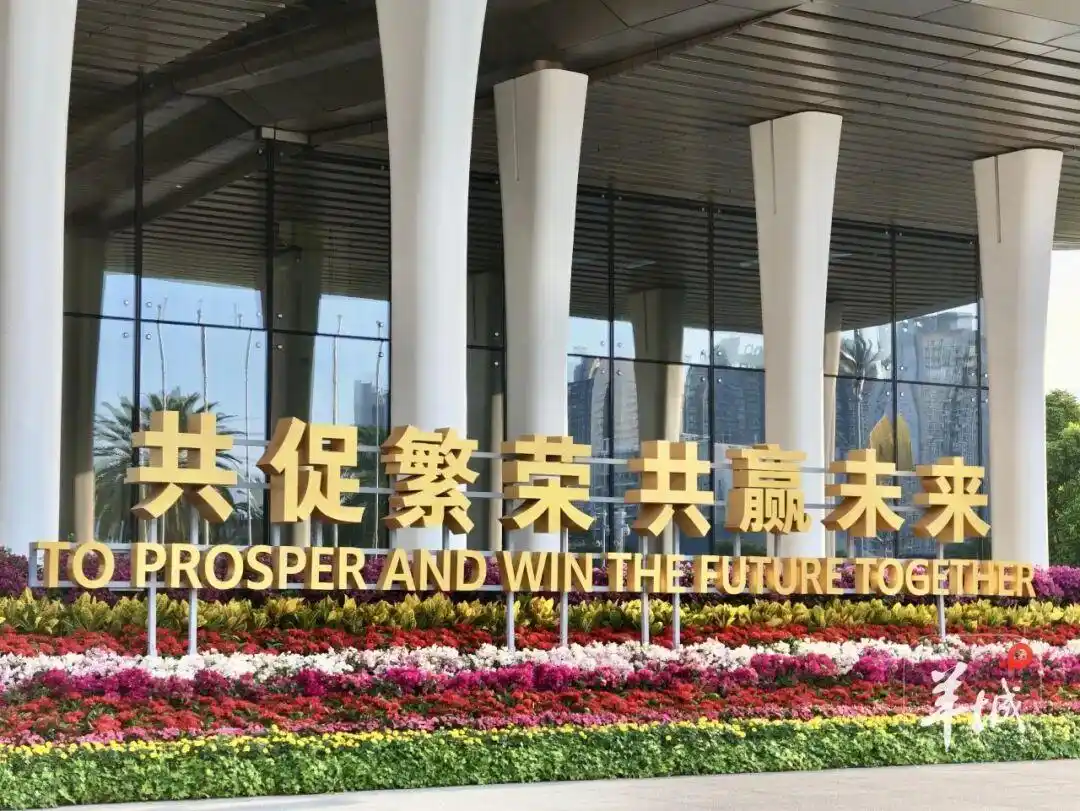
That this highest-level dialogue of the Asia-Pacific business community is being held in Shenzhen is rich in symbolic significance.
In the first 10 months of this year, Shenzhen's foreign trade imports and exports surged to 5.25 trillion yuan.
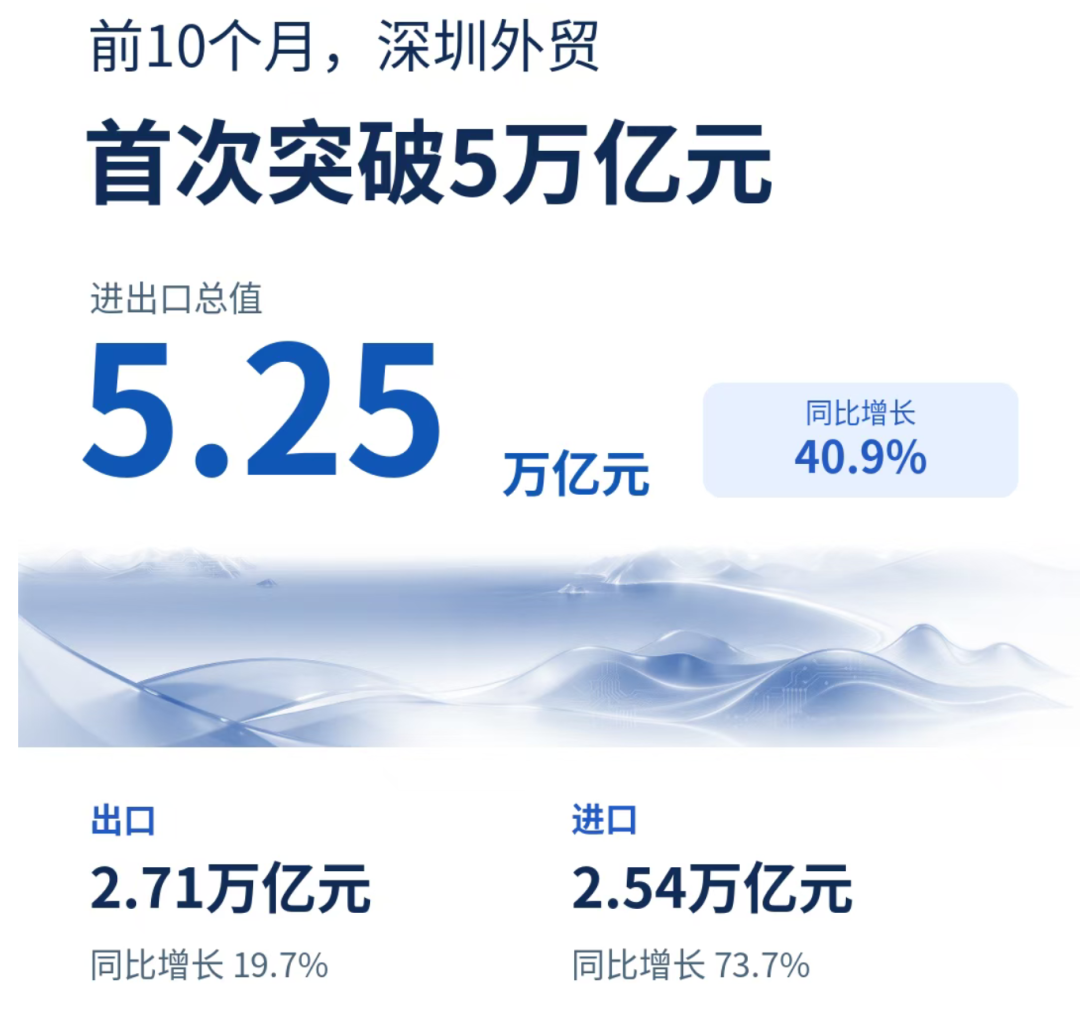
This makes it the first mainland city to cross the 5-trillion-yuan threshold in foreign trade — and behind this impressive trade report card, there is nothing accidental.
In Shenzhen, private enterprises account for as much as 74.2% of foreign trade, demonstrating outstanding market resilience against fluctuations. The industrial track has completed a transition from old to new — upgrading from the "old three" of traditional clothing, furniture, and home appliances to the "new three" of photovoltaics, electric vehicles, and power batteries, and further expanding to a "new new three" composed of AI, robotics, and innovative drugs, with emerging industries succeeding one another.
With the explosive growth of imports and exports of AI servers and integrated circuits, Shenzhen has achieved both "selling globally" and large-scale "buying globally." It is no longer merely an export factory, but a key hub in the global AI supply chain.
The foreign trade volume of a single city has already surpassed that of major foreign trade provinces such as Zhejiang and Shandong, and if placed on the list of global economies, it would rank among the world's top 20. More noteworthy still is that nearly 70% of Shenzhen's trade exchanges are with APEC economies.
The venue and the port corroborate each other: the clash of ideas at the forum mirrors the real flow of goods at the docks.
The APEC CEO Summit began in 1996, and it is no ordinary industry exchange meeting.
This is a negotiating table where leaders of various economies and business giants refine economic and trade rules and exchange practical demands. Many directions of Asia-Pacific regional cooperation have fermented and taken shape here.
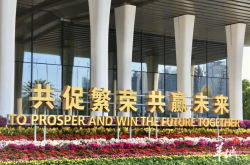
The theme of this year's summit is "Promoting Prosperity, Winning the Future Together." The first day's agenda was tightly paced: after welcome remarks and a business dialogue, seven thematic discussions followed in succession. Artificial intelligence, the digital economy, and green transformation are all the main battlegrounds in the current global contest over industrial standards. The specially added topic "The Guangdong-Hong Kong-Macao Greater Bay Area and Asia-Pacific Development Opportunities" carries the unique weight of Shenzhen as the host city.
The list of Chinese participating enterprises is a condensed map of China's industries.
Zeng Yuqun, Li Yanhong, Wang Xingxing, Wang Chuanfu, Lei Jun, Ho Chiu-king, Dong Mingzhu, Li Dongsheng, and Zhou Qunfei appeared on the same stage.
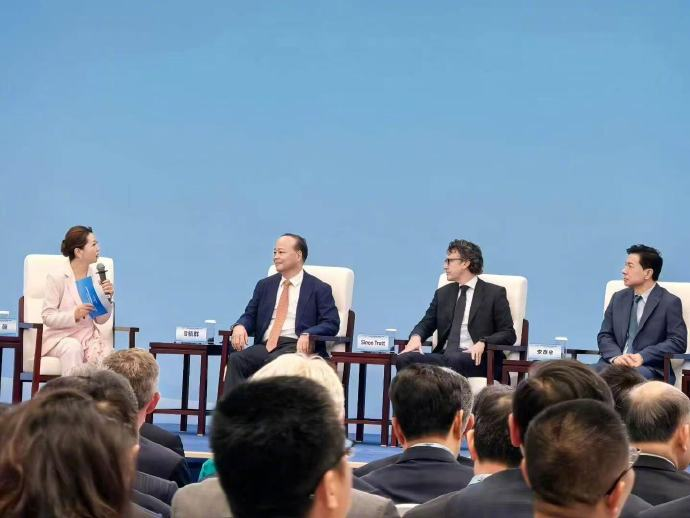
Baidu's Li Yanhong and CATL's Zeng Yuqun attended together. Photo courtesy of Southern Metropolis Daily
Power batteries, large-model AI, humanoid robots, new energy vehicles, home appliance manufacturing, precision manufacturing, and Hong Kong and Macao capital — pioneers of the new economy and veterans of manufacturing stand side by side.
This is not just a collective appearance.
New energy and robotics represent China's new growth poles breaking out externally; home appliances and electronic manufacturing represent the supply chain foundation that we have accumulated over decades and that is difficult to easily replace. Local Shenzhen enterprises such as BYD, ZTE, and UBTECH took the stage on their home turf, directly placing the Greater Bay Area's industrial sample in front of global merchants.
The overseas participant lineup hides even more thought-provoking realities.
The global CEOs of Visa and Mastercard, as well as senior executives from Citi, Google, and Boeing, all accepted the invitation.
All 21 APEC economies were covered, with U.S. companies accounting for about 20% of foreign participants, ranking first in number; 13 non-regional economies, including the UK, France, Germany, and Switzerland, also sent senior executives to attend.
Voices of geopolitical friction are endless, but capital answers with its feet: rhetoric can build barriers higher and higher, yet multinational giants are unwilling to give up the Asia-Pacific, the most resilient market.
But contradictions are also on the table.
Today's Asia-Pacific is no longer the era of simple division of labor and contract manufacturing. AI is contesting technological discourse power, green transformation is raising industrial costs for all countries, and supply chain security has become a common anxiety for all economies. Everyone must face a difficult question: under white-hot competition, how much room is left for open cooperation?
The significance of placing the summit in Qianhai lies precisely here.
The Guangdong-Hong Kong-Macao Greater Bay Area has the most complete domestic industrial chain and the deepest integration of domestic and international circulation. It is both a springboard for Chinese manufacturing to go global and a window for foreign capital to enter China. The practice of Shenzhen's 5-trillion-yuan foreign trade is exactly a typical model of connectivity among Asia-Pacific economies.
For the many Chinese entrepreneurs present, this is a two-way game.
They need to explain China's industrial path to the outside world, and also confront the pickiness, concerns, and competition of overseas markets.
In a cycle of accelerating global divergence, the APEC table is a rare buffer zone.
The winds and waves of the Pacific never cease, and prosperity has never been a zero-sum game.
When the whole world is searching everywhere for certainty, this city that has just crossed the 5-trillion-yuan threshold is using a top-level summit to answer: in a torn world, openness is still the way out.
*Disclaimer: The content of this article represents only the author's views. Markets carry risks, and investment requires caution. Under no circumstances does the information or opinions expressed in this article constitute investment advice to anyone.
The Shenlan Finance new media cluster originated from the Shenlan Finance reporter community and has a history of 16 years. It is a well-known domestic financial new media outlet. Its accounts focus on China's most valuable companies, frontier industry development, and emerging regional economies, providing valuable content for investors, listed company executives, and the middle class. Welcome to follow.
-
Jet Fuel Price Surge Inflates Costs, Net Profit Falls Over 20%; Spring Airlines Issues 10 Billion Yuan in Bonds to Fund 27.6 Billion Yuan Aircraft Purchase
-
![]()
A $5 Trillion Foreign Trade Hub Hosts a Landmark Gathering of Chinese and Global Titans
-
Baidu's AI Revenue Tops 50% for the First Time, Yet Shares Hit Record Low—Baidu Is Still Essentially Selling Computing Power
-
![]()
China's 6G Communications Breakthrough: Q/V-Band Experiment Hits 27Gbps, Setting New Domestic Record
-
![]()
AI Revenue Climbs to 13.2 Billion Yuan as AI Commercialization Reshapes Baidu's Growth Logic
-
The Better the Product, the Fewer Seats Sold? AI Is Forcing Software to Reinvent Its Business Model
-
![]()
Voyah | 10,526 Units Sold Above 200,000 Yuan, Dreamer PHEV Alone Accounts for 42.5%
-
![]()
Which Brands Drive Dongfeng Motor Group's Domestic Retail Volume in October?