Tesla's Gross Profit Increased by 440 Million, Yet Operating Profit Fell by 900 Million: Where Did Tesla's Money Go?
 10/23 2026
 534
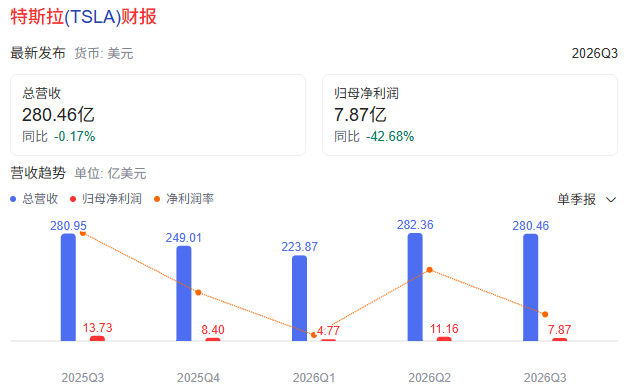
Tesla's revenue in the third quarter of 2026 was $28.046 billion, down slightly by 0.2% year-on-year and slightly below market expectations of $28.13 billion. Net profit under U.S. GAAP was $787 million, down 43% year-on-year, while operating profit was $718 million, a 56% year-on-year decline. After the earnings release, the stock price fell nearly 5% in pre-market trading.
This set of figures reveals an apparent contradiction. The same earnings report showed that the company's total gross margin rebounded to 19.6% from 18.0% a year earlier, with the automotive business's gross margin (excluding regulatory credits) rising to 18.1% from 16.3% in the second quarter, and free cash flow turning positive at $1.531 billion.
Gross margins are improving, cash flow is turning positive, yet profits have collapsed. This is not a contradiction in the earnings report but rather the result of two separate issues being conflated.
Some say Tesla saw "increased revenue but decreased profit" in the third quarter, but this popular narrative is not entirely accurate. From the earnings report, third-quarter revenue was $28.046 billion, compared to $28.095 billion a year earlier—zero growth or even a slight decline, hardly an increase. The real contradiction lies in stagnant revenue coinciding with soaring expenses.
On the revenue side, automotive revenue was $20.56 billion, down 3% year-on-year, with 486,500 vehicles delivered, a 2% decline. Energy generation and storage revenue was $2.881 billion, down 16% year-on-year and far below market expectations of $3.91 billion. The only bright spot was services and other revenue at $4.61 billion, up 33% year-on-year.
While Tesla's third-quarter deliveries exceeded expectations, production was only 464,400 vehicles, meaning 22,000 units were sold from inventory. The real structure of stagnant revenue is declining automotive growth, stalled energy storage, and the only incremental growth coming from high-margin services.
So, where did the profit go? The answer lies in the expense report.
Gross margin improved by 160 basis points year-on-year, increasing gross profit by about $440 million. However, operating expenses surged 39% year-on-year to $4.776 billion, $1.35 billion more than a year earlier, with R&D expenses alone reaching $2.761 billion. The $440 million improvement was dwarfed by the $1.35 billion expansion, resulting in a $906 million year-on-year decline in operating profit. Tesla's additional earnings in the third quarter barely covered a third of the expense gap.
Tesla's own explanation was straightforward: the decline in operating profit was primarily due to increased operating expenses related to AI and other R&D projects, as well as rising stock-based compensation costs.
In other words, the core automotive business did not deteriorate; what deteriorated was the expense structure.
It is worth noting that the 18.1% gross margin is significant, as it came from cost reductions outpacing price cuts.
Excluding regulatory credits and leasing, third-quarter average revenue per vehicle was about $41,300, down about $370 sequentially. However, variable costs per vehicle fell about $1,700 sequentially to $32,000, thanks to lower battery costs from renegotiated raw material contracts, Cybertruck gross margin turning positive for the first time, and reduced shipping and tariff costs. 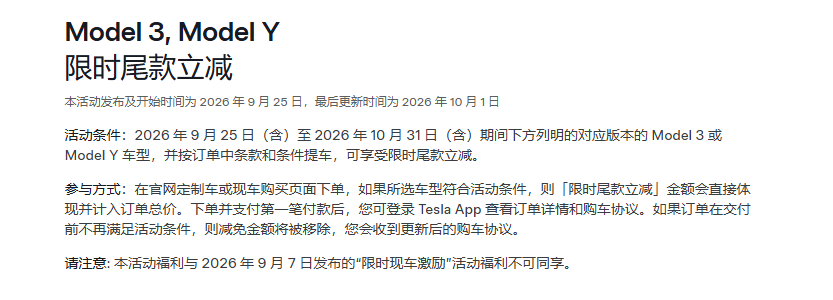
Of course, pricing pressure is real in the competitive new energy vehicle market. In September, Tesla launched two waves of promotional offers for the Model 3/Y in China, its first in 19 months. In the U.S., it maintained interest subsidies, but rising interest rates increased costs. Meanwhile, deliveries of high-priced models like the Cybertruck fell 33% sequentially, reducing their share from 2.6% to 1.7% and further lowering the average vehicle price.
Beyond automotive sales, Tesla faced a hidden drag: regulatory credit revenue was only $113 million, down 73% year-on-year. This nearly cost-free revenue source shrunk, meaning the 18.1% gross margin (excluding credits) better reflects true automotive profitability than the 18.5% GAAP figure.
The third-quarter expense surge was not a loss of control but a deliberate investment with clear destinations. During the earnings call, Musk outlined three mid-to-long-term growth pillars and provided a timeline.
First, for Robotaxi, the Cybercab fleet in Austin expanded tenfold in about a month and will enter Dallas next month. However, the company made clear that financial contributions will not be significant until after the second quarter of 2027.
Second, Optimus humanoid robots began early production on a high-volume line in Fremont, with planned annual capacity of 1 million units. A second line in Texas is being prepared for long-term annual capacity of 10 million units. However, Musk admitted that reaching a weekly production rate of 20,000 units will take at least another year, possibly longer, with external customer deliveries expected around the end of 2027 and AI5 chips slated for integration next April.
Third, the Terafab chip factory in Austin, with equipment costs in the tens of billions and long-term total investment exceeding $100 billion, plans to begin equipment commissioning in the first half of 2027, aim for first test chip production in May or June, and achieve mass production around the third quarter of 2028.
The earliest financial returns from these three projects will arrive in 2027, with the furthest not until late 2028. This means expense pressure will not ease for at least the next two years.
When viewed holistically, the logic is clear: Tesla is using cash flow from automotive manufacturing to fund a high-stakes bet on AI and robotics transformation.
-
![]()
Doubao Phone: Will It Spark a Fresh Wave of 'Soul Theory' Controversy?
-
![]()
When AI Creates Problems but No One Is Held Accountable: It Gave the Police a False Tip
-
![]()
From Doubao Mobile Phone to OPPO’s Partnership with Manus, and the Gradual Rise of Startups like Jieyue Xingchen: Who’s Riding the Wave of Opportunity?
-
![]()
Audi in Negotiations with Huawei: Developing Next-Gen A8 for China Using Huawei’s Platform, with Plans for Multiple New Models | Mirror Pro
-
![]()
People Trapped in Algorithms
-
![]()
Musk’s Computing Power Venture Recoups Investment Within a Year, Meta’s Muse Faces Uncertain Rollout Timeline
-
![]()
AI: From ‘Accelerator’ to ‘Paradigm Reconstructor’ in Metaphotonics
-
![]()
"You've Been Replaced by AI": The Future Landscape for Short Drama Creators in 2026