Desay SV’s Q3 Revenue Hits 9.519 Billion Yuan, Up 23.75%; Overseas Gross Margin at 31.34%, Domestic at 17.58%
 10/29 2026
 355
In September, retail sales of passenger vehicles in China declined by 28% year-on-year. However, the retail penetration rate for new energy vehicles (NEVs) soared to 67%. This year’s automotive market has put significant pressure on all component suppliers.
Q3 2026 Highlights:
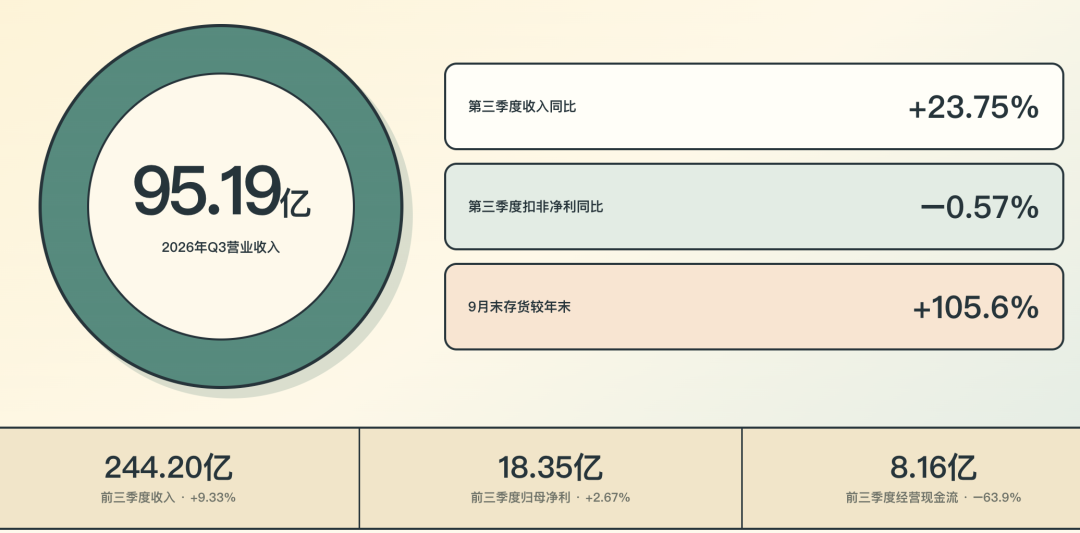
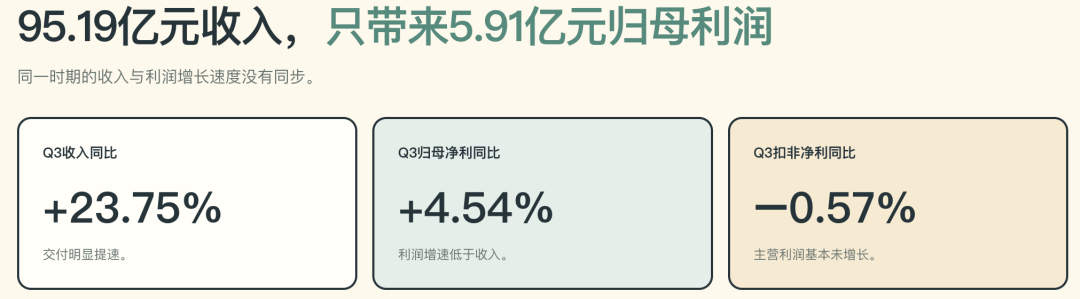
◎ Desay SV’s revenue: 9.519 billion yuan, a 23.75% increase year-on-year;
◎ Net profit attributable to shareholders: 591 million yuan, a 4.54% increase year-on-year;
◎ Net profit attributable to shareholders, excluding non-recurring items: 568 million yuan, a 0.57% decrease year-on-year.
Part 1: Quarterly Report Overview
Revenue for the first three quarters amounted to 24.420 billion yuan, marking a 9.33% increase year-on-year. Net profit attributable to shareholders reached 1.835 billion yuan, up 2.67% year-on-year.
Q3 revenue growth significantly outpaced the 1.75% growth seen in the first half of the year. However, the quarterly net profit margin attributable to shareholders stood at approximately 6.21%, lagging behind revenue growth. This indicates that scale expansion has not yet fully translated into improved profitability.
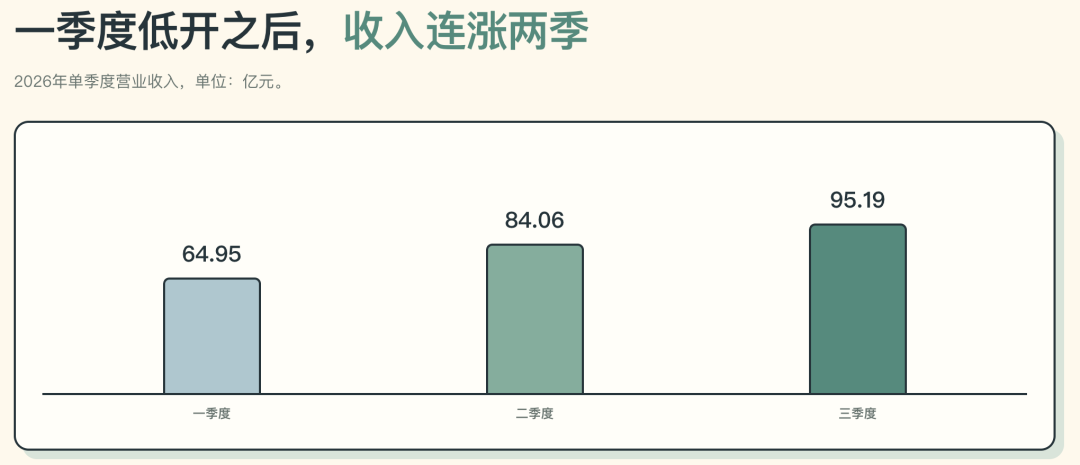
◎ Q1 revenue: Approximately 6.495 billion yuan;
◎ Q2 revenue: Approximately 8.406 billion yuan;
◎ Q3 revenue: 9.519 billion yuan.
Revenue increased sequentially from Q1’s low point, with Q3 seeing a ~13.2% increase quarter-on-quarter.
Profit trends, however, did not align:
◎ Q1 net profit attributable to shareholders: Approximately 461 million yuan;
◎ Q2: Approximately 784 million yuan;
◎ Q3: Declined to 591 million yuan.
Quarterly figures indicate increased deliveries in Q3, though profitability has not yet caught up.
Desay SV’s H1 Performance:
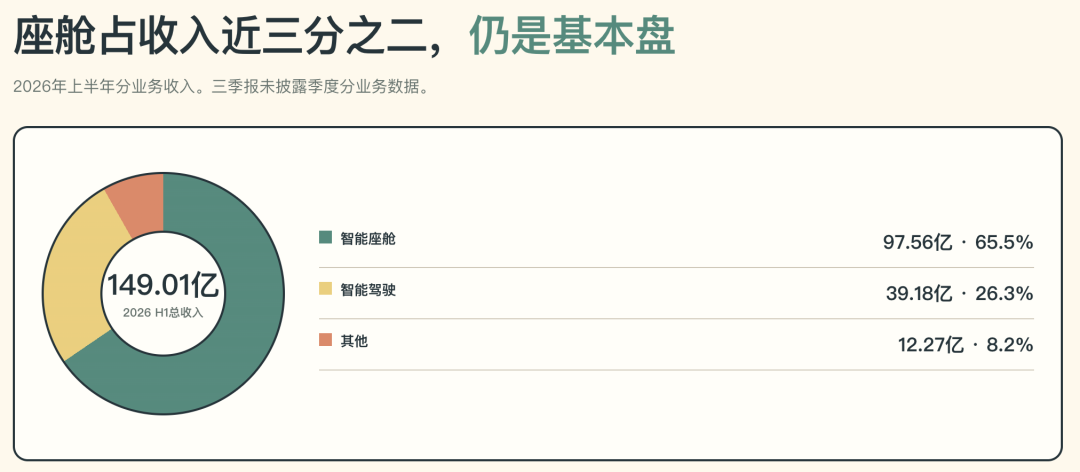
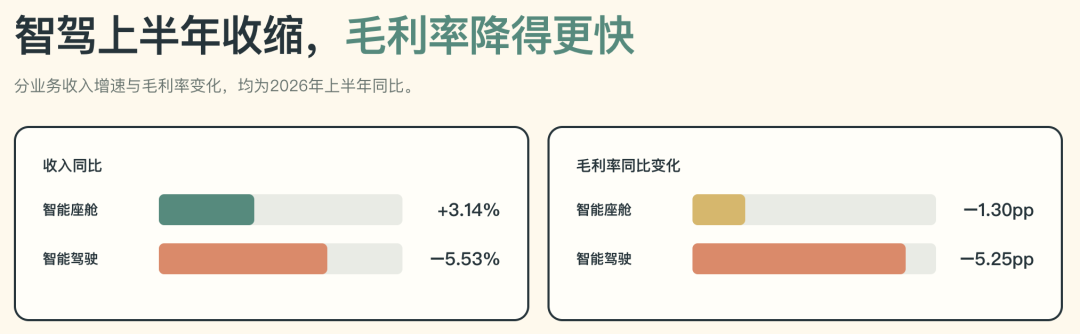
◎ Smart cockpit revenue: 9.756 billion yuan, a 3.14% increase year-on-year;
◎ Intelligent driving revenue: 3.918 billion yuan, a 5.53% decrease year-on-year;
◎ Other businesses: Approximately 1.227 billion yuan.
The cockpit segment accounted for ~65.5% of H1 revenue, remaining the foundation for scale and customer relationships.
Product expansion from displays and audio to central computing platforms enables greater value capture during vehicle electronic architecture upgrades.
From single displays to underlying hardware combinations, the fourth-generation cockpit domain controller continues to supply Li Auto, Chery, Geely, and GAC. Meanwhile, smart amplifiers secured project nominations from SAIC Volkswagen, SAIC-GM, and BAIC.
Pressure persists in the intelligent driving business.
The H1 revenue decline reflected client model cycles, production transitions, and product mix changes. Demand for high-level ADAS remains strong, with domain controllers delivered at scale to Li Auto, Great Wall, XPeng, Geely, and GAC Toyota.
Cross-domain fusion solutions completed technical validation and entered mass production in domestic automaker projects. The body domain control business is expected to scale in the second half of the year.
Three stages must be distinguished: “project nomination,” “mass production,” and “profit contribution.” New orders exceed 22 billion yuan in annualized sales, indicating future visibility, though not yet realized as current revenue.
More critical than revenue decline is the unit economics of intelligent driving:
◎ Intelligent driving gross margin: 14.49%, down 5.25 percentage points year-on-year;
◎ Smart cockpit gross margin: 18.45%, down 1.30 percentage points year-on-year.
Intelligent driving products, driven by high-computing-power upgrades, face margin compression due to early-stage mass production, hardware cost reductions, and client price negotiations.
Part 2: Industry Structure Offers Opportunities—and Pricing Pressures
Domestic auto market (Jan–Sep 2026): Passenger vehicle retail sales fell 21.7% year-on-year, while September’s NEV retail penetration rose to 67.0%.
Increased NEV adoption boosts electronic content in electric drivetrains, thermal management, body control, and smart cockpits. However, automakers emphasize cost control amid weakening volumes.
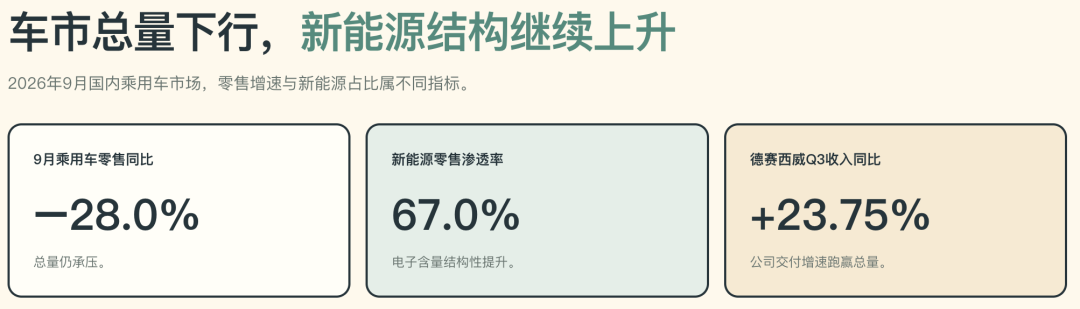
Desay SV’s revenue growth thus outpaces the auto market, though gross margins may not improve.
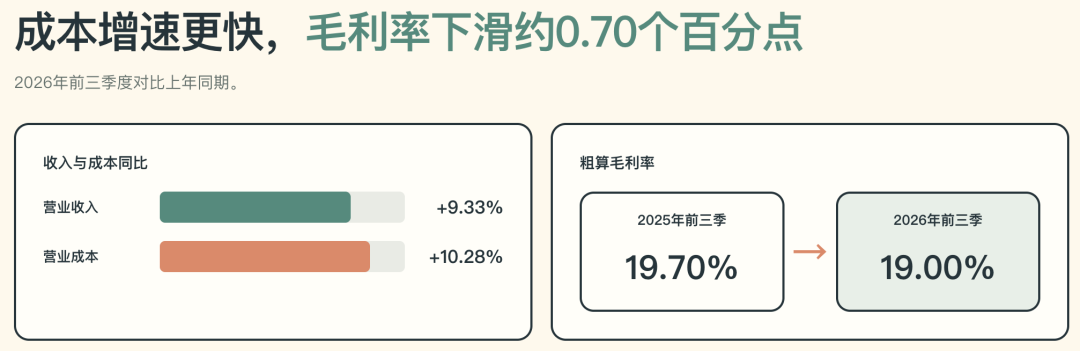
Revenue for the first three quarters rose 9.33% year-on-year, while operating costs increased ~10.28%, reducing gross margin from ~19.71% to 19.00% (a decrease of 0.71 percentage points). Quarterly profit, excluding non-recurring items, declined slightly, reflecting this cost-price dynamic.
Overseas business represents another growth vector.
H1 overseas sales reached 1.617 billion yuan, a 55.71% increase year-on-year, accounting for ~10.9% of total revenue.
The company secured project orders from clients including Volkswagen, Stellantis, Mazda, Toyota, and Honda. Its Spanish plant began trial production and sample deliveries in July.
Overseas expansion aims not only to increase sales but also to align with automakers’ procurement and local delivery systems, reducing exposure to domestic model cycle fluctuations.
However, overseas projects require validation, ramp-up, and cost control before mass production. High overseas revenue growth remains based on a small base, and maturity in overseas profitability will take time.
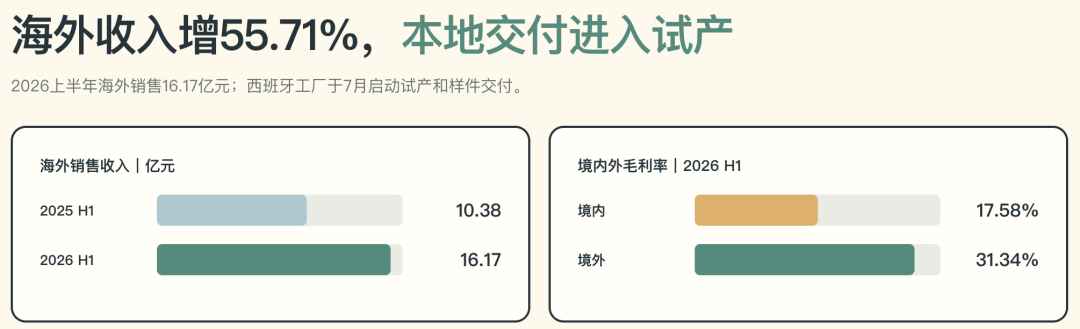
H1 regional gross margins provide finer clues: Overseas sales gross margin stood at 31.34%, exceeding domestic margins of 17.58% and improving by 2.41 percentage points year-on-year.
This gap supports the view of a superior overseas product mix, though H1 results may shift as Spanish localization progresses, altering cost and delivery structures. Whether overseas revenue share and group gross margin improve in tandem remains to be seen.
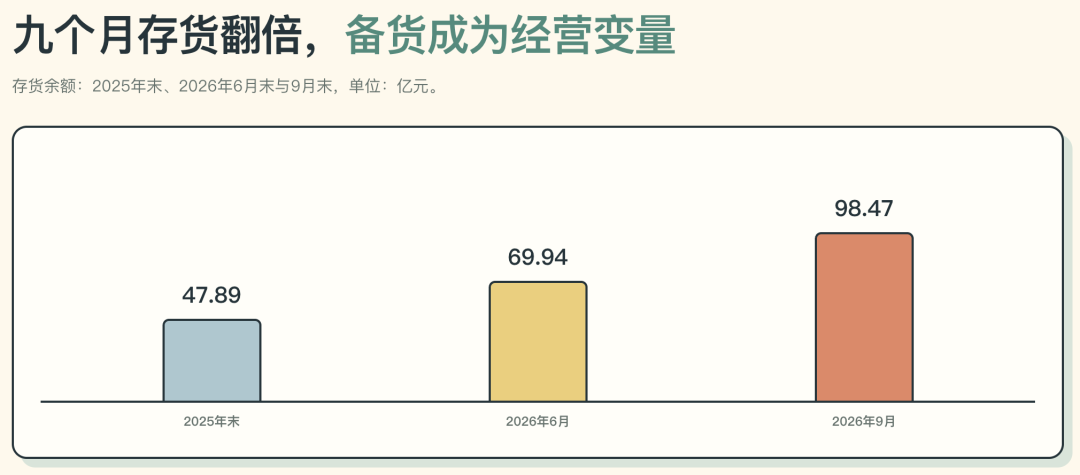
As of late September, inventories reached 9.847 billion yuan, up ~105.6% from end-2025’s 4.789 billion yuan, reflecting increased raw material stockpiling.
Stockpiling supports concentrated model launches and supply chain stability but ties up cash and carries risks of impairment amid demand shifts or product iterations.
Operating cash flow for the first three quarters totaled 816 million yuan, down 63.9% year-on-year. H1 cash flow stood at 1.063 billion yuan, with Q3 alone contributing ~-247 million yuan. Despite Q3’s record revenue, cash flow turned negative.
Accounts receivable rose moderately to ~10.012 billion yuan by late September, up from 9.778 billion yuan at year-end. Inventory growth (~5.058 billion yuan) far outpaced receivables growth.
Summary
Desay SV is transitioning from a cockpit supplier to a comprehensive provider of cockpit, intelligent driving, body domain control, and cross-domain fusion platforms, while extending domestic project delivery capabilities overseas. Q3 results demonstrate faster revenue recovery than industry-wide trends.
-
![]()
Fuyao Glass Reports 14.97% Drop in Net Profit to 6.006 Billion Yuan for First Three Quarters, While Dimming Glass Yield Soars from 10% to 90%
-
![]()
GPS is Vulnerable to Interference, This Startup Aims to Provide a Centimeter-Level Alternative with 258 Satellites
-
![]()
Desay SV’s Q3 Revenue Hits 9.519 Billion Yuan, Up 23.75%; Overseas Gross Margin at 31.34%, Domestic at 17.58%
-
![]()
Automotive Parts Behemoth Huayu Reports 45.5 Billion Yuan in Q3 Revenue, Net Profit Dips 6.4% to 1.687 Billion Yuan, Yet Stays Robust
-
![]()
Li Auto Shifts Focus: Can Chips, Batteries, and L4 Tech Drive the Next Phase of Competition?
-
Suzhou: Not Just Aiming for Daily Access to Driverless Cars, but Transforming the Entire City into a 'Testing Ground' for Embodied AI
-
![]()
Who Benefits More from the Split of FAW-Audi and SAIC-Audi?
-
40-Year Reversal in Technology Flow: Why Did Volkswagen Transform China from a Factory into a Global Development Hub?