Smart Cockpits Going Global: Beyond GAS, a Product-Technology Roadmap for Chinese Automakers
 11/09 2026
 570
This year, two developments in smart cockpits unfolded in quick succession as Chinese cars went global—and I've studied them side by side.
On October 15, Xpeng announced that it would install native Google Play into the cockpits of its overseas models, with plans to launch in early 2027. Back in July, it had already used Google Maps' Auto SDK to build its own overseas navigation.
The very next day, Geely Holding signed with Google to bring Google Built-In—including Gemini, Google Maps, and the app store—into its overseas models, covering Geely, Lynk & Co, Proton, Riddara, and smart, with the first vehicle slated to land in the second half of 2027.
Both are among the Chinese automakers most capable of developing cockpits in-house, yet overseas they both handed the ecosystem layer to Google. That made me realize: the difficulty of taking smart cockpits global isn't technology—China leads the world in human-machine interaction, voice, and response speed—it's the three external constraints of ecosystem, compliance, and data that no automaker can solve on its own.
But is their current approach the way of the future—and is it the optimal solution? (Vehice will offer its answer at the end of this article.)
So, drawing on overseas cockpit research and hands-on experience, this article focuses on four questions: where exactly going-global cockpits get stuck, how to choose between GAS and pure AAOS, how foreign automakers do it, and how Chinese automakers should implement it in practice.
01 Strengths in hand—but going global is another question: installation share is a domestic metric and does not mean it works overseas
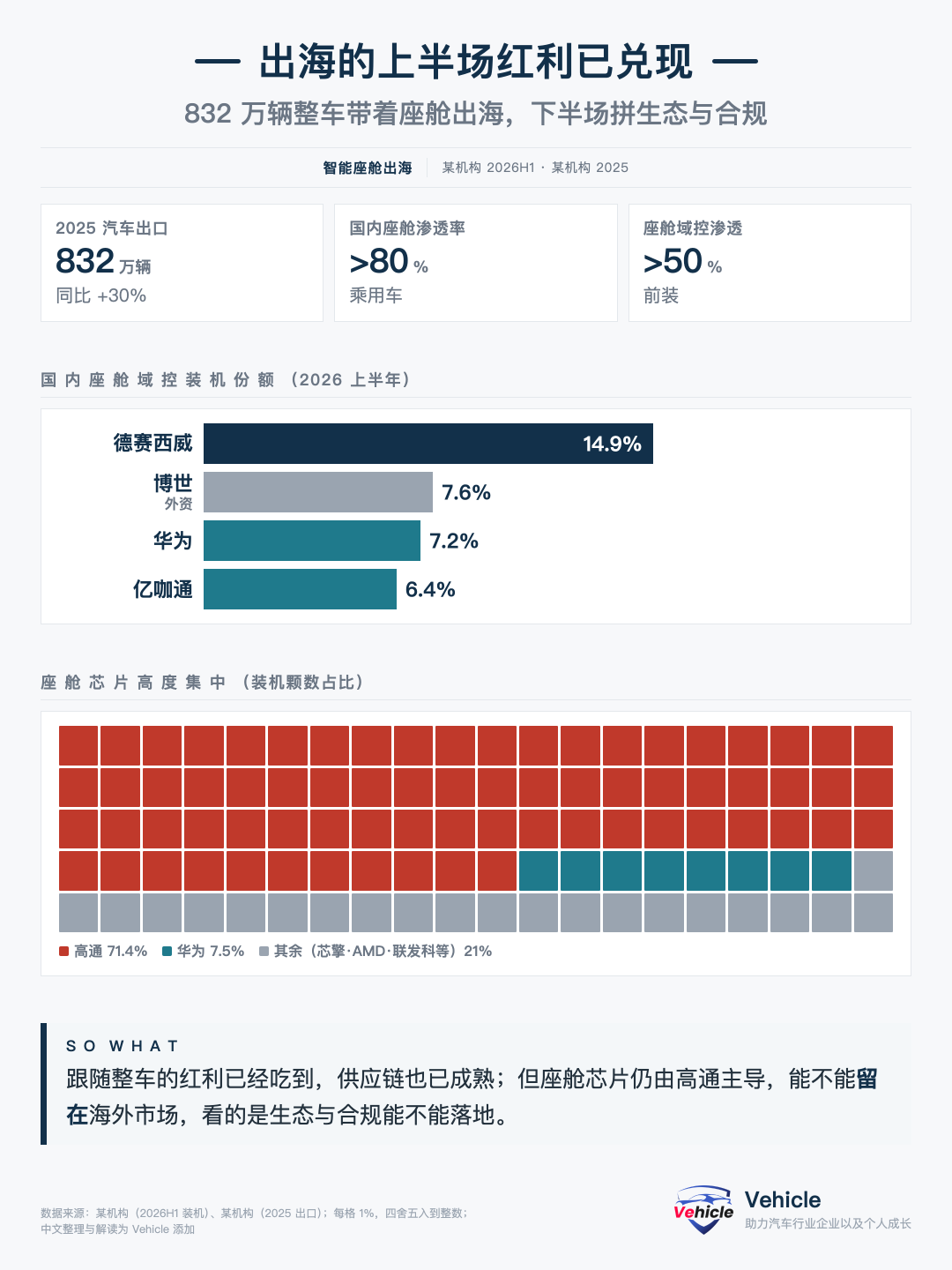
The overall product strength of Chinese cars is already very strong. In 2025, China's automobile exports reached 8.32 million units, up 30% year on year; domestic cockpit penetration exceeds 80%, front-installed cockpit domain control penetration has surpassed 50%, the supply chain is mature and highly concentrated, and cockpit chips are still dominated by Qualcomm with more than 70% share. In 2026, exports will most likely exceed 10 million units.
But these are all domestic metrics, which do not mean they will be accepted by local users overseas. I categorized the pitfalls encountered in early going-global efforts, and what holds Chinese cockpits back are four external constraints.
The ecosystem cannot be moved: the local ecosystem of WeChat, Amap, and Douyin cannot be reproduced in overseas app stores; what European and American users are familiar with is maps such as Google/TomTom and the Play ecosystem.
Navigation and voice must be locally replaced: Russia requires switching to Yandex Maps and adapting the Alice assistant; some automakers in the early days launched with only translation, and navigation drift and voice failures broke out in concentrated fashion.
Data cannot pass compliance: the EU GDPR has not made an adequacy decision for China, and cross-border transfers require de-identification; China's Guidelines for Cross-Border Security of Automotive Data (2026 Edition) took effect on July 1 and requires outbound assessments; type approval also has to pass UNECE R155 and R156.
Trust and pace: overseas certification cycles are long, Western automakers still mostly avoid adopting Chinese cockpit technology; plus the dual-version cost at home and abroad forced by Google being unavailable in China.
The blocker is not making the system smarter, but the four external conditions that automakers cannot fully manage: ecosystem, localization, compliance, and trust.
02 How overseas users see it—complaining about connectivity while acknowledging that software has overtaken
I went through overseas owner communities, and the reaction is split, which precisely points out where the pain point lies.
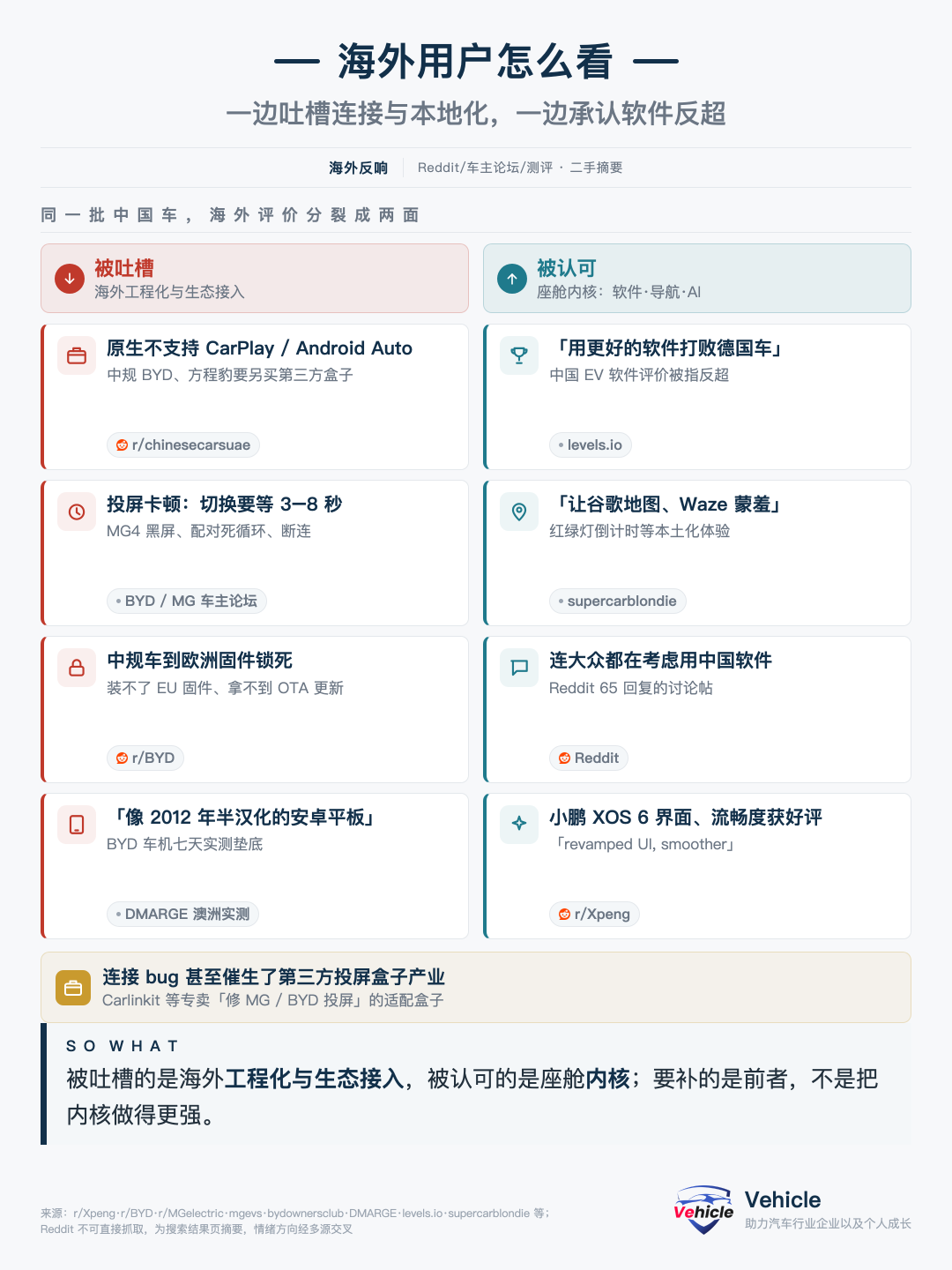
On one side, complaints. China-spec versions of BYD and Fangchengbao natively do not support CarPlay and Android Auto, and owners have to buy third-party boxes; a BYD owner in the UK said screen mirroring was so laggy that switching took three to eight seconds; MG forums are full of black screens and pairing loops, and around "fixing screen mirroring" a small business selling boxes even grew up; China-spec cars driven to Europe still cannot get OTA; Australia's DMARGE described a BYD head unit as "a half-localized Android tablet from 2012."
On the other side, it is heating up. A widely shared review said Chinese EVs beat German cars with better software; some media said Chinese navigation makes Google Maps look inferior; communities are discussing that even Volkswagen is considering adopting Chinese software; and Xpeng's XOS 6 is also widely praised.
Note: Vehicle has compiled overseas users' reactions into a report through research; you can send a message in the background for the PPT to learn about purchasing.
What is criticized is overseas engineering and ecosystem integration; what is recognized is the cockpit core. What Chinese cockpits need to improve is the former, not making the core stronger.
03 Three solutions—the key being GAS vs. pure AAOS: first, clarify three concepts that are often conflated
Overseas smart cockpits basically take three forms:
Phone mirroring (CarPlay, Android Auto) merely projects the phone screen onto the car;
Android Automotive OS (AAOS) is an in-vehicle operating system deeply embedded in the car; the open-source part is free but must be maintained by yourself;
GAS (Google Automotive Services) is a package of Google services licensed separately and layered on top of AAOS, including Google Maps, the Play Store and Assistant, and Gemini.
The key is that using AAOS does not equal using GAS; you can take only the open-source base and not connect to Google. Stellantis and Dodge use AAOS with Amazon Alexa to bypass GAS.
Of course, there are also those developed in-house based on Linux, such as Tesla.
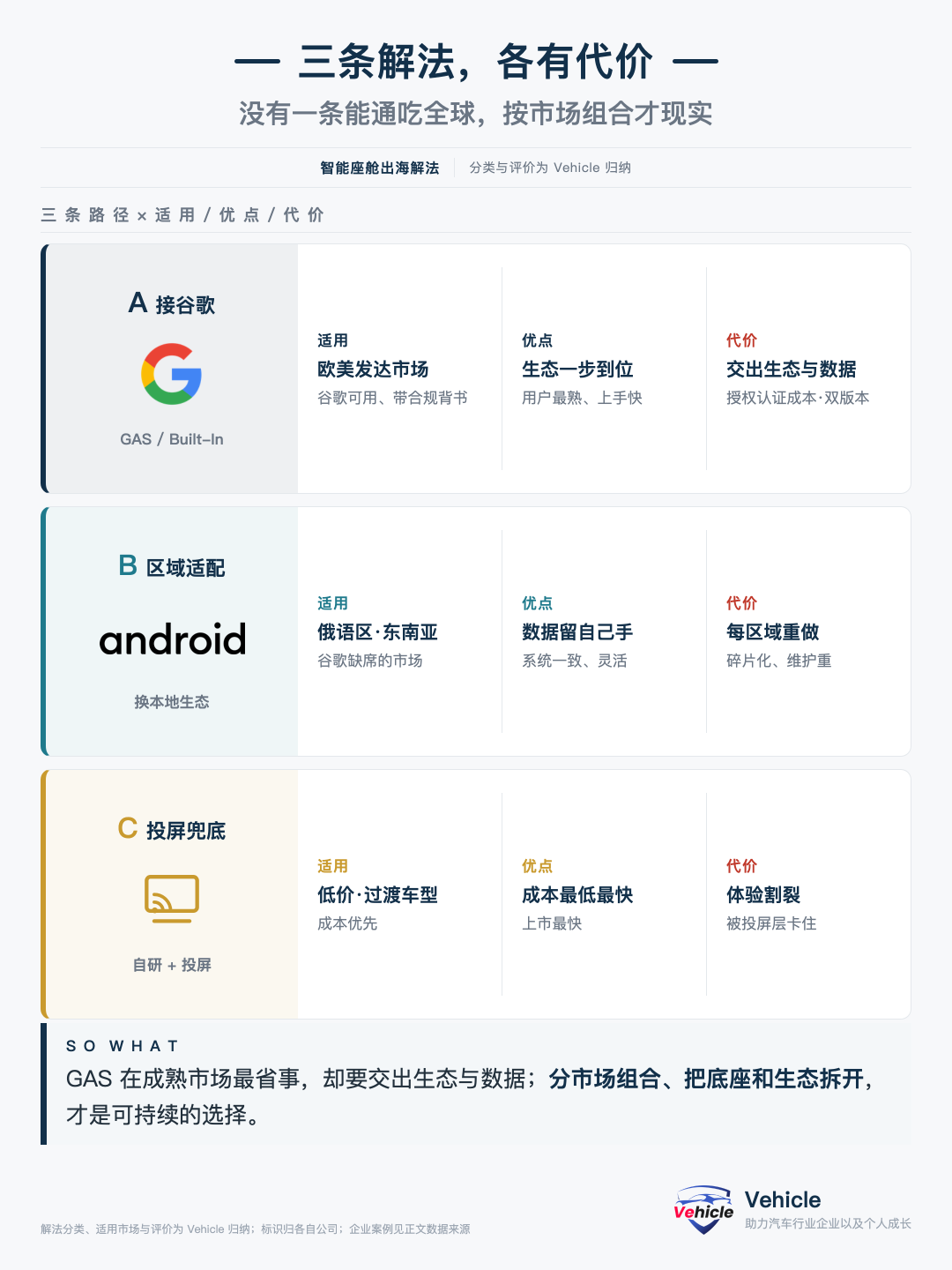
Around the four constraints, China's auto industry has figured out three paths, to be used in combination by market, each with its own characteristics.
A Connect to Google: use AAOS at the bottom or add licensed GAS, with the ecosystem in place in one step, the most familiar to users, and with compliance endorsement. Geely, Xpeng overseas, and Volvo, Ford, Honda, and Renault all take this path, which is very common in mature markets where Google is available.
B Regional adaptation: keep the Chinese head unit and swap ecosystems by region: connect to Yandex in Russian-speaking regions, and to Huawei HMS and local maps, payments, and charging in Southeast Asia. Data stays in your own hands, but each region must be redone, causing fragmentation.
C Screen mirroring as a fallback: in-house head unit plus phone mirroring, the cheapest and fastest, but the experience is fragmented and constrained by the mirroring layer, suitable only for transition and low-priced cars.
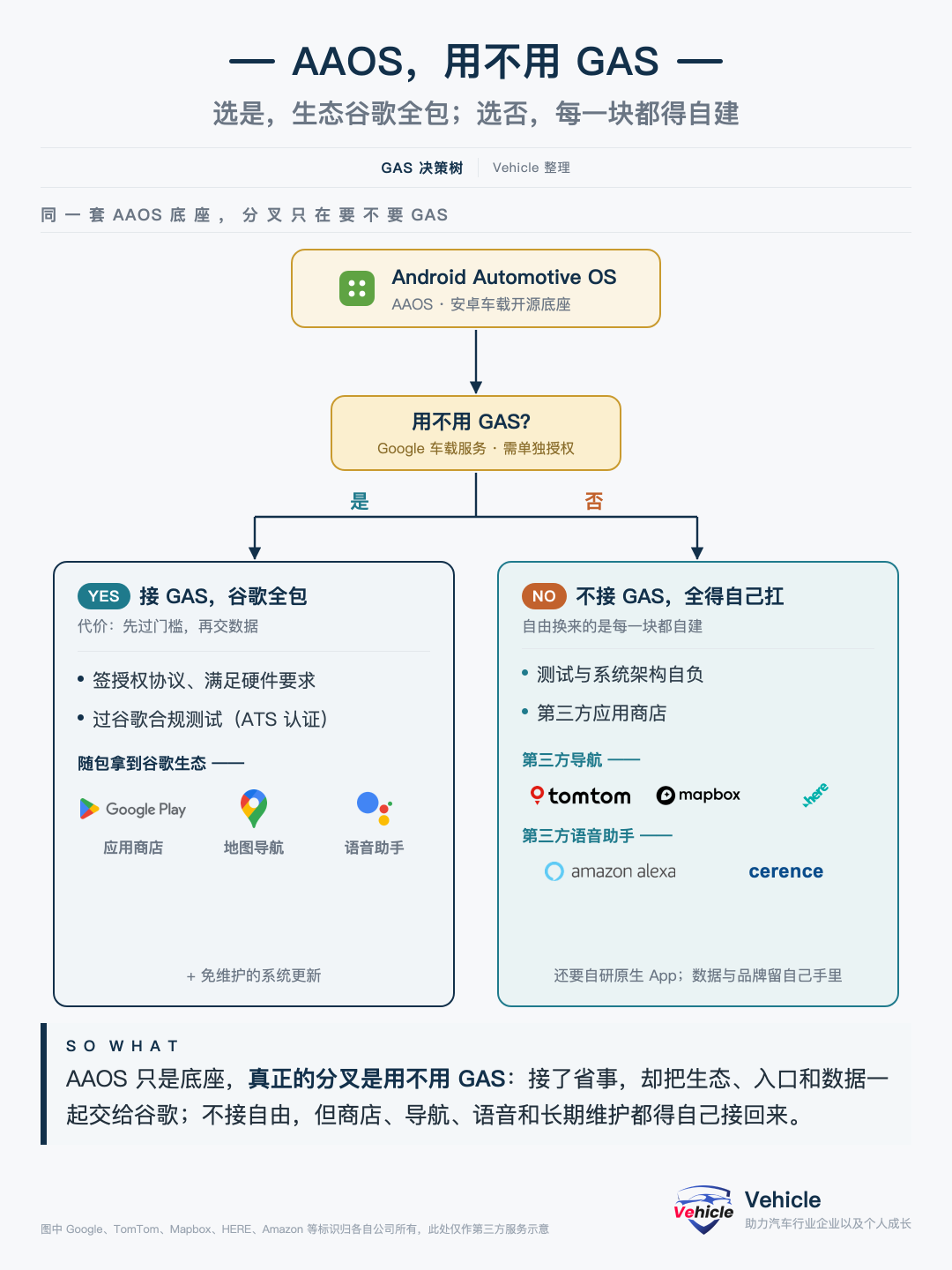
Among these three paths, the real watershed is the first: if you use AAOS, do you connect to GAS or not? Drawing this question as a decision tree makes the costs to be paid on both the YES and NO sides clear at a glance.
01 Connecting to GAS means giving up more than imagined
In addition to licensing fees and passing Google certification, Google stipulates hardware thresholds in its compatibility documents, and hardware must be replaced if standards are not met; the interface is constrained by Google's style, losing part of brand recognition; most importantly, data—under Google's terms, if you do not want to hand user behavior and usage data to Google, you can only not use GAS. Stacked together, these amount to ceding the ecosystem, the entry point, the data, and part of the brand.
02 Using only AAOS splits into two sub-paths
Taking only the open-source AAOS base and not connecting to GAS keeps the brand and data in your own hands and saves licensing fees, at the cost of having to bear the app store, maps, voice assistant, and long-term maintenance all by yourself. This path of not connecting to GAS splits into two types:
One connects to third-party ecosystems (Amazon Alexa, Yandex in Russian-speaking regions, and Huawei HMS in Southeast Asia all count), and the other makes key ecosystems controllable and partly self-developed; Stellantis connecting to Amazon belongs to the former, while Tesla's full in-house development and Rivian's deep modification of the AAOS open-source base with a self-built ecosystem (neither connecting to Google) belong to the latter.
Going with Google is not the endpoint either. Volvo and Polestar's Built-In is praised by overseas reviews as clean and thoughtful, but AAOS itself has also been criticized as "not finished" and has had location-loss issues; after Xpeng only put Google Play on new models, existing owners worried about being left behind; Google has also tightened its version cadence—the new version in April 2026 requires higher computing power and adds Gemini, and AOSP source code is released only in the second and fourth quarters. It still cannot be used in China, and it directly fails in markets where Google is absent.
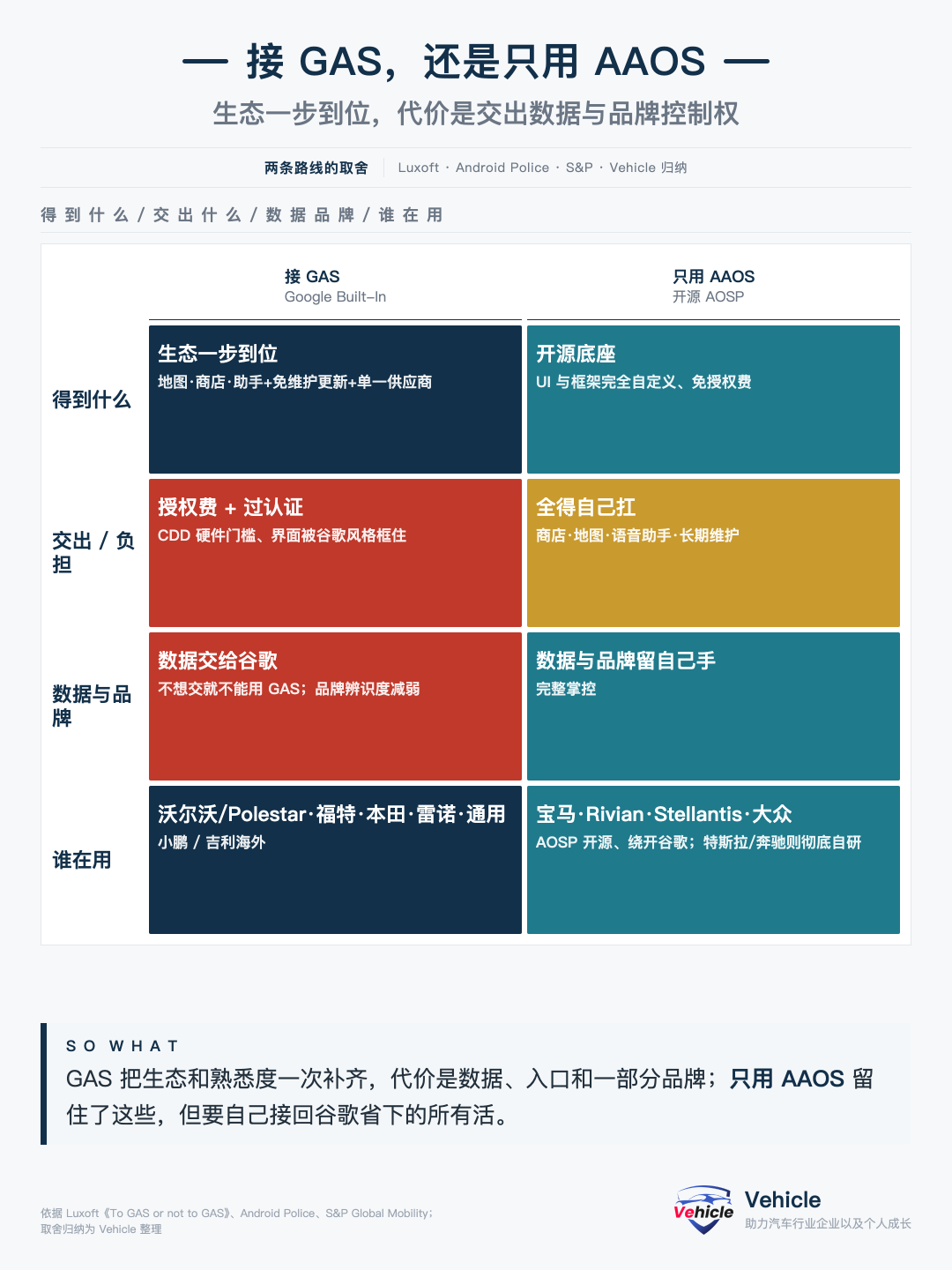
GAS is the most hassle-free answer in mature markets, but it hands over the ecosystem and data; no single solution works globally, and combining by market is the realistic approach.
04 How foreign automakers choose: connect to GAS, or use only AAOS—the same question, and foreign automakers split into two camps along this line
Foreign automakers also follow the GAS/AAOS dividing line from Chapter 3, only it becomes clearer when applied to brands: some hand the ecosystem layer to Google (connect to GAS), while others take only the open-source base or simply develop in-house (do not connect to GAS), keeping data and the entry point in their own hands.
01 The camp connecting to GAS: some foreign automakers
This camp all uses AAOS as the base and layers Google Built-In on top, with the ecosystem in place in one step. Volvo and Polestar were the earliest to shift comprehensively, Ford moved over from QNX, and Honda and Renault (together with Qualcomm and Google) followed; GM is more aggressive, natively embedding Google in EVs and directly canceling CarPlay and Android Auto (triggering owner backlash). Even these century-old foreign automakers outsource the ecosystem to Google, showing that in mature markets where Google is available, connecting to GAS is a hassle-free and cost-effective option.
02 The camp using only AAOS or in-house development: guarding data and sovereignty
This camp does not connect to GAS and splits into two approaches.
One still uses the AAOS open-source base but bypasses Google services: Stellantis pairs with Amazon Alexa, Rivian modifies AAOS so deeply that it is unrecognizable and does not include the Play Store (navigation uses Google Maps' Auto SDK), BMW's iDrive is also built on AOSP without Google services, and Volkswagen's next-generation One.Infotainment directly switches to the AAOS open-source version plus Harman's self-built store;
The other does not even touch Android and develops fully in-house, represented by Mercedes-Benz MB.OS and Tesla. The common point is keeping operating system sovereignty and user data in their own hands, at the cost of having to bear the app store, maps, voice assistant, and long-term maintenance all by themselves. Apple's attempt to use CarPlay Ultra to take over the entire instrument cluster is precisely blocked by brands such as Mercedes-Benz, Audi, Volvo, and Renault that want to guard their sovereignty.
What Chinese automakers should note most is Toyota. The world's top-selling automaker did not join GM, Ford, and Volvo in switching to AAOS+GAS, but developed in-house—the new head unit debuting in the 2026 RAV4 runs on Automotive Grade Linux plus Woven's Arene platform, with CarPlay and Android Auto only as screen-mirroring fallbacks, and it will later roll out across the lineup. The automaker with the largest volume, which should most seek convenience, instead chose the heaviest in-house path, which amounts to another signal: connecting to GAS is hassle-free, but operating system sovereignty may not be conceded.
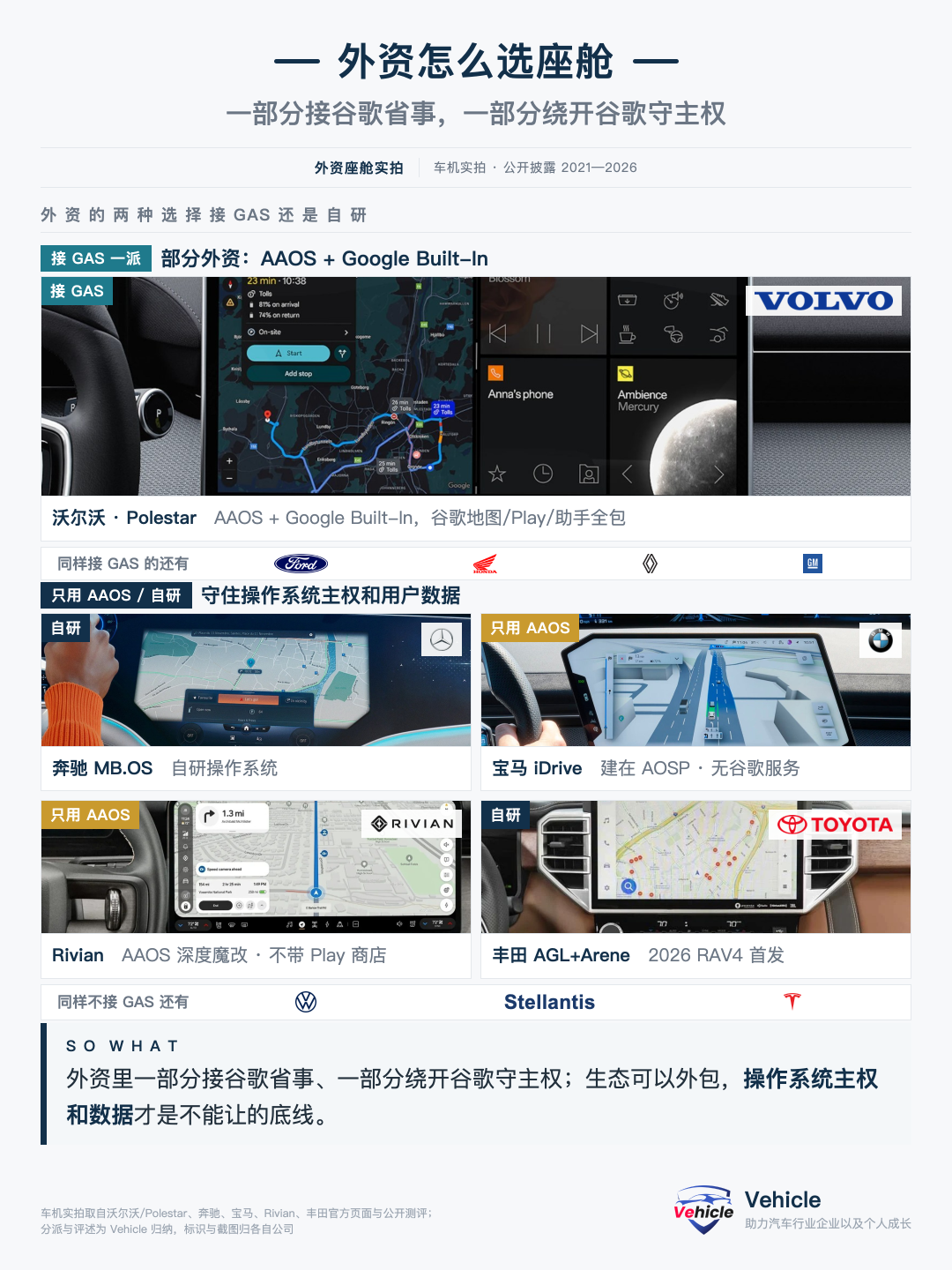
Connecting to GAS is hassle-free but hands over the ecosystem, entry point, and data; using only AAOS/in-house development guards sovereignty but requires filling in all ecosystems yourself; the split among foreign automakers shows that the ecosystem can be outsourced to Google, but operating system sovereignty and data are the bottom line that cannot be conceded.
How this bottom line lands in architecture, I use a building-block diagram to illustrate: make the base a globally common panel, make the ecosystem layer replaceable blocks, and plug in the corresponding block for whichever market you enter, while the base itself does not move.
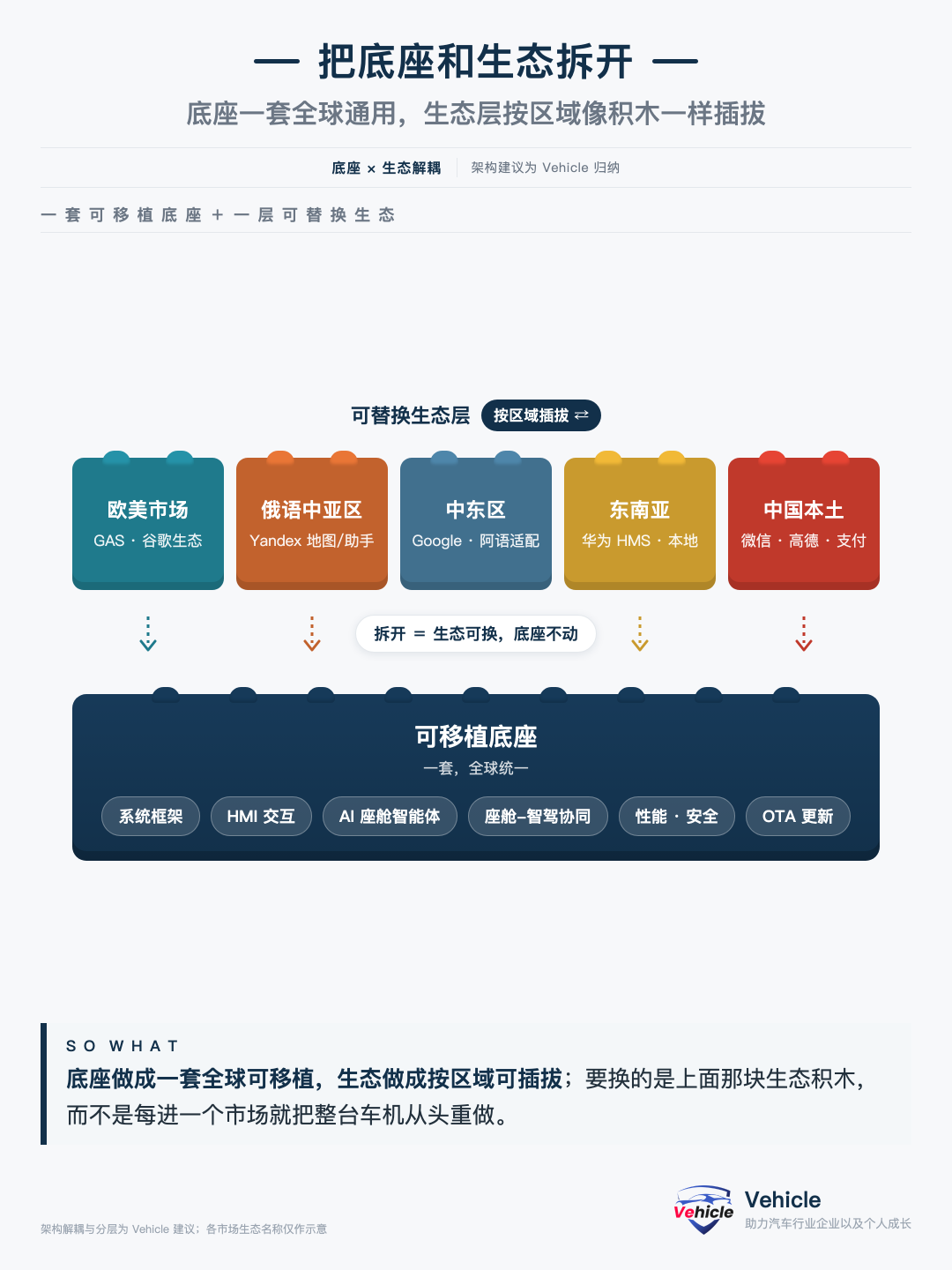
05 In closing, what Chinese automakers should do—a product technology roadmap that can be put to direct use
Does Xpeng and Geely handing overseas ecosystems to Google count as admitting defeat?
Probably not, but it is definitely a compromise; GAS's rigid standards and data requirements may cause them to lose their own distinctiveness.
It may be that they have recognized the boundaries of this question: rather than waiting to develop everything in-house, it is better to quickly borrow local ecosystems and compliance.
Overall, I think brand characteristics and distinctiveness will be lost. Xpeng's approach in China has actually revealed Xpeng's problem: Xpeng always pursues newness and completeness quickly, forgetting to build what its own identity is.
In the early stage of competition, this approach may be effective, but when others quickly follow, homogenization will emerge, ultimately losing one's distinctiveness and drowning among many brands.
So in the global race for smart cockpits, Chinese systems don't lack a core—what they lack is the ability to turn overseas ecosystems, connection stability, and regulatory compliance into hard capabilities on par with that core, and, even more importantly, to build a brand identity of their own.
This article is based on publicly available information and reflects the author's judgments and inferences. It is for reference only and does not constitute any investment or procurement advice.
That's all for today's sharing. If you find it useful, please like, repost, and hit Wow, and you're also welcome to share your views in the comments.
*Unauthorized reproduction and excerpting are strictly prohibited.
-
So Embarrassing: Apple Alone Takes 50% of Global Phone Revenue—All Domestic Brands Combined Only 30%!
-
![]()
160 Million Views Earn Just 390,000 Yuan: Who Really Profits from AI Short Dramas?
-
Is Cost-Effectiveness Dead? Average Phone Prices Have Risen by 620 Yuan in a Year—Even Xiaomi Is Up 410 Yuan
-
One Headline, Big Headache: "Buy One Get One Free Across the Entire Lineup" Backfires—SAIC Audi Under Investigation
-
From "Competing on Parameters" to "Getting Things Done": AI Is No Longer Just "Pleasing Itself"
-
With a 5-Fold Hourly Wage Gap, Strike-Driven Pay Raises Are Speeding German Cars Toward Their Own Funeral
-
Global Annual Sales of Just 15,000 Units—Can Moving Production to India Cure Honda's EV Woes?
-
Maserati: 7,900 Vehicles Sold Annually With a Net Loss of €840 Million—Will a Chinese Automaker Acquire It?