Shenzhen Bus Group Launches New Tender for 660 Buses Worth 607 Million Yuan
 11/12 2026
 473
On November 10, Shenzhen Bus Group published a tender announcement on the Shenzhen Sunshine Procurement Platform to procure 660 10.5-meter pure electric buses. The project consists of a single bid package, with a procurement control price of 607.2 million yuan—equivalent to a per-vehicle price cap of approximately 920,000 yuan. Consortium bids will not be accepted. The deadline for bid submission and the bid opening time are both set for 10 a.m. on December 2, and the delivery deadline is May 31, 2027. This marks the largest whole-vehicle procurement by Shenzhen's public transport sector in recent years.
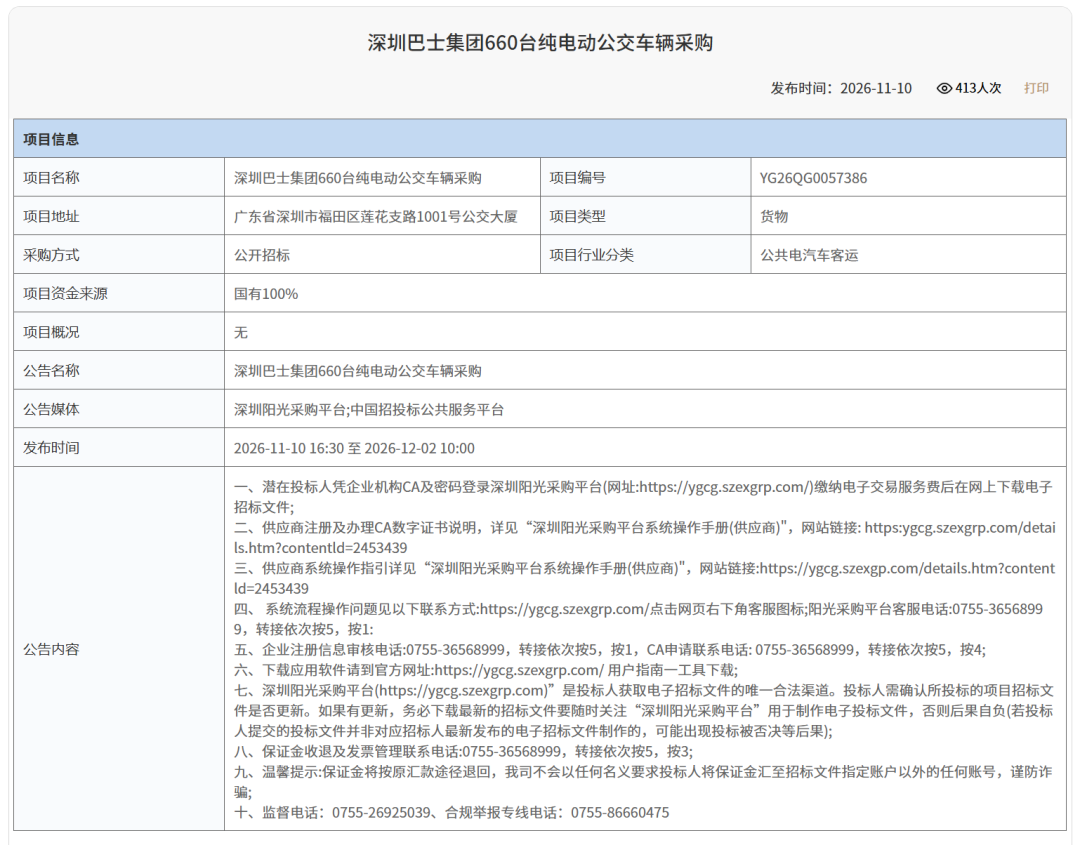
Let us first examine the composition of this sum. The per-vehicle price cap of 920,000 yuan is not high among pure electric buses of the same class, and this price band essentially defines the range of potential bidders. The final result will only be confirmed after bid opening on December 2, but the tender conditions themselves have already narrowed the field of competition considerably.
These new vehicles are intended to replace Shenzhen's first-generation pure electric buses. Shenzhen was the first city in China to complete the full electrification of its bus fleet. In 2016 alone, the three major bus companies put more than 10,000 pure electric buses into service. In June 2017, the last diesel vehicle of Shenzhen Bus Group was retired, and 5,698 vehicles achieved full electrification. The main model deployed that year was the BYD K8. Shenzhen Bus Group alone procured 3,990 units in three batches, accounting for more than 60 percent of all vehicles at the time. Given an operating cycle of 8 to 10 years for buses, the retirement point for these vehicles falls exactly between 2025 and 2027.
Public information shows that the retirement of the K8 is already under way: from February to December 2025, Shenzhen Bus Group retired the first batch of 600 units and the second batch of 382 units. According to industry statistics, about 1,600 early K8 units remain in service in the fleet, plus more than 250 C8 highway coaches—all of which will reach retirement age by 2027. In other words, the capacity gap around 2027 is close to 1,900 vehicles. This procurement of 660 new buses cannot fill the entire gap, and Shenzhen Bus Group will most likely release more batches of tenders in the future.
There is also a price background worth comparing for this procurement. In 2015 and 2016, the per-vehicle price of the K8 was about 1.8 million yuan. Thanks to new energy subsidies of 500,000 yuan each from the national and Shenzhen municipal governments at the time, the actual procurement price was pushed below 900,000 yuan, and the average price of Shenzhen Bus Group's third batch of K8 buses was only 580,000 yuan. Ten years later, purchase subsidies have been largely withdrawn, and this price cap of 920,000 yuan is actually higher than the post-subsidy price paid back then. These figures show that this round of vehicle replacement in Shenzhen is being completed entirely under a price system without subsidies. Vehicle selection, budgeting and batch size are all calculated by the company itself according to operational needs, which also makes it a bellwether for bus procurement across the country after the withdrawal of subsidies.
From the perspective of industry rhythm, Shenzhen's situation is not an isolated case. The period from 2016 to 2020 was a concentrated deployment period for new energy buses in China, and these vehicles are successively entering the replacement window. Replacement demand in various cities will be released in a concentrated manner over the next two to three years. As the earliest city to electrify, Shenzhen is also the first to hit the retirement period of its first-generation vehicles. Its procurement scale, price cap level and bid results have direct reference value for other cities' vehicle replacement budgets. After bid opening on December 2, who will win the order for 660 buses will also reveal the real market price of current 10.5-meter-class pure electric buses.
-
![]()
Jiuzhang Cloud's IPO: Can Computing Power Metrics Determine Pricing Power?
-
Cerebras' Stock Plunged 77% Within Six Months of Going Public—What Happened to Nvidia's "Challenger"?
-
![]()
01.AI Sets Up Headquarters in Hangzhou
-
![]()
The Three German Auto Giants Have All Stalled—What Exactly Happened to Them?
-
![]()
Great Wall Motor October Sales: Why Great Wall Has a Stronger Presence in the 200,000–300,000 Yuan Range Without Relying on 100,000-Yuan-Class Models
-
![]()
How Much of Li Auto's October Sales Beyond the L Series Can Its All-Electric Vehicles Capture?
-
Optical Module Order Cut Rumors Resurface
-
![]()
Domestic Competition Hits Rock Bottom—Can Going Global Save New Energy Vehicle Makers?