WeRide's Q3 2026: Revenue up nearly 90%, gross margin 43%—Is Spring Finally Coming for L4 Companies?
 11/23 2026
 374
On November 20, WeRide released its third-quarter report. Both revenue and gross margin hit record highs, giving the impression that spring may finally be arriving for L4 companies:
Revenue reached 321.5 million yuan, up 88.0% year over year; gross margin came in at 43.0%, 10.1 percentage points higher than a year earlier;
Overseas revenue totaled 146.9 million yuan, up 171.5%, accounting for 45.7% of total revenue;
Quarterly Robotaxi revenue exceeded 100 million yuan for the first time, and WeRide's Robotaxi operations in Guangzhou also broke even on a per-vehicle economics basis for the first time.
Accordingly, the company raised its full-year revenue guidance to no less than 1.1 billion yuan.
Yet the last few lines of the same income statement barely budged.
The loss for the period was 310 million yuan, compared with 307 million yuan a year earlier;
Cash reserves on the books fell from about 7.1 billion yuan at the beginning of the year to 4.66 billion yuan.
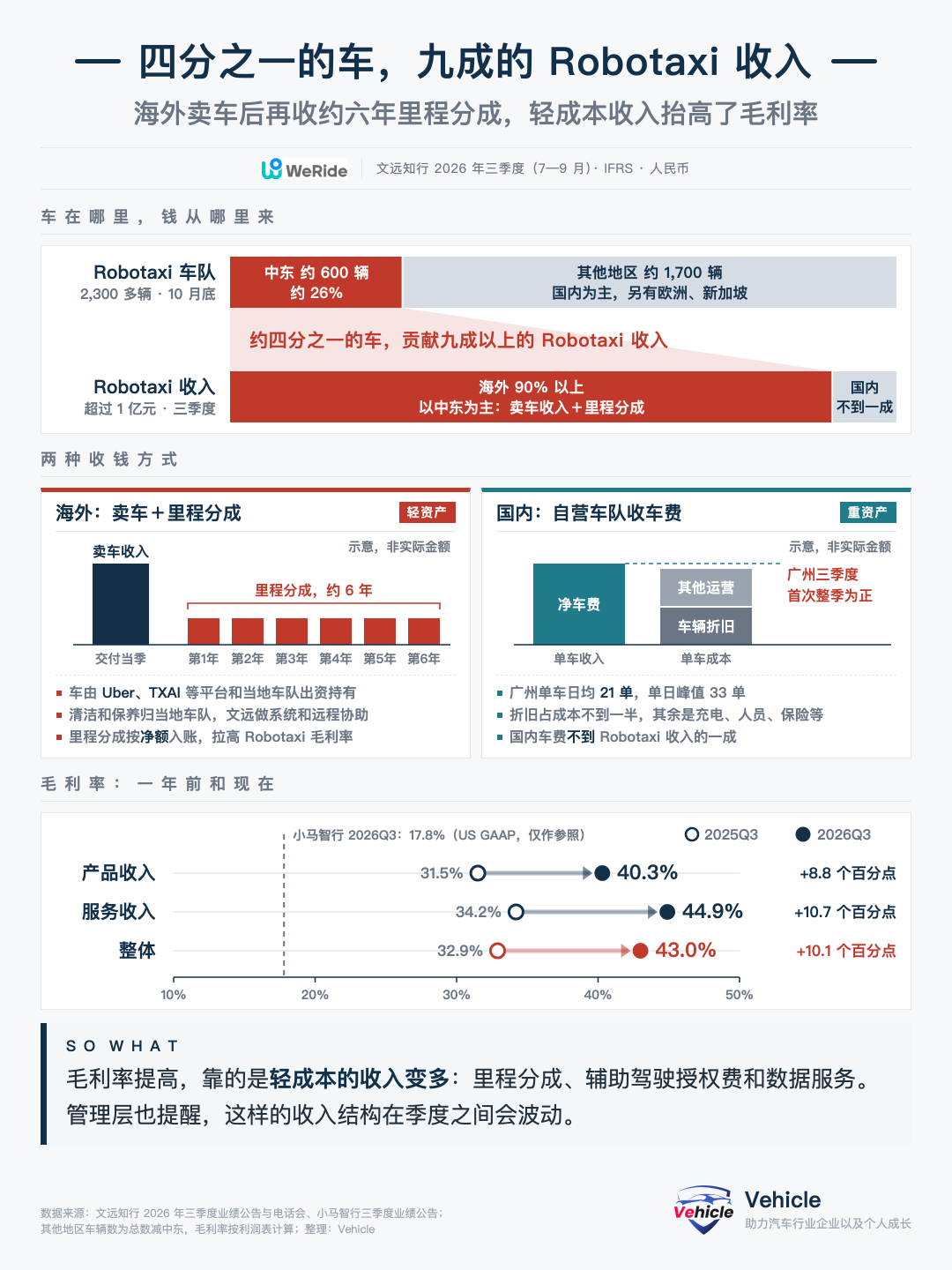
Another contrast is hidden in the revenue mix. WeRide is headquartered in Guangzhou, and most of its fleet is also in China, yet more than 90% of Robotaxi revenue comes from overseas, while its Middle East fleet numbers only about 600 vehicles—roughly a quarter of the more than 2,300 Robotaxis worldwide.
Moreover: revenue rose nearly 90% and gross profit more than doubled, so why has the loss not narrowed? With only a quarter of the vehicles, how does the Middle East account for 90% of revenue? Where did the 465 million yuan of R&D go in a single quarter, and was it worth it?
Drawing on WeRide's earnings announcements and investor call content, this article examines in turn where revenue comes from, why it rose, what cards WeRide holds, and how the R&D bill adds up.
We hope to offer readers some information and inspiration about today's L4 companies.
Earnings at a Glance: Nearly Half of Revenue Overseas, Nearly 60% from Service Fees
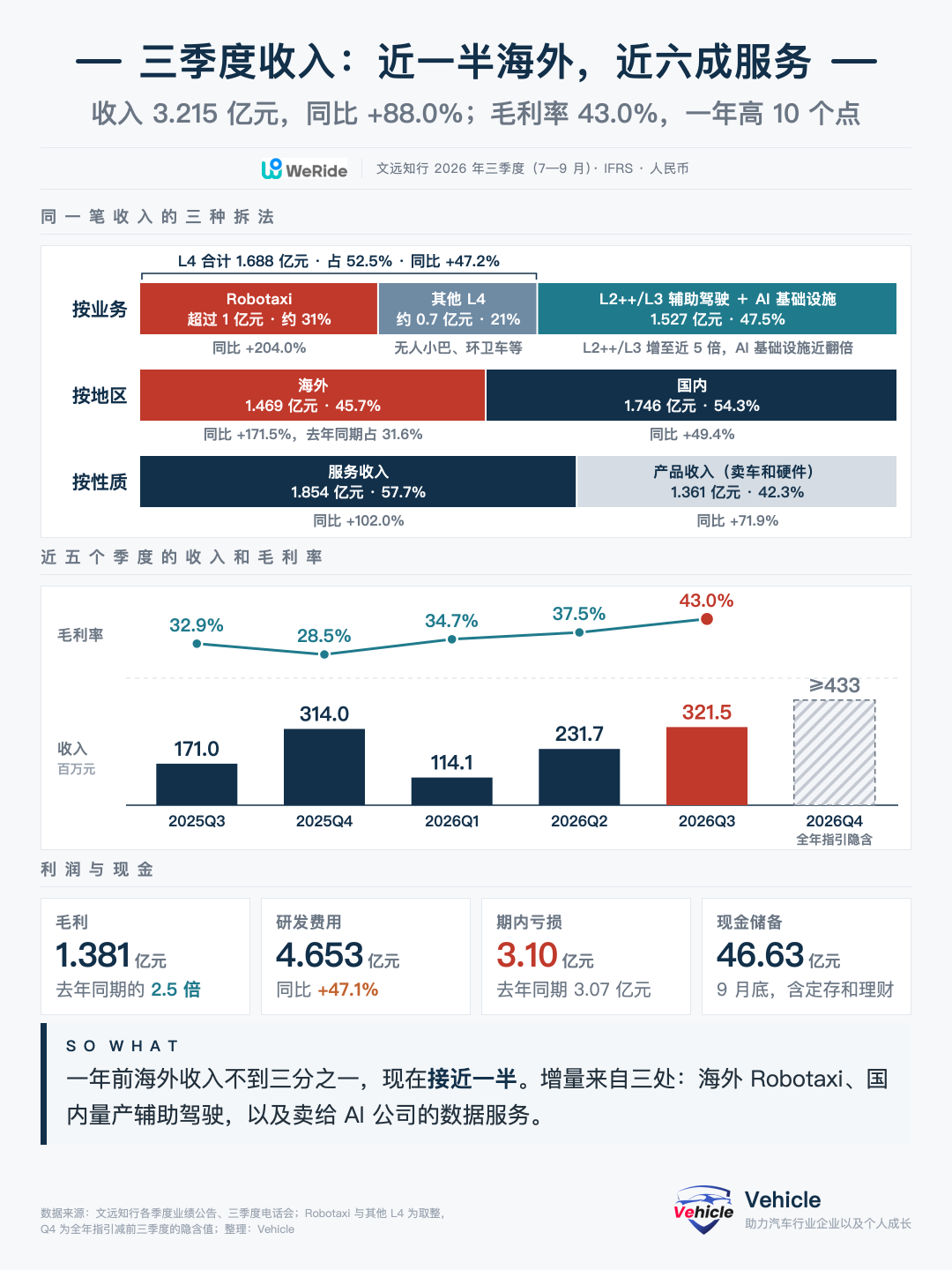
Third-quarter revenue was 321.5 million yuan, up 38.8% quarter over quarter. Cumulative revenue for the first three quarters was 667.4 million yuan, up 80.1% year over year. The numbers actually look really good, and it feels like spring for L4 companies is coming. WeRide's revenue this quarter can be broken down from three angles.
By autonomous driving level:
L4 business revenue was 168.8 million yuan, up 47.2% year over year, accounting for 52.5%. Within that: Robotaxi exceeded 100 million yuan, up 204.0% year over year, about 60% of L4, with the remainder from unmanned minibuses, unmanned sanitation vehicles, and other segments.
L2++/L3 assisted driving and AI infrastructure together totaled 152.7 million yuan, accounting for 47.5%. The former increased nearly fivefold year over year, and the latter nearly doubled. The company did not disclose the respective amounts of these two segments. Back-calculating from the two growth rates, they are each between 70 million and 85 million yuan, roughly comparable in scale.
By region:
Overseas: 146.9 million yuan, accounting for 45.7%, compared with 31.6% a year earlier;
Domestic: 174.6 million yuan, up 49.4% year over year.
By nature:
Service revenue: 185.4 million yuan, up 102.0% year over year, accounting for 57.7%;
Product revenue (mainly vehicle and hardware sales): 136.1 million yuan, up 71.9%.
Profit and cash:
Gross profit: 138.1 million yuan, about 2.5 times the year-earlier period.
R&D expenses: 465.3 million yuan, up 47.1% year over year—still 1.45 times revenue.
Operating loss: 332.9 million yuan, narrowed by 12.3% year over year.
As of the end of September, cash, time deposits, and wealth management products totaled 4.663 billion yuan.
Source: WeRide quarterly earnings announcements and third-quarter conference call; the split between L2++/L3 and AI infrastructure is a scale back-calculated by this article based on growth rates
A year ago, less than one-third of WeRide's revenue was overseas; now it is nearly half. It seems that in the auto industry, only going overseas makes money. In addition, the increment came from three places: overseas Robotaxi, domestic mass-production assisted driving, and data services sold to AI companies.
Why It Rose: Sell a Car Once, Then Collect Mileage Sharing for Six More Years
A quarter of the vehicles contribute 90% of Robotaxi revenue because of how the money is collected. In China, WeRide owns and operates the vehicles itself, and revenue consists only of fares paid by passengers; overseas, it sells vehicles to local partners and then collects long-term mileage sharing.
The overseas model. Li Xuan said on the conference call that for every Robotaxi delivered overseas, WeRide first recognizes vehicle sales revenue and at the same time locks in about six years of mileage sharing. The vehicles are paid for by platforms such as Uber and TXAI and by local fleets, which are also responsible for cleaning and maintenance. WeRide is responsible only for the autonomous driving system and remote assistance. Mileage sharing is recorded on a net basis and carries almost no cost. In the third quarter, the Middle East fleet grew from about 400 to about 600 vehicles, and operating hours and areas expanded simultaneously. The growth rate of mileage sharing was higher than that of Robotaxi revenue overall. This overseas model looks like a good business.
Supply chain cost. The vehicle sales part itself is also profitable. Based on a rough calculation from the income statement, the gross margin of product revenue was 40.3%, compared with 31.5% a year earlier; the gross margin of service revenue was 44.9%, compared with 34.2% a year earlier. Han Xu attributed this to vehicles and hardware being cheaper than competitors', backed by China's automotive supply chain. For reference, Pony.ai's gross margin in the same quarter was 17.8%.
Assisted driving licensing. The L2++/L3 solution WRD 3.0 has cumulatively delivered more than 100,000 units, earlier than the company expected at the beginning of the year, and this quarter added 10 mass-production design wins (there is gossip that WeRide may have won a design win from Geely). This business is paid through development fees plus licensing fees. According to Li Xuan, the gross margin is in the high double digits, and marginal costs are very low.
Data services. The subsidiary Jing Shuo Technology turns the data collection, labeling, and simulation capabilities accumulated from autonomous driving into datasets and training environments and sells them to embodied intelligence, robotics, and large-model companies. Li Xuan said Jing Shuo has framework agreement orders worth billions of yuan. Several leading customers used to buy millions of hours of data and are now discussing volumes of tens of millions of hours over the next two years.
Guangzhou turns positive. Guangzhou vehicles average 21 orders per day, with a single-day peak of 33 orders, and the city-level per-vehicle economic model was positive for a full quarter for the first time. The cost calculation is quite comprehensive: vehicle depreciation (including batteries and autonomous driving hardware) accounts for less than half, with the rest being charging, remote and ground personnel, maintenance, insurance, parking, and communications. However, domestic fare revenue is still less than 10% of Robotaxi revenue, so its contribution to the financial statements is limited.
Source: WeRide third-quarter earnings announcement and conference call; gross margin calculated from the income statement; Pony.ai is on a US GAAP basis and is for reference only
Obviously, however, this quarter's gross margin benefited from a favorable revenue mix and will fluctuate between quarters. Gross margin rose from 32.9% to 43.0% because low-cost revenue increased: mileage sharing, licensing fees, and data services.
The Cards in Hand: One Algorithm for Three Businesses, Licenses in Nine Countries
Technology. WeRide's L4 system is a one-stage end-to-end model, plus an independent rule-based safety layer and redundancy. Han Xu's comparison is that Tesla relies basically on end-to-end, while Waymo still relies heavily on rules; WeRide combines the two, adapting quickly to another city while its safety architecture can also meet European standards. The same technology applied to mass-production vehicles becomes WRD 3.0, installed on vehicles such as the Aion i60 and Trumpchi Yue 7. Models equipped with it have won the Chinese intelligent driving competition eight times, and Han Xu says the cost is significantly lower than peers'. There is a common view in the industry that WeRide's performance at 200 TOPS of computing power is indeed industry-leading.
Products. One algorithm supports three businesses. On the L4 side, there are Robotaxi, unmanned minibuses, and unmanned sanitation vehicles, with a global fleet of about 4,100 vehicles, including more than 2,300 Robotaxis; on the mass-production vehicle side, there is WRD 3.0; on the data side, there is Jing Shuo Technology. At present, the largest portion of R&D investment goes to the next-generation Robotaxi, which will be pre-installed and mass-produced, with the goal of continuing to reduce vehicle material costs.
Licenses. WeRide operates in 13 countries and more than 60 cities, and holds licenses in 9 countries. The ninth was the first national-level L4 passenger vehicle permit issued by Spain's Directorate-General for Traffic in September this year—a valuable resource card.
Partners. Overseas, it does not build its own platform. Passengers and dispatch are handed to Uber and Grab, and the fleet is handed to local operators. Uber is also a shareholder of WeRide. By the number of fully driverless vehicles on its platform, WeRide is Uber's largest autonomous driving partner outside the United States.
WeRide said that before the end of this year:
L4 deployment: the Middle East fleet will increase to 800–1,000 vehicles, L4 vehicles in Europe will exceed 100, commercial operations will begin in Madrid (20 vehicles in the first phase, with safety officers in the vehicles), and Abu Dhabi and Dubai will cover all core urban areas. In 2027, the Middle East fleet will nearly double, and Europe will enter several more cities.
L2++ assisted driving: cumulative deliveries of WRD 3.0 will reach 500,000 units.
The first quarter with positive free cash flow will appear in 2028, and the full year will be positive in 2029. The longer-term goal is to expand the commercial fleet about tenfold every three years. WeRide also disclosed in this earnings report that it has signed binding contracts for about 3,000 Robotaxis globally and will deliver once licenses are obtained.
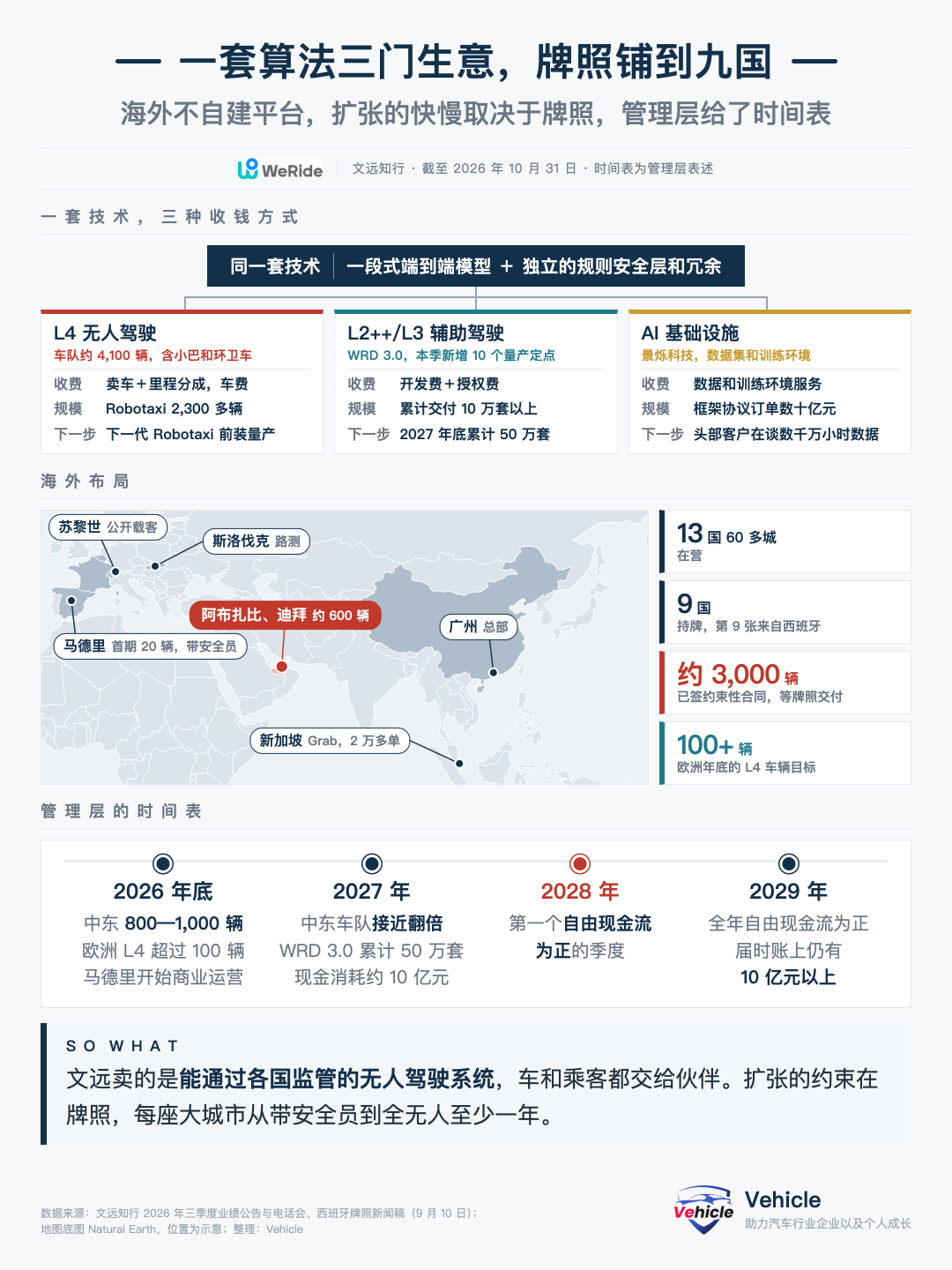
Source: WeRide third-quarter earnings announcement and conference call, September 10 Spain license press release; map locations are illustrative, and the timetable is management's statement
The R&D Bill: 465 Million Yuan in One Quarter—Where It Went, and Whether It Was Worth It
Back to the question at the beginning. Third-quarter gross profit increased by 82 million yuan year over year, but R&D expenses increased by 149 million yuan. That is why the loss did not move. WeRide did not disclose R&D broken down by business. Based on a rough calculation from the announcement, of the 465 million yuan, 390 million yuan was cash expenditure such as personnel, outsourcing, outsourced R&D, and cloud services, accounting for 84% and up 56.6% year over year; the rest was depreciation and amortization and share-based payment. Based on the past four announcements and conference calls, the money mainly went to three places.
Team. Personnel is the largest single item. Full-year R&D expenses in 2025 increased by 281 million yuan, of which personnel increased by 150 million yuan; this year's third quarter also included summer campus recruitment and first-half performance bonuses. Li Xuan said the R&D team is basically in place and will not be significantly expanded further.
Next-generation vehicles. Management said current investment is mainly spent on the next-generation Robotaxi. It is a pre-installed model developed with Geely Farizon, with the autonomous driving kit installed in the factory, so no retrofitting is needed after rolling off the line. Production time per vehicle is reduced to within 10 minutes. There is also a right-hand-drive version for Singapore and Hong Kong. In 2025, R&D project service fees increased by 115 million yuan, and one of the reasons given in the announcement was the development of the pre-installed Robotaxi.
Computing power and data. Model training is a recurring expense, corresponding to cloud service fees and data center depreciation. In the first half of this year, depreciation and amortization within R&D increased 72% year over year. Going overseas also brings two new expenses: data compliance in various countries, and building computing clusters locally in Europe and the Middle East.
Have these funds contributed to the future? They can be viewed in three tiers.
What has already taken effect is the algorithm. The same model obtained licenses in 9 countries, and after being applied to mass-production vehicles, 100,000 units were delivered. L2++/L3 revenue increased nearly fivefold in a year.
What is beginning to take effect is data. The data capabilities accumulated from autonomous driving were transferred to Jing Shuo Technology, and AI infrastructure revenue nearly doubled.
What has not yet taken effect is the next-generation vehicle. It determines the gross margin of vehicle sales and partners' payback speed, but neither the third-quarter report nor the conference call gave the mass-production timetable or cost reduction range.
Was it worth it? Three calculations can be made.
The first is coverage ratio, gross profit divided by R&D. It was 17.8% in the third quarter last year and 29.7% in the third quarter this year. The direction is right, but gross profit still covers less than 30% of R&D.
The second factor is incremental return. Year over year, every additional 1 yuan invested in R&D yields 0.55 yuan more in gross profit. Quarter over quarter, R&D rose by 31 million yuan while gross profit rose by 51 million yuan, meaning the increase in gross profit has now outpaced the increase in R&D spending.
The third factor is the break-even threshold. Based on third-quarter expenses and a 43% gross margin, quarterly revenue would need to reach roughly 1.3 billion yuan to cover all costs; on a cash basis, it would still need around 1.1 billion yuan. Management has said the first quarter with positive free cash flow will not arrive until 2028, which means revenue must reach three to four times the current level within two years—even though this year's full-year guidance calls for 60% growth.
For context, Pony.ai's R&D spending in the same quarter was 403 million yuan, essentially flat year over year. Over 400 million yuan per quarter is the current entry ticket for playing in L4. The difference is that Pony.ai's R&D is no longer climbing, whereas WeRide's still is.
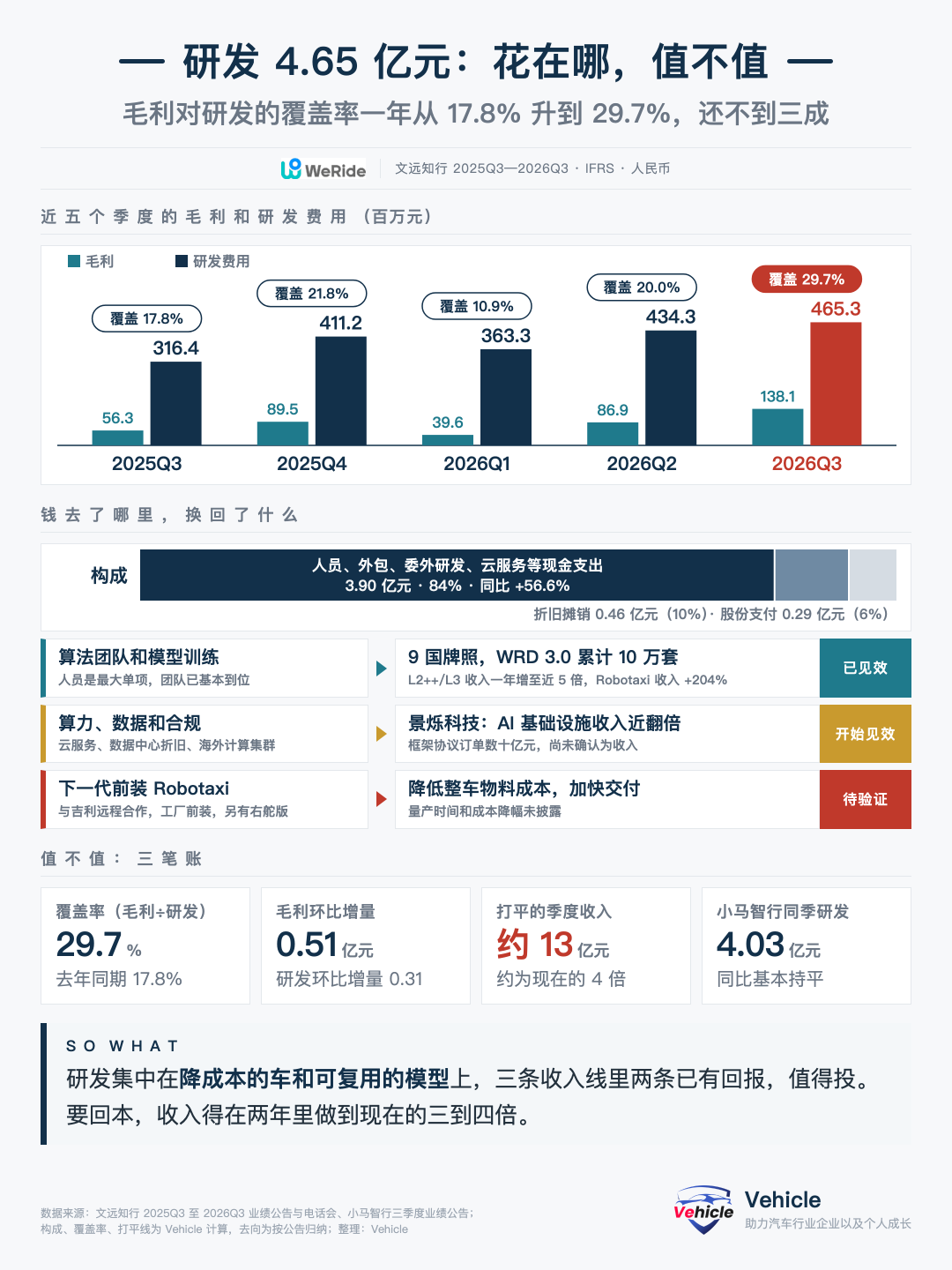
Source: WeRide earnings releases and conference calls from Q3 2025 to Q3 2026; Pony.ai's third-quarter earnings release. The composition, coverage ratio, and break-even threshold are calculations made for this article.
Our assessment, then, is that this R&D is worth the investment, though it cannot yet be called a proven success: the money is going into cost-reducing vehicles and reusable models, and two of the three revenue streams have already delivered returns. But to recoup the investment, revenue must reach three to four times the current level within two years.
Final thoughts
Going global is not just a lifeline for automakers—it is equally so for L4 companies. WeRide's business model of selling vehicles to local partners and collecting mileage-sharing fees achieved a 43% gross margin this quarter.
In addition, WeRide's assisted-driving business—as noted in our previous article, "WeRide's 2026 Q2: Making Money from L2, Turning Profitable in Sight"—also helped generate half of the revenue this quarter.
In this way, overseas Robotaxi players like WeRide avoid heavy asset exposure and treat licenses and safety records as products to be operated. A single algorithm is sold simultaneously to Robotaxi operators, L2++ automakers, and AI companies, spreading the same R&D cost across three revenue streams. This approach has proven effective.
References and images
*Unauthorized reproduction and excerpting are strictly prohibited.*
-
![]()
What Is Leapmotor Really After? Q3 Revenue of 31.7 Billion Yuan, Yet Only 40 Million Yuan in Profit!
-
![]()
Himile Technology: Tire Mold Leader with Steady Revenue Growth and Over 2 Billion Yuan in Cumulative R&D Investment Over Five Years
-
![]()
WeRide's Q3 2026: Revenue up nearly 90%, gross margin 43%—Is Spring Finally Coming for L4 Companies?
-
![]()
From 89.6% Digitalization to AI Empowerment: Unveiling the "Nerve Center" of the Modern Industrial System
-
The AI Hardware Bull Market Is Over
-
![]()
Guangdong Leads by a Landslide, Shanghai Dominates Finance, Beijing's Giants Set the Pace
-
![]()
Breaking: Huawei Unveils First HarmonyOS AI Phone — Netizens Say They Guessed Wrong as Price Exceeds Expectations
-
![]()
Anthropic Prospectus Insights: How Compute Power, Jobs, and Organizations Will Change