Why Do AI Glasses No Longer Need Cameras?
 09/22 2026
 337
337
From Addition to Subtraction
By VR Gyroscope ZJ
A few days ago, Apple officially released its new iPhone series, with the foldable iPhone Duo being the most eye-catching. However, to achieve the foldable form, this product made trade-offs in many configurations. Its standalone telephoto lens was removed, it does not support capturing spatial photos, Face ID is gone, and the product weight has reached 254g.
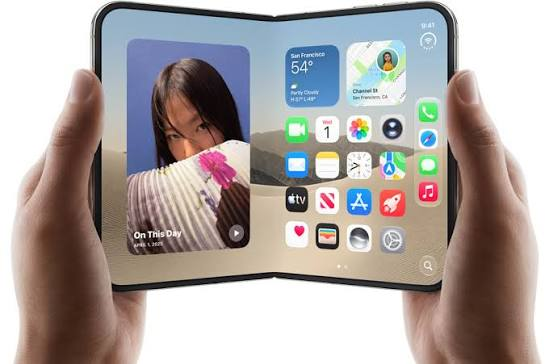
Image Source: Apple
It is evident that even Apple finds it challenging to achieve perfection in a single product. This is especially true for hardware that is worn close to the body and emphasizes prolonged use. Apple's previous attempt at a "do-it-all" device, the Vision Pro, tried to cram display, computing, sensing, and interaction capabilities into one headset, resulting in a bulky and heavy device with questionable battery life, making it unsuitable for extended wear.
The same goes for AI glasses. Looking back a few years, since Meta incorporated cameras into AI glasses, many camera-equipped products have flooded the market, offering features like photography, video recording, visual recognition, AI Q&A, as well as display, audio, and additional sensors. Manufacturers continuously added functions to the frames, hoping they could handle more tasks. Despite efforts to reduce weight, glasses still weighed around 40 grams.
However, a different trend has emerged this year. More and more new products are voluntarily removing cameras while retaining displays. This raises the question: when AI glasses are truly worn all day, what features are worth keeping on one's face?
01
Camera-Free + Display: Another New Wave in AI Glasses
As early as 2024, Even Realities launched its first AI glasses product, the Even G1, which had no camera or speakers but featured binocular single-green displays, primarily used for content such as navigation, translation, teleprompter, and AI information prompts. At a time when many products were vying to add cameras and more sensors, the Even G1 took a unique path.

Even G1 Image Source: Even Realities
This trend has caught on in the industry this year.
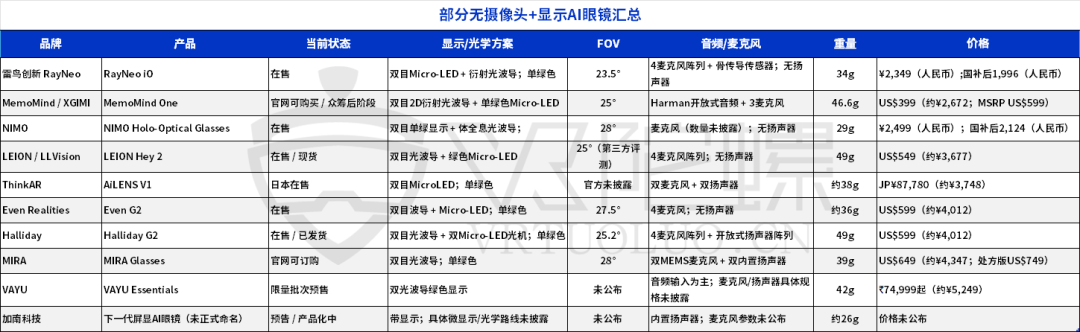
Note: Based on publicly available information, specifics are subject to official announcements.
From the products already released or disclosed, manufacturers' specific product positioning varies. Some emphasize daily information, some revolve around AI assistants, and others directly target conference and business scenarios. However, the common feature of these products is the removal of cameras while retaining display functions.
Even continues to iterate along this path. Compared to the first generation, the Even G2 still follows the camera-free + binocular single-green display route, with major upgrades focused on display and wearing experience. Its display resolution, refresh rate, field of view, and brightness have all improved. The official also redesigned the optical structure, reducing lens thickness by about 30% compared to the previous generation.
Another product, the Rayneo iO, focuses on AI capabilities and daily use. It removes the camera and adopts binocular Micro-LED with diffractive waveguide displays, weighing about 34g. Equipped with a 4-microphone array and bone conduction sensors, it can present AI answers, notifications, schedules, real-time subtitles, translations, and teleprompter content in front of the eyes. Functions like Life Log and meeting records also primarily rely on voice information.

Image Source: Rayneo Innovation
Compared to simply integrating large models, the Rayneo iO goes a step further by reorganizing AI capabilities around all-day wearing scenarios. In addition to regular Q&A, it hopes to enable AI to have long-term memory and participate in all aspects of users' lives and work by continuously acquiring voice and contextual information. This camera-free AI glasses forms a complete interaction loop through voice, memory, and display.
The Halliday G2 brings this combination to more explicit business scenarios. Like the others, it has no camera and features binocular single-green displays. Its core function, Meeting Flow, revolves around voice information in business scenarios, providing users with subtitles and translations, decision confirmation, to-do tracking, quick searches, and other functions, while also organizing structured records after meetings.
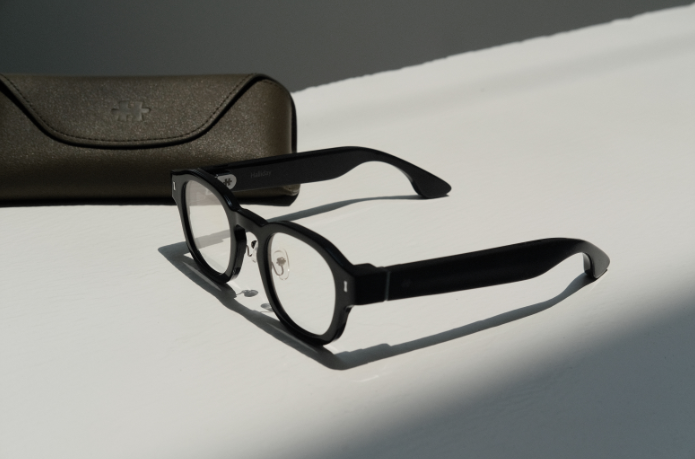
Image Source: Halliday
Even Meta, a representative manufacturer that popularized camera-equipped AI glasses, has started experimenting with camera-free products. It plans to launch a new smart glasses model, internally codenamed Luna, this fall, with the significant change being the removal of the camera, while retaining microphones, speakers, and AI capabilities. Although it is not yet confirmed whether Luna will feature a display, this move at least indicates that cameras are gradually transitioning from a default configuration in AI glasses to an optional feature that can be adjusted based on different product positioning.
Additionally, VR Gyroscope has learned from sources that two leading domestic AR glasses manufacturers are also preparing such AI glasses products, which may be released as early as the fourth quarter of this year or during CES.
Overall, these glasses products cater to different needs, but the trade-offs behind them are clear. AI glasses no longer strive to handle all tasks simultaneously, such as shooting, displaying, recognizing, and AI. Instead, they focus on specific scenarios where display and continuous access to voice information are essential, but a camera may not be necessary.
As similar hardware combinations begin to appear in more products, it reflects that manufacturers are reevaluating the value of each hardware component and function in AI glasses.
02
Removing Cameras, Retaining Displays: Manufacturers Are Recalculating
So, why are cameras the first to be removed?
The burden of cameras goes beyond just adding a sensor to the frame. To accommodate the visual processing demands of cameras and ensure all-day battery life, many AI glasses adopt a heterogeneous dual-chip solution. A high-performance chip handles the camera, image processing, and heavy AI computations, while a low-power chip manages voice, audio, Bluetooth connectivity, and other tasks that require prolonged operation, allowing the high-performance chip to not be constantly active.
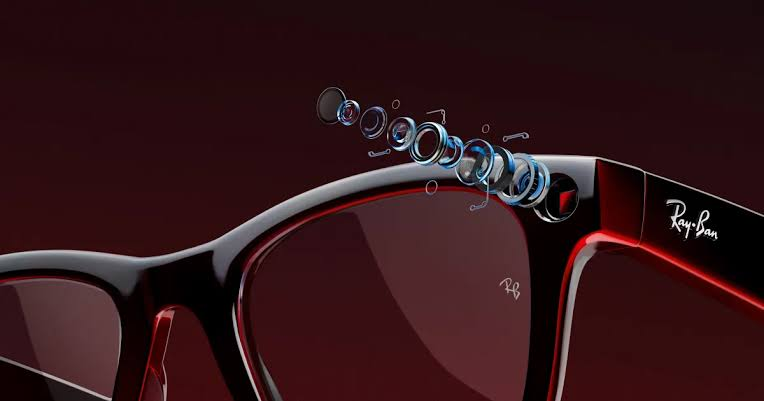
Image Source: Meta
After removing the camera, the situation becomes much simpler. Without the continuous need for image capture and visual computation, some products no longer require a separate high-performance visual processing platform for the camera. Instead, they can use a single low-power SoC to handle audio, connectivity, display, and basic AI tasks. The Rayneo iO is an example, adopting a single BES2800 chip from Bestechnic. Compared to a dual-chip solution, this architecture reduces PCB space and system complexity, while also lowering overall power consumption and BOM costs. With fewer chips, the glasses' price and battery life have more room for optimization.
This system-level simplification ultimately translates into a better wearing experience, with the most noticeable change being weight. Taking the Ray-Ban Meta as an example, its standard version weighs around 48g, and other commonly available camera-equipped AI glasses on the market also generally fall within the 40g range. However, things have changed this year.
After removing the camera, this batch of display-equipped AI glasses has further reduced their weight to around 30g. For instance, the Rayneo iO weighs about 33g, the Even G2 around 36g, and Jinan Technology's next-generation display-equipped AI glasses may further reduce the weight to about 26g, which is very close to the weight of ordinary glasses.
Meanwhile, advancements in display technology are also supporting this form of AI glasses. As technology continues to break through, display systems that once occupied significant space in the frame are evolving towards smaller, lighter, and better-performing designs. From the products showcased by upstream exhibitors at this year's Optoelectronics Expo, Micro-LED-based microdisplay modules continue to shrink in volume, with some monochrome optical engines now able to achieve volumes of 0.1cc or even less than 0.05cc, further reducing weight while maintaining display quality and mass production capabilities.
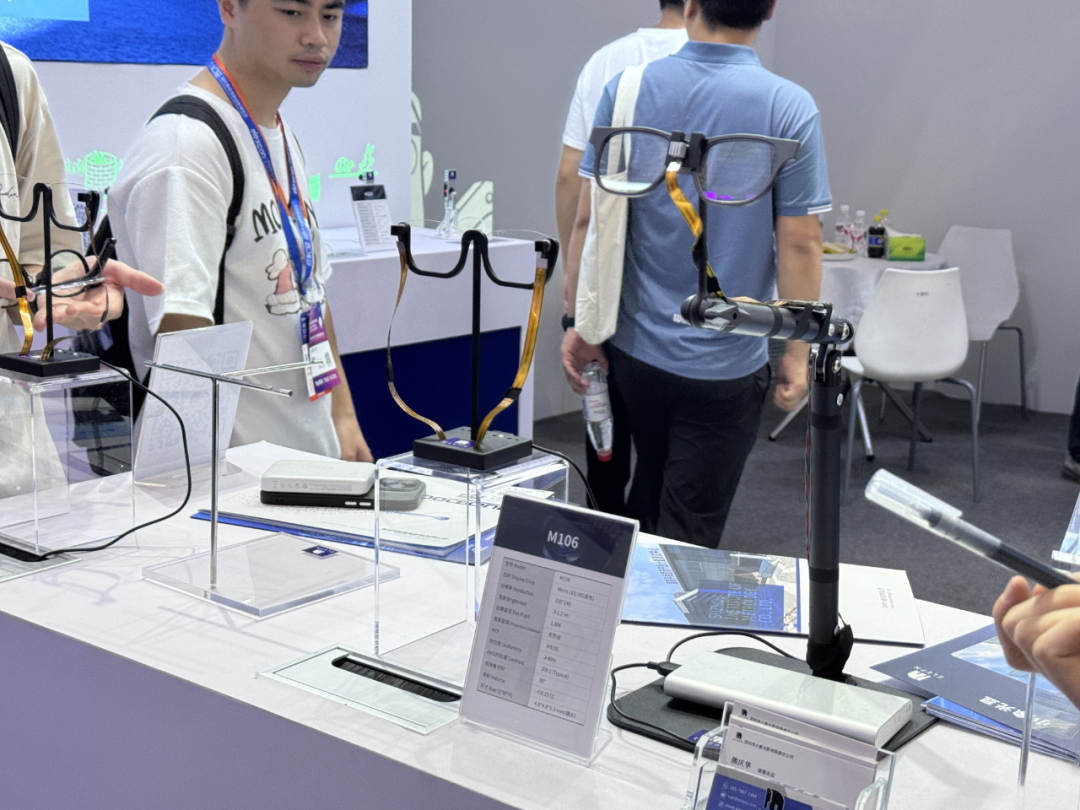
Image Source: VR Gyroscope
Light guides are also becoming thinner and lighter simultaneously. At the Optoelectronics Expo, Goertek Optics showcased multiple diffractive waveguide solutions for lightweight AI/AR glasses, including the F20Gi, which uses a nanoimprint process and has a single-layer thickness of only 0.5mm and weighs 3.2g. Another fully laminated etched full-color diffractive waveguide, the F20Ge-FL, has a total thickness of only 0.65mm, including dual cover glasses, and weighs less than 4g. At the same time, advancements in manufacturing processes such as DUV lithography, etching, and nanoimprinting are driving diffractive waveguides to continue evolving towards a balance of lightweight design, display quality, and mass production capabilities.
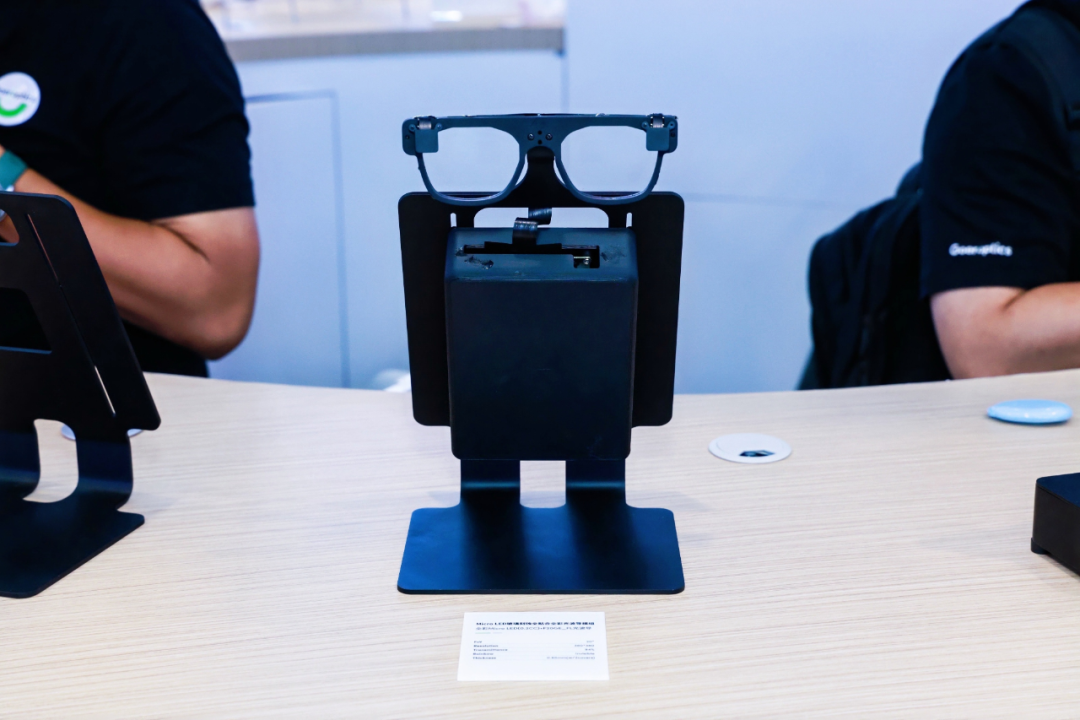
These upstream technological changes enable manufacturers to provide decent display quality and push the entire glasses towards a lighter, more ordinary glasses-like design after removing the camera.
Beyond hardware, cameras also introduce a problem that is difficult to solve through hardware iterations: privacy. For business meetings, office work, and other daily scenarios requiring prolonged wear, a camera constantly facing outward can easily raise concerns among those nearby. While the wearer knows whether they are recording, bystanders may find it difficult to determine at first glance. As seen from Meta's recent privacy controversies, such issues are becoming increasingly concerning as devices become more widespread.

Image Source: Meta
After removing the camera, such products at least bypass the most direct concern of bystanders being recorded and are more easily accepted in scenarios emphasizing long-term wear.
Furthermore, from an information acquisition efficiency perspective, numerous studies indicate that approximately 70-80% of human information acquisition comes from vision. This advantage is even more direct when applied to AI glasses. Whether for navigation or information prompts, if displayed directly in front of the eyes, users can quickly obtain key information with just a glance. This is precisely why manufacturers are willing to allocate structural, power, and cost space for displays even after abandoning cameras.
Cameras still hold value, but for products emphasizing lightweight design, privacy, and prolonged wear, they are no longer a must-have configuration.
03
From Addition to Choice: AI Glasses Are Diverging
However, the increase in camera-free products does not mean the camera-equipped route will be eliminated. For users who wish to use glasses as a first-person recording device or rely on visual recognition and multimodal AI, cameras remain indispensable.
Therefore, the more likely change in the AI glasses market is a further divergence in product strategies.
One type of product will continue to retain cameras and audio, with recording, visual understanding, and AI as core capabilities. These products do not require displays, have relatively simple structures, and have already proven consumer demand through existing products.
Another type prioritizes weight, power consumption, and space for displays by removing cameras, aiming for longer daily wear through functions like subtitles, navigation, translations, notifications, and AI information prompts.
A third type retains cameras, displays, and complete AI capabilities, handling both visual input and information output, hoping to cover more interaction scenarios. Compared to the first two types, this route has a higher functional ceiling and more closely aligns with manufacturers' vision for the next generation of spatial computing terminals. For example, the Rayneo X3 Pro and INMO Air 3 are deep cultivation (deeply exploring) this route, and Rokid's new generation of AI glasses, set to debut on September 24, will also continue to advance in this direction.
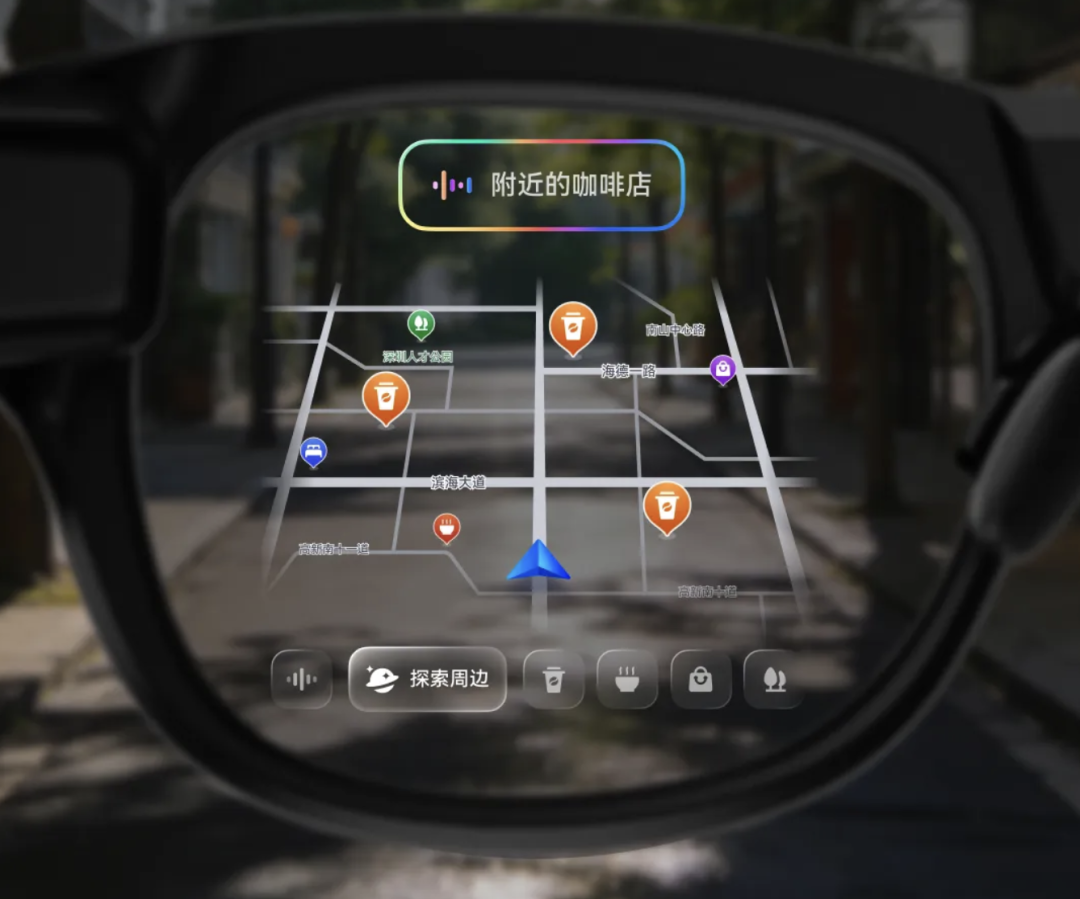
There is no superiority among these routes, as they address different needs. For AI glasses, this is an inevitable phenomenon as the market matures.
When the market is still in its early stages, manufacturers need to continuously prove what a pair of glasses can do by adding features. As products truly start to be used daily by consumers, their functions are naturally reselected, and people with different needs begin to decide which features are more suitable for them. This is also a manifestation of the trends towards "one person, multiple glasses" and "a thousand people, a thousand glasses."
-
![]()
Selling Cars Proves Unprofitable: 'NIO, Xpeng, Li Auto, Leapmotor' Step into Supplier Role, Challenging Bosch and Huawei!
-
![]()
Chery’s Overseas Brands Set to Make a Comeback in the Domestic Market
-
AI Computing Power Surges, Colliding with the Most Vulnerable Metal Supply Chain
-
![]()
All Models to Feature Self-Developed Batteries: Will Others Follow Li Auto's Lead?
-
5G Private Networks and Physical AI: A Mutually Reinforcing Development Process
-
![]()
Why Do AI Glasses No Longer Need Cameras?
-
![]()
The Battle Among Tech Giants for AI Dominance: ByteDance Earns $20 Billion but Takes Out a $29.6 Billion Loan?", "ByteDance, Syndicated Loan, AI, Computing Power, Infrastructure
-
![]()
Is the XPENG GX, a 'Greater Bay Area Range Rover' Priced at 300,000 Yuan, Worth Buying? | Test Drive Report