A Chaotic Battle in the Smartphone Market: Who is Redefining the Imaging War?
 10/10 2026
 499
499

By Liu Yong
Edited by Zhang Xiao
The smartphone industry has entered another round of dense (intensive, retained as the term fits the context of frequent product launches) product launch cycles.
From imaging flagships to high-end all-rounders, smartphone manufacturers are rolling out new generations of products. Larger sensors, longer zoom ranges, stronger stabilization, and continuously upgraded computational photography remain the highlights of product launches—even though smartphone imaging capabilities have already undergone multiple iterations, the war around lenses shows no signs of stopping.
The reason is not hard to understand. As foundational experiences like performance and screens mature, imaging remains a key anchor for smartphone manufacturers to sustain differentiation and compete for high-end users.
But problems have also arisen.
With hardware parameters increasingly converging, how much competitive advantage can be gained by simply stacking sensors and competing on pixel count?
At the same time, user demands for imaging are evolving. Capturing a clear photo is no longer the be-all and end-all. Recording a concert, capturing fleeting emotions, shooting cinematic videos, and enabling ordinary users to create high-quality content without mastering complex techniques are all becoming new challenges for smartphone imaging.
This has set a new direction for imaging competition. On September 21, vivo launched the X500 series and announced its elevation of dynamic imaging to a company-wide strategic priority, introducing the Blueprint Dynamic Imaging Technology Stack. This move attempts to extend competition from traditional static photography to dynamic imaging experiences like video and Live.
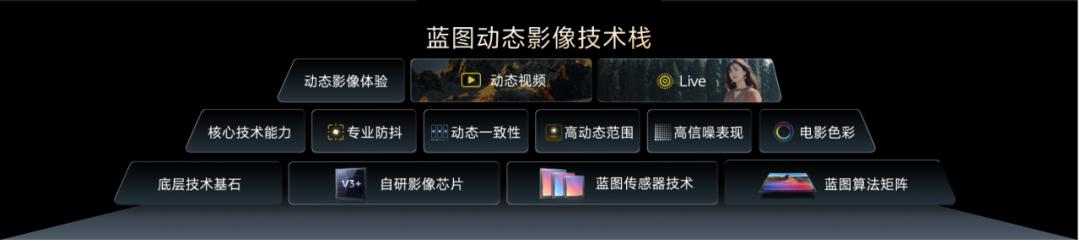
While all manufacturers are striving to enhance imaging performance, why has vivo chosen to make dynamic imaging a strategic core? Is this a proactive layout (layout, retained for strategic positioning) in response to changing user needs, or an inevitable choice as smartphone imaging competition enters a new phase? And what technical and commercial barriers must vivo overcome to make professional creation capabilities accessible to everyday users?
01 Dynamic Imaging: Difficult but Right
Why are smartphone manufacturers still competing fiercely in imaging?
A key reason is that as foundational smartphone experiences mature, imaging remains one of the few core capabilities that simultaneously influence consumer purchasing decisions, product differentiation, and brand perception. Processor performance can be measured with benchmarks, and screen specifications can be compared at launch events. However, whether a photo is sharp enough or a video is stable enough is ultimately tested in users' real lives.
For smartphone manufacturers collectively breaking into the high-end market, imaging is not just a hardware configuration but a product value that consumers can directly perceive.
But imaging competition is facing new challenges. Over the past few years, manufacturers have continuously upgraded sensor sizes, zoom ranges, low-light algorithms, and portrait effects. Computational photography has enabled smartphones to produce impressive photos in many scenarios. However, as foundational image quality improves, the difficulty of establishing differentiation through hardware parameters alone is increasing.
At the same time, how users document their lives is changing. Dynamic content like short videos and Live streams is becoming more prevalent. People want to preserve not just a single moment but also the stage at a concert, the movement of an athlete, the voices of friends gathered together, and those fleeting emotions.

This means smartphone imaging competition is shifting from "taking a great photo" to "recording a great process."
Static imaging remains important, but dynamic imaging offers manufacturers new competitive space. Especially for brands aiming to establish professional imaging credibility, video involves not just image quality but also shooting continuity, color performance, motion tracking, and post-production workflows. Brands that can truly integrate these elements have the opportunity to establish new differentiation beyond existing imaging competition.
However, moving from photography to dynamic imaging is not simply about porting photo features into video mode.
The technical requirements differ significantly.
For a single photo, smartphones can use multi-frame synthesis and computational photography to integrate information from different exposures in a short time. Videos, however, require real-time image capture and processing in every consecutive frame. Exposure cannot fluctuate frequently, colors cannot shift erratically, focusing must keep up with subject movement, and stabilization cannot come at the cost of noticeable loss in field of view or unnatural distortions. Even if single-frame quality is excellent, flickering, motion blur, or inconsistent colors during playback will degrade the overall viewing experience.
More complexly, smartphones must accomplish these tasks within limited physical space and power constraints.
High-specification video requires continuous sensor, processor, and imaging algorithm engagement. Higher resolution, frame rates, and dynamic range place greater demands on real-time processing, thermal management, and power efficiency. Meanwhile, smartphones must also balance slimness, battery life, and everyday usability.
This makes dynamic imaging a quintessential systems engineering challenge: sensors determine how much information can be captured, chips affect processing efficiency, algorithms determine how the image is rendered, and optical and electronic stabilization jointly influence stability in dynamic scenes.
vivo has chosen to elevate dynamic imaging to a company-wide strategic priority at this stage precisely because it involves not an isolated video feature but a technical system requiring sustained investment.
On September 21, 2026, vivo launched the X500 series and introduced the Blueprint Dynamic Imaging Technology Stack, identifying high dynamic range, high signal-to-noise ratio performance, professional stabilization, dynamic consistency, and cinematic color as five core technical capabilities. According to vivo's product planning, this system aims to enhance overall performance from shooting to final output through sensor, imaging chip, and algorithm synergy—rather than relying on a single parameter as a selling point.
Dynamic consistency deserves particular attention. Photos can be improved with post-processing, but videos are continuous visual experiences. When users pan the camera, change scenes, or move from indoors to outdoors during shooting, whether exposure, color, and focusing remain natural often matters more than peak single-frame quality in determining the final viewing experience.
The same goes for stabilization. What users truly need is not a specific stabilization rating on a spec sheet but consistently stable footage when shooting while walking, tracking moving subjects, or using long zoom.
In other words, dynamic imaging truly tests not whether a smartphone can shoot a visually appealing video but whether it can deliver consistently stable results in complex, unpredictable real-world scenarios.
Of course, elevating dynamic imaging to a strategic direction does not mean the industry has formed a new competitive landscape, nor can leadership be determined solely by technical announcements. Other brands are also continuously investing in video shooting, computational photography, and professional creation capabilities. For vivo, introducing a technical system is just the beginning. Subsequent success depends on proving through actual product experiences whether these capabilities can be reliably delivered and whether consumers will change their purchasing choices accordingly.
But from an industry development perspective, dynamic imaging has indeed opened a new technical frontier for smartphone manufacturers.
For vivo, the value of this path lies not just in shooting better videos but in whether it can translate professional imaging capabilities into product experiences that ordinary users can easily use.
This leads to the next question: When dynamic imaging requires such complex technical support, how can vivo prevent professional capabilities from remaining in the hands of a few creators? How can it enable ordinary users to achieve better creative results without learning complex shooting techniques? This will determine whether dynamic imaging remains merely a high-specification feature for flagship phones or becomes a product capability that truly expands the boundaries of mobile creation for the masses.
02 Raising the Professional Ceiling, Lowering the Mass Barrier
If dynamic imaging tests smartphone manufacturers' systemic technical capabilities, the more practical question is: What can these technologies ultimately offer users?
For smartphone manufacturers, a persistent gap exists between professional imaging capabilities and everyday user experiences.
On one end are professional creators who care about image quality, dynamic range, color depth, encoding formats, and post-production flexibility, seeking greater creative freedom from smartphones. On the other end are ordinary users who may not understand these professional concepts but want to easily shoot clear, stable, and atmospheric videos at concerts, travels, or gatherings.
Focusing solely on raising the professional ceiling may confine imaging capabilities to spec sheets and a few creators' workflows. Lowering barriers too much may limit the product's extension into professional creation.
vivo is attempting to address both challenges through its dynamic imaging strategy: on one hand, continuing to expand the boundaries of smartphone imaging professionalism; on the other, leaving complex technical processing to the system as much as possible so users can focus more on content itself.
First, consider the professional ceiling.
Historically, smartphone video shooting has primarily served daily documentation. As sensors, processing chips, and algorithms improve, smartphones are beginning to handle more complex creative tasks. For professionals, video quality means not just high resolution but also whether highlights and shadows are fully preserved, whether rapid movement remains sharp, and whether sufficient color grading and editing flexibility exist after shooting.
This is where vivo's dynamic imaging layout (layout, retained) with the X500 series becomes noteworthy. vivo has incorporated high-specification video, professional Log video, and related post-production workflows into its product capabilities.
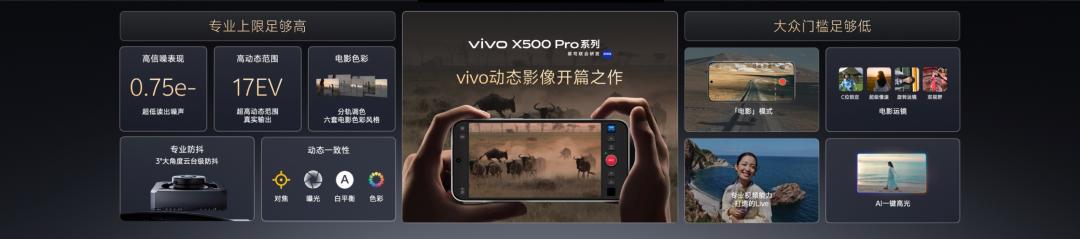
Take high-frame-rate video as an example. Higher frame rates offer more creative space for slow-motion effects but also increase data capture and processing demands. Log video preserves greater adjustment flexibility for post-production color grading but requires users to have some post-processing knowledge. The value of professional encoding and color workflows lies not just in making video specifications more impressive but in minimizing barriers between smartphone shooting and post-production.
The underlying competitive logic is that smartphones aim to become independent devices capable of handling more creative tasks rather than just supplementary tools to professional equipment.
Of course, this does not mean smartphones can fully replace professional cameras. Lens systems, sensor sizes, thermal management, and control space in complex shooting environments remain real differentiators between devices. What smartphones truly need to prove is whether they can offer sufficiently reliable professional creation capabilities beyond portability and ease of use.
But raising professional capabilities solves only half the problem. For broader user groups, richer professional features may also raise operational barriers. Users may not know what Log is or understand the relationships between shutter speed, exposure compensation, and color spaces. If a feature requires users to first learn a complex knowledge system, it is unlikely to become part of everyday imaging experiences.
Thus, lowering barriers does not mean simply reducing a few operational steps but transforming technical complexity into product usability—whether the system can recognize shooting scenarios and provide reasonable suggestions, automatically handle challenging lighting, night scenes, or motion scenarios more appropriately, and deliver finished results that meet expectations without complex post-processing all affect the practical value of imaging technologies.
For dynamic imaging, this capability is especially critical.
Video shooting typically occurs in faster-changing, less forgiving scenarios. Concert lights flash by in an instant, children and pets move unpredictably, and travel highlights cannot be repeated. Users have little time to adjust parameters, let alone complete professional setups before each shot.
At such moments, a smartphone's value lies not just in offering more optional features but in helping users achieve stable, natural shooting results even when they cannot think through every detail.

This is where AI and computational photography can help. Through scene recognition, parameter optimization, and intelligent processing, smartphones can attempt to automate what previously required experienced judgment. However, automation does not mean unconditionally making decisions for users.
A good intelligent imaging experience must balance automatic processing and user control: operations should be simple enough for ordinary users, while the system should retain necessary adjustment space for more demanding creators.
From this perspective, professional ceilings and mass barriers are not separate product paths. The former determines how far technology can go, while the latter determines how many people can ultimately use it. Professional features validate a smartphone's technical potential, while usability determines whether these capabilities can integrate into real life and create sustained user value.
For vivo, the challenge of its dynamic imaging strategy lies precisely here.
Technical specification upgrades are relatively easy to showcase at launch events, but true experience differences often emerge only after extensive testing in complex scenarios. Whether professional features are sufficiently reliable, whether automatic processing feels natural, and whether users can enjoy a coherent experience across shooting, editing, and sharing all require long-term product refinement.
Therefore, the true pursuit of dynamic imaging is not about turning all users into professional creators but about ensuring professional capabilities do not remain exclusive to a few. For users requiring fine control, smartphones should offer a sufficiently high creative ceiling. For ordinary users who just want to document life, smartphones should minimize operational costs. Only when both needs are addressed within the same product system can dynamic imaging transform from a high-specification feature into a broadly valuable product capability.
Achieving this requires more than a single product's technical breakthrough. It demands long-term R&D accumulation, hardware-software synergy, and continuous understanding of user needs.
This brings us back to vivo itself: Why has vivo chosen to make dynamic imaging a strategic core? What technical accumulations can it leverage, and how must it convert these advantages into sustained product competitiveness?
03 Why vivo?
Elevating dynamic imaging to a company-wide strategic priority means vivo seeks to answer not just how to make a flagship smartphone shoot better videos but how to build a differentiated capability that can continuously accumulate and iterate as smartphone imaging competition enters a new phase.
This path is not without its barriers to entry.
Dynamic imaging requires the collaborative efforts of sensors, chips, algorithms, and software experiences, as well as long-term product refinement and user feedback. For vivo, the real question worth discussing is not what breakthroughs it has achieved in a specific technology, but why it chooses to concentrate its resources on dynamic imaging at this moment, and whether its previously accumulated capabilities can support this transformation.
First and foremost, there is the strategic starting point provided by long-term accumulation in imaging.
From establishing a global imaging strategic partnership with Zeiss in 2020 to continuously advancing research and development in optical technology, imaging algorithms, and professional portrait experiences, vivo has developed a relatively clear technological path centered around mobile imaging. The collaboration between the two parties is not limited to brand co-branding but extends to specific areas such as joint optical system development, coating technology, portrait styles, and telephoto lenses. In 2025, vivo and Zeiss further renewed and expanded their cooperation, proposing to continue exploring a broader range of imaging product matrices and ecosystems.
This means that vivo's advancement in dynamic imaging does not start from scratch. The optical, sensor, chip, and algorithm accumulations developed in the field of static imaging can provide a foundation for video capabilities; however, when the competitive focus shifts from single photos to continuous footage, these capabilities need to be reintegrated and validated.
Particularly noteworthy is that vivo does not simply interpret dynamic imaging as an upgrade in video parameters but categorizes it into five directions: high dynamic range, high signal-to-noise performance, professional image stabilization, dynamic consistency, and cinematic color. Behind this technological layout lies a reorganization of the complete video production chain: sensors are responsible for information collection, chips provide real-time processing capabilities, algorithms enhance image performance in complex scenarios, and software translates these technologies into user-friendly functions.
However, existing accumulations can only explain why vivo is qualified to enter the field; they are insufficient to explain why it has elevated dynamic imaging to a company-wide strategic level.
A more critical reason may lie in the changing cycle of imaging competition.

As more and more manufacturers acquire strong static imaging capabilities, differentiation achieved through single hardware upgrades may be difficult to sustain in the long term. For vivo, continuing along the existing upgrade path can still improve product experiences but may not consistently establish new user perceptions.
Dynamic imaging offers an alternative possibility: it extends the application scope of traditional imaging technologies and shifts the competition to broader scenarios such as video creation, dynamic recording, and professional workflows.
This is also the difference between a company-wide strategy and a single product's selling point. The former implies that relevant investments should not be limited to a single generation of flagship products but should span technology research and development, product planning, software experiences, and user services. Upgrades to sensors and chips require time, algorithm optimizations for complex scenarios demand continuous accumulation, and professional creation functions need ongoing adjustments based on user feedback. Only if these efforts persist across multiple product generations can dynamic imaging transition from a technical highlight at product launches into a brand capability recognized by consumers.
Another area of accumulation for vivo is its established connections with imaging creators.
In September 2026, vivo announced the strategic upgrade of its Blueprint Imaging initiative at a creator summit, proposing to further integrate imaging technology with imaging culture and continue promoting mobile imaging creation through imaging competitions, creator exchanges, and other means. The value of such initiatives should not be understood solely from a brand communication perspective. For mobile phone manufacturers, professional creators bring more complex shooting demands and more specific product feedback; authentic creation cases also help manufacturers test the actual performance of their technologies in complex environments.
More importantly, imaging itself possesses dual attributes of technology and expression. What users ultimately care about is often not what technology the sensor employs but whether they can capture important moments and convey the emotions they wish to express. If manufacturers focus solely on hardware parameters, they struggle to fully explain the significance of imaging capabilities to users; however, by forging connections between technology, products, and creation scenarios, they have the opportunity to establish more sustainable brand recognition.
Of course, an imaging ecosystem cannot be built by simply hosting a few events or introducing several creation features. It requires creators to continue using the products, software and hardware to iterate continuously, and these investments to genuinely improve user experiences. Whether the ecosystem can become a competitive advantage ultimately depends on whether it can feed back into product development and foster long-term, sustainable user engagement.
This brings us back to the business perspective: What can vivo gain by choosing dynamic imaging?
From a product standpoint, dynamic imaging can provide new dimensions of differentiation for flagship smartphones. For high-end users and professional creators, professional video capabilities may become a deciding factor in purchase decisions; for ordinary users, simpler shooting operations and more stable video output experiences may enhance the product's daily usability. Only when both aspects work together can technological investments translate into broader market competitiveness.
However, this path also faces practical constraints. Professional video capabilities require stronger hardware and computational support, necessitating trade-offs between research and development costs, product costs, and power management; the widespread adoption of high-specification features cannot be judged solely by technical metrics. Even if a product can shoot high-specification videos, whether users are willing to pay a premium for these capabilities or choose vivo over other brands based on them remains to be validated by market performance.
Therefore, the true test of dynamic imaging for vivo is not whether it can achieve several industry-leading specifications in a single product generation but whether it can continuously improve experiences in subsequent products and ensure that these improvements are perceived, utilized, and acknowledged by users. If professional creation capabilities can continuously trickle down and ordinary users can genuinely feel the convenience brought by dynamic imaging, then this strategy has the potential to transform from technological investment into product advantages and further into brand competitiveness.
The next phase of mobile imaging may not be determined by a single parameter. The real competition is likely to occur at the intersection of technological accumulation, product experiences, and user needs.
vivo's elevation of dynamic imaging to a company-wide strategic level indicates its attempt to find a new breakthrough in this competition. However, the strategic direction is only the starting point; ultimately, what determines how far this path can go is whether technology can consistently translate into experiences and whether those experiences can further translate into commercial value.
-
![]()
A Chaotic Battle in the Smartphone Market: Who is Redefining the Imaging War?
-
![]()
Chaotic Competition in the Smartphone Market: Who is Redefining the Imaging War?
-
![]()
AI Is Not a Get-Out-of-Jail-Free Card: Why Only Microsoft Is Being Rewarded for Its AI Investments
-
![]()
Li Auto’s 2026 i6: The Brand’s Debut Global All-Electric Model Headed to Europe
-
![]()
Kimi K3 Goes Viral and Suspends Service in 48 Hours: Model Wins Benchmarks, Compute Falls Short Against Big Players
-
![]()
Zhixiang Future Secures 2.1 Billion Yuan in Three Months of Financing, Yet Founder Maintains: 'We Haven't Achieved World-Model Status'
-
11 Days, Five Launch Events: The Battle Behind the 2026 Domestic Flagship Smartphones
-
![]()
Lenovo's PC Shipments Plunge 22% Year-on-Year: The AIPC Narrative Faces Challenges