Insta360 Q3 Financial Report: Revenue Surges to 3.9 Billion Yuan, Net Profit Plummets 93% to Just 17.43 Million Yuan
 11/24 2026
 474
Produced by Zhineng Zhixin
In Q3 2026, Insta360 Innovation's revenue reached 3.919 billion yuan, up 33.3% year-over-year. Net profit attributable to shareholders, however, came in at just 17.43 million yuan—a 93.59% year-over-year collapse—leaving a net margin of merely 0.44%. Gross margin fell from 47.65% in the same period last year to 33.70%, a single-quarter drop of 13.95 percentage points.
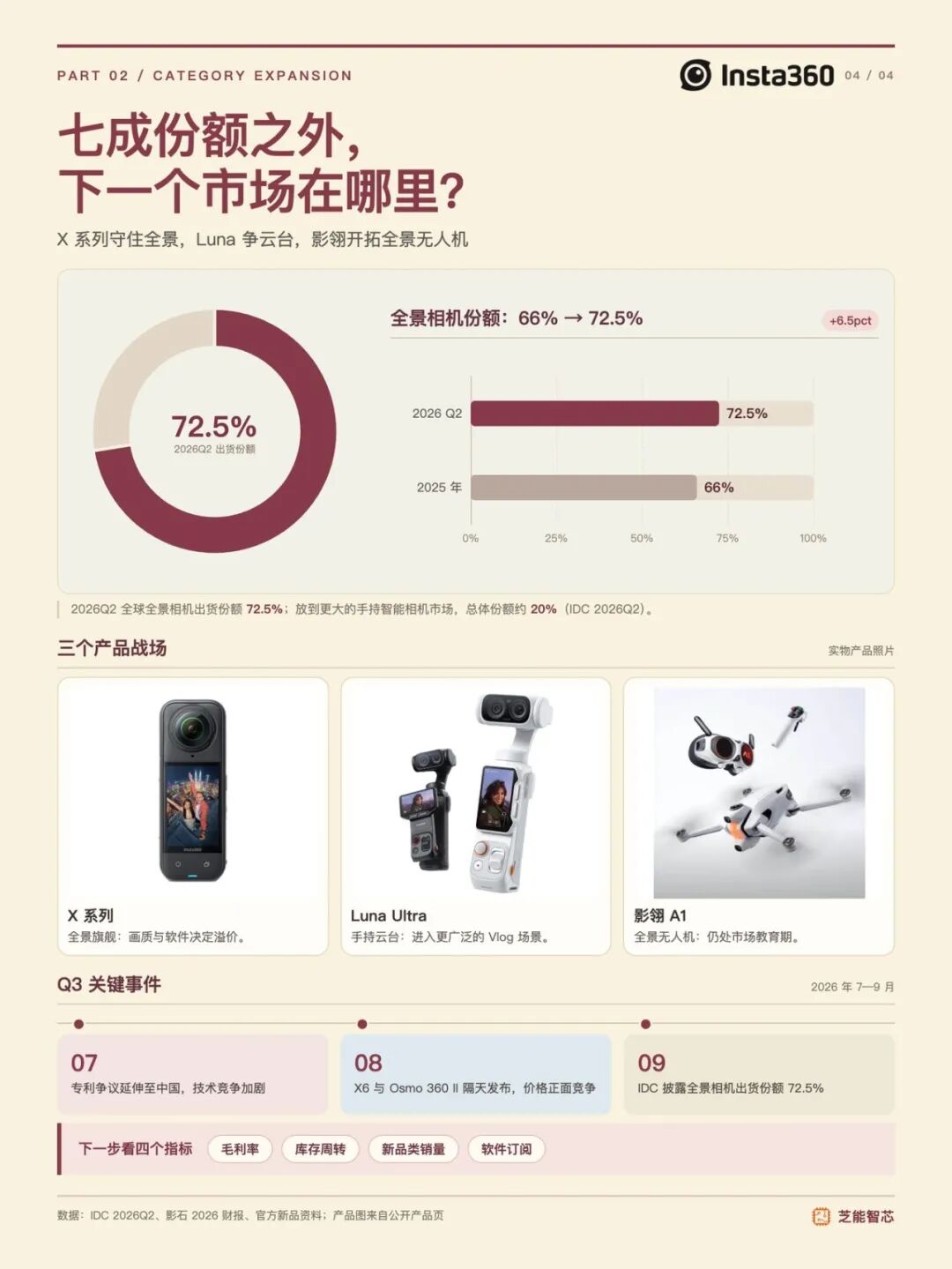
According to IDC's Q2 2026 global panoramic camera shipment share data, Insta360 held 72.5%, up from 66% in 2025.
DJI has entered the panoramic camera market, while Insta360 has pushed into gimbal cameras and panoramic drones. In August, the two companies released their new flagship products just one day apart, with a 700 yuan gap in launch price. In the first half of the year, the company procured nearly 2 billion yuan worth of storage components, and inventory at the end of September stood at 7.154 billion yuan. The new product categories are still burning cash.
This year, electronic components and memory prices have hit consumer electronics companies hard. Even after reaching global No. 1, Insta360 is still not profitable.
Part 1: Selling More, Keeping Less per Device
Insta360's revenue has been rising consistently.
◎ Q1, Q2, and Q3 2026 revenue came in at 2.481 billion yuan, 3.035 billion yuan, and 3.919 billion yuan respectively, with Q3 alone up 979 million yuan year-over-year.
◎ Gross profit fell from 1.401 billion yuan in the same period last year to 1.321 billion yuan. Revenue grew by one-third, yet gross profit dropped by about 80 million yuan.
◎ Gross margin declined from approximately 45.2% in Q1 and 38.3% in Q2 to 33.7% in Q3.
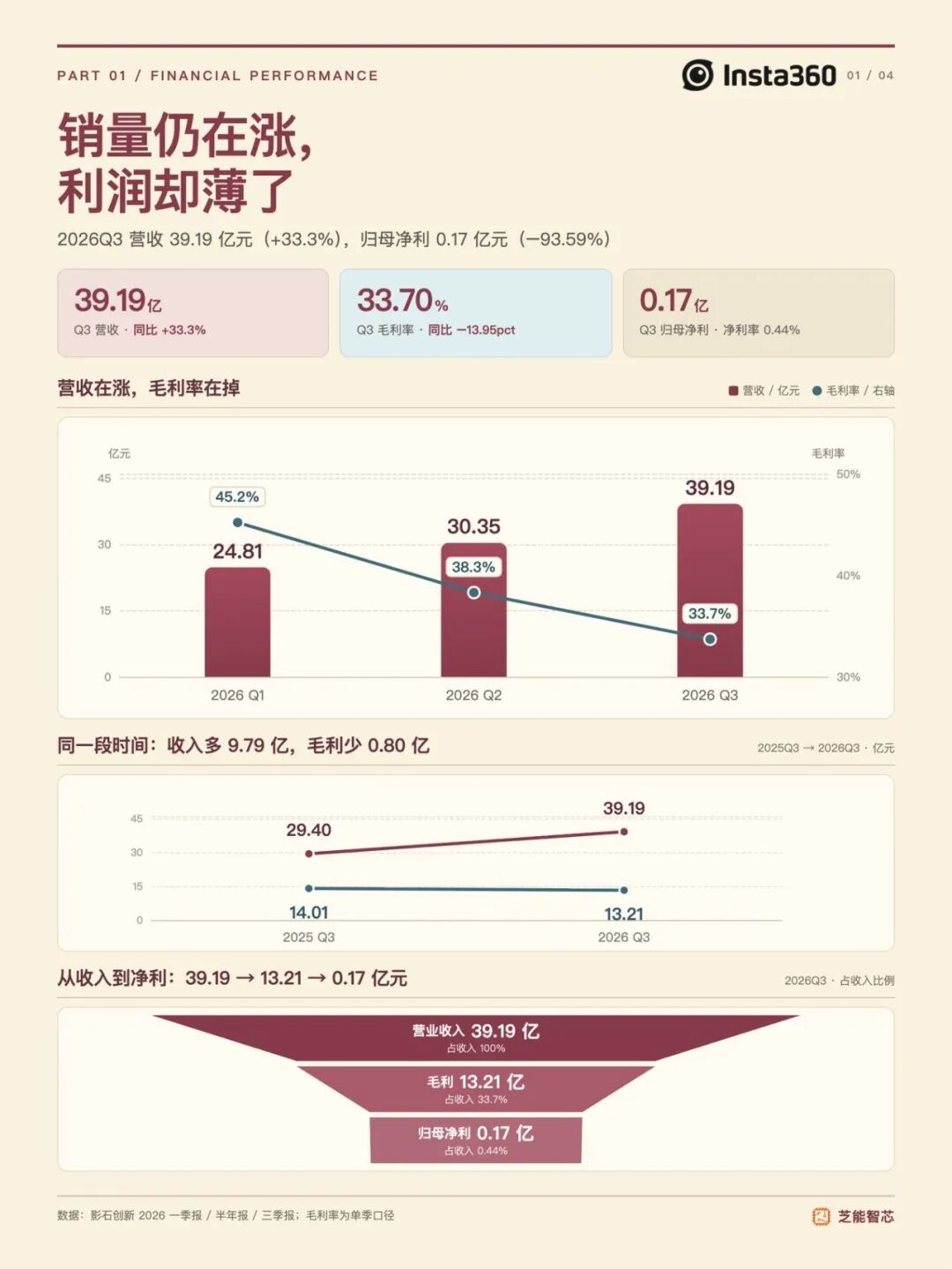
In Q3, selling, administrative, and R&D expenses totaled approximately 1.327 billion yuan—nearly matching the quarter's gross profit of 1.321 billion yuan. The contraction in gross profit completely offset any dilution benefit from expenses growing more slowly than revenue. Q3 net profit attributable to shareholders was 17.43 million yuan, with a net margin of 0.44%; non-GAAP net profit attributable to shareholders was 20.47 million yuan.
Consumer electronics profits are determined jointly by average selling price, per-unit hardware cost, and channel marketing expenses. Insta360 once commanded a high premium in panoramic cameras, but new product competition has now simultaneously pushed up specifications, AI editing capabilities, and price concessions—while rising key component prices have raised costs, squeezing gross margin from both ends.
Seventy Percent Share: Holding the Market but Not the Premium
The IDC data released on September 23 covers two scopes.
In Q2 2026, within the global panoramic camera sub-segment, Insta360's shipment share was 72.5%. In the broader handheld smart camera market—which includes action cameras, gimbal cameras, and panoramic cameras—Insta360's overall share was about 20%.
That 72.5% figure represents share of this sub-category, not the entire action imaging device market.
Insta360's advantage stems from a complete usage workflow: dual-lens panoramic shooting, stabilization, and an invisible selfie stick, followed by frame selection via the mobile app, AI automatic editing, and sharing to social platforms.
Skiers, cyclists, travelers, and content creators can first capture everything around them and decide the camera direction afterward, eliminating the compositional pressure during shooting. This experience underpins the brand premium of the X series.
After DJI brought its sensors, stabilization, algorithms, accessories, and channels into panoramic cameras, users can now directly compare prices between two devices with similar functions.
Insta360's share can still grow, but the profit margin per device has changed. Consumers get lower prices and higher specifications, and Insta360 pays more in costs to defend this market.
7.154 Billion Yuan in Inventory Weighing on the Balance Sheet
In the first half of the year, Insta360 made strategic procurement of nearly 2 billion yuan around storage components, with storage chip book value reaching 1.748 billion yuan at the end of June.
Total inventory at the end of September was 7.154 billion yuan, compared to only 2.919 billion yuan at the beginning of the year—an increase of 4.235 billion yuan in nine months. Total inventory at the end of June was 6.212 billion yuan, meaning Q3 alone added approximately 942 million yuan.
High-specification video shooting has increased demand for storage and data throughput, and before new cameras launch, component procurement, contract manufacturer scheduling, accessory preparation, and global channel distribution must all be completed.
The company locks in component supply volumes and prices. Materials enter the balance sheet first, cash leaves the company first, and revenue and profit can only be realized after products are sold.
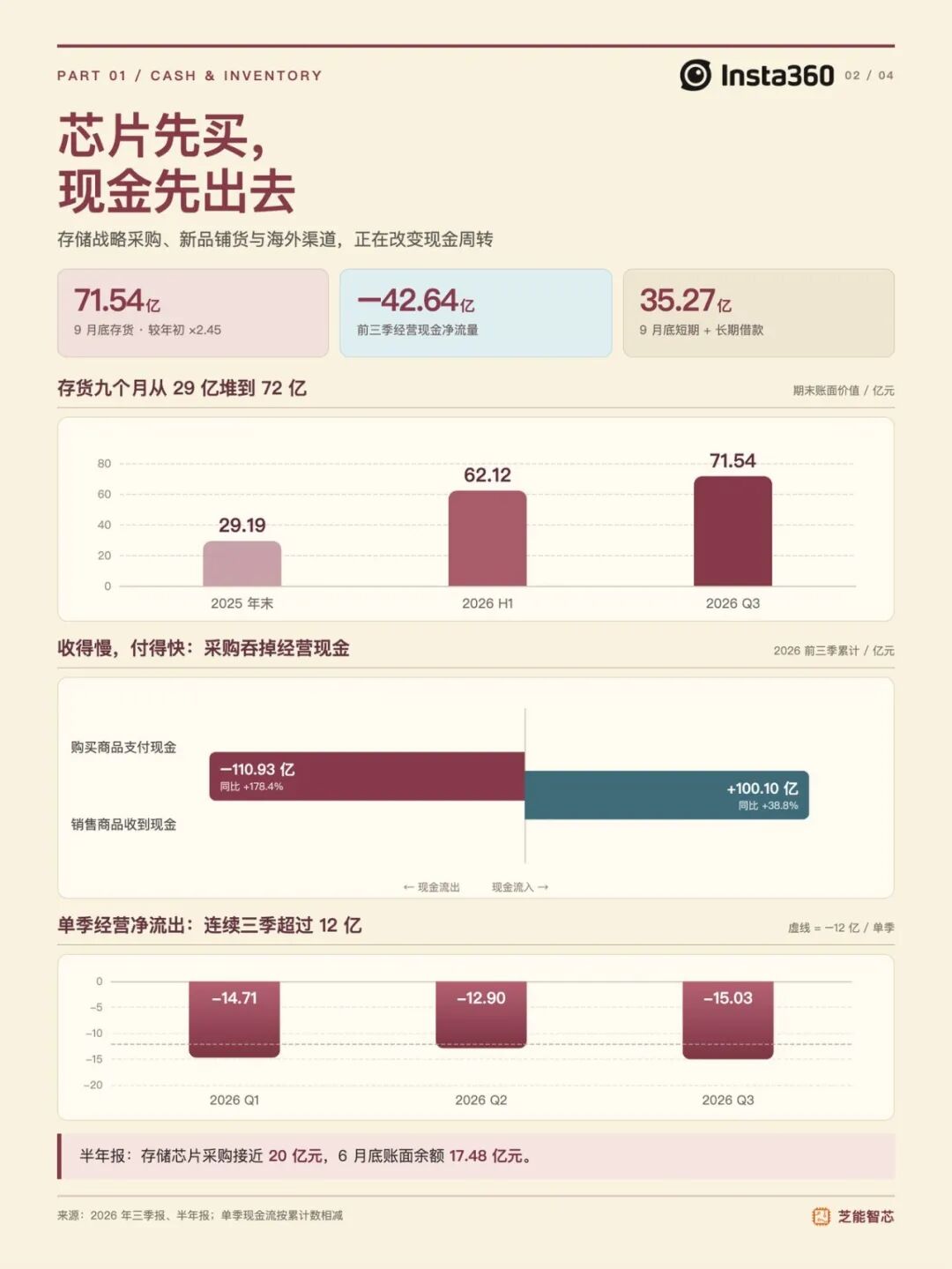
In the first three quarters, cash received from sales of goods was 10.010 billion yuan, up approximately 38.8% year-over-year; cash paid for purchases of goods was 11.093 billion yuan, up approximately 178.4% year-over-year. The increment in procurement cash expenditure significantly exceeded the increment in sales cash inflow.
In the first three quarters, net operating cash outflow was 4.264 billion yuan, with a Q3 single-quarter net outflow of approximately 1.503 billion yuan—large net outflows every quarter.
During peak-season shortages, advance stocking can secure shelf space and share. But during product transitions and retail price declines, these inventories lengthen the capital recovery cycle and bring pressure from price markdowns.
New Product Categories Pull Profit from the Parent Company to Outside the Group
In the first three quarters, Insta360's R&D investment was 1.675 billion yuan, accounting for 17.75% of revenue, of which 1.601 billion yuan was expensed in the current period.
It no longer just makes a single panoramic camera: the X series, GO wearable, Ace action camera, Luna gimbal camera, and Shadowwing panoramic drone correspond to different sensors, cooling, chips, optics, controls, and software solutions.
Early-stage investment in new product categories is directly reflected in the income statement. In the first three quarters, the group's consolidated net profit was negative 167 million yuan, net profit attributable to shareholders was positive 48 million yuan, and minority interest loss was negative 215 million yuan.
Insta360 disclosed that panoramic drones are still in the market education phase and have not yet achieved economies of scale, with staged investment dragging down overall profit. The parent company is making money, but the group as a whole is still spending on new product categories.
At the end of September, short-term and long-term borrowings totaled 3.527 billion yuan, compared to approximately 123 million yuan at the beginning of the year; interest expenses for the first three quarters were 63.83 million yuan. The company uses subsidiary financing to support new business investment.
Each new product category ultimately needs new usage scenarios to generate long-term sales sufficient to cover development, marketing, and channel costs.
Part 2: What Happened in Imaging Consumer Electronics Competition in Three Months
July: The Technical Boundaries of Cameras and Drones Cross
In early July, the domestic patent dispute between Insta360 and DJI further unfolded, involving panoramic shooting, editing, gimbals, cooling, and other technical fields.
Competition extended from sales prices to shooting experience, algorithm capabilities, and intellectual property. In the past, Insta360 excelled at panoramic and software processing, while DJI excelled at drones, gimbals, and action imaging. Now both sides have entered each other's domains, and the overlap between the two technology systems is growing.
Insta360's entry into panoramic drones sharply increased development difficulty. Ground panoramic cameras solve shooting, stabilization, and post-production, but drones must also solve flight control, obstacle avoidance, communication, battery life, reliability, and regulatory compliance.
Whether users are willing to pay for a flying panoramic perspective determines whether this business can move from a technology demonstration into everyday consumption.
August: Two Flagships Released a Day Apart, 700 Yuan Price Gap on the Counter
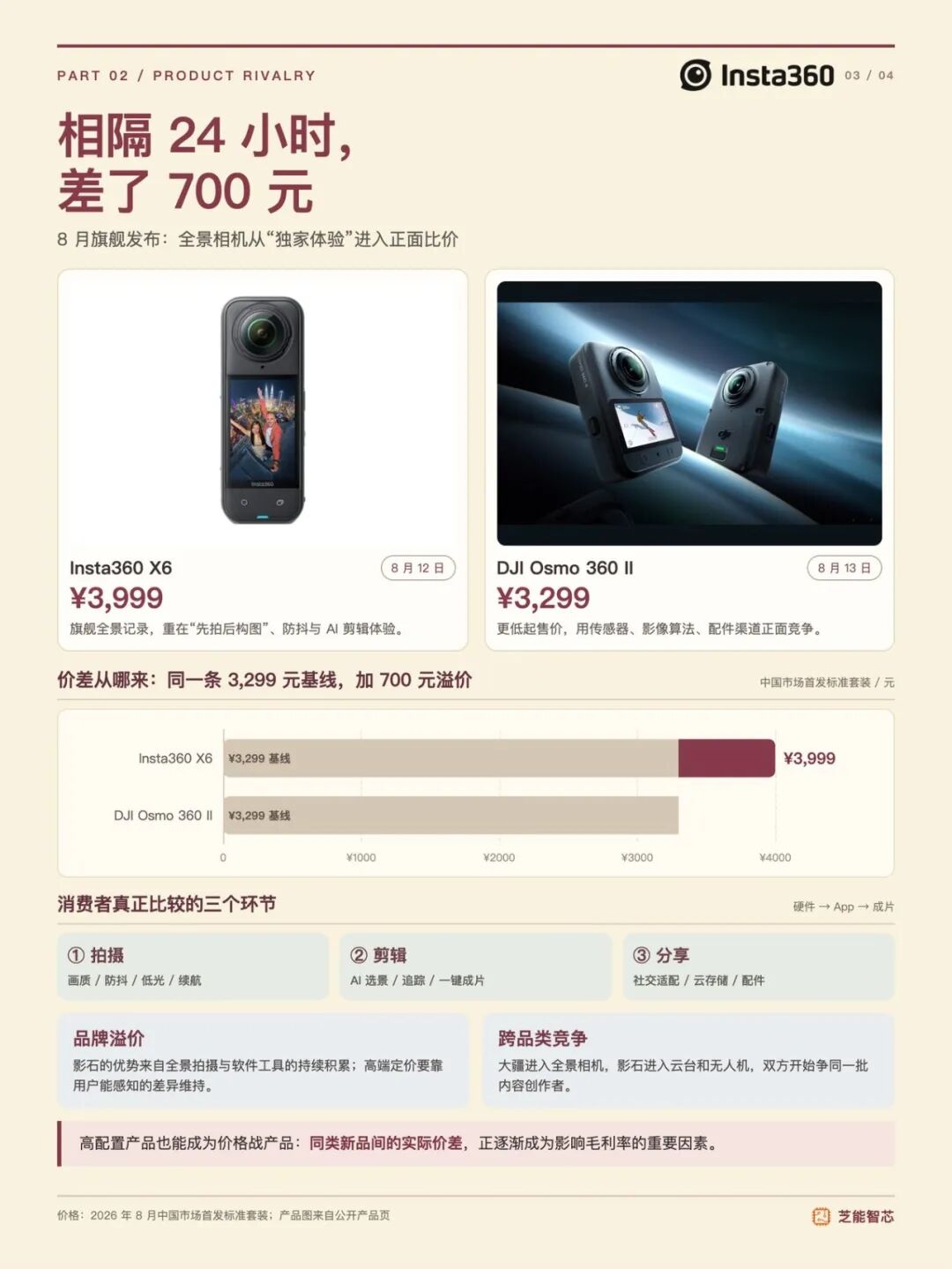
On August 12, Insta360 released its flagship panoramic camera Insta360 X6; on August 13, DJI launched the Osmo 360 II. Their China standard kit launch prices were 3,999 yuan and 3,299 yuan respectively—a difference of 700 yuan.
Both products focus on high-specification 8K panoramic recording, sensors, and AI algorithms. Competition has moved from whether panoramic shooting exists to item-by-item comparison of image quality, operation, editing, accessories, price, and after-sales service.
This is a common inflection point in consumer electronics: a leading brand creates a new experience, and followers use mature supply chains and sales networks to quickly pull specifications and prices back onto the same comparison table.
Insta360 improved one-click video production efficiency, accessory convenience, and software experience on the X6 so users can understand what the higher price buys. The closer the hardware specifications, the more easily pricing is pulled by competitors.
September: Share Continues to Rise, Repeat Purchases Loom
On September 23, IDC data was released: Insta360's Q2 2026 panoramic camera shipment share was 72.5%, higher than 66% in 2025, with cumulative global camera shipments exceeding 10 million units.
Brand, channels, and core product experience remain attractive, and the product reach has extended to gimbals, wearable imaging, and panoramic drones.
Users' consumption path has two stages.
◎ The first panoramic camera purchase is for the shoot-first-compose-later experience;
◎ The second upgrade depends on low-light image quality, battery life, lens durability, editing speed, and whether there are new usage scenarios.
High share gives Insta360 a massive user base.
Software is a growing line. Insta360's semi-annual report shows that as of June, monthly active users grew 67% year-over-year, user export volume grew 126% year-over-year, and cloud storage paying users grew over 124% year-over-year. Beyond device sales, the creation workflow is forming a higher-frequency usage relationship.
Summary
Insta360's financial report provides a sample of the consumer electronics industry: new-form products can quickly build high share, but once a sub-category enters head-on competition with major players, product iteration, supply chain capital, and price management together determine profit.
Revenue up 33% and net profit down 93% occurred simultaneously. Gross margin retreated 13.95 percentage points in a single quarter, inventory increased 4.235 billion yuan in nine months, and borrowings rose from 123 million yuan to 3.527 billion yuan.
The 72.5% share proves Insta360 can sell new-form products to global No. 1. Revenue up 33% with net profit down 93% is indeed a tough cycle right now.
It'll be fine once this cycle passes!
-
![]()
Doubao Tests Shopping as a Primary Entry Point: Is AI Conversation Becoming the New Shelf?
-
![]()
Insta360 Q3 Financial Report: Revenue Surges to 3.9 Billion Yuan, Net Profit Plummets 93% to Just 17.43 Million Yuan
-
Global Investors Are Converging on AI Hardware
-
Is Charging Now Faster Than Refueling?
-
![]()
$10 Billion Entry: Who Is Pricing AI4S
-
![]()
Why Is ChatGPT Still Running Ads? | iAnalysys Insights
-
![]()
Anthropic's Trillion-Dollar Valuation
-
Optical Communications' "Fire and Ice": Amid NVIDIA Personnel Turmoil, Should We Panic or See the Big Picture Clearly?