Leqi’s Second-Gen AI Glasses: The Path to Blending In—Four Optical Hurdles to Tackle!
 10/14 2026
 355
355

Abstract: While AI functions can be enhanced through OTA updates, the optical experience provided by diffractive waveguide technology is largely fixed once finalized. Leqi’s second-generation AI glasses focus on four engineering challenges: making the grating area stealthy, reducing rainbow artifacts, slimming down the lenses, and preserving brightness with anti-reflection measures. These are also the key barriers that consumer-grade AI glasses must overcome to truly blend in with ordinary eyewear. Today, boosting AI capabilities in glasses is no longer a major challenge for the industry.
Features like translation, voice prompts, meeting transcription, and image recognition can all be continuously improved via OTA software updates. However, for AI glasses to be indistinguishable from regular prescription glasses, the real test lies in the advanced optical waveguide technology hidden within the lenses.
Leqi’s first-generation product has successfully commercialized consumer-grade binocular diffractive waveguide AI glasses.
The upcoming second-generation Leqi AI glasses will shift focus away from simply chasing field-of-view (FOV) metrics. Instead, they will tackle the four most critical optical experience issues for everyday wear: visible grating imprints, rainbow patterns under sunlight, lens thickness and weight, and display brightness loss after anti-reflection treatment.
Software can be updated endlessly, but once optics are finalized, there’s little room for correction later. Whether the second generation can truly pass as “everyday glasses” hinges largely on how well these four challenges are addressed.
Challenge 1: Can the grating area be made nearly invisible to the naked eye?
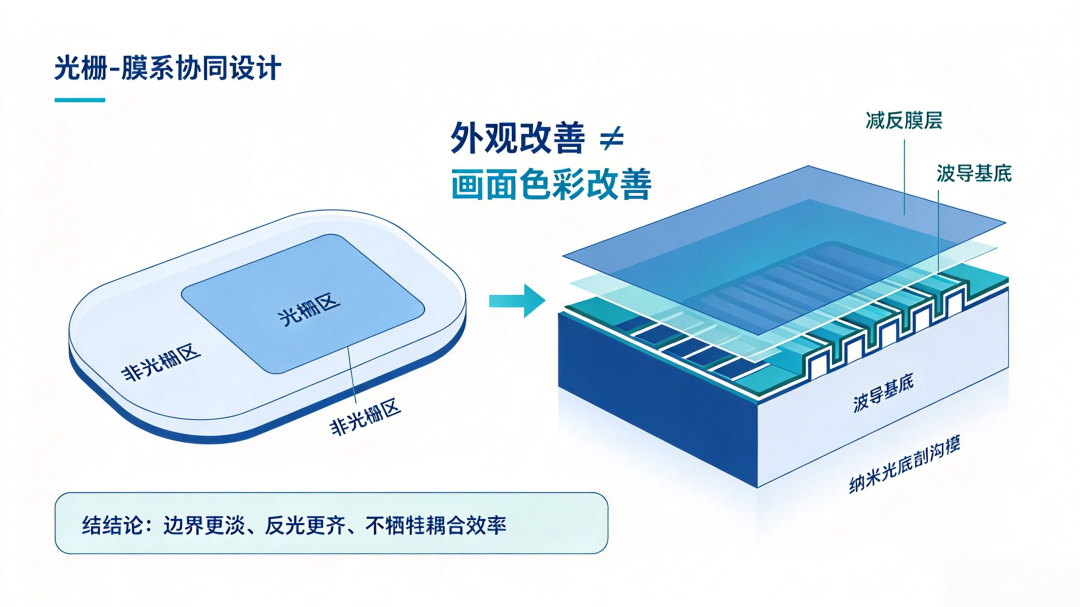
Diffractive waveguide lenses feature a nano-imprinted coupling grating area on their surface. This microscopic groove structure is vastly different from the surrounding ordinary lens material.
Under specific lighting angles or sunlight, noticeable color blocks and reflective patches appear. During face-to-face interactions, outsiders can easily spot the display area on the lens, instantly breaking the “ordinary glasses” illusion.
Many might assume a standard anti-reflective coating could solve this, but that’s not practical.
The grating handles all diffraction tasks: coupling light in, guiding it through the waveguide, and coupling it out. The thickness and composition of a regular anti-reflective coating would alter the grating’s effective refractive index, disrupting its coupling efficiency.
For second-gen consumer products to achieve grating stealth, the industry’s mainstream approach is collaborative design of grating film systems: the anti-reflective coating isn’t just applied to grating-free zones but is tailored to the nano-groove topography, ensuring consistent reflective properties across the entire lens.
Here’s a crucial engineering fact about diffractive waveguides: improving external appearance (color blocks) ≠ improving color accuracy in displayed images.
Many newcomers confuse the two: the lens’s external appearance (as seen by others) and the image quality (as seen by the wearer) are entirely separate evaluation systems.
When a film layer covers the nano-grating grooves, it not only affects light coupling efficiency but also alters the grating’s effective refractive index, further distorting the diffraction angles of different light wavelengths. After passing through the grating, the proportions of red, green, and blue light deflection and output will shift.
Ultimately, a contradictory phenomenon arises: from the outside, the lens grating boundaries fade, and reflections appear clean, resembling ordinary glasses. However, the wearer sees color shifts and imbalance in the internal virtual display.
In other words, making the external appearance attractive is just the first step. Additional joint simulation and parameter tuning of the grating film layer across multiple RGB bands are required to ensure color accuracy in the virtual image.
If this collaborative design is implemented, it will be easier for others to see the wearer’s eyes during face-to-face communication, further aligning the glasses’ external appearance with civilian ordinary glasses—without sacrificing display color performance for the wearer.
Challenge 2: Rainbow patterns can only be suppressed, not completely eradicated
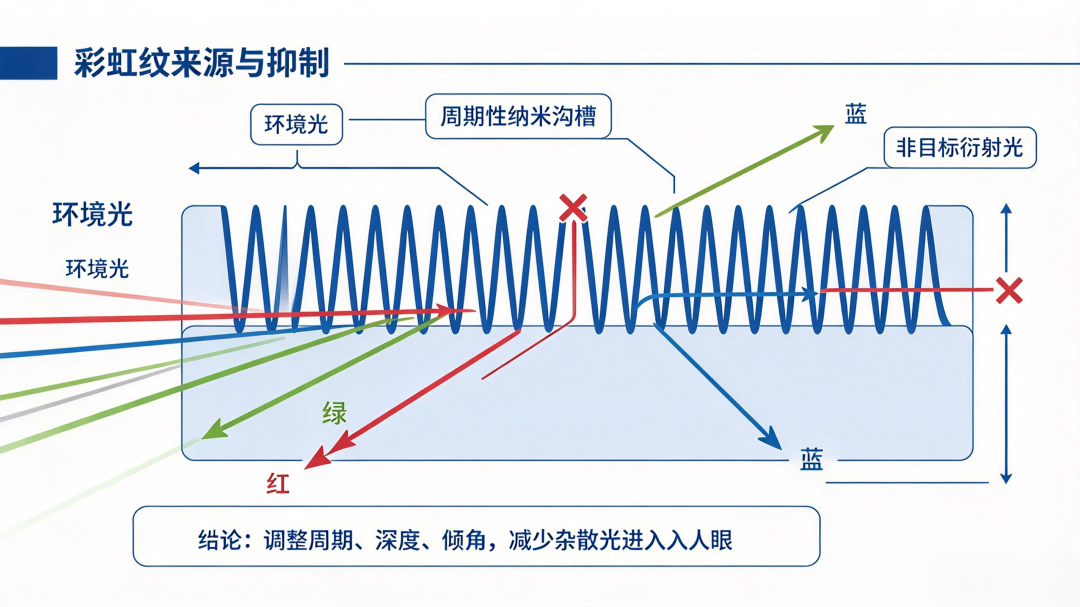
Many diffractive waveguide glasses users have experienced this: when walking under spotlights or sunlight, colorful stripes appear in their field of view, and these stripes shift when they turn or tilt their head.
It’s important to clarify the source: rainbow patterns don’t come from the images projected by the glasses but from ambient light hitting the periodic nano-grating, breaking down into stray light of different wavelengths that enter the human eye—an inherent dispersion side effect of diffractive waveguides.
To suppress rainbow patterns, second-gen consumer solutions typically require readjusting the grating’s period, groove depth, sidewall angle, or even adopting composite grating structures to redirect non-target stray light away from the human eye.
However, altering grating parameters affects the entire system. While suppressing rainbow patterns, it must not sacrifice field of view, image brightness, or ambient light transmittance.
The reality is that engineering methods can only minimize the intensity and occurrence probability of rainbow patterns, making complete physical eradication difficult.
Performance can’t be judged solely under laboratory lighting; it must undergo real-world testing under sunlight, car headlights, and indoor spotlights from multiple angles.
Challenge 3: Thinner lenses don’t automatically mean wearing comfort
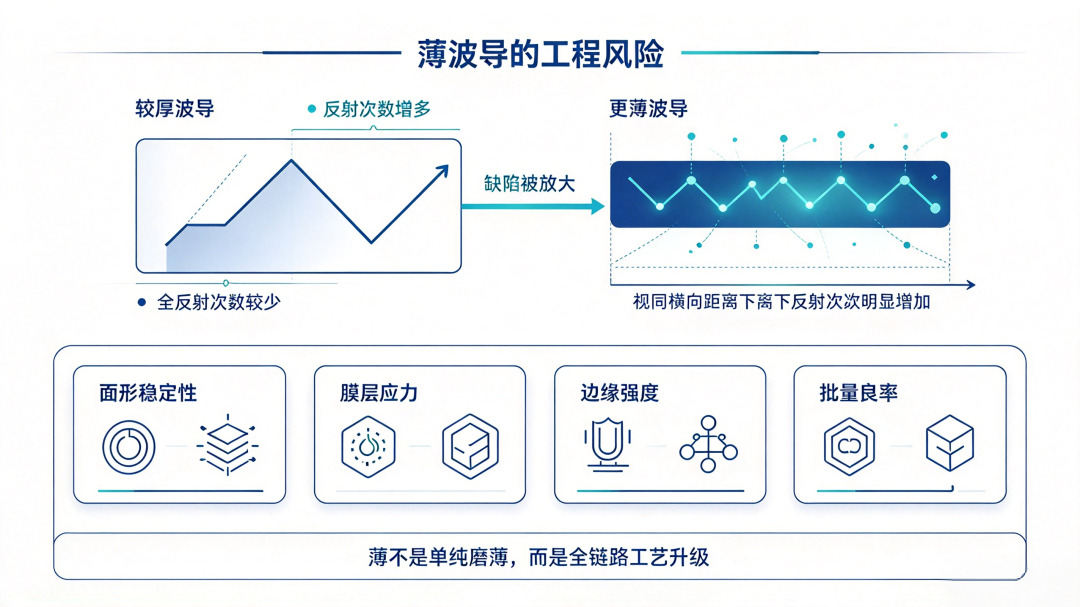
The industry is obsessed with lens thinning. Thinner lenses reduce weight and free up more space inside the frame for batteries and sensors.
However, simply grinding down the glass substrate doesn’t automatically improve the experience. The engineering difficulty of thin waveguides increases exponentially.
From Leqi’s disclosed technical roadmap and industry patents, it’s clear that for thin lenses to truly reach consumer-grade products, a complete set of process upgrades is required:
Under the same lateral propagation distance, thinner lenses significantly increase the number of total internal reflections of light within the waveguide.
Any minor defects inside the waveguide are continuously amplified along each reflection path, resulting in ghosting, image distortion, and uneven local brightness.
Moreover, thin substrates are extremely sensitive to various stresses, with risk sources throughout the entire process chain:
• Coating stress: The deposition process of grating and anti-reflective films introduces internal stress, “pulling” the lens out of shape;
• Adhesive shrinkage: The curing and shrinkage of adhesive layers in multi-layer composite waveguides cause persistent deformation;
• Framing pressure: Mechanical compression from frame clamping and assembly causes slight lens warping;
• Temperature cycling: Cold-hot environment switching exacerbates surface shape changes due to differential thermal expansion and contraction of different materials.
The consequences of deformation aren’t just cosmetic bending but directly alter the light propagation angles inside the waveguide.
For thin lenses to be truly usable, a complete set of process upgrades is required: low-stress coating processes to strictly control film internal stress, full-process monitoring of substrate flatness and surface shape stability, optimized grating precision imprinting processes to ensure nanostructure consistency, reinforced lens edge structural strength, assembly structures that avoid clamping stress, and finally, batch yield control to minimize individual lens variations.
Thickness is just a number. Whether thinness truly translates into wearing comfort depends on overall weight, structural strength, and passing long-term reliability tests such as drop and temperature cycling. This is the complete engineering validation that consumer-grade second-gen products must complete on the thinning path.
Challenge 4: Improving appearance shouldn’t come at the cost of display brightness
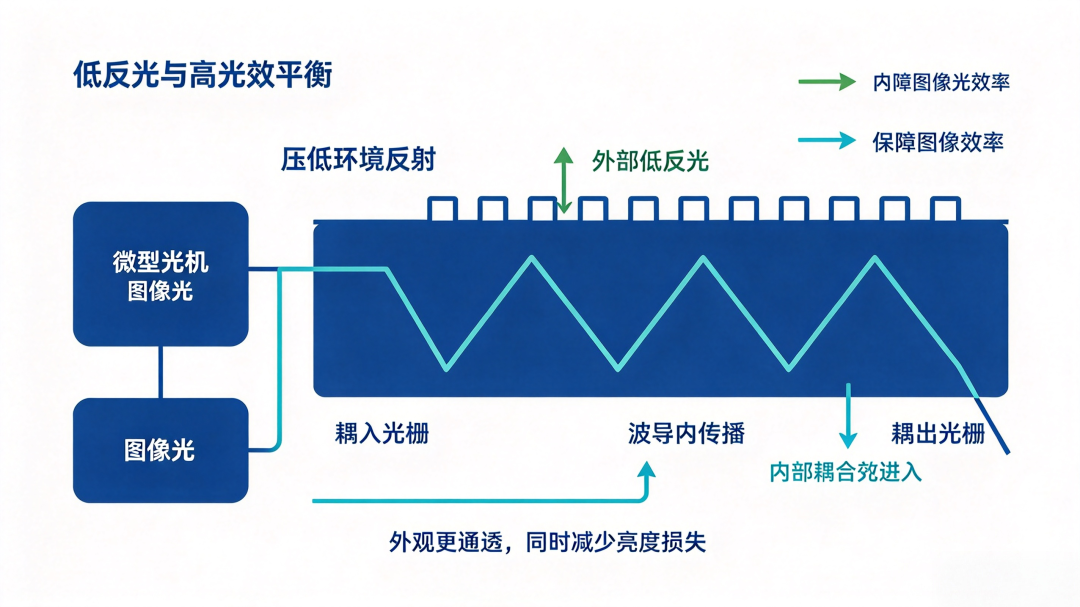
This is the most torturous trade-off in the entire waveguide system: improving external appearance with anti-reflection often comes at the cost of reducing the coupling efficiency of internal image light.
Image light couples into the waveguide from the projector, undergoes multiple total internal reflections inside the lens, and then couples out to the human eye—a process with inherent losses.
If the anti-reflective design in the grating area is crude, while external reflections are suppressed, the coupling-in and coupling-out efficiency simultaneously drops, resulting in a darker image, uneven edge brightness, and forcing higher projector power, leading to increased power consumption and heat.
Finding a balance between anti-reflection and brightness is a common solution for second-gen consumer products: developing a dedicated film system design for the coupling-in grating.
While suppressing external ambient light reflections, it strives to maintain the coupling efficiency of image light into the waveguide, ensuring balance across the image center, edges, and different RGB bands.
The goal isn’t to maximize any single parameter but to deliver a comprehensive experience: the lens looks clear and natural from the outside, the wearer can clearly read navigation and subtitles, and there’s no need to excessively increase projector power.
Final Thoughts: Leqi’s second generation is worth anticipating—but boundaries must be viewed rationally
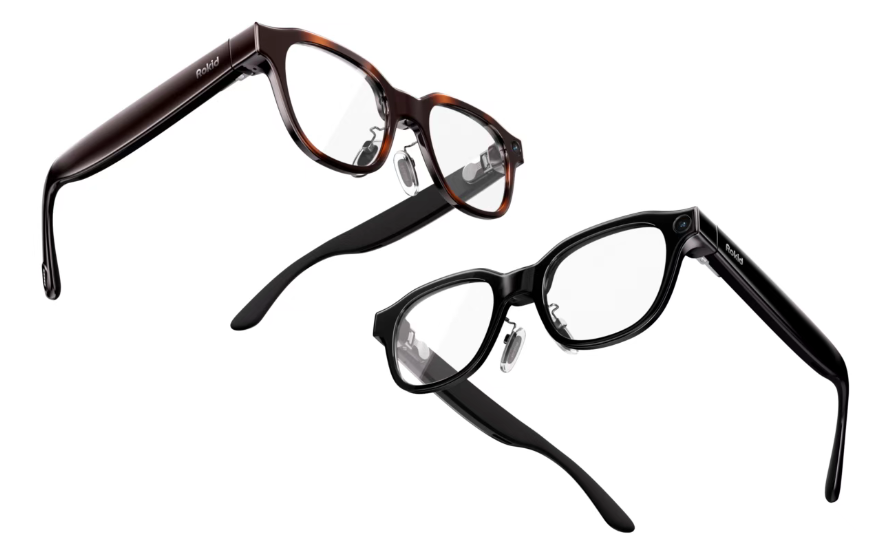
When these four points are connected, it becomes clear: grating stealth, suppressing rainbow patterns, thinner lenses, and bright images are interconnected goals. Maximizing any single indicator can easily sacrifice the others. There’s no miracle technology that can solve all pain points at once.
From achieving consumer-grade binocular diffractive waveguides in the first generation to addressing the most intuitive appearance, stray light, and lightweight balance issues for daily social wear in the second generation, Leqi’s product rhythm demonstrates pragmatic engineering judgment.
As AI glasses gradually move toward the mass consumer market, this product is also highly anticipated—if it can successfully mass-produce this optical experience, it has the potential to rewrite the public’s fixed impression of diffractive waveguide AI glasses and open up a broader consumer market space.
Of course, rationality must be maintained: the above analysis is based on the technical evolution trends and public information in the diffractive waveguide industry. Prototype simulations don’t equal mass-produced finished products.
Some inherent optical defects of diffractive waveguides can only be suppressed, not completely eradicated, at this stage. The actual experience and market performance will ultimately depend on real-world testing and market feedback after launch.
Interactive Topic: If grating stealth, rainbow pattern suppression, image brightness, and lightweight wear cannot all be satisfied simultaneously, how would you prioritize them? Additionally, what product performance do you believe can truly motivate ordinary consumers to purchase AI glasses? Welcome to leave a comment and share your expectations.
[Risk Disclaimer] This article is a forward-looking analysis of industrial technology. The R&D directions mentioned are based on industry public information and patent data and do not represent Leqi’s official finalized parameters. Diffractive waveguides have physical limitations in their optical characteristics, and the actual experience will be based on mass-produced finished products after launch.
—— AR Andy | Focusing on the waveguide and AR microdisplay sectors, deeply dissecting the underlying logic of the optical industry
-
Q3 Report | Inspur Information’s Net Profit Soars 176%, Fueled by Robust Server Demand
-
Chinese Automakers Shine Bright at the Paris Auto Show
-
![]()
Changan Technology Strikes Out on Its Own, Leaving Parent Company Behind
-
![]()
US/China: The All-Out War for AI Gateways
-
![]()
Leqi’s Second-Gen AI Glasses: The Path to Blending In—Four Optical Hurdles to Tackle!
-
![]()
GAC Toyota’s September Vehicle Registrations Reach 49,000 Units, with Camry Registering 6,898 Fewer Units Than Wholesale Volume
-
![]()
The Hidden Tycoon: Wang Xuning, the Powerhouse Behind Joyoung Co., Ltd.
-
![]()
V4 Pro Official Version Yet to Launch, Yet DeepSeek Opts for Price Hike