Ultrafast Nonlinear Optics Technologies: 103rd Update on Optical Parametric Multi-Pass Cell Amplifier
 10/16 2026
 553
553
High-power, high-energy ultrafast lasers play a pivotal role in various fields, including high-order harmonic generation, strong-field physics, and laser-plasma acceleration. Currently, the prevalent technical approaches encompass multi-pass cell (MPC) post-compression and optical parametric amplification (OPA). The former is characterized by high transmission efficiency and excellent beam quality, albeit with a limited wavelength tuning range. The latter, on the other hand, facilitates broadband wavelength conversion but generally exhibits lower conversion efficiency from pump to signal light. In 2026, researchers from institutions such as DESY in Germany reported in Optica the development of an optical parametric multi-pass cell amplifier (OPMPC) that integrates both technologies. Through a non-collinear dual-MPC experimental setup, they achieved higher pulse energy and remarkable relative conversion efficiency [1].
Figure 1 presents a simplified collinear OPMPC concept. The nonlinear crystal is strategically positioned near the MPC focal point, where pump and seed lights undergo parametric amplification during each pass. After each amplification cycle, the generated idler light is removed before the next pass, ensuring that each pass commences from a nearly idler-free state. This approach effectively suppresses reverse conversion during multiple passes and enhances the sustained transfer of pump energy to the signal light. Simultaneously, the quasi-waveguide propagation and spatial mixing effects of the MPC contribute to maintaining the spatial uniformity of the amplified beam.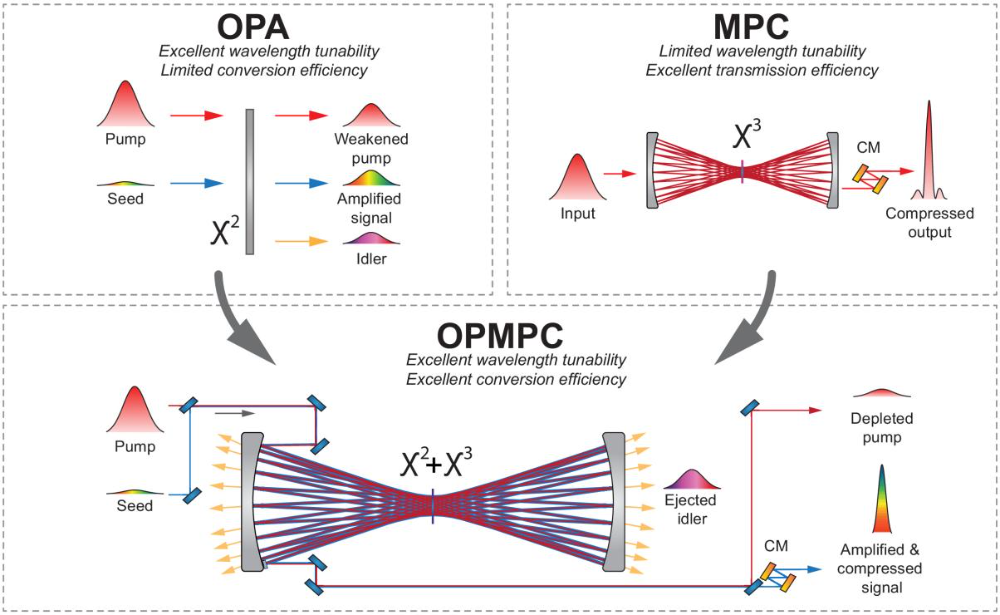 Figure 1 Basic concept and working principle of OPMPC [1]
To minimize broadband coating requirements and facilitate pass-by-pass adjustment of pump-signal delay, the actual experiment employed a non-collinear dual-MPC structure, as depicted in Figure 2. Two independent, non-collinearly crossed MPCs were utilized to transmit 1030 nm pump light and broadband seed light separately, converging at two common focal points. A KTA crystal was placed at each focal point to enable spatial and temporal overlap of pump and signal lights during each pass. This configuration allowed for the separate use of mirrors optimized for each wavelength band for pump and signal lights. Additionally, the naturally diverging non-collinear propagation of the idler light eliminated the need for additional idler filtering structures. The system featured 20 crystal interactions, with independent adjustment of spatial and temporal overlap between pump and seed lights for each pass.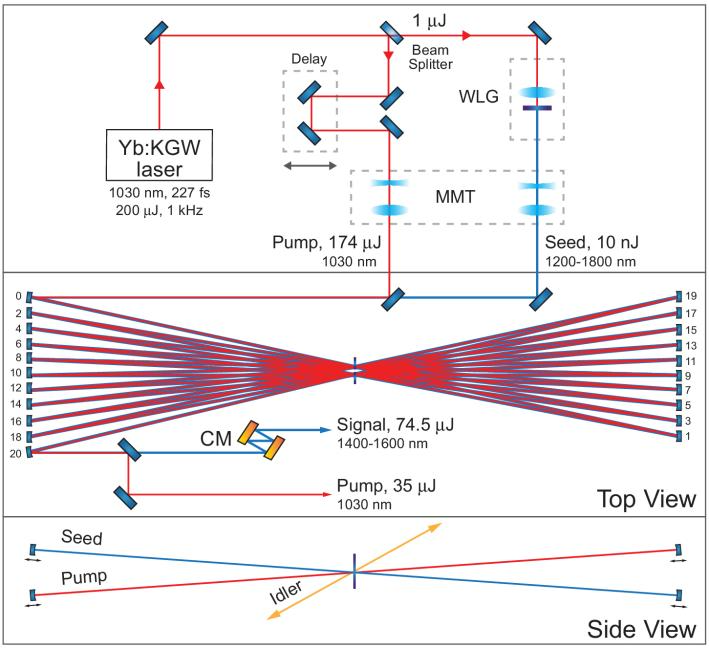 Figure 2 Schematic of non-collinear OPMPC experimental setup [1]
The experiment utilized a Yb:KGW laser as the pump source, characterized by a central wavelength of 1030 nm, a pulse width of 227 fs, and a repetition rate of 1 kHz. An input pump energy of 174 μJ was directed into the OPMPC. As illustrated in Figure 3(a), residual pump levels gradually diminished, and conversion efficiency continuously improved with an increasing number of passes, approaching saturation around 15-20 passes. At 20 passes, the signal light pulse energy near 1500 nm reached 74.5 μJ, corresponding to a pump-to-signal conversion efficiency of 42.9%. Figure 3(b) displays the evolution of the signal spectrum during amplification, with simulated results considering self-phase modulation (SPM) demonstrating good agreement with experimental spectra. Figure 3(c) shows the output signal light's M2 values of 1.29×1.01, indicating that the system maintained excellent beam quality at high conversion efficiency.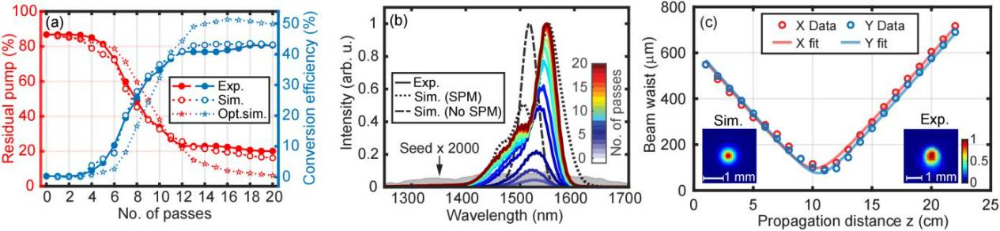
Figure 3 OPMPC parametric amplification performance: (a) Residual pump ratio and optical conversion efficiency under different pass numbers; (b) Evolution of signal spectra and simulation results under different pass numbers; (c) M2 measurement and spatial beam distribution of output signal light [1]
The Fourier-transform-limited pulse width corresponding to the amplified spectrum was approximately 43.3 fs. After dispersion compensation using chirped mirrors, frequency-resolved optical gating (FROG) measurements yielded an output pulse width of 47.7 fs, corresponding to a peak power of approximately 1.3 GW, as shown in Figure 4. The measured and retrieved FROG traces exhibited good agreement, indicating the excellent compressibility of the amplified broadband signal light.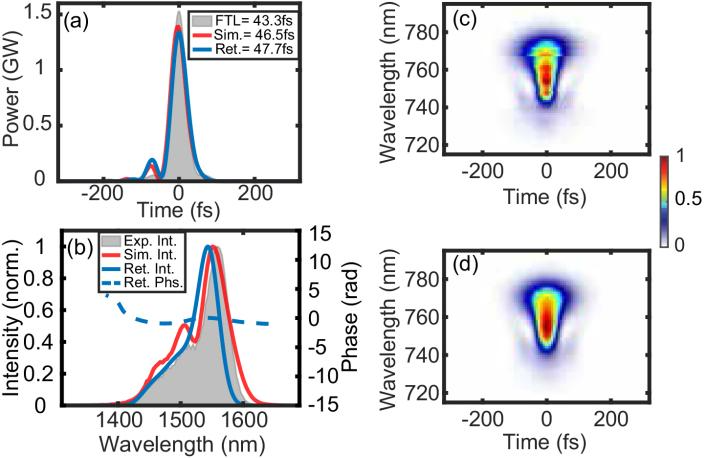 Figure 4 Temporal and spectral characteristics of OPMPC output pulses: (a) Temporal intensity distribution of compressed pulses; (b) Experimental, simulated, and FROG-retrieved spectra and spectral phases; (c) Experimental FROG trace; (d) FROG-retrieved trace [1]
This OPMPC achieved an output of 74.5 μJ, 48 fs pulses at 1500 nm with an optical conversion efficiency of 42.9%. The authors noted that by optimizing crystal coatings, focusing conditions, and crystal thickness, the system could further enhance efficiency and bandwidth while scaling toward millijoule-level energy and mid-infrared wavelengths. This work validates the feasibility of integrating OPA's wavelength tuning capability with MPC's efficient multi-pass interaction, offering a novel implementation approach for high-energy, high-peak-power, broadband-tunable ultrafast light sources.
References: [1] Rajhans, S., Rupp, N., Escoto, E., Schnberg, A., Laumer, D., Sumfleth, M., Abdallah, I., Manschwetus, B., Juliano, C., Javid, N., Arnold, C. L., Gorkhover, T., Drescher, M., Riedel, R., Hartl, I., Heyl, C. M., & Lang, T. (2026). Optical parametric multi-pass cell amplifier. Optica, 13(7), 1303–1310. https://doi.org/10.1364/OPTICA.597010
-
![]()
Thousand-Kilometer Range BMW i3, Ioniq V Priced Under RMB 100,000: Chinese Automakers Must Guard Against Joint Venture Encroachment in Global Expansion
-
![]()
Competition Among Cities Enters the Second Half: The Outcome Lies Beneath the Surface
-
iPhone 18 Pro Series Sees Price Reductions—Apple Can't Afford to Stay Idle During Double 11
-
![]()
A Whopping 550 Million Yuan Investment! Fanchuangwei’s High-Transparency Optical AR Lens Project Takes Root in Taizhou
-
![]()
Domestic Triumph in Glass Substrate Lithography! Optical Firm Lands Major Orders
-
![]()
AI-Powered Alternatives Offer Free Substitutes, Posing Threat to Adobe's 'All-in-One' Suite
-
![]()
McKinsey Report: AI Inference to Account for 60% of Computing Power by 2030
-
Meitu, Shifting to Token-Based Charging, Remains an Internet Company