Competition Among Cities Enters the Second Half: The Outcome Lies Beneath the Surface
 10/16 2026
 430
430
01
The More Developed the City, the More It Extends Underground
Let’s discuss a phenomenon that many have overlooked. In recent years, the wealthiest cities worldwide have been focusing on the same endeavor:
—increasing investment beneath their own ground.
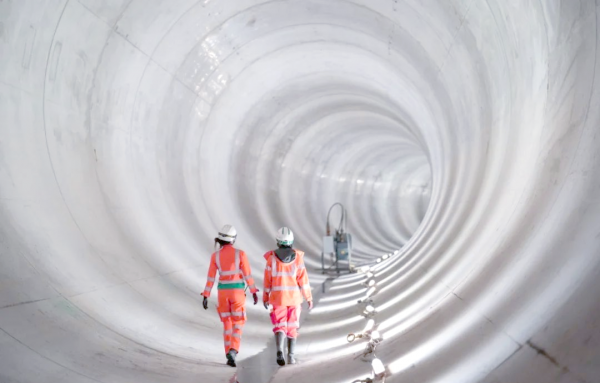
London has constructed a massive 25-kilometer-long tunnel beneath the Thames River—the Thames Tideway Tunnel—with a total investment of approximately £4.6 billion (over RMB 40 billion), set to be operational by 2025.
The tunnel has an inner diameter of 7.2 meters and is buried up to 67 meters beneath the riverbed at its deepest point. It connects 34 of the dirtiest combined sewer overflows along the Thames, intercepting sewage that would otherwise be discharged directly into the river during heavy rainstorms and transporting it to the Beckton Sewage Treatment Plant in East London for centralized treatment.
Singapore has gone even further. Despite having a land area of just over 700 square kilometers, it has invested nearly SGD 10 billion (approximately RMB 52 billion) to construct a "sewage highway" 30 to 60 meters beneath the surface, spanning the entire nation.
Officially known as the Deep Tunnel Sewerage System (DTSS), its main tunnel stretches 88 kilometers in total length. It relies on gravity to transport sewage to centralized water reclamation plants, where it is treated and converted into NEWater and industrial water.
Singaporeans evaluate (pinyin: píngjià) this system as having a design lifespan of 100 years, representing a comprehensive upgrade of the city's sewage treatment capacity.
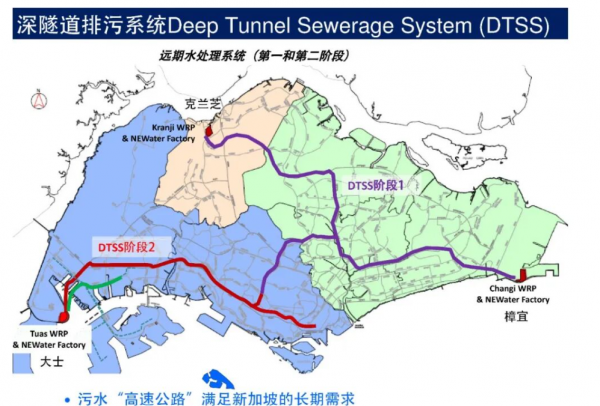
What is the scale of London and Singapore? Both are global financial centers with extremely limited land resources and generally recognized (gōngrèn) (widely recognized) top-tier governance standards.
They have Coincidentally, at the same time (bùyuēértóngdé) (coincidentally) chosen the same solution: digging deeper beneath the existing urban infrastructure to construct an underground drainage and sewage treatment system.
When we look at the long-term timeline, investing in underground infrastructure is an inevitable challenge for all megacities. London and Singapore today are, to a large extent, what many major cities will become tomorrow.
Take London as an example. The main drainage system currently in use was built in the 1860s after the "Great Stink" era, when London's population was only 2 million.
More than a century has passed, and London's population has more than tripled to over 8 million. The area of impermeable surfaces has multiplied, yet the underground pipe network remains unchanged.
The result is that during heavy rainfall, the combined sewer system becomes overwhelmed, leading to sewage mixed with rainwater being discharged directly into the Thames River dozens of times a year. Before the construction of the Thames Tideway Tunnel, London experienced approximately 50 combined sewer overflows annually, discharging nearly 40 million cubic meters of overflow sewage into the river each year.

As cities develop to a certain stage and surface space approaches its limits, seeking space, capacity, and efficiency underground becomes an inevitable choice.
02
Hong Kong, Wuhan, Shanghai, and Guangzhou Have Quietly Forged a Path
While overseas experiences are certainly persuasive, Chinese cities face more complex challenges, including higher population densities, denser underground utilities, and greater difficulties in renovating older urban areas.
For this reason, domestic pioneering explorations are particularly noteworthy.
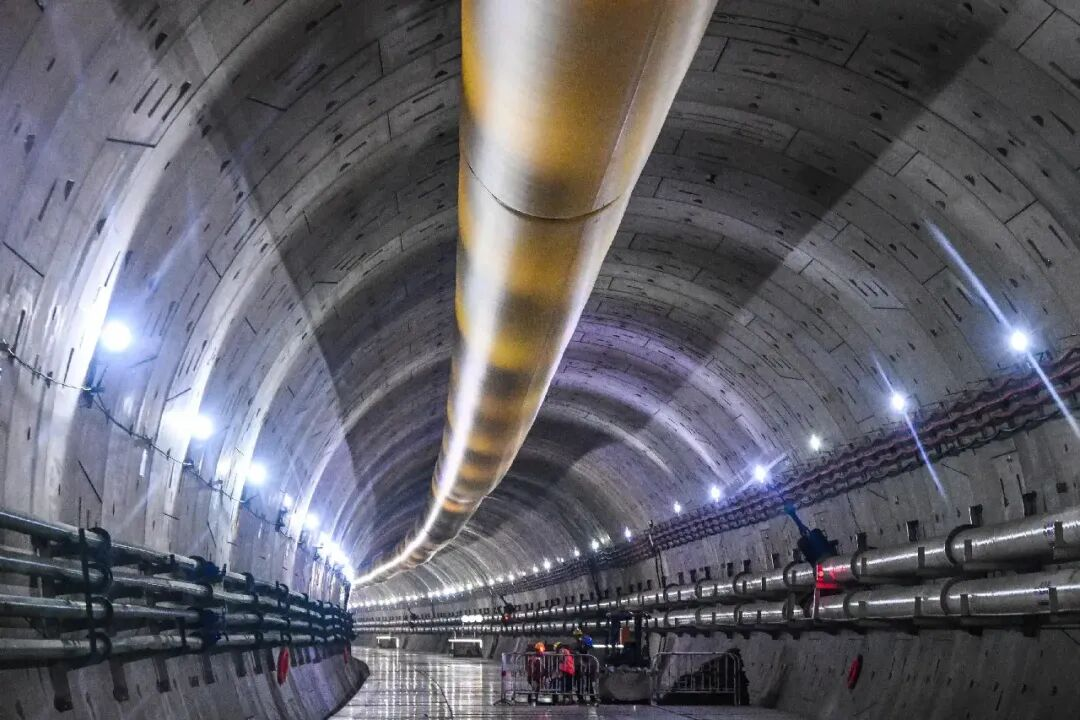
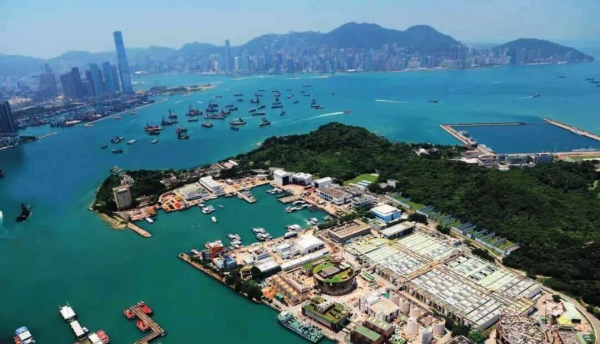
To improve the water quality in Victoria Harbour, Hong Kong launched the Harbour Area Treatment Scheme (HATS) in 1994. It constructed a 23.6-kilometer-long deep sewage tunnel beneath the seabed (with a burial depth of approximately 70 to 150 meters), collecting sewage from both sides of Victoria Harbour through siphon principles. The sewage undergoes preliminary treatment (screening and grit removal) at small coastal primary treatment plants before being transported to the Stonecutters Island Sewage Treatment Works.
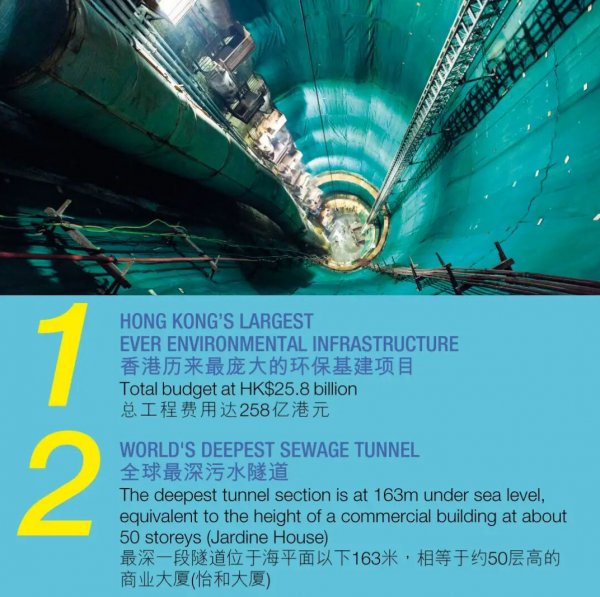
The Stonecutters Island Sewage Treatment Works Phase I has a designed daily treatment capacity of 1.7 million cubic meters. Its main pump house, with a diameter of 55 meters and a depth of 40 meters, is claimed to be the largest in the world. The entire system ultimately serves 5.7 million residents.
Hong Kong's project also addresses a core contradiction: in a highly dense central urban area where land is extremely scarce, it is impossible to continuously add large numbers of surface sewage treatment structures. The solution of long-distance deep tunnel conveyance + centralized treatment balances environmental, land, and urban operational needs.
Wuhan was one of the first mainland cities to venture into this field. The East Lake (Donghu) Core Area Sewage Transmission System Project, known as the "Donghu Deep Tunnel" in the industry, is the first operational urban deep sewage transmission tunnel in China.
The main tunnel spans 17.5 kilometers, starting from the Erlangmiao Pretreatment Station and extending along Shahu Avenue and Huanle Avenue to the Third Ring Road, passing through Yanxi Lake and Beihu Park, and finally reaching the Beihu Sewage Treatment Plant.
The project collects sewage from parts of Wuchang, Hongshan, Qingshan, and the East Lake Scenic Area, sends it to the tunnel after pretreatment, and serves approximately 3 million residents within a 130-square-kilometer area of Greater Wuchang.
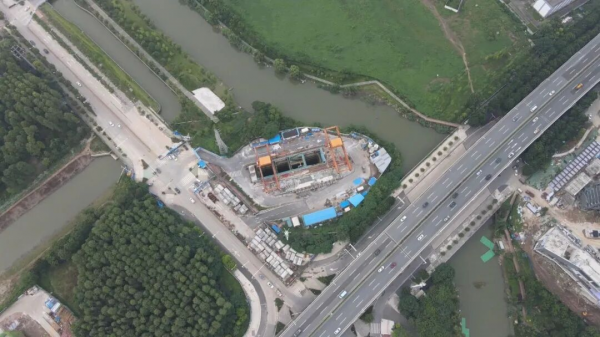
As of the latest publicly available data in 2025, the cumulative water volume transported has exceeded 1 billion tons, equivalent to relocating the water volume of eight East Lakes, fundamentally improving the ecological environment of East Lake, an urban lake.
Shanghai's approach differs slightly. The Suzhou Creek Deep Tunnel Project is positioned as a deep drainage and storage pipeline system with three core functions: system upgrading, drainage and flood prevention, and initial rainwater treatment.
The project plan consists of a 15.3-kilometer main tunnel, 37 kilometers of secondary and tertiary conveyance pipelines, and eight comprehensive facilities, with a storage capacity of no less than 740,000 cubic meters. Its logic is not simply to transport sewage away but to temporarily store initial rainwater in the deep tunnel during peak rainfall periods and then convey it to treatment plants during off-peak hours. This "peak-shaving and slow-release" approach addresses both urban flooding and pollution control.
Considering the dense building construction in Shanghai's central urban area, where there is simply no space for surface renovation of aging pipe networks, seeking space 40–60 meters underground was almost the only solution forced by reality.
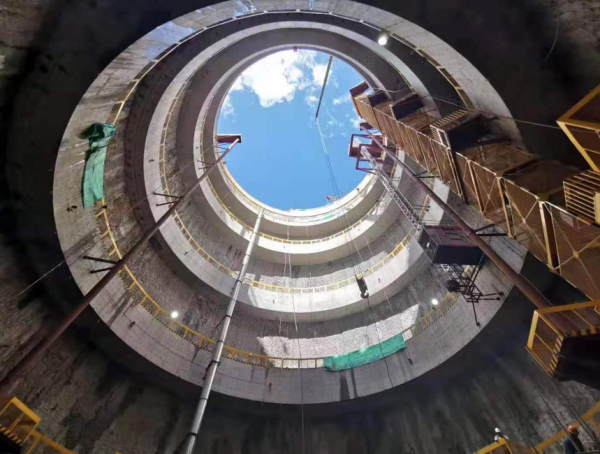
Guangzhou actually began its journey in this field earlier than many people realize—the Donghao Yong Deep Tunnel Drainage Project experimental section is the first large-scale deep tunnel in China with both pollution control and flood drainage functions.
The main tunnel is buried 43.2 meters underground, with a diameter of 6 meters. The nearly 2-kilometer-long experimental section cost approximately RMB 700 million. Since its official operation and maintenance in 2022, it has achieved underground operations at a depth of over 40 meters using intelligent silt removal robots, clearing 358 cubic meters of sediment in 31 days.
The overall governance effect of Donghao Yong is reflected in official data: the flood control and drainage standard has been raised to a 20-year return period, annual sewage discharge reduction exceeds 2 million tons, and water quality has improved from Class V (the worst) to Class III (good).
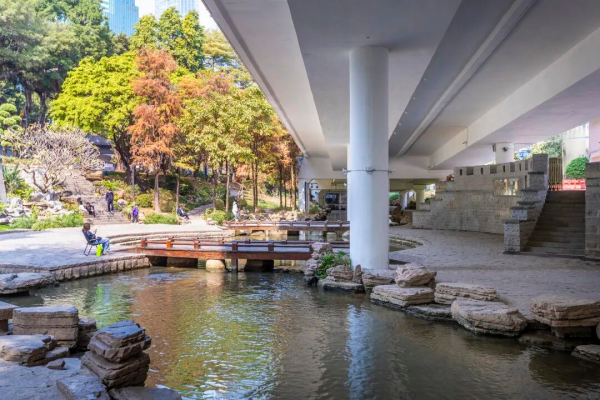
The environmental improvements are visible: 26 native aquatic plants have returned, the red-tailed water thrush, a bird with high water quality requirements, has reinhabited the riverbanks, and the project was even selected as an excellent case of Guangdong Province's Beautiful Rivers and Lakes in 2025, the only one in the city that year.
When examining several domestic cases together, three layers of meaning emerge.
First, technically, China's capabilities in soft soil deep excavation, deep-buried shield tunneling, and deep tunnel operation and maintenance have been validated through practical applications, even leading globally in some areas.
Second, in terms of models, approaches such as Public-Private Partnerships (PPP), experimental section pilots, and full-lifecycle operations have been successfully implemented.
Third, in terms of outcomes, improvements in water quality, alleviation of urban flooding, land release, and enhanced sewage treatment efficiency are tangible.
Therefore, for domestic cities, the question is not whether to pursue this path but who can walk it steadily first.
03
Sewage Network Upgrades Are an Inevitable Stage as Cities "Grow Up"
Why is it necessary to invest billions of yuan to dig tunnels dozens of meters deep and undertake such large-scale reconstruction of urban sewage systems when they seem to be functioning adequately?
Let us step outside the engineering perspective and understand this through the framework of urban economics.
Urban infrastructure suffers from a significant generational mismatch.
Sewage treatment systems built decades ago were designed based on the population, industry, and living needs of that time. As cities continue to expand, with population growth, increased built-up areas, and more frequent extreme rainstorms, the old design limits are continuously exceeded—this is the common contradiction faced by all megacities.
London's case best illustrates this: the same 19th-century pipe network functioned well for a population of 2 million but began to overflow frequently when the population reached 8 million.
Singapore's experience is even more direct. With limited land area and continuous population and industrial growth, land planning constraints make seeking underground space the optimal solution.
As the population along both sides of Victoria Harbour in Hong Kong continues to grow, there is no space to expand small coastal sewage treatment plants. The only solution is to rely on deep tunnels to transport sewage long distances to Stonecutters Island for centralized treatment.
Thus, projects like underground deep tunnels represent foundational repairs for cities. While their short-term GDP impact is weak, they determine the upper limits of a city's carrying capacity for decades to come.
Improvements in river and lake water quality enhance the land value of waterfront areas, which can be transformed into parks, cultural tourism sites, and public spaces, driving land asset appreciation. The continued realization of waterfront land value along Victoria Harbour after its water quality improved is a typical example.
At the same time, these projects avoid disaster losses. The economic damages caused by urban flooding and water pollution, including property destruction, business interruptions, and public health costs, are often hidden but enormous during extreme years. Enhancing drainage and pollution interception capabilities through deep tunnels is like purchasing long-term urban safety insurance.
From an economic standpoint, while deep tunnel projects require tens of billions or even hundreds of billions of yuan upfront, a detailed cost-benefit analysis often reveals them to be the most cost-effective option.
In Shanghai, for example, the densely built central urban area makes surface pipe network renovations involving large-scale demolition and resident relocation prohibitively expensive. In contrast, deep underground tunnels do not occupy a single inch of surface land, which can still be used for roads, green spaces, and buildings.
Wuhan's deep tunnel project offers a different cost-saving approach: consolidating scattered treatment facilities into one large plant reduces the need for upgrading multiple older plants, significantly improving operational efficiency.
Moreover, these projects typically have design lifespans ranging from several decades to over a century, making the average annual cost less daunting than imagined.
A review of global cases shows that public acceptance of large-scale underground water environment projects generally shifts from skepticism to approval over time. After the Donghu Deep Tunnel became operational in Wuhan, the water environment in the Donghu area continued to improve, enhancing surrounding ecological and residential values.
Following the operation of Guangzhou's Donghao Yong Deep Tunnel, Donghao Yong transformed from a black and odorous stream into an urban waterfront landscape river, allowing residents to enjoy riverside leisure activities and significantly alleviating flooding in the basin. The sense of gain among the public is real and tangible.
04
Epilogue
Our generation is accustomed to marveling at skyscrapers, cheering for cross-sea bridges, and applauding high-speed rail networks. These projects share one common trait: they are visible. However, a city's true strength often lies in what remains unseen.
London built its old sewers 160 years ago to save a city plagued by cholera; decades later, it invested heavily again in constructing a 25-kilometer super deep tunnel to address new urban pressures.
Singapore, with its limited land area, has made deep sewage tunnels the core framework of its national water strategy.
Hong Kong relied on a deep tunnel system to save Victoria Harbour; Wuhan, Shanghai, and Guangzhou have successively explored deep tunnel systems suited to their own conditions.
Skyscrapers define a city's skyline, while underground pipe networks define its baseline.
A city willing to spend billions on something invisible to most people sends a clear signal:
It is preparing for the next five decades, even a century.
-
![]()
Thousand-Kilometer Range BMW i3, Ioniq V Priced Under RMB 100,000: Chinese Automakers Must Guard Against Joint Venture Encroachment in Global Expansion
-
![]()
Competition Among Cities Enters the Second Half: The Outcome Lies Beneath the Surface
-
![]()
AI-Generated Comic Drama Concept Stocks Surge: Is ByteDance the Sole Profit-Maker?
-
iPhone 18 Pro Series Sees Price Reductions—Apple Can't Afford to Stay Idle During Double 11
-
![]()
A Whopping 550 Million Yuan Investment! Fanchuangwei’s High-Transparency Optical AR Lens Project Takes Root in Taizhou
-
![]()
Domestic Triumph in Glass Substrate Lithography! Optical Firm Lands Major Orders
-
![]()
AI-Powered Alternatives Offer Free Substitutes, Posing Threat to Adobe's 'All-in-One' Suite
-
![]()
McKinsey Report: AI Inference to Account for 60% of Computing Power by 2030