China's AI Large Model Invocation Volume Outpaces U.S. for Five Straight Weeks: What's the Implication?
 04/15 2026
 475
475

By | Xiaofeng
Source | Bowang Finance
The intensity of the artificial intelligence (AI) rivalry between China and the United States is on par with that of trade wars and international diplomatic standoffs.
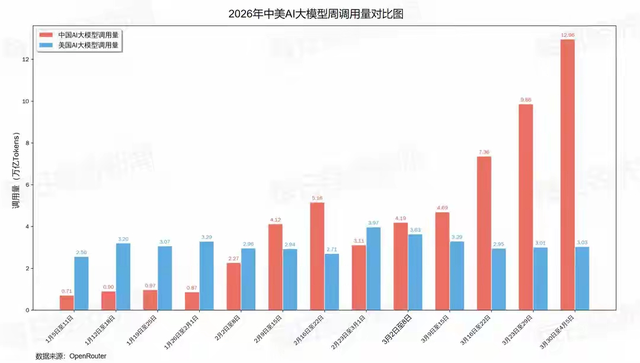
Data from a globally recognized internet traffic statistics agency reveals that in early April, China's weekly invocation volume of AI large models soared to 12.96 trillion tokens.
This marks the fifth consecutive week that China has outstripped the United States in this crucial metric, signaling a significant departure from the previous trend where the U.S. consistently held a substantial lead.

In just a few months, the tide has turned dramatically. Contrary to the prevailing international notion that the "U.S. AI dominance is unassailable," the global AI landscape has been quietly reshaped.
This development signals a new phase in the AI competition between China and the U.S. It not only underscores the divergent market demands between the two nations but also hints at a broader contest centered around computational power, innovation, and applications.
However, focusing solely on the national-level competition is insufficient. The fact that China's AI large model invocation volume has exceeded the U.S. for five consecutive weeks also unveils another reality: the AI competition among domestic tech behemoths has intensified into a fierce close-quarters battle.
01
Fluctuations in Large Model Invocation Volume
The market performance of commodities is often assessed by trading volume and price movements in the stock market. Similarly, fluctuations in invocation volume are not just numerical fluctuations; they are widely regarded as the most sensitive indicator of the global pace of AI application deployment.
Looking back over the past year, the trend in invocation volumes between Chinese and U.S. large models has mirrored a fierce tug-of-war. In the first half of 2025, ChatGPT's global popularity peaked, with the weekly invocation volume of U.S. large models once surpassing 150 billion, leading the world. At that time, many predicted that China's AI would lag far behind the U.S., with the gap only widening.
The reversal occurred swiftly, with the situation beginning to shift in the second half of 2025.
Domestic large models underwent rapid iteration, significantly enhancing their capabilities while prices continued to decline. According to the "2025 White Paper on the Development of Artificial Intelligence Large Models" released by the China Academy of Information and Communications Technology, the inference costs of mainstream domestic large models plummeted by over 80% in 2025, with some models priced lower than their U.S. counterparts.
The cost reductions and technological innovation efficiency directly fueled a surge in invocation volumes. From February 9th to February 15th, China's AI large models recorded 4.12 trillion tokens in invocation volume, surpassing the 2.94 trillion tokens of U.S. models during the same period for the first time.

The lead was sustained.
According to the latest data from OpenRouter, the total global invocation volume of AI large models in early April reached 27 trillion tokens, representing an 18.9% increase from the previous week. Among the top AI large models listed, China's AI large models saw their weekly invocation volume rise to 12.96 trillion tokens, a 31.48% increase from the previous week; in contrast, the weekly invocation volume of U.S. AI large models was 3.03 trillion tokens, showing a mere 0.76% increase. China's AI large models have experienced five consecutive weeks of growth and have surpassed the U.S. for five straight weeks.
Breaking it down by platform, the top six globally ranked AI large models in terms of invocation volume are all Chinese, with two models from Alibaba's QianWen 3.6 series ranking in the top three. Specifically, Qwen3.6 Plus (free) topped the list with a weekly invocation volume of 4.6 trillion tokens, while Qwen3.6 Plus Preview ranked third with 1.64 trillion tokens.
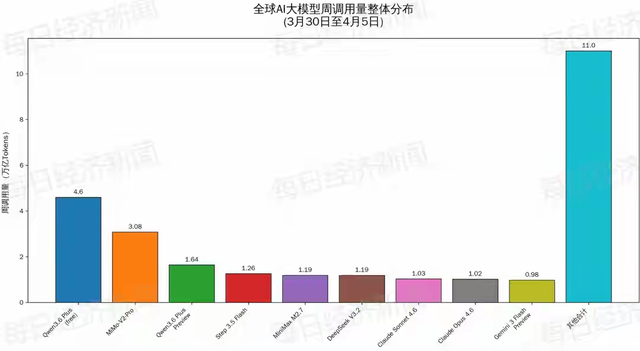
On the U.S. side, although ChatGPT's invocation volume previously led globally, its growth rate has significantly slowed.
One often-overlooked detail is the vast difference in user structure between Chinese and U.S. large models. Mobile invocation accounts for a significant portion of Chinese large models.
This means that China's large models have truly integrated into the daily lives of ordinary people, whereas U.S. large models are primarily used by professionals on PCs. From students organizing learning materials to office workers processing work documents, and even small vendors designing marketing posters, the proliferation of large models in China has far exceeded everyone's expectations.
Objectively speaking, market demand is always the primary driver of technological development. The surpassing of invocation volumes essentially reflects that China's market demand for AI has surpassed that of the U.S. While the U.S. is still debating the ethical boundaries and security risks of large models, China has already begun transforming them into tangible productivity.
Of course, this difference in demand will continue to grow like a snowball, ultimately translating into technological and industrial advantages.
To support this explosive demand, a robust resource system is essential. This is precisely the second battleground in the AI competition between China and the U.S.
02
A New Resource Competition Between China and the U.S.
We believe that the resource competition in the AI era has redefined the rules. In the past, major powers competed for oil, coal, and iron ore; now, we compete for computational power, electricity, and data infrastructure.
Many assume that the AI competition is about algorithms and models, but in reality, when model architectures gradually converge, the true determinant of success lies in underlying resource capabilities. Training a large model with 100 billion parameters can consume tens of millions of kilowatt-hours of electricity, while the energy consumption during the inference stage is dozens of times higher than during training. Without strong computational power and electricity support, even the most advanced models remain mere castles in the air.
In terms of computational power construction, China has demonstrated astonishing speed. Data from the Ministry of Industry and Information Technology shows that as of the end of June last year, China's total number of in-use computing center racks reached 10.85 million standard racks, with intelligent computational power reaching 78.8 exaflops per second and storage capacity exceeding 1,680 exabytes. Additionally, 1,509 large models have been released, ranking among the highest globally.
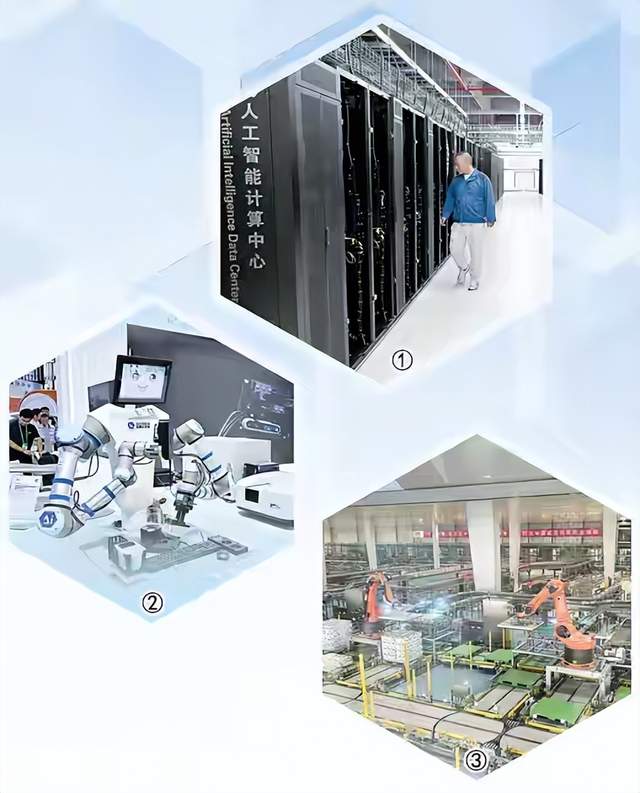
At this rate, China's total computational power is expected to soon surpass that of the U.S.
Even more crucial than computational power is electricity. The essence of AI computational power is the digital conversion of electricity. Whoever can secure cheaper and more stable electricity will gain a cost advantage in the AI competition.
China possesses unique advantages in this regard.
In 2025, data released by the National Energy Administration at the beginning of the year showed that the cumulative electricity consumption for the whole society reached 10,368.2 billion kilowatt-hours, a year-on-year increase of 5.0%, marking a historic breakthrough of over 10 trillion kilowatt-hours. This figure is unprecedented for a single country globally, more than double the annual electricity consumption of the U.S., and also higher than the combined annual electricity consumption of the EU, Russia, India, and Japan. Electricity consumption serves as a barometer for socio-economic and industrial operations.
It signifies the accelerated upgrading of traditional industries and the continuous implementation of new quality productive forces...
Meanwhile, data infrastructure is also a strength for China. By 2025, the total number of 5G base stations will reach 4.84 million, accounting for approximately 60% of the global total. The total length of optical cable lines nationwide will reach 74.99 million kilometers, with fiber networks covering all administrative villages and the number of gigabit broadband users exceeding 300 million. This globally unparalleled digital infrastructure provides a solid network foundation for the proliferation of large models. Whether in remote rural areas or bustling cities, users can seamlessly access large model services.
Another often-overlooked resource is data. China boasts the world's largest internet user base, with over 1.2 billion netizens generating vast amounts of data daily. This data, covering all aspects of life, work, and production, serves as the most valuable raw material for training large models.
The competition for resources is a marathon. Unlike algorithmic breakthroughs that bring overnight surprises, it determines a country's long-term competitiveness in the AI industry. The complete industrial system and infrastructure network that China has built over decades are revitalizing new life in the AI era. When these resources are fully mobilized, the energy unleashed is astonishing.
However, resources are merely the foundation. Ultimately, it is original innovation capability that determines the height of AI development. In this regard, China and the U.S. have taken distinct paths.
03
Close-Quarters Battle Among Tech Giants in Original Innovation and Application Competition
In fact, the AI competition between China and the U.S. has entered a new phase of differentiated development. The U.S. maintains its lead in original innovation, while China has taken the lead in application deployment. We predict that this dual-power pattern will persist for a long time to come.
There is no denying that the U.S. remains the global leader in AI fundamental research. From the proposal of the Transformer architecture to the iteration of the GPT series models and breakthroughs in multimodal technology, nearly all significant original innovations originate from the U.S. The foundational models of companies like OpenAI, Anthropic, and Google still lead domestic models by 3-12 months in terms of general capabilities, reasoning abilities, and multimodal capabilities.
However, China's strength lies in its ability to rapidly translate the latest technologies into practical applications. China possesses the world's most complete industrial system and the richest application scenarios, providing a vast testing ground for large models.
From intelligent quality inspection and predictive maintenance in manufacturing to intelligent customer service and personalized recommendations in services, and from auxiliary diagnosis in healthcare to personalized tutoring in education, large models are taking root in various industries across China.
Of course, looking deeper, the fact that China's AI large model invocation volume has surpassed the U.S. for five consecutive weeks also reflects the ongoing competition among domestic tech giants. Whether it's Alibaba, ByteDance, Tencent, Baidu, or other small and medium-sized players,
All parties are continuously innovating in model iteration, releasing new models to the market every month to avoid becoming laggards in the market competition.
The AI competition has just begun. Among nations and among tech giants, players are already seated at the table.
-
![]()
Wang Huiwen, Former Meituan Executive, Achieves 20-Fold ROI, Supports 24 AI Startups
-
![]()
Another AI Computing Power Unicorn Launches IPO! Founded by a Changjiang Scholar
-
![]()
OFILM Holdings Secures Zhongke Daojing, Marking a Significant Leap in the Optical Communication Industry!
-
What Will Be the Next Key Battleground for Large Models After AI Coding?
-
![]()
Leapmotor's Sales Soar, Yet Hidden Concerns Loom
-
![]()
China’s Action Camera Market Soars: 3.12 Million Units Sold in Six Months, DJI Secures 74% Dominance
-
![]()
Zhang Yiming: Strategic Retreat as a Path Forward
-
![]()
Exploring Charging for Some Features of QianWen App: Can It Follow the Path of Doubao?