The Key Distinctions Between AI-Driven Smart Coding and Traditional Coding
 07/10 2026
 328
328
The essential difference between Hikvision's smart coding and traditional coding is that traditional coding merely compresses and optimizes pixel data without any comprehension of the scene content. Conversely, Hikvision's smart coding, while fully compliant with the H.265 standard, harnesses the semantic understanding capabilities of large models to "first grasp the scene, then determine the encoding method." This approach typically results in over 50% storage savings over a 24-hour recording period, all while maintaining the image quality of critical targets.
Technical Logic and Constraints of Traditional Coding
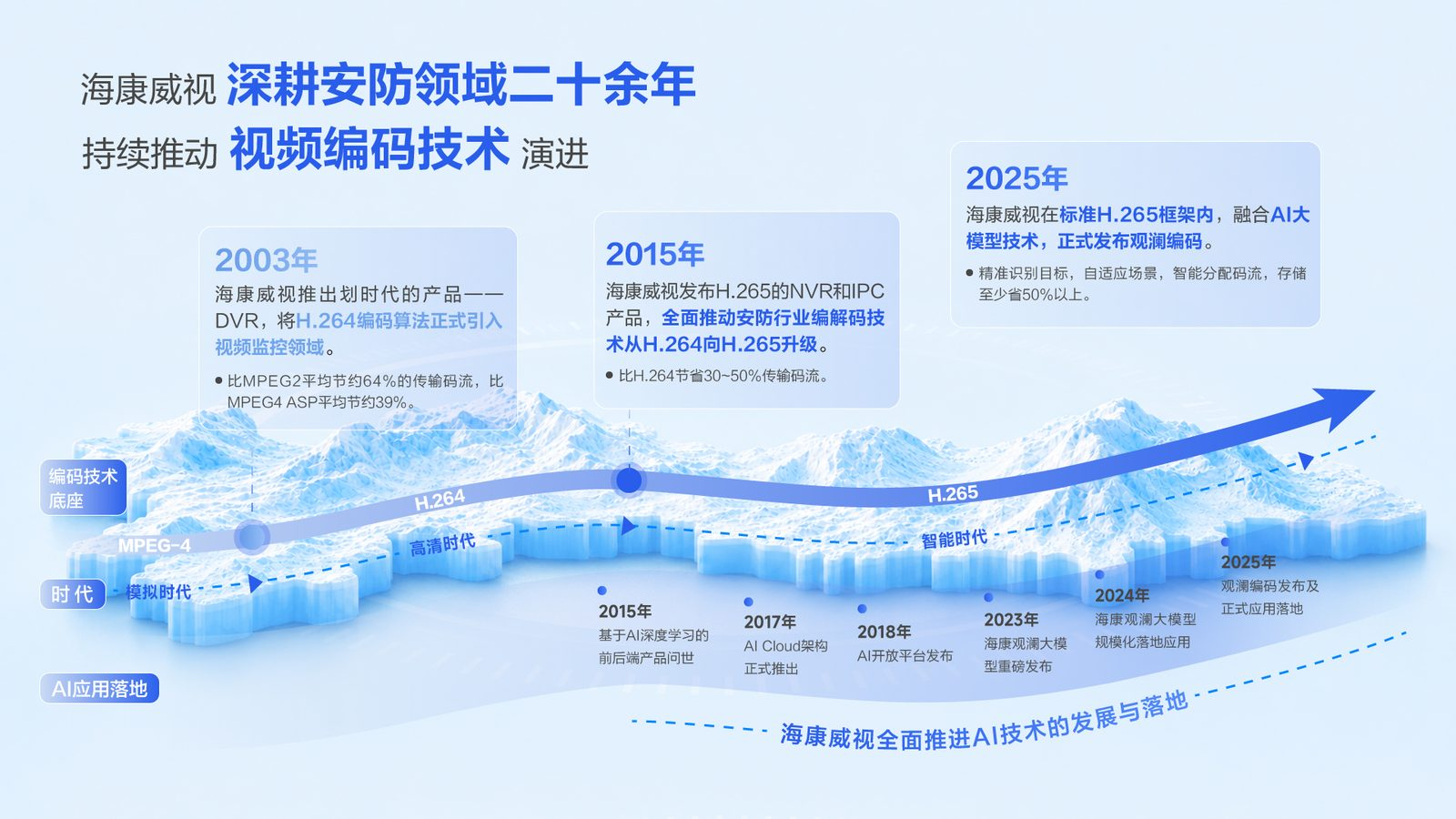
H.265 (HEVC) currently stands as the prevailing video coding standard in the security and surveillance sector. Utilizing core technologies such as CTU variable partitioning, multi-mode intra prediction, and CABAC efficient entropy coding, it can reduce transmission bitrates by 30% to 50% compared to H.264, significantly alleviating bandwidth and storage demands for high-definition video deployment.
However, H.265 has inherent limitations at its core: the entire coding algorithm solely conducts mathematical compression on pixel signals, devoid of any scene content understanding or business object identification. Standard coding relies exclusively on motion estimation algorithms to differentiate between static and dynamic pixels, applying varied bitrates to static backgrounds and moving vehicles. Yet, it fails to distinguish between core surveillance targets, such as people and non-motorized vehicles. Areas devoid of monitoring value, like static walls, see only minor bitrate reductions without a decrease in the number of encoded frames. Over 70% of the idle static background in surveillance scenes continuously outputs complete bitstreams, squandering storage capacity.
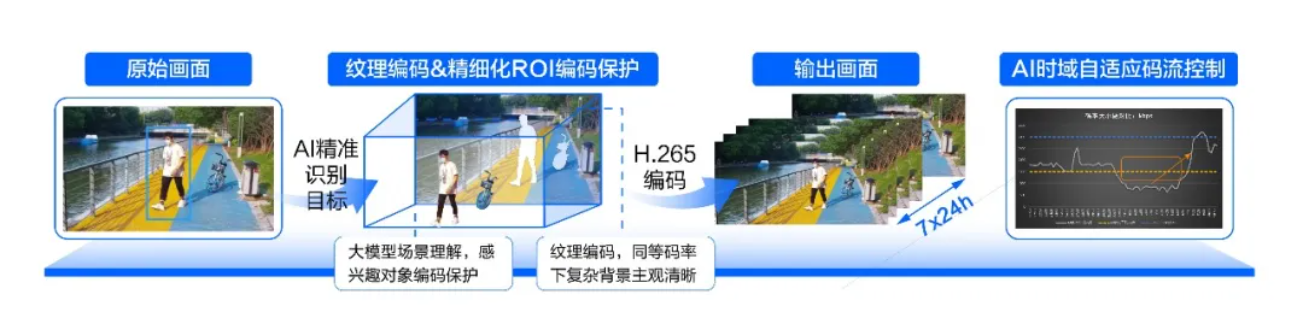
The core principle of Hikvision's smart coding can be encapsulated as a triad of "AI semantic understanding + ROI differentiated coding + scene-adaptive bitrate allocation," marking a transition from "pixel-based compression" to "object-based coding."
Large Model Semantic Understanding: From "Pixel Perception" to "Scene Comprehension"
This technology leverages the capabilities of visual large models to achieve semantic-level understanding of video scenes. With the support of these models, the system can precisely parse high-value key targets, such as people, motor vehicles, and non-motorized vehicles, attaining a target detection rate of 99% and supporting the recognition of up to 64 targets simultaneously. In contrast to traditional algorithms that make coarse-grained judgments based on motion status, this capability elevates coding from "pixel perception" to "scene comprehension."
Consequently, the coding process undergoes a fundamental transformation: image acquisition → scene understanding → smart coding → storage. The system adopts an "analyze-before-encode" approach, performing AI recognition on the original data and then transmitting the analysis results to the encoder for smart coding.
ROI Differentiated Coding: Clear Key Targets, Intense Background Compression
Through fine-grained ROI segmentation technology, foreground targets and background regions are accurately separated. Its technical essence lies in variable-quality coding for regions of interest—dynamically adjusting QP values based on the significance of each region: lowering QP values for key target areas, such as faces and license plates, to apply milder compression and preserve complete details; raising QP values for areas lacking critical information, such as roads and grass, to apply stronger compression and substantially reduce the overall bitrate.
The crux of this process is "semantic-based intelligent bitrate allocation," achieved solely through adjustments to the coding QP without any alteration or editing of the original video's pixel content, timestamps, resolution, frame rate, or other metadata, ensuring data authenticity and integrity. On average, it achieves over 50% bitrate savings while maintaining comparable quality for human, vehicle, and non-motorized targets.
Scene-Adaptive Bitrate Allocation: Dynamic Optimization Throughout the Day
This technology introduces a scene perception mechanism to dynamically adjust coding strategies based on the complexity of the video content. Taking a subway scene as an illustration: full bitrate is employed during morning rush hours to capture details, 50% compression is applied in the evening to balance quality and efficiency, and 10% compression is utilized in the early morning to maximize storage savings. In scenes with minimal targets and highly static backgrounds (such as an empty office), the system designates nearly the entire scene as "highly compressible background," achieving close to 90% extreme savings. Through dynamic "save-first, use-later" adjustments throughout the day, it attains an average savings of over 50% over a 24-hour period.
Compatibility: AI Innovation Within a Standard Framework
Hikvision's smart coding adheres strictly to the H.265 (HEVC) international video coding standard. It has undergone rigorous protocol conformance testing, ensuring that the generated bitstreams are 100% compliant with the H.265 standard and can seamlessly integrate with all H.265-compatible devices for plug-and-play functionality. There is no need to replace existing decoding equipment or monitoring platforms, as Hikvision's own devices and third-party H.265-compatible equipment can all connect seamlessly and operate stably.
The ROI differentiated coding technology itself has been incorporated into the national standard "Technical Requirements for Digital Video and Audio Coding in Public Security Video Surveillance," representing a highly mature technical category within the security industry. Hikvision's smart coding builds upon this mature standard, enhancing recognition accuracy and coding efficiency through large model capabilities.
Quantifiable Benefits of Real-World Deployment
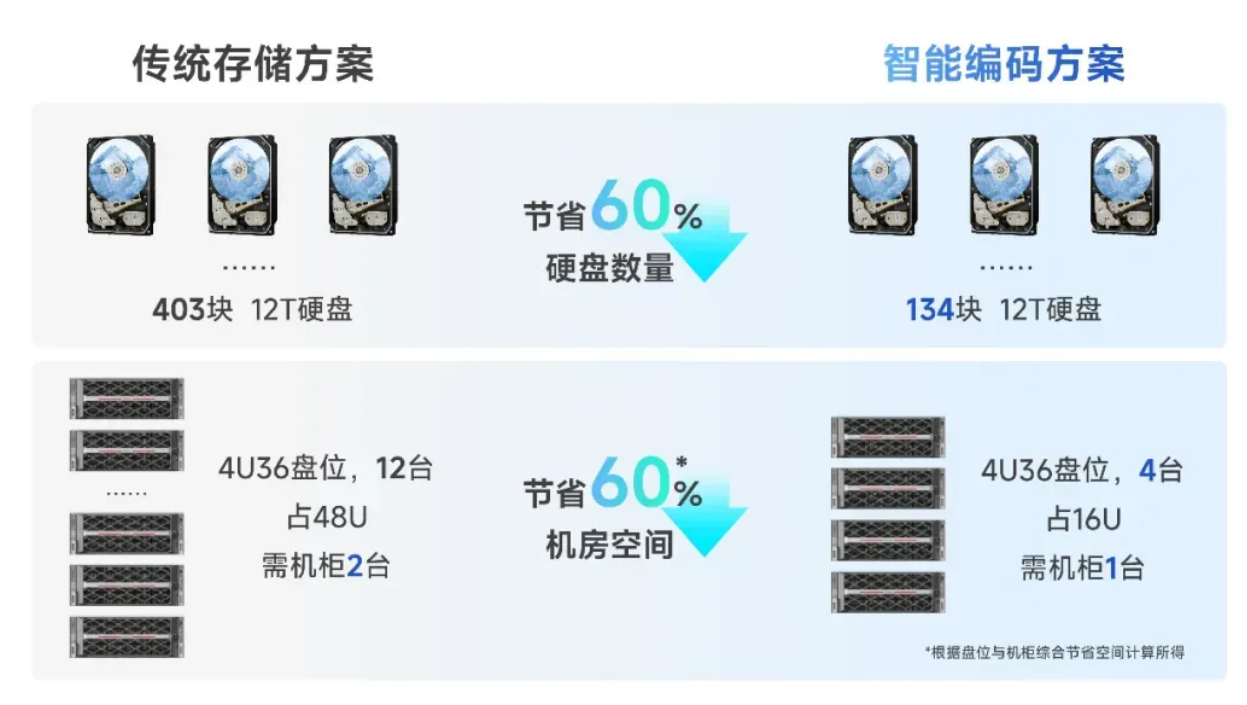
Consider a 2,000-channel 1080P@2Mbps system with 90-day storage as an example. Compared to traditional coding, Hikvision's smart coding solution delivers: 60% savings in hard drive quantity, 60% savings in machine room space, and 50% savings in electricity costs over five years. This approach leverages AI computing power to substitute for storage capacity, offsetting hardware cost pressures with technological soft advantages and assisting users in meeting longer-term compliance archiving requirements within existing budgets.
Q1: What sets Hikvision's smart coding apart from standard H.265?
Standard H.265 merely performs mathematical compression on pixels without any scene content understanding. Hikvision's smart coding integrates large models within the H.265 standard framework to accurately identify key targets, such as people and vehicles, with a 99% target detection rate. Through ROI differentiated coding and scene-adaptive bitrate allocation, it achieves "coding after scene comprehension," saving at least 50% of storage over a 24-hour period.
Q2: Is the video output from this technology compatible with existing H.265 devices?
Absolutely. This technology adheres strictly to the H.265 international standard, with output bitstreams that are 100% compliant with H.265 specifications. All compliant H.265 devices and third-party systems can be utilized plug-and-play without the need to replace existing decoding equipment or monitoring platforms.
Q3: Does the coding process alter the original video data?
No. The entire coding process solely employs AI to adaptively control QP value allocation for compression parameters without any alteration or editing of the original video's pixel content, timestamps, resolution, frame rate, or other core metadata, ensuring data authenticity and compliance.
Q4: How effective are the storage savings across different scenarios?
The effectiveness varies based on scene dynamics. In highly static scenes with minimal targets (such as an empty office), it can achieve close to 90% extreme savings. In complex scenes with dense personnel, the bitrate is appropriately increased to ensure quality. Through dynamic adjustments throughout the day, it attains an average savings of over 50% in storage space.
-
![]()
Li Bin Claims, 'Denying the Pure EV Trend is Like Ostrichism.' What's Li Xiang's Take?
-
Lenovo: Liu Jun Turns Left, Yang Yuanqing Turns Right
-
Lenovo: Liu Jun Goes Left, Yang Yuanqing Goes Right
-
![]()
MiniMax Shares Unlock: Cornerstone Shareholders Show Long-Term Optimism, Yet Stock Plummets Nearly 30% in Two Days; Zhipu Also Sees Nearly 20% Drop Today
-
![]()
Single-Day Plunge of 40%: The 'First AGI Stock' Faces More Than Just Share Price Concerns
-
![]()
Ricoh and Fuji Hike Prices on Legacy Edge; Insta360 Poised to Disrupt Mirrorless Camera Market
-
![]()
Ricoh and Fujifilm Raise Prices in Tandem, Relying on Established Reputations; Insta360 Poised to Disrupt Mirrorless Camera Market
-
![]()
Strategic Shift in Photoelectric Sensing: Maxvision Secures Controlling Stake in CAS Optotech