OpenAI, Grok, and Meta Release Three Major Models: Who is the King of Cost-Effectiveness?
 07/10 2026
 353
353
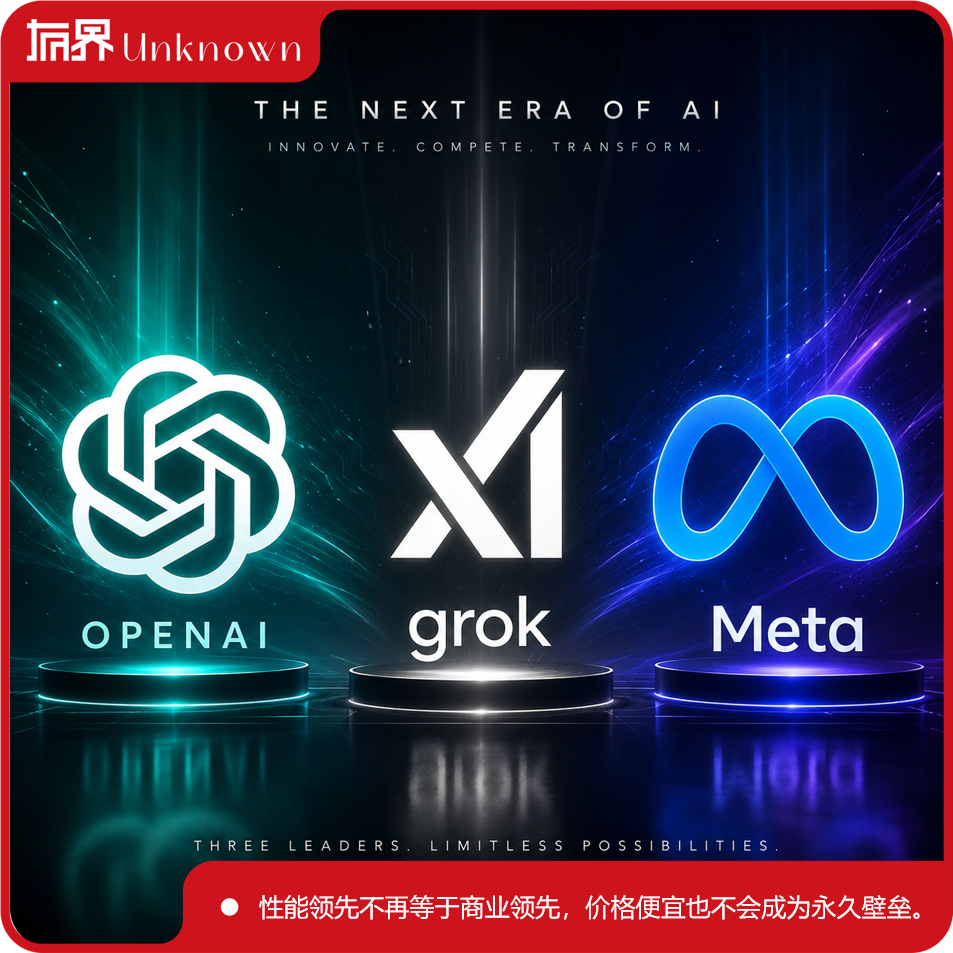
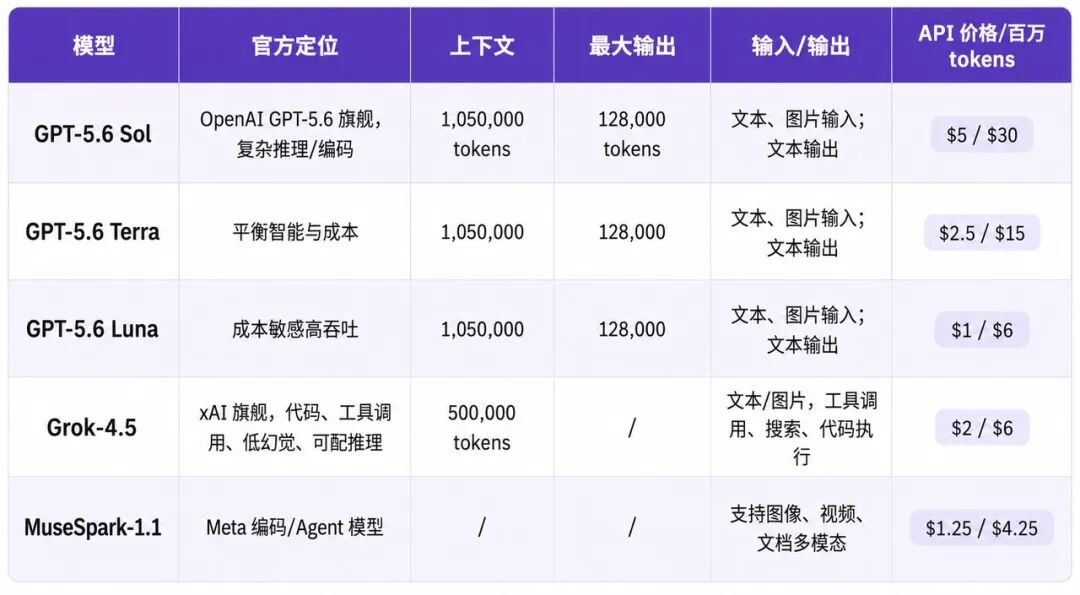
First, SpaceX AI/X AI released Grok-4.5, followed by Meta's Muse Spark 1.1, and then OpenAI's GPT-5.6, which came in three versions at once: Sol, Terra, and Luna.
While the simultaneous release of multiple models can be overwhelming, they all share one common trait.
That is, their capabilities have improved while prices have dropped, with a strong emphasis on cost-effectiveness.
For example, when Zuckerberg announced Muse Spark 1.1 on X, his first remark was: Muse Spark 1.1, a powerful model for coding and other tasks, at a very affordable price.
Elon Musk's Grok-4.5 also made cost-effectiveness its key selling point in this update. The official Grok account described the release of Grok-4.5 as providing cutting-edge intelligence while delivering leading speed and cost efficiency.
OpenAI took it a step further by dividing the new GPT-5.6 into three versions: Sol (flagship), Terra (balanced), and Luna (affordable), allowing users to choose based on their needs.
Those seeking performance can opt for the more expensive version, while those prioritizing cost can choose the cheaper one.
So, among this new wave of models, who is the king of cost-effectiveness, and who will emerge as the new favorite?
1. Who is the King of Cost-Effectiveness?
With everyone vying for cost-effectiveness, which of the newly released models offers the best value?
We can compare them based on price and capability.
First, let's consider capability. Since testing and disclosure dimensions vary across companies, we'll try to compare them on the same metrics.
The biggest overlap among the three models is coding ability, a key area of competition for AI companies.
The main dimensions disclosed for coding are Terminal-Bench 2.1 (AI's ability to use a computer) and SWE-Bench Pro (code repair ability in real projects).
Specific scores are as follows:
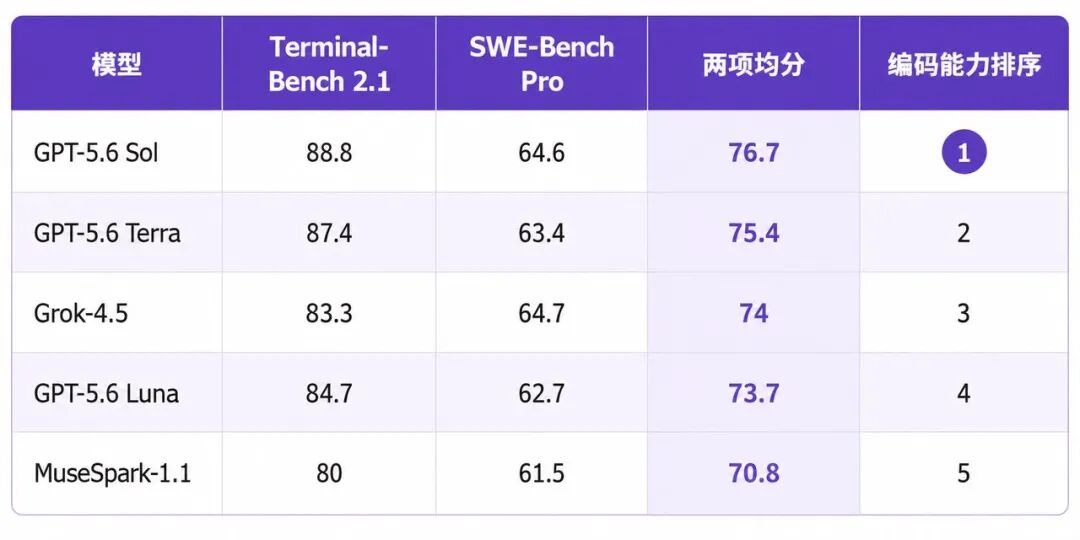
Under these metrics, GPT-5.6 Sol ranks first, Terra second, Grok-4.5 third, Luna is very close to Grok, and MuseSpark-1.1 last.
However, note that Grok-4.5 scored 64.7 on SWE-Bench Pro, the best among the three models.
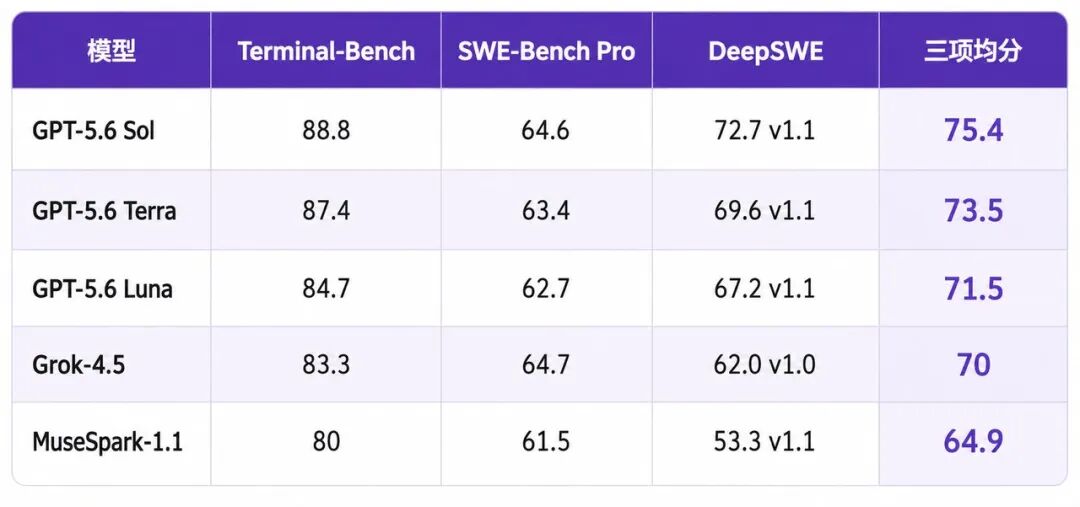
Of course, each company also disclosed scores for DeepSWE (AI's ability to complete longer, more open engineering tasks).
But the versions tested varied: GPT-5.6 and MuseSpark-1.1 were evaluated on DeepSWE1.1, while Grok-4.5 disclosed results for DeepSWE1.0, making direct comparison difficult.
For example, when GPT-5.5 switched from DeepSWE1.0 to DeepSWE1.1, its score improved across the board.
If we consider DeepSWE, GPT-5.6's three versions still outperform Grok-4.5 and MuseSpark-1.1 overall, but MuseSpark-1.1 falls significantly behind.
Of course, MuseSpark-1.1 has its unique strengths.
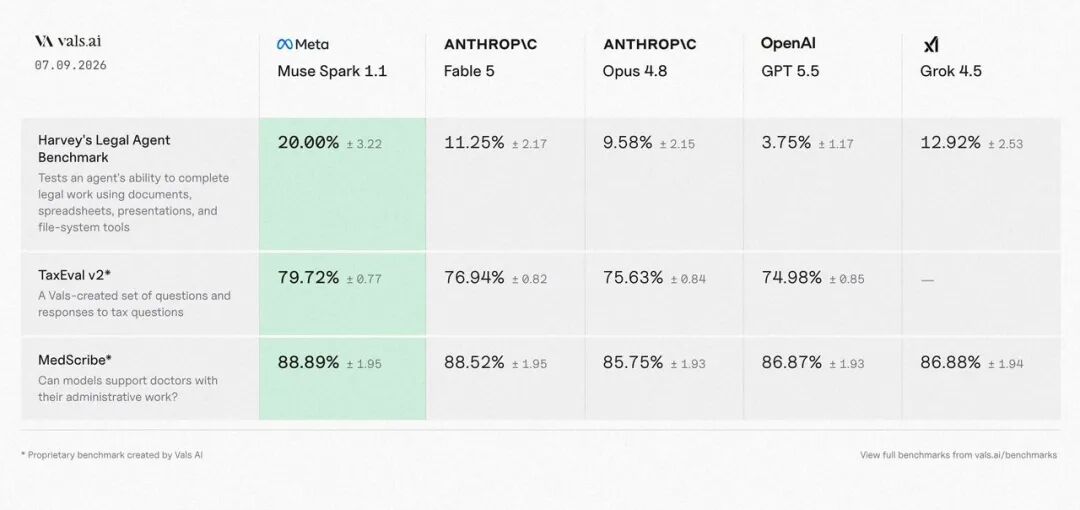
For example, in professional capabilities including MedScribe, TaxEval, and Harvey's Legal Agent Bench, Muse Spark 1.1 is now the best-performing model in the industry (SOTA).
MedScribe evaluates whether the model can generate qualified medical records from doctor-patient conversations; TaxEval tests the model's ability to answer complex tax questions; Harvey's Legal Agent Bench assesses whether large models/agents can complete real legal tasks.
Of course, to discuss cost-effectiveness, capability alone isn't enough—we must also compare prices.
Currently, MuseSpark-1.1 is the cheapest, with an input price of $1.25 and an output price of $4.25 per million tokens, totaling $5.50.
The highest-performing GPT-5.6 Sol is the most expensive, with an input price of $5 and an output price of $30 per million tokens, totaling $35.
Grok-4.5 falls in the middle, with an input price of $2 and an output price of $6 per million tokens, totaling $8—only slightly more expensive than GPT-5.6 Luna.
However, Grok officially states that Grok 4.5 consumes only half the tokens per task compared to leading models at the same level.
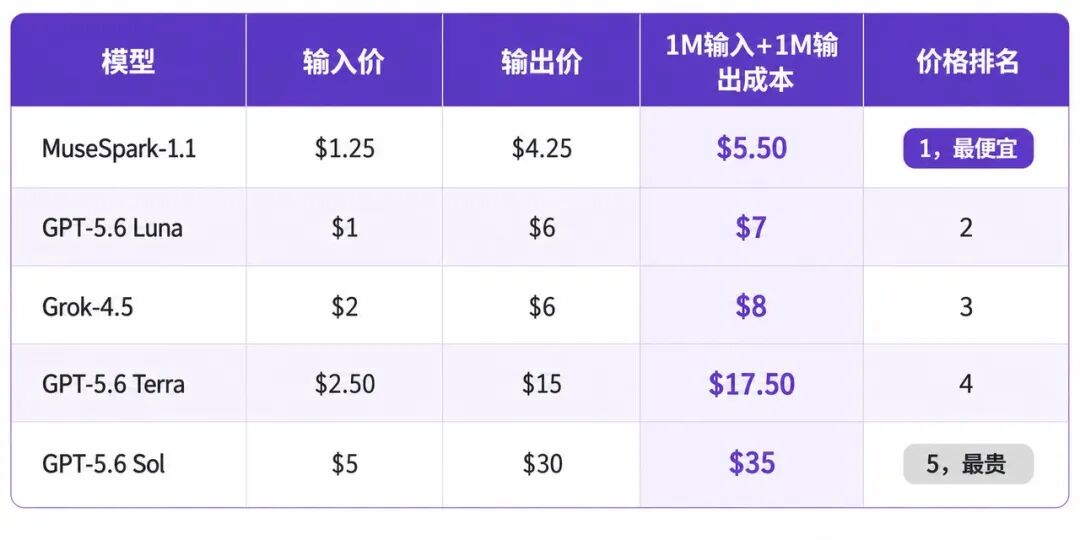
So, considering price overall:
GPT-5.6 Luna appears to offer the best overall cost-effectiveness, with a price close to the low-end bracket but significantly stronger coding, terminal task, and long-context capabilities. Its 1.05M context window is also a major advantage.
Next is Meta's MuseSpark-1.1, the cheapest option, which excels in legal, tax, medical, tool invocation, computer operation, and multimodal chart tasks, offering the best cost-effectiveness for agent/professional tool tasks.
Then comes Grok-4.5. While not the cheapest per million tokens, it may offer the best cost-effectiveness in coding scenarios when considering the total tokens, steps, and speed required to complete a coding/engineering task.
As for GPT-5.6 Sol and GPT-5.6 Terra, they seem more suited for users prioritizing pure performance, where price is almost irrelevant.
2. Climbing Over the Hill, Only to Find Chinese Models Waiting?
Regardless, cost-effectiveness has become the most critical metric for models today.
OpenAI CEO Sam Altman specifically mentioned after GPT-4.5's release, "We've heard enterprises' concerns about costs..."

But there's context to this: over the past few months, many U.S. companies have been abandoning OpenAI and Anthropic in favor of more cost-effective Chinese models like DeepSeek, Zhipu, and QianWen.
Data from OpenRouter (a platform allowing developers to access multiple AI models) shows that in the first half of 2025, Chinese models accounted for only 4.5% of token consumption on the platform, averaging 11% over the past 12 months. However, since February this year, Chinese AI models have consistently accounted for over 30% of token consumption weekly, peaking at 46%.
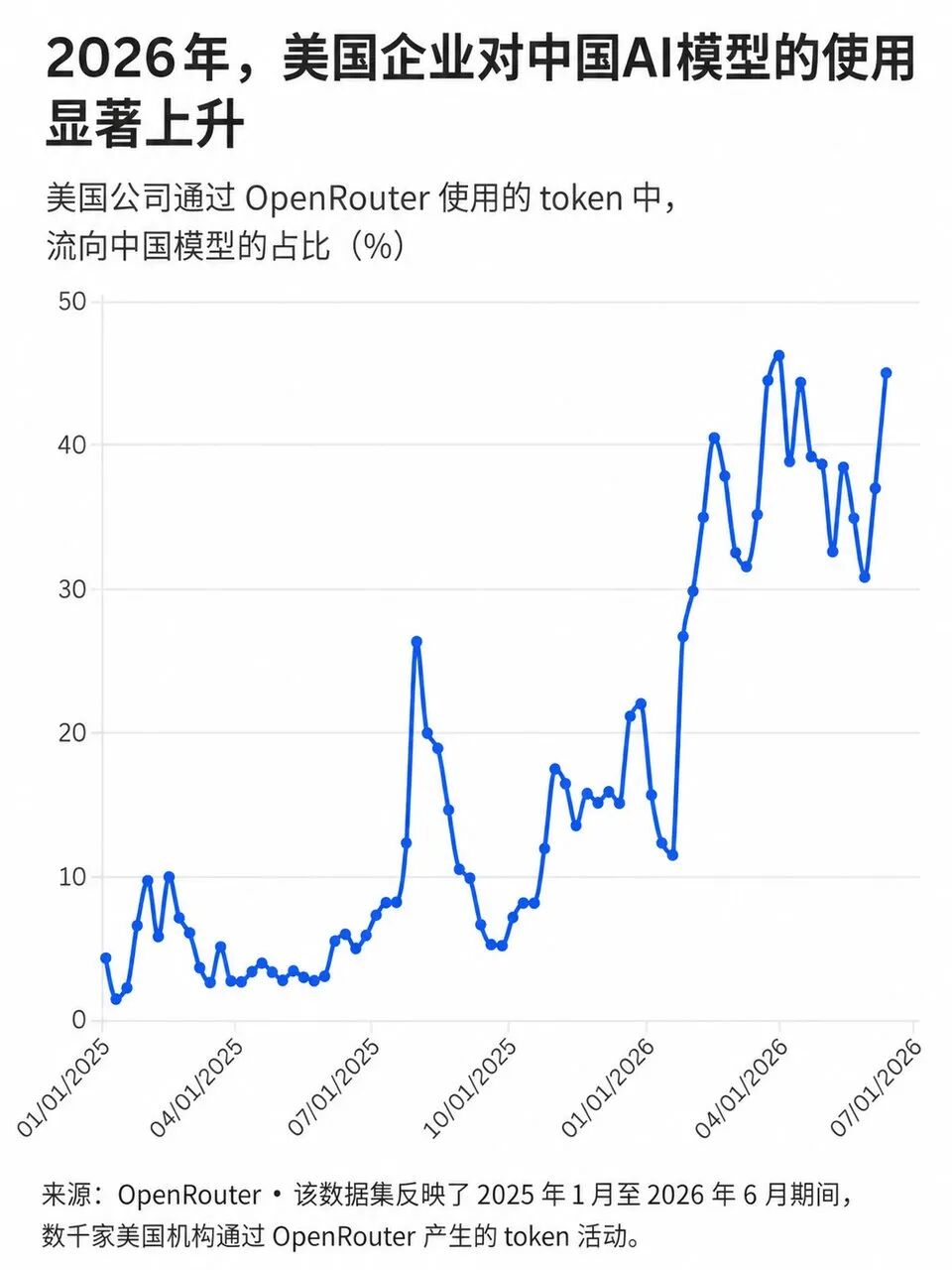
The key reason U.S. companies are embracing Chinese models is cost-effectiveness.
While Chinese AI models may still lag slightly behind OpenAI and Anthropic in capability, their prices are only 10%-40% of those of similar models from Anthropic/OpenAI.
An AI company founder in the U.S. stated on X that he switched 100% of his company's traffic from Anthropic to DeepSeek V4 in early June, saving millions of dollars while seeing actual performance improvements in many use cases.
For more details, refer to our previous article: Zhipu and DeepSeek: Breaking Into the U.S. Market with Cost-Effectiveness?
After these recent model releases, Artificial Analysis, a U.S.-based professional model evaluation agency, conducted a test comparing mainstream models from China and the U.S. The test evaluated their ability to complete real-world tasks across industries and the average cost per task.
Under Artificial Analysis' framework, models with stronger capabilities and lower prices have an advantage, corresponding to the second quadrant in the upper left corner.
In this quadrant, aside from Gork-4.5, the models are primarily Chinese, such as DeepSeek V4 Pro, Xiaomi's MiMo-V2.5 pro, and MiniMax-M3. (GPT-5.6 series and MuseSpark-1.1 were not yet included.)
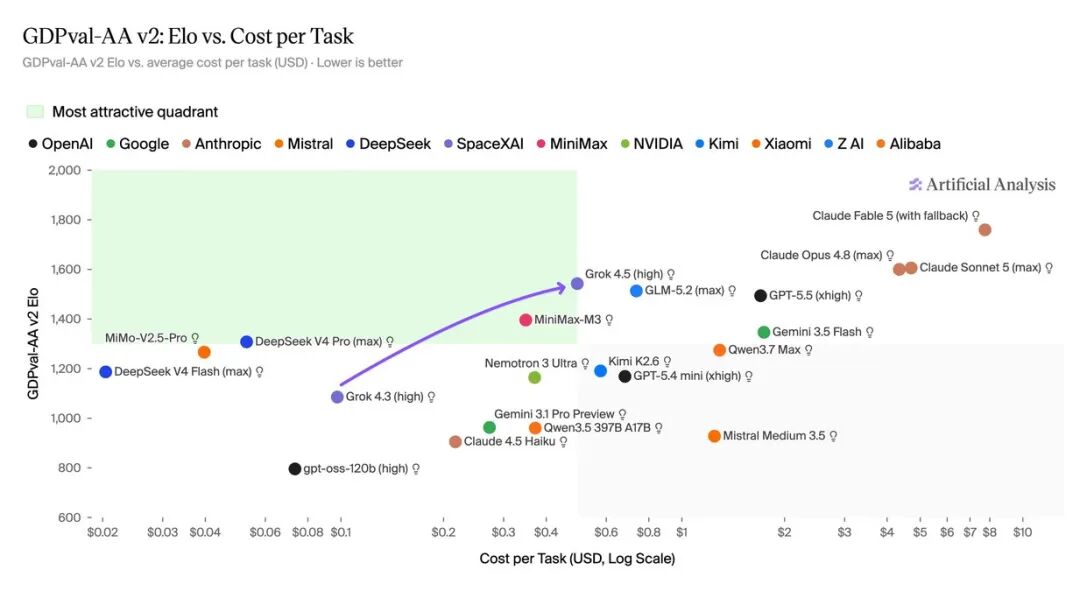
Before this round of releases by leading U.S. vendors, Chinese AI models had already begun gradually penetrating the U.S. market due to their cost-effectiveness.
With these releases, top U.S. model vendors have regained their footing and reclaimed the narrative.
However, market competition is never linear, nor is it determined by a single model release.
Chinese models have proven that cost-effectiveness is not just a local market advantage—it can translate into real choices for global developers and market share.
Going forward, model vendors will compete not just on benchmark percentages or per-million-token pricing, but on who can complete more real-world tasks more stably at a lower total cost. Model invocation prices, tokens required per task, execution speed, success rates, and tool/ecosystem capabilities will all be factored into the same equation.
This means large model competition is entering a harsher, more pragmatic phase: performance leadership no longer guarantees commercial success, and low prices won't serve as a permanent barrier.
* All images are sourced from the internet.
- END -
-
![]()
Li Bin Claims, 'Denying the Pure EV Trend is Like Ostrichism.' What's Li Xiang's Take?
-
Lenovo: Liu Jun Turns Left, Yang Yuanqing Turns Right
-
Lenovo: Liu Jun Goes Left, Yang Yuanqing Goes Right
-
![]()
MiniMax Shares Unlock: Cornerstone Shareholders Show Long-Term Optimism, Yet Stock Plummets Nearly 30% in Two Days; Zhipu Also Sees Nearly 20% Drop Today
-
![]()
Single-Day Plunge of 40%: The 'First AGI Stock' Faces More Than Just Share Price Concerns
-
![]()
Ricoh and Fuji Hike Prices on Legacy Edge; Insta360 Poised to Disrupt Mirrorless Camera Market
-
![]()
Ricoh and Fujifilm Raise Prices in Tandem, Relying on Established Reputations; Insta360 Poised to Disrupt Mirrorless Camera Market
-
![]()
Strategic Shift in Photoelectric Sensing: Maxvision Secures Controlling Stake in CAS Optotech