AMD's Bold 'Strategic Move': Securing Partnerships with Two AI Leaders Through 1-Cent Stock Options
 02/26 2026
 481
481
Yesterday, AMD made a bold and uncommon 'strategic move'.
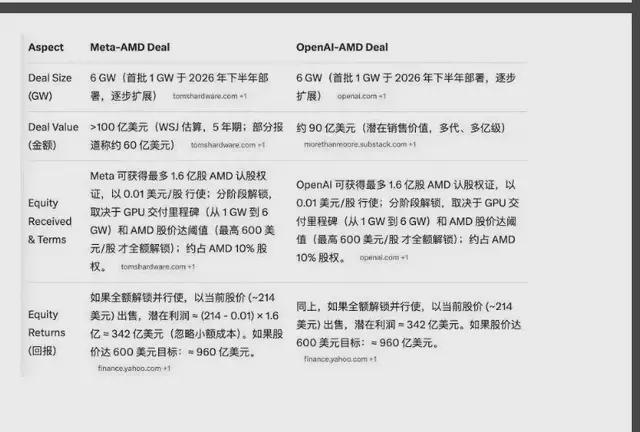
Meta and AMD have forged an agreement wherein Meta will acquire up to 6 gigawatts of AMD AI chips over the next few years, an amount equivalent to the annual electricity consumption of 5 million U.S. households. The deal is anticipated to surpass $100 billion in value.
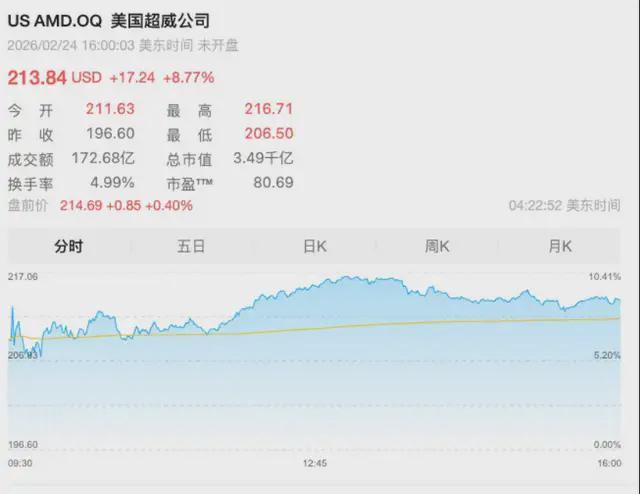
In return, AMD has granted Meta stock options that allow the purchase of up to 160 million AMD shares (approximately 10% of the total outstanding shares) at a price of $0.01 per share. These shares will vest in batches, contingent upon Meta meeting specific procurement targets and AMD's stock price reaching $600 (AMD's stock closed at $196 on the day of the announcement).
Following the agreement with Meta, AMD's pre-market stock price soared by over 10%. Notably, this announcement came just one day prior to NVIDIA's earnings release.
01
New Equity Stakes for AI Players
Several months ago, AMD entered into an identical agreement with OpenAI, utilizing an 'equity-for-procurement' model.
OpenAI has announced plans to purchase and deploy up to 6 gigawatts of AMD Instinct series GPUs, with potential sales reaching $90 billion. In exchange, AMD issued options for up to 160 million shares at $0.01 each. If AMD's stock reaches $600 and GPU deployment milestones are achieved, OpenAI will receive the 10% stake free of charge.
This strategy transforms traditional procurement into a deep strategic partnership. By converting discounts into 'equity stakes', it creates significant value for both parties involved.
For AMD, this represents an innovative customer acquisition strategy:
Firstly, it shifts rigid upfront costs, such as discounts and rebates, into equity costs tied to future performance, while also creating opportunities for flagship validation of MI450 GPUs and Helios platforms. This successfully binds Meta and OpenAI to AMD.
Secondly, with only a 5-10% market share in AI chips and a less mature ROCm software ecosystem compared to CUDA, securing partnerships with OpenAI and Meta provides direct access to endorsements from top AI labs and opportunities for technical collaboration, thereby accelerating ecosystem development.
Thirdly, even if stock price targets are not met, this strategy poses a challenge to NVIDIA's monopoly and promotes the growth of AMD's ecosystem.
For Meta and OpenAI, this resolves two critical challenges: ensuring a diverse supply of non-NVIDIA chips while hedging AI infrastructure costs through stock appreciation, creating a 'self-funding' pathway. Industry experts note: 'Major firms cannot rely on a single AI chip supplier due to concerns over supply chain security, negotiation power, delivery cycles, and costs. AMD's partnership with Meta represents a strategic attempt to reduce dependence on NVIDIA.'
02
AMD's Leverage
In both collaborations, AMD's key asset is the MI450 series.
Built on AMD's new CDNA 4 architecture, the MI450 is designed for high-end AI training and inference. Unlike traditional single-process strategies, it employs an innovative hybrid design: XCD compute cores utilize TSMC's N2P 2nm process, while AID interposers and MID interface chips use N3P 3nm technology.
In terms of key metrics, the MI450 directly competes with NVIDIA's next-generation products. AMD claims a 50% superior memory capacity and vertical bandwidth compared to NVIDIA Rubin, with parity in memory bandwidth, FP4/FP8 performance, and horizontal bandwidth.
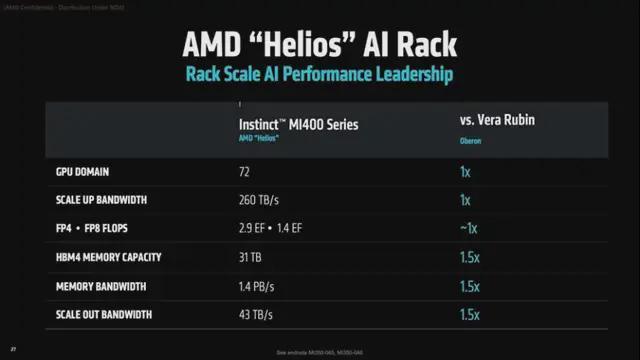
AMD is not merely competing on single-chip performance but aims to challenge NVIDIA's Vera Rubin NVL72 racks with its new 'Helios' rack system.
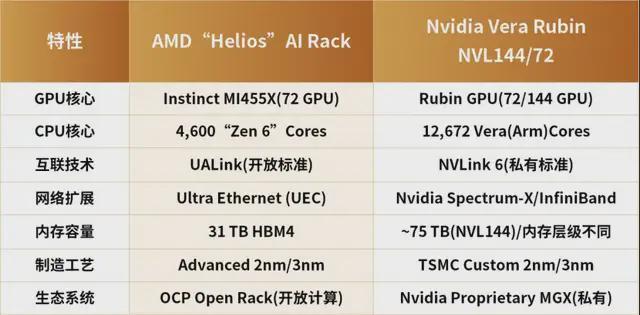
The Helios rack utilizes the latest MI455X GPUs, combining 72 MI455X GPUs and 18 Venice CPUs to deliver an astonishing 2.9 ExaFLOPS of AI computing power. In comparison, NVIDIA's Vera Rubin NVL72 offers 3.6 exaFLOPS NVFP4 inference, 2.5 exaFLOPS training, 54 TB LPDDR5X memory connected to Vera CPUs, and 20.7 TB HBM4 with 1.6 PB/s bandwidth.
The pace of commercialization for AI products will determine whether AMD can seize opportunities during the 2026-2027 AI computing window.
At AMD's Q1 earnings call, CEO Lisa Su confirmed that the MI450 series would launch and enter mass production in the second half of 2026, with revenue starting in Q3 and significantly increasing in Q4 2026 into 2027. The OpenAI collaboration is also planned to escalate from the second half of 2026 into 2027.
03
A Masterstroke of Commitment?
Current industry giants employ different strategies. NVIDIA's Stargate projects rely on direct co-investments with Microsoft, Oracle, and others, locking partners into vertically integrated infrastructure through massive capital deployments (e.g., NVIDIA's planned $100 billion investment in OpenAI over ten years, with OpenAI agreeing to deploy NVIDIA-powered facilities consuming 10 gigawatts).
Upon learning that AMD offered 10% equity as part of its OpenAI deal, NVIDIA CEO Jensen Huang expressed surprise: 'Given AMD's high expectations for their next-gen products, this imaginative, unique, and unexpected proposal - offering 10% equity before product availability - surprised me. But I must admit it's clever.'
Intel mitigates financial pressure from fab expansions by securing co-investments from NVIDIA, SoftBank, and the U.S. government, blurring the lines between suppliers, customers, and even competitors.
AMD has ingeniously transformed customer procurement into investment: AI firms exchange future orders for AMD equity appreciation, while AMD secures long-term orders with future stock. This creates a mutual gamble between two trillion-dollar entities. CEO Lisa Su described it as a win-win for shareholders, indicating aggressive plans and financial models, and called the deal transformative.
Industry experts note: 'If AMD meets the high unlocking conditions, the benefits could be explosive. Even partial success would challenge NVIDIA's monopoly and boost AMD's ecosystem. While short-term sales matter, the core is securing future ecosystem positions. This model drives immediate sales while enabling AMD to enter major clients' technology stacks through joint product definition. Success would attract more mid-to-large enterprises, weakening CUDA ecosystem loyalty.'
Analysts view this as more than a supply agreement - essentially a financial instrument converting AI hardware sales into equity allocations, directly tying AMD's long-term valuation to OpenAI and Meta's infrastructure growth.
04
Can Domestic AI Chip Firms Follow Suit?
AMD's equity swap with Meta provides valuable insights for Chinese AI chip companies. During this golden era of localization, the 'deep binding + mutual benefit' model helps startups achieve more solid initial mass production.
Firstly, evolve from 'selling shovels' to 'joint mining.' Adopt this 'space-for-time' strategy by deeply binding with internet giants (Alibaba, Tencent, ByteDance) through joint product definition and development for specific domestic large model inference/training scenarios, similar to AMD's MI450 customization for Meta. This ensures chips have customers upon tape-out, reducing market promotion costs. While direct '1-cent stock purchase' financial operations are challenging domestically, alternative models like cross-shareholding, joint computing companies, or 'procurement rebates + technology dividends' can deeply bind chip firms with internet giants' AI strategies.
Secondly, avoid being 'all-rounders' and become 'specialists.' Experts note that China's AI chip industry remains fragmented without an AMD-like entity. Even for AI firms akin to Meta, multiple chip bindings are needed. Rather than competing head-on in general-purpose training cards, focus on inference and specific scenarios. Meta's AMD deal heavily targets AI inference (user queries, model responses). Domestic internet giants have massive demand for inference chips in recommendation algorithms, search, and AIGC generation. If domestic chips excel in energy efficiency and cost control compared to training chips, they can capture significant inference market share.
However, we must recognize that despite surface-level activity, Chinese AI chip firms generally face 'technology without products, samples without usability' challenges. AMD's confidence in gambling 10% equity stems from having 'hard currency' to compete with NVIDIA. Most domestic AI chip firms remain at the 'storytelling' stage, with a significant gap from market needs.
05
Conclusion
AMD's CFO stated: 'We expect this collaboration to drive significant revenue growth for years and enhance non-GAAP EPS, marking another step toward our long-term financial model. This performance-based model aligns AMD and Meta on execution and long-term value creation.'
Meta's global infrastructure head Santosh Janardhan said: 'Our ambitions are enormous,' noting continued self-developed AI chip efforts alongside NVIDIA procurement for different computing workloads.
Analysts see this blockbuster deal as key progress in AMD's pursuit of NVIDIA, showing that despite investor bubble concerns, AI device spending across the tech industry continues to accelerate.
However, long-term stock price gambles carry significant risks. Industry sources note: 'The Meta agreement requires a $600 stock price (currently ~$196). If unmet, Meta might abandon the options, leaving AMD with order losses and equity dilution - ultimately becoming a capital game.'
-
![]()
The World's First Trillionaire Emerges: Is SpaceX's $2 Trillion Valuation Justified?
-
Volkswagen to Implement 19,000 Job Cuts in Germany This Year
-
![]()
Tremble, Humans: AI Continues to Accelerate at Breakneck Speed
-
![]()
A Strategic Vision: Taking a Leaf Out of Apple’s Book in China’s Operation-Intensive Auto Market
-
![]()
Yu Chengdong Declares, ‘Only First Place Exists in My Lexicon.’ Is This Bold Claim or a Promise of Excellence?
-
![]()
Agent OS is Here! HarmonyOS 7 Unveiled, Huawei Redefines OS
-
![]()
Agent OS is Here! Huawei Unveils HarmonyOS 7, Redefining Operating Systems
-
DingTalk’s Evolution and the Dilemma Facing Alibaba