AI Competition: Alibaba Holds Back the 'Volcano'!
 03/02 2026
 606
606
If you've recently visited Beijing Capital Airport or Hangzhou Xiaoshan Airport, you've likely been captivated by two enormous billboards. On one, Alibaba Cloud confidently asserts, 'Leading the AI cloud market share, surpassing the combined total of ranks 2-4.' On the other, Volcano Engine fires back with, 'Holding a 46.4% share of China's public cloud large model market.'
This spectacle is reminiscent of two martial arts masters facing off outside an inn—one proclaiming, 'My inner strength is unparalleled,' while the other retorts, 'My techniques are unmatched.' Spectators (in this case, us enterprise IT buyers) watch in awe, pondering: Who is the true champion?
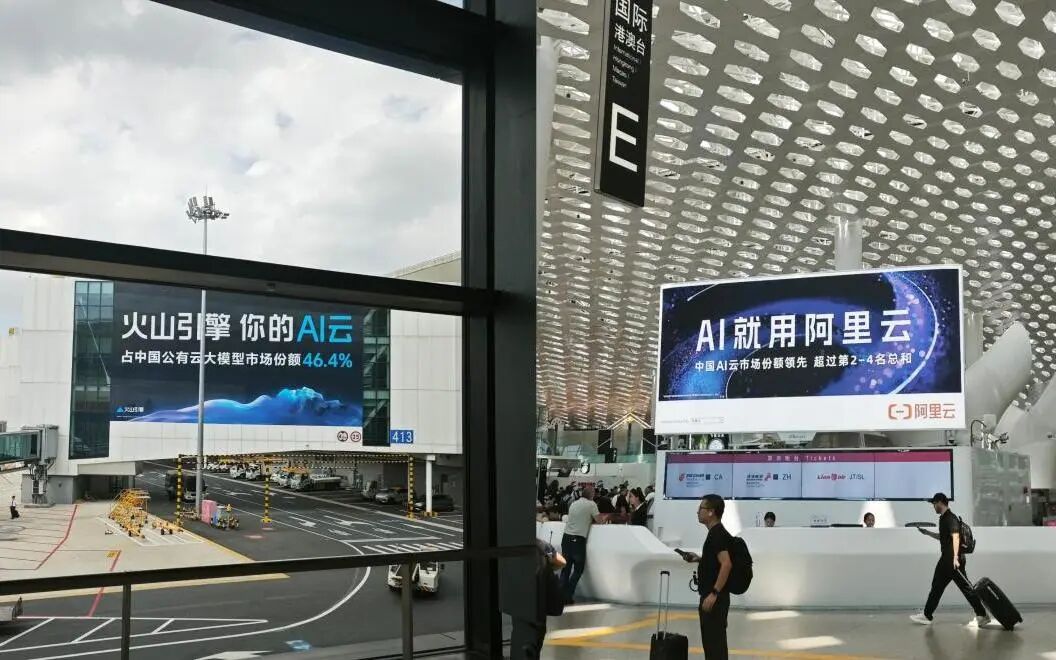
Alibaba and Volcano Engine are akin to two boxers who have each claimed victory in their home arenas, both brandishing championship belts. However, when we take a broader view, Alibaba has been steadily 'holding back' this recently active 'volcano'.
I. From 'Ambushed' to 'Building Fortifications'
The tale begins in 2024. That year, Volcano Engine erupted like a sudden volcano, with lava (Token invocation volume) flowing abundantly. IDC data reveals that in 2024, Volcano Engine dominated 46.4% of China's public cloud large model invocation volume. By the end of 2025, the Doubao large model's daily average invocation volume soared to a staggering 63 trillion Tokens. To put this into perspective, for every two AI bytes generated in China, one passes through Volcano Engine's pipelines. This rapid growth has alarmed established cloud vendors.
Even more daring is Volcano Engine's 'price-cutting warrior' approach. The Doubao large model Pro-32k version's inference input price is just 0.0008 yuan per thousand Tokens, 99.3% lower than the industry average. It's as if an item originally priced at 100 yuan suddenly drops to 80 cents, disrupting the entire market's pricing structure. Major clients like Weibo, Vivo, and Li Auto 'defected,' with Zhang Yiming reportedly personally intervening to secure Li Auto's ~300 million yuan project from Alibaba Cloud with a 250 million yuan quote plus a 15 million yuan investment commitment.
Suddenly, 'ByteDance storms the gates while Alibaba builds fortifications' became the industry's hottest topic.
But Alibaba is no stranger to competition—a seasoned veteran that survived the 'Thousand-Group War' and 'Double 11 traffic tsunamis' in e-commerce. How could it surrender easily?
II. Open Source Becomes Alibaba's 'Defensive Wall'
Alibaba's counterattack commenced with 'open source'.
While Volcano Engine relied on its closed-source Doubao large model to aggressively capture Token invocation volume, Alibaba unleashed Tongyi Qianwen (Qwen) as its open-source powerhouse. When the Qwen2.5 series models were released, global developers were thrilled—covering parameters from 0.5B to 1000B, supporting all modalities from images/text to video, and crucially, being free and open-source! It was as if Alibaba constructed a free theme park adjacent to Volcano Engine's meticulously designed paid amusement park, with comparable attractions (model capabilities).
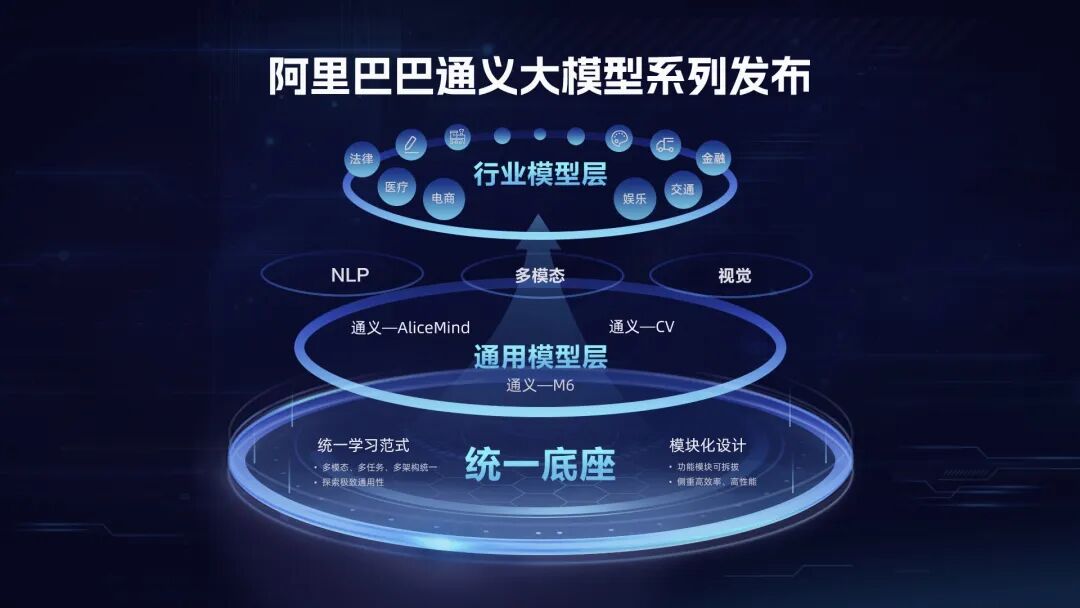
Data indicates that Tongyi Qianwen's open-source models have surpassed hundreds of millions of global downloads, with over 100,000 derivative models. On Hugging Face, the world's largest AI model community, Qwen series models consistently rank at the top. This 'open source for ecosystem' strategy has solidified Alibaba's unshakable position among global developers. While Volcano Engine leads in domestic Token invocation volume, Alibaba has quietly erected a formidable wall in global developer ecosystems and overseas markets.
Even more astutely, Alibaba introduced Qwen-Flash, a 'million-Token long-text' model supporting a 1 million Token context window. This means you could input an entire *Dream of the Red Chamber* novel for AI analysis. While Doubao large model 1.6's 256K window is impressive, Alibaba has clearly taken the lead in the 'ultra-long text' arena. For enterprise clients processing massive documents, this is like placing a 'constriction spell' on the volcano's crater—you can erupt lava, but I can contain the entire Pacific Ocean.
III. Alibaba's Comprehensive Industry Chain 'Deep Snow'
If Volcano Engine's strength lies in 'extreme cost-performance + scale effects,' Alibaba's defensive wall is 'comprehensive industry chain control'.
In the AI era, cloud computing competition has evolved from merely 'selling computing power' to 'selling AI capabilities.' Alibaba's 160 billion yuan in capital expenditures over the years hasn't just purchased GPUs—it's invested in AI Agents, computing power scheduling efficiency, self-developed chips, and other comprehensive industry chain links. From foundational Yitian 710 and Hanguang 800 chips, to mid-tier PAI Lingjun AI computing clusters, to upper-layer BaiLian platforms and Tongyi Qianwen model families, Alibaba has constructed a complete 'AI full stack'.
This is akin to Volcano Engine being an active volcano—erupting violently but reliant on tectonic movements (external computing power purchases)—while Alibaba is a human-made 'super dam,' with every component from foundation to structure self-designed. When global GPU supplies tighten and computing costs soar, Alibaba's self-developed chips and computing power scheduling become unique advantages—not only controlling costs but ensuring supply stability.
By 2025, Alibaba Cloud's AI revenue had maintained triple-digit growth for nine consecutive quarters, with its China cloud market share rising to 36% for three straight quarters. While Volcano Engine leads in MaaS (Model-as-a-Service), Alibaba remains first in the overall AI cloud market (IaaS+PaaS+MaaS full chain). Omdia data shows Alibaba Cloud led with 35.8% in H1 2025, with Volcano Engine at 14.8% in second place.
In other words, Volcano Engine may excel at 'selling AI electricity' (Token invocations), but Alibaba controls the entire 'power grid' (cloud infrastructure) + 'power plants' (self-developed chips) + 'appliance stores' (SaaS application ecosystem). This comprehensive industry chain advantage keeps Alibaba highly attractive among B-end enterprise clients and government markets.
IV. The Agent War: 'Coze' vs. 'BaiLian'
In 2025, AI Agents emerged as the new battleground. Volcano Engine launched the 'Coze' platform, serving millions of Douyin creators; Alibaba built the 'BaiLian' platform, attracting over 290,000 enterprises and developers.
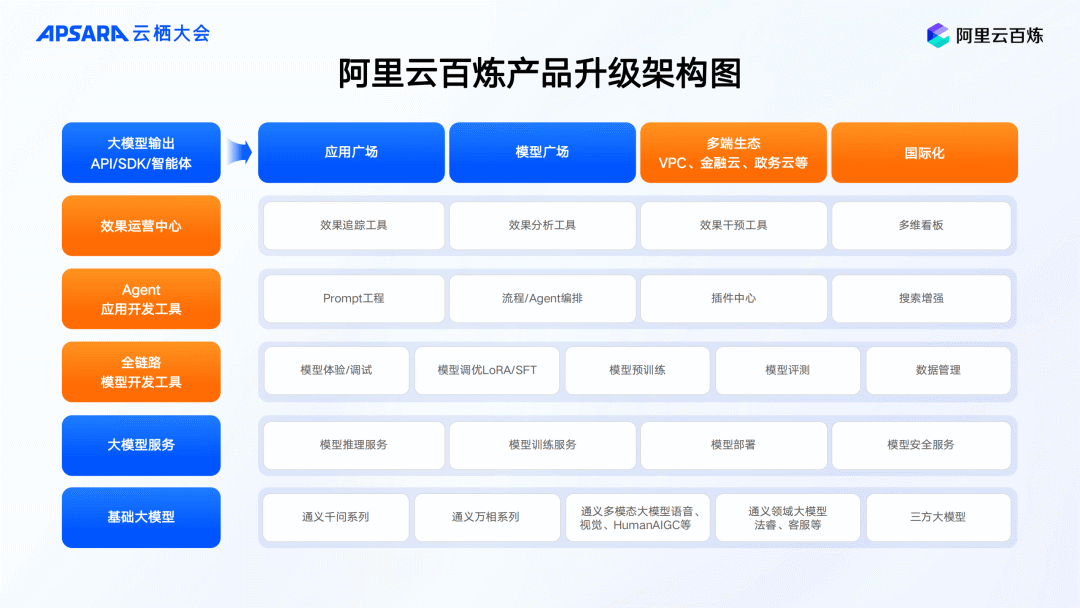
This Agent platform competition resembles two different 'App Stores' vying for developers. Coze's strength lies in deep integration with Douyin's ecosystem, enabling creators to rapidly generate content and manage fans; BaiLian excels at enterprise-grade customization, empowering government, healthcare, and other clients to develop intelligent agents in just 7 days on average through 'drag-and-drop' tools and industry plugins.
While Coze shines in C-end creator markets, BaiLian penetrates deeper in B-end enterprises. Among global top 10 smartphone makers, though 9 have integrated Doubao large models, Alibaba's roots in fintech, retail, manufacturing, and other traditional industries remain deep. As AI Agents evolve from 'toys' to 'tools,' from 'creator assistants' to 'enterprise productivity,' Alibaba's enterprise service experience becomes another obstacle blocking the volcano's crater.
V. CCTV Spring Festival Gala: 'Exclusivity' vs. 'Surround'
The 2026 Spring Festival Gala AI partnership battle epitomizes this 'volcano-holding' campaign.
Volcano Engine secured CCTV's 'exclusive AI cloud partner' status, deeply participating in gala program interactions and video streaming via multimodal large models. Doubao distributed over 100,000 tech gifts and cash red packets up to 8,888 yuan to nationwide viewers, stealing the spotlight.

But Alibaba's strategy was more 'astute'—though it didn't win CCTV's core slot, Qianwen App sponsored four local Spring Festival Galas (Dragon TV, Jiangsu TV, Henan TV, Zhejiang TV). This 'rural surround urban' tactic ensured Alibaba's overall exposure wasn't outmatched, while local TV audiences offered better precision marketing.
It's like Volcano Engine constructing a massive volcano model at the gala's main venue, erupting spectacularly; Alibaba set up booths at four sub-venues, each smaller but collectively covering more ground. More importantly, Alibaba signaled to the market: I'm not chasing fleeting fame—I want long-term user mindshare.
Epilogue: The Volcano Still Erupts, But the Dam Holds
To conclude, we must acknowledge: Volcano Engine remains a fiercely erupting volcano, with 63 trillion daily Tokens no joke, and Doubao maintains strong C-end user activity. ByteDance's planned 150-160 billion yuan AI investment in 2025 signals no letup in this saturation attack.
Yet Alibaba has indeed been 'holding back' this volcano—using open-source ecosystems to bridge globalization gaps, comprehensive industry chain advantages to secure B-end enterprise markets, and long-text capabilities/Agent platforms to fill technological differentiation gaps. IDC data shows that while Volcano Engine holds 49.2% of public cloud large model invocation volume, Alibaba Cloud's 27% share, combined with its overall AI cloud market leadership, forms an effective 'containment' posture.
The headline 'Alibaba Holds Back the Volcano' doesn't imply Alibaba has 'defeated' Volcano Engine. Rather, in this fierce competition, Alibaba has successfully limited Volcano Engine's infinite expansion, transforming the battle from a 'one-sided volcanic eruption' into an 'Alibaba containment campaign.' And through this campaign, China's AI industry is maturing at an unprecedented pace.
-
![]()
AI Giants Start Borrowing to Fuel Computing Power Race
-
ByteDance Initiates Largest B2B Structural Adjustment, This Time It's Truly Different
-
![]()
Let's Talk About Kingsoft Office's Mid-Year Outlook and the True Strength of Its AI-Powered Office Solutions
-
Despite 150 Million Users, Struggles Persist: AIShige Faces Tough Competition from Seedance and Kling in AI Video Monetization
-
![]()
Ensuring Safe Gear Shifting in the Automotive Industry: Transitioning from 'Product Oversight' to 'Full-Chain Governance'
-
![]()
Net Profit Soars to $133.7 Billion! Azure Revenue Tops $100 Billion, with AI Fueling Microsoft's Growth
-
![]()
Before 6G Hits the Market, the U.S. Forges a 'Rules Alliance': What Challenges Await Chinese IoT Enterprises?
-
![]()
Intelligent Driving's 'Little Blue Light' Faces Ban: Night Glare and Cut-in Risks Prompt Official Action