Conflict Persists, Chip Firms Exit Israel
 03/05 2026
 525
525

The strikes launched by the United States and Israel against Iran have now entered their fifth day. As the night sky is ablaze with colossal explosions, the natural rhythm of day and night across the globe is disrupted.
The conflict has not only wreaked havoc on daily life but also cast a shadow over other Middle Eastern nations. Gulf countries, including the United Arab Emirates, have experienced missile interceptions and falling debris, with the world's sole seven-star sailing hotel engulfed in flames. A significant number of Chinese nationals have rushed back to China, and tragically, some have lost their lives.
Diplomatic ties between Iran and Israel were severed in 1979, and since then, the two nations have remained in a state of hostility. In 2025, Israel and Iran engaged in a "Twelve-Day War"; early in 2026, the United States and Israel launched a joint, larger-scale offensive against Iran.
In the wake of the conflict, several tech behemoths have swiftly responded. NVIDIA has confirmed the safety of approximately 6,000 employees and their families in Israel. Due to the impact on Dubai and other locations, it has temporarily shuttered its Dubai office. Amazon has mandated remote work for all its Middle East office employees and advised clients to back up data or shift workloads. Google, affected by the widespread cancellation of regional flights, has temporarily stranded some employees attending a conference in Dubai. The company is closely monitoring the operational status of large R&D centers such as those in Tel Aviv, with employee safety as its top priority.
Several tech and multinational corporations, including Samsung and Hyundai, have convened emergency meetings to restrict employee travel to Iran and surrounding sensitive areas and are poised to evacuate personnel from the conflict's epicenter at a moment's notice.
Amidst the chaos, how can we discern the path to civilization?
01
The US-Israel Chip Alliance
Israel's semiconductor industry has long been hailed as the nation's most formidable technological powerhouse, epitomized by the "Two-Engine Paradox." This model synergizes the R&D centers of global multinational corporations with the innovative agility of local startups, jointly propelling technological breakthroughs vital to global computing and AI systems.
As of 2025, Israel boasts over 250 active semiconductor companies, accounting for roughly 3.5% of its tech sector and employing around 45,000 individuals. Over the past decade, the sector has witnessed a 16% growth, with reports indicating a shift from rapid expansion to more stable, capital-intensive growth. Intel and NVIDIA remain the largest employers, with a combined workforce of nearly 15,000 and extensive R&D activities.
Israeli semiconductor company Tower Semiconductor achieved a record quarterly revenue of approximately $440 million in Q4 2025, marking a roughly 14% year-on-year increase, driven by demand for AI infrastructure-related chips. Its stock price soared in the latter half of 2025, and by early 2026, its market capitalization surpassed $15 billion, nearly triple the $5 billion acquisition price proposed by Intel two years prior. Mobileye, an automotive chip company once acquired by Intel, is also an Israeli startup.
Israel not only harbors a plethora of local semiconductor companies but also serves as a pivotal R&D and manufacturing hub for the world's leading chip firms.
Amazon's Graviton CPU and Nitro networking chips, NVIDIA's data center networking technology, Intel's Gaudi AI chips, and Apple's core M-series chips and Face ID sensor technology were all developed in Israel's R&D centers. Microsoft crafted its self-designed Cobalt CPU and Maia AI accelerator in the northern city of Haifa.
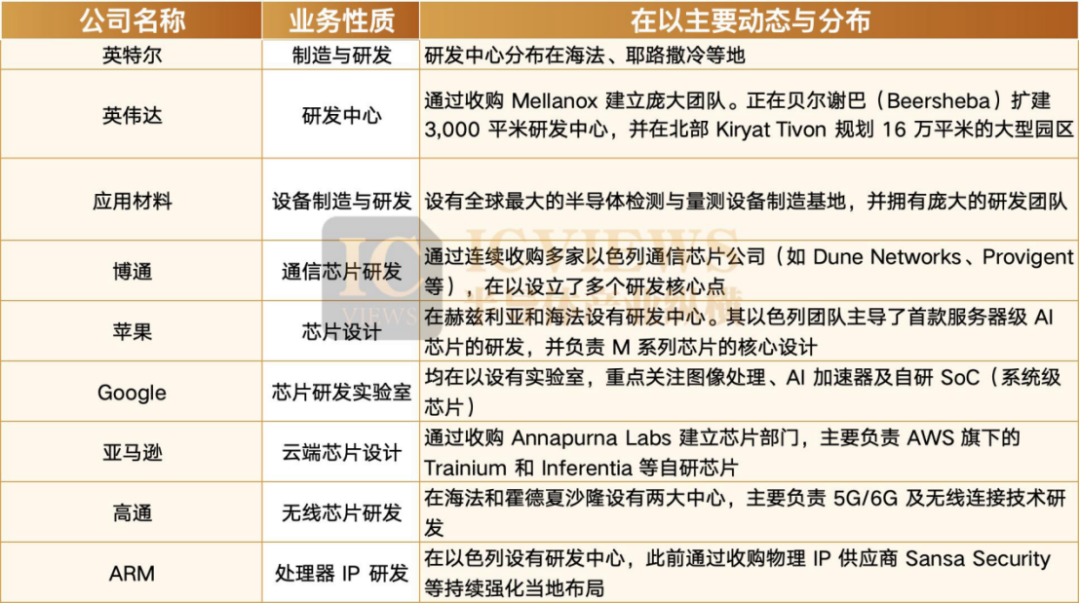
In essence, Israel's infrastructure is intricately linked to the continuity of global cloud services and AI computing power. As witnessed in the latter half of 2025, any disruptions at companies like Intel can trigger a domino effect in global semiconductor equipment manufacturing and supply. Should the regional situation deteriorate severely, it could disrupt the global chip supply within months and escalate prices for certain chips, particularly those related to high-performance computing and networking equipment.
02
Iran: Chips for the 'Cutting Edge'
Compared to Israel, Iran's semiconductor industry lags behind and lacks direct access to advanced-process chips. Iran's semiconductor sector is closely aligned with its political strategy, pursuing targeted, militarized self-sufficiency.
Iran Electronics Industries (IEI, also known as Sairan) is a core entity under the Ministry of Defense and is considered Iran's largest electronics enterprise. It operates through six subsidiaries, covering areas from radar systems and electronic warfare to satellite technology. Among them, the Electronic Components Industries (ECI) specializes in microelectronics and has a factory in Shiraz producing transistors, integrated circuits, multilayer PCBs, and hybrid circuits.
In chip applications for specific military purposes, Iran's semiconductor industry has demonstrated remarkable resilience. For instance, Iran's "Shahed-136" drones transform low-cost, readily available civilian electronic components into military weapons. It is estimated that Iran can produce around 400 such drones daily, with its inventory reaching 80,000 by early 2026. This mass production relies on reverse engineering Western and Asian parts, such as Sarmad Electronic Sepahan's successful reverse engineering of Japanese-origin servo motors and flowmeters, which are utilized in drones like the Mohajer-6.
In July 2024, Iran established the National Organization for Artificial Intelligence to foster technological development in the AI field. By 2025, Iran had constructed numerous tech parks or tech towns, such as the Isfahan Science and Technology Town (hosting enterprises in food, agriculture, steel manufacturing, ICT, and biochemical industries), the Khuzestan Science and Technology Park (an innovation center for petrochemicals and information technology), and the Semnan Science and Technology Park (hosting around 360 entities, including ICT, biotechnology, mining, and agricultural manufacturing). According to the law, tech companies are those that innovate, develop, and apply technologies in scientific fields and commercialize R&D results (including plans and production of products and services). Such companies require government approval. While the government encourages AI industry development, Iran's AI achievements are seldom reported.
03
War Targets the Tech Industry
Following Iran's announcement to close the Strait of Hormuz, about 170 container ships and over 450 oil tankers were left stranded. Global maritime insurance rates skyrocketed by 50% within days, with many major insurance providers even withdrawing war risk coverage. For the chip industry, which heavily relies on just-in-time delivery models, shipping delays mean that critical semiconductor materials and electric vehicle (EV) batteries needed for 2026 production are trapped in the Gulf region.
Air freight suffered even more severe disruptions. With the airspace of the UAE, Qatar, and Oman closed due to missile threats, global air cargo capacity plummeted. Dubai International Airport, the world's busiest aviation hub, was forced to shut down, severing the most critical logistical link in the global market. Air freight costs soared by 400% within 48 hours. For high-value, short-lifecycle premium chips and smartphones, this translates to extreme compression of profit margins and violent fluctuations in retail prices.
The repercussions of the conflict's spread in the Middle East are intensifying.
Crude oil prices swiftly surged past $100 per barrel after the conflict erupted. Rising energy costs directly translated into higher factory electricity expenses, freight surcharges, and increased prices for plastic and petrochemical raw materials, exacerbating the "electricity anxiety" of US computing power giants.
The US domestic power grid, plagued by aging infrastructure and complex permitting processes, can no longer meet the exponential growth in electricity demand from AI data centers. Goldman Sachs explicitly stated that by 2030, nearly all US power grids will face insufficient reserve capacity, a structural bottleneck that could give China a first-mover advantage in the AI competition.
The Middle East's significance to the global semiconductor industry, especially the AI sector, has evolved from being merely a "consumer" to an "indispensable infrastructure provider." The AI competition ultimately boils down to an energy competition. As the training demands of large language models continue to push up grid loads, regions like the Middle East, which can simultaneously offer extremely low-cost energy, abundant capital, and a relatively flexible regulatory environment, will become the main battleground for AI industrialization.
To address energy issues, the US has been accelerating cooperation with Middle Eastern countries on computing power centers. In May 2025, Trump visited the Gulf region and signed military, technology, and commercial deals worth $3.2 trillion with the UAE, Qatar, and Saudi Arabia, covering multiple cutting-edge tech fields such as AI and semiconductors.
Saudi Arabia is a crucial partner for US computing power. However, on the morning of March 3, local time, a loud explosion was heard at the US Embassy in Riyadh, Saudi Arabia. Iranian drones and missiles struck Saudi Aramco's Ras Tanura facility and directly hit Amazon AWS's data center in the UAE. AWS confirmed service disruptions at its data center due to physical strikes.
Saudi Arabia is not only home to US data centers; Huawei Cloud, Alibaba Cloud, and Tencent Cloud have all entered the Saudi data center market.
04
Final Reflections
During this conflict, whether AI is involved in warfare has become a hot topic of debate. Given the technological disparity between the two nations, if AI were to participate in war, the outcome might be swiftly decided. Microsoft and Amazon confirmed that their cloud services are supporting Israel's missile defense systems (such as Iron Dome and Arrow) in real-time target analysis. Despite facing ethical controversies, the tech giants emphasize the necessity of their technology in maintaining the stability of critical regional infrastructure.
If a butterfly's wings can stir a storm, what kind of hurricane will a barrage of missiles unleash? Even more terrifying than missiles is the unpredictable and increasingly unequal Middle Eastern landscape after AI joins the fray. AI has learned to think but lacks morality and humanity; meanwhile, humans use AI's ruthlessness as an excuse to expand harm.
The clash between the "Iron Shield Nation" and the "Sword of Revolution" persists. Amidst the chaos, there are no winners in this world.
-
![]()
AI Giants Start Borrowing to Fuel Computing Power Race
-
ByteDance Initiates Largest B2B Structural Adjustment, This Time It's Truly Different
-
![]()
Let's Talk About Kingsoft Office's Mid-Year Outlook and the True Strength of Its AI-Powered Office Solutions
-
Despite 150 Million Users, Struggles Persist: AIShige Faces Tough Competition from Seedance and Kling in AI Video Monetization
-
![]()
Ensuring Safe Gear Shifting in the Automotive Industry: Transitioning from 'Product Oversight' to 'Full-Chain Governance'
-
![]()
Net Profit Soars to $133.7 Billion! Azure Revenue Tops $100 Billion, with AI Fueling Microsoft's Growth
-
![]()
Before 6G Hits the Market, the U.S. Forges a 'Rules Alliance': What Challenges Await Chinese IoT Enterprises?
-
![]()
Intelligent Driving's 'Little Blue Light' Faces Ban: Night Glare and Cut-in Risks Prompt Official Action