“Lobster Farming” Trend Gains Momentum: Why Are Big Tech Firms Less Keen on Token Exports?
 03/13 2026
 512
512
Indirect Competition Outperforms Direct Rivalry
By Chen Dengxin
Edited by Li Ji
Formatted by Annalee
At present, the super-intelligent agent OpenClaw is the center of attention.
Amid the "lobster farming" trend, the focus of large model competition has shifted from model capabilities to application capabilities, propelling Tokens from the background to the forefront.
For a while, “OpenClaw’s massive Token consumption” sparked widespread discussion.
Coincidentally, China is abundant in Tokens—it has even ushered in a new era for Chinese exports: Multiple media outlets reported that, for the first time during the same period, the Token usage of Chinese large models has surpassed that of overseas counterparts, with significant contributions from models developed by MiniMax, DeepSeek, Zhipu, Moonshot AI, and StepFun.
This raises a question: Despite their vast Token resources, why haven’t internet giants become the main force in Token exports, even after launching various adaptation plans to embrace OpenClaw?
Cost Efficiency Takes Center Stage
In the AI era, Tokens reign supreme.
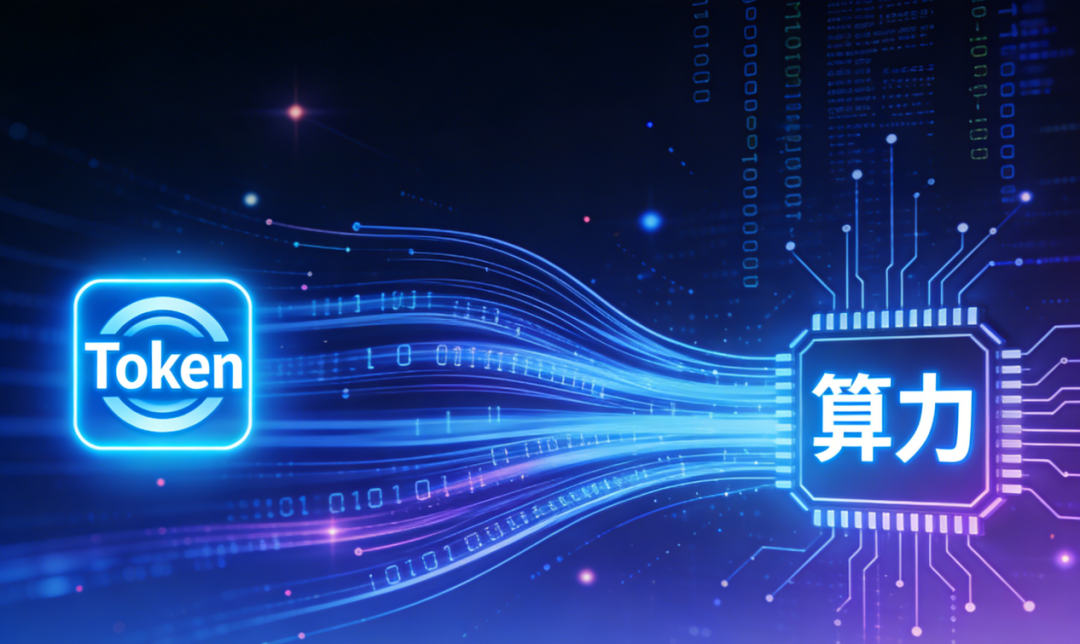
As digital units in computing, Tokens represent the smallest unit of computational power and serve as a key metric for measuring AI inference capabilities.
It is widely acknowledged that computational power demand can be broadly categorized into two scenarios: training and inference.
Training involves continuously feeding large amounts of data over an extended period, enabling large models to learn, digest, and master more knowledge, thereby becoming increasingly intelligent. Inference, on the other hand, leverages trained large models to empower external applications and facilitate AI implementation, a process that consumes a significant amount of Tokens.
Particularly after OpenClaw gained widespread popularity, it became evident that Token consumption has grown exponentially.
“Naobrain” stated: “Previously, AI interactions were limited to a simple Q&A chat mode, where an individual’s daily Token consumption would peak at the million level. However, things have changed. Once switched to AI task mode, daily Token consumption can reach the hundred-million level, marking a hundredfold increase in per capita usage.”
Against this backdrop, cost-effective Tokens have taken center stage.
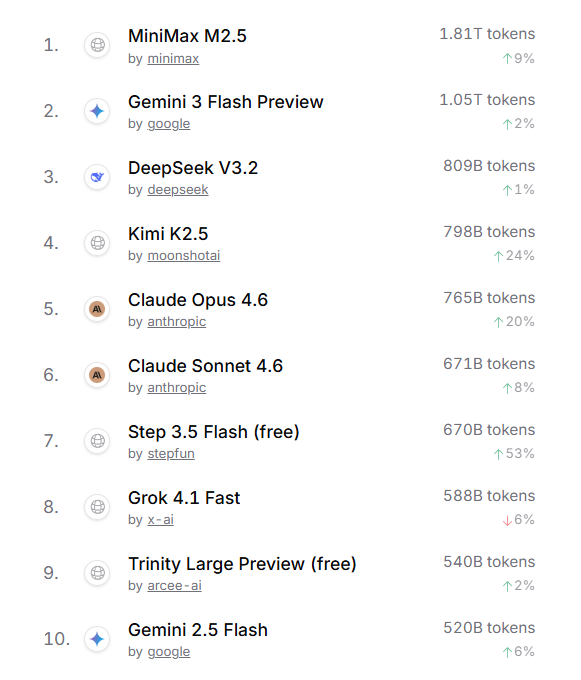
Recent data from OpenRouter reveals that MiniMax’s M2.5, DeepSeek’s V3.2, Moonshot AI’s Kimi K2.5, StepFun’s Step 3.5 Flash (free), and Zhipu’s GLM 5 have all ranked in the Top 10 for model Token usage, collectively accounting for half of the list.
Source: OpenRoute
Notably, the majority of users in this Token usage ranking are overseas, with Chinese users making up only 6.01%, providing an objective reflection of the real global appeal of Chinese large models.
In other words, OpenClaw has inadvertently spurred the accelerated export of Chinese Tokens.
The primary reason for this lies in cost: The input price for MiniMax M2.5 is $0.3 per million Tokens, and the output price is $1.1 per million Tokens. In contrast, Claude Opus 4.6 charges $5 per million Tokens for input and $25 per million Tokens for output—a stark difference in cost between Chinese and foreign models.
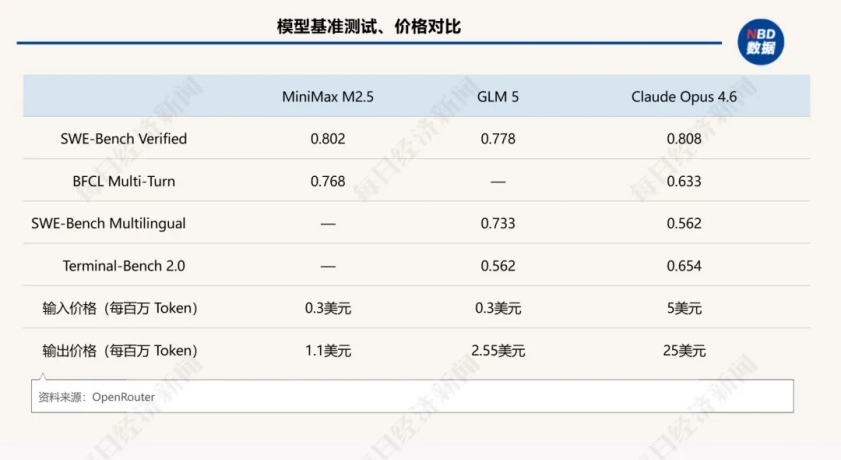
Source: National Business Daily
Huatai Securities pointedly noted: “Electricity and computational power account for over 70% of Token cost structures. China’s advantage in low electricity prices is being transformed into global AI service pricing power.”
Indeed, at the core of computational power lies electricity.
This means that the underlying logic of Token exports is essentially the export of electricity: When overseas users call upon the APIs of Chinese large models, the latter complete inference and provide feedback to overseas users through the conversion chain of “electricity → computational power → Tokens.”
As a result, Tokens have become a new medium for China’s export of electricity and computational power.
The latest data released by the National Energy Administration shows that China’s total electricity consumption in 2025 exceeded 10 trillion kWh for the first time, more than double the annual consumption of the United States and higher than the combined annual consumption of the European Union, Russia, India, and Japan.
“Jiou Studio” remarked: “When the wind from Gansu, the sunlight from Qinghai, and the water from Yunnan flow into the GPU arrays of western data centers through the ‘East Data, West Computing’ initiative, they are transformed into Tokens. These Tokens, leveraging systematic low costs, are sold abroad at high prices, becoming the ‘containers’ of the AI era.”
Market Expansion Still Hinges on Big Tech
Despite this, internet giants such as Baidu, Tencent, Alibaba, and ByteDance are unlikely to become the main players in Token exports in the short term.
This is because Tokens have become a “bellwether” for AI cloud services.
AI cloud represents the deep integration of AI and industries, serving as a critical hub for implementing large models and providing users with a continuous supply of Tokens, reflecting the actual demand for AI services.
Consequently, internet giants have been ramping up their investments in AI cloud.
This is evident from Alibaba Cloud’s bold declaration of “capturing 80% of the new share in China’s AI cloud market by 2026,” which surprised the industry.
Behind this ambition lies the rapidly growing AI cloud market.
According to IDC, in the first half of 2025, the usage of large models on China’s public cloud reached 536.7 trillion Tokens, nearly quadrupling compared to the entire year of 2024.
“In the new era of AI, computational power equals revenue; without computational power, Tokens cannot be generated; without Tokens, revenue growth cannot be achieved,” said Jensen Huang, founder and CEO of NVIDIA. He believes that global demand for Tokens is growing exponentially: “We have reached an inflection point where valuable Tokens are being generated—ones that not only enhance productivity for customers but also bring profits to cloud service providers.”
The issue, however, is that smaller players lag far behind internet giants in terms of infrastructure and AI capabilities, especially as competition intensifies and their survival space is further squeezed.
Even the renowned DeepSeek has lost some of its initial luster.
The “2025 Core Report on the Development of the AI Application Layer” reveals that as of December 2025, DeepSeek’s monthly active users stood at 135 million, down from 145 million in September of the same year—a loss of 10 million monthly active users within three months, representing a 25% decline from its peak.
In short, large models from MiniMax, DeepSeek, Zhipu, Moonshot AI, and StepFun are leveraging Token exports not only to engage in indirect competition and avoid ineffective internal competition but also to find new growth drivers for their businesses.
Take MiniMax as an example: In 2025, its revenue reached $79.038 million, a 158.9% year-over-year increase, with 73% of that revenue coming from international markets. Its products now cover over 200 countries and regions.
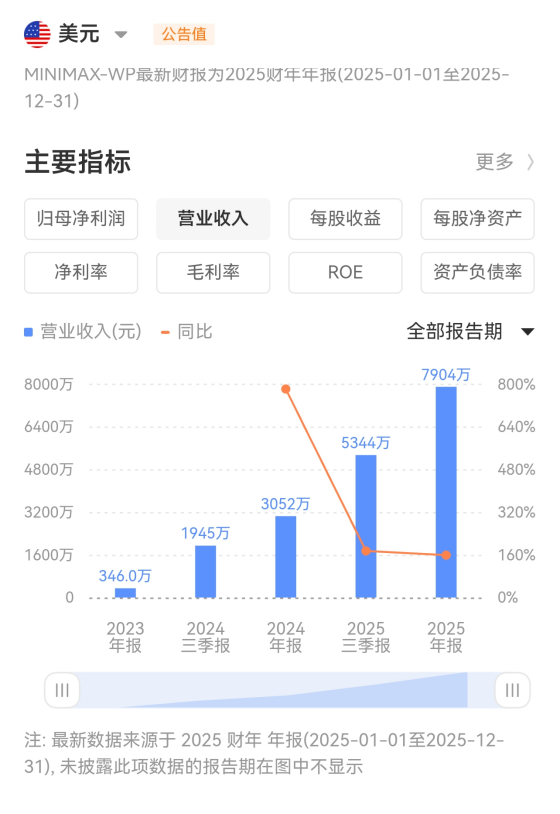
Source: Flush
Looking back, MiniMax achieved this by collaborating with platforms such as Google Vertex AI, Microsoft Azure AI Foundry, Fireworks AI, and Nebius AI, becoming the default model of choice for platforms like OpenCode and Kilo Code.
Yan Junjie, founder and CEO of MiniMax, defines the value of an AI platform as intelligence density multiplied by Token throughput: “Each generation of models has seen significant improvements in capabilities and usage. We have proven our R&D capabilities and our ability to handle model traffic.”
Clearly, while internet giants are busy expanding their domestic market share, smaller players are launching low-cost, dimension-reducing attacks overseas—each pursuing a promising future.
In fact, internet giants vary in their approaches to market expansion.
For instance, Baidu favors intelligent agents, believing they represent the mainstream form of future AI applications. With the advantage of being “easier to create than a webpage in the internet era,” intelligent agents can maximally satisfy users’ complex needs.
Simply put, intelligent agents act as multipliers for Token consumption.
Public data shows that over 30 million intelligent agents worldwide are now serving users, contributing to a nearly 300-fold increase in global daily Token consumption over the past two years.
Another example is ByteDance’s focus on AI intelligent assistants, with its Doubao app becoming a leader in AI applications. Especially after the Chinese New Year red envelope campaign, users increasingly turn to Doubao for answers.
According to Quest Mobile, as of December 2025, the monthly active users of mobile AI apps and PC AI apps reached 722 million and 205 million, respectively. Among them, Doubao ranked first with 226 million monthly active users, nearly equaling the combined user base of the next four players.
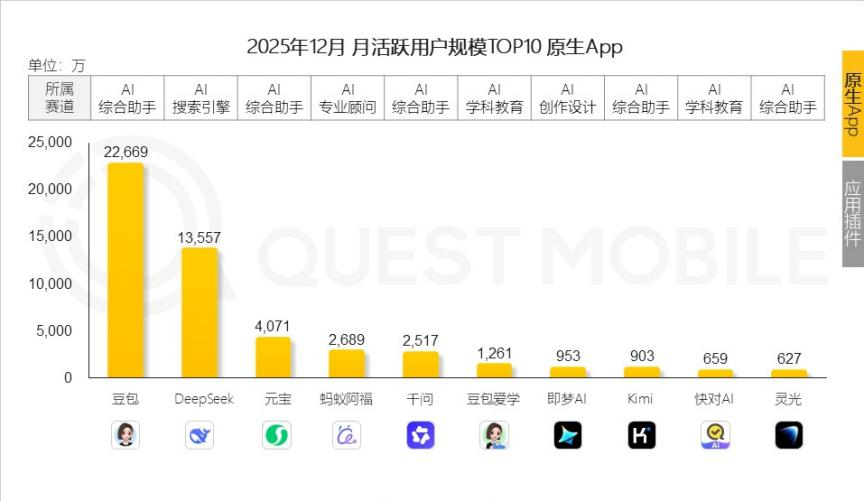
Source: Quest Mobile
As a result, Doubao leads the industry in Token consumption, ranking among the global TOP 3.
Official data shows that Doubao’s large model used 120 billion Tokens per day on average in May 2024. Today, its daily Token usage has grown more than 500-fold.
Wu Di, head of intelligent algorithms at Volcano Engine, stated: “By 2030, Token consumption in the domestic market will be more than a hundred times higher than today. By then, the core metric for measuring a company’s level of intelligence will shift from the number of GPUs it owns to the total amount of Tokens it consumes, as Tokens are the only unified indicator that can simultaneously reflect ‘model capabilities, usage frequency, and real demand.’”
It is worth noting that beyond internet giants, leading players in the mobile and automotive sectors also view Tokens as a critical means of embracing AI.
The most notable example is XPENG Motors.
XPENG’s second-generation VLA in-vehicle model has been deployed in 200,000 XPENG Ultra vehicles, consuming 58.8 trillion Tokens daily—a figure comparable to that of internet giants.
He Xiaopeng, chairman and CEO of XPENG Motors, stated: “I firmly believe that fully autonomous driving will become a reality in one to three years, and within three to five years, all cars will be super intelligent agents—and powerful ones at that.”
In summary, the rise of Token exports reflects internet giants vying for incremental domestic markets while smaller players avoid direct competition by opening up a “second front” overseas.
Undoubtedly, Chinese large models have become even more formidable.
-
![]()
AI Giants Start Borrowing to Fuel Computing Power Race
-
ByteDance Initiates Largest B2B Structural Adjustment, This Time It's Truly Different
-
![]()
Let's Talk About Kingsoft Office's Mid-Year Outlook and the True Strength of Its AI-Powered Office Solutions
-
Despite 150 Million Users, Struggles Persist: AIShige Faces Tough Competition from Seedance and Kling in AI Video Monetization
-
![]()
Ensuring Safe Gear Shifting in the Automotive Industry: Transitioning from 'Product Oversight' to 'Full-Chain Governance'
-
![]()
Net Profit Soars to $133.7 Billion! Azure Revenue Tops $100 Billion, with AI Fueling Microsoft's Growth
-
![]()
Before 6G Hits the Market, the U.S. Forges a 'Rules Alliance': What Challenges Await Chinese IoT Enterprises?
-
![]()
Intelligent Driving's 'Little Blue Light' Faces Ban: Night Glare and Cut-in Risks Prompt Official Action