The $5 Billion Unicorn Behind ByteDance's Seedance Viral Phenomenon
 08/10 2026
 495
495

Historically, China imported overseas models; now, the trend has reversed.
Written by | Landong Business Zhao Weiwei
"Sign up now to enjoy 7 days of unlimited access upon the launch of Seedance 2.5 on Higgsfield."
This is the latest advertising tagline from Higgsfield, a US-based AI video generation startup. Higgsfield doesn't develop its own models but instead provides orchestration services for video generation models like Google Veo, Kling, and Seedance.
Remarkably, Higgsfield operates with a lean team of just 150 people, including around 60 core engineers and product team members, and over 70 filmmakers with advertising experience. Despite being online for only 15 months, the platform has achieved an annualized revenue of $500 million, primarily catering to B-end advertising agencies.
Higgsfield is undoubtedly one of the companies reaping the benefits of the video creation model boom. Early this year, Higgsfield was valued at $1.3 billion during its fundraising round. Six months later, its valuation nearly quadrupled to $5 billion.
Another notable development in the past six months is that after ByteDance's Seedance 2.0 went viral, it accounted for over 40% of the token consumption on Volcano Engine, with overseas usage nearing 50%. Now, with Seedance 2.5 entering overseas markets, another wave of growth has commenced.
Chinese-made video generation large models dominate Higgsfield's platform, with Seedance taking the lead, followed by Kling 3.0, MiniMax H3, Alibaba's Happy Horse, and Wan 2.7. The collective strength of Chinese AI has fueled Higgsfield's valuation, helping it become a US AI unicorn.
Historically, China imported overseas models; now, Chinese video large models are supplying the global film and advertising industry. As the B-end emerges as the most certain direction in the AI industry, and AI video generation becomes the most commercially viable independent sector, Higgsfield's growth underscores two certainties:
On the production side, while model capabilities can be caught up or replaced, cloud collaboration networks form the competitive moat. User-accumulated assets exhibit a "stronger get stronger" characteristic. In terms of commercial closed loops, building end-to-end commercial links with advertising platforms, ultimately charging based on value results, and using agents to help brands improve product sales conversion are key.
A $500,000 Open-Source Initiative
Recently, Higgsfield open-sourced the secrets to creating an AI film.
"Hell Grind" is a 95-minute AI feature film, with every frame generated by AI. Produced by Higgsfield at a cost of $500,000, including $400,000 in computing expenses, the film was generated by Seedance 2.0 and showcased at the Cannes Film Festival Market this year alongside Volcano Engine.
The open-source materials provided by Higgsfield include 115,446 generation records, over a hundred asset folders organized by scene number, some video prompts extending up to 3,000 words, and three methodological documents outlining work rules. These materials have been viewed over 300,000 times.
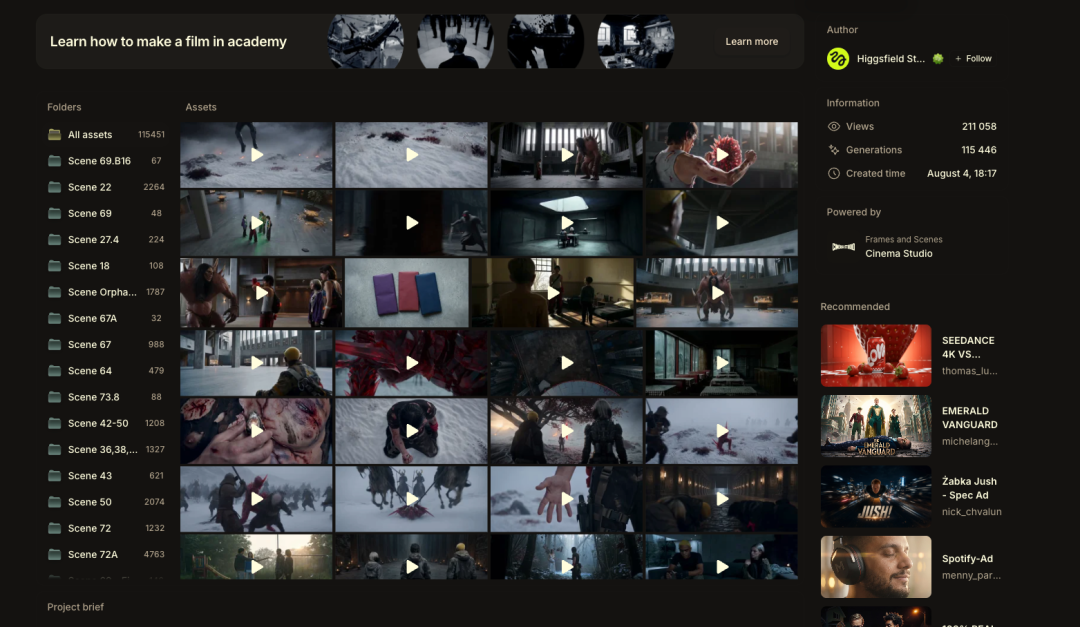
This open-source initiative addresses a systemic industry problem: video generation models lack memory. If a prompt fails to fully describe a protagonist, they may appear with a different face or outfit in the next shot. This open-source release provides a comprehensive work system to tackle these issues point by point. The released tool, named CINEDANCE, can automatically write video prompts based on all the above rules.
Given the $400,000 computing cost, each AI generation for this Cannes-bound AI film averaged $3.5. For AI filmmakers, this open-source release is akin to receiving $500,000 worth of tuition for free.
For instance, to overcome the model's lack of memory, character cards consist of three images: a facial close-up, a full-body front view, and a full-body back view. Each asset must pass a stress test before being locked: ten generations with different poses and lighting must be recognizable each time.
Another example: to orchestrate AI emotional performances, prompts cannot contain emotional words like "sad" or "angry." Instead, they describe muscle movements: the jaw clenches and relaxes, blood flows to the lip without wiping, a slow blink followed by two quick blinks. Dialogue can only appear in the audio block, with no words allowed in the action block; otherwise, the model may add unintended actions or chuckles.
Additionally, AI models do not remember who stood where in the previous shot, so accurate marking is needed during shot transitions. The team's solution is to write a pure text floor plan for each scene, indicating landmarks, left-right relationships, camera positions, and an impassable line. This is written once per scene and pasted for each subsequent shot. Each scene also begins with a one-second full shot without dialogue or action, allowing the model to take a "photo" of the positioning.
Most importantly, there is a dedicated folder in the asset library for rework records, totaling 14,593 entries, accounting for about 13% of the total.
The climactic action scene in the middle of the film consumed 4,000-5,000 generations per scene. By the later scenes (73.x), the same team used only a dozen or twenty generations per scene. The production brief explains this directly: the work formula only took shape near the end. This open-source report is that formula—the version the team wishes they had from day one.
In other words, behind the seemingly perfect AI filmmaking process lies a complex production workflow and massive computing consumption. The team wrote in the production brief: Every rule in this brief stems from a failed shot.
For the AI film and television industry, this batch of open-source assets may be more valuable than the film itself.
Not a Model Maker, but a Major Wholesaler
Higgsfield initially took a wrong turn.
Initially, Higgsfield AI's CEO, Alex Mashrabov (formerly of Snap's generative AI department), and CTO, Yerzat Dulat (from Kazakhstan), attempted to develop their own video generation model, challenging Sora. Later, they pivoted to become an AI video platform aggregating multiple models.
Mashrabov later explained the pivot: new video models are released almost weekly, and no single lab can win all scenarios. Binding to any one model would be a mistake.
For startups, "selling shovels" is more viable than "digging for gold."
Mashrabov shifted focus, offering Google Veo, Kuaishou Kling, and ByteDance Seedance on his platform, becoming a wholesaler. Users can send the same instruction to multiple models simultaneously and choose the best output. Responding to accusations of being a mere "wrapper," he argued that nearly all software companies will run on models they do not own, making the debate meaningless.
The real competitive advantage is not the model, which is a general-purpose capability that can be purchased. While anyone can access the same Seedance interface, they cannot obtain your project files, team collaboration processes, or accumulated film and television assets. The key is enabling multiple users to collaborate seamlessly, improving the experience over time, and generating network effects.
For ByteDance, it needs wholesalers like Higgsfield to promote its large models and showcase products like "Hell Grind" at Cannes. For US startups like Higgsfield, they need special cooperation rights with Seedance and to open-source "Hell Grind" to attract industry attention and investors.
On Higgsfield's platform, you can find the exclusive cooperative version Seedance 2.0 Enhanced Fast, along with Seedance 2.5.
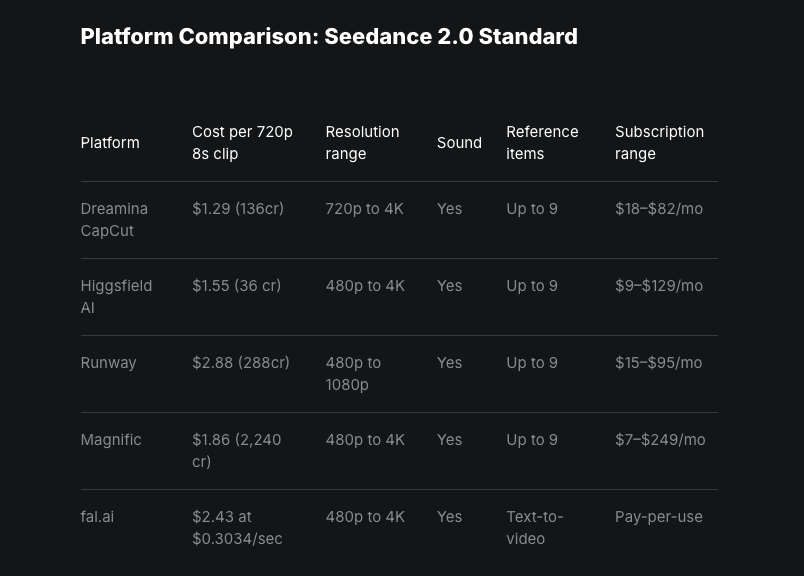
Comparing prices, occasional US users generating a small number of videos find the official Dreamina (CapCut) the most cost-effective for single uses. However, for long-term monthly subscriptions and high-frequency batch creation, Higgsfield AI offers the best overall value, with an entry-level subscription at just $9/month—the lowest among the four mainstream AI video subscription platforms.
This is a typical loss-leader pricing strategy: models are sold at cost, with profits made at a higher level.
According to a Sacra report, about 40% of Higgsfield's usage runs on workflow products like Cinema Studio and Marketing Studio, with an average annual spend of around $1,000 per user—five times that of Canva—and enterprise clients spending over $200,000 annually.
More importantly, Higgsfield has transformed model products from tools into workflows.
Seventy percent of its revenue comes from advertising agencies, providing B-end certainty. Previously, a US advertising creative director needed a crew, equipment, and a location to shoot an ad. Now, it can be done in a day, with actor changes, lighting adjustments, and ten variations all handled through software, allowing users to modify video characters and objects more easily.
Riding the wave of China's AI model development, Higgsfield's valuation has soared.
In January, Higgsfield completed an $80 million funding round led by Accel, valuing it at $1.3 billion with an annualized revenue of $230 million. A month later, Seedance 2.0 launched, followed by Kling 3.0 three days later, and Higgsfield secured an exclusive partnership.
By June, Higgsfield's revenue exceeded $500 million, and it raised $300-500 million at a pre-money valuation of $5 billion. This nearly fourfold valuation increase from $1.3 billion to $5 billion occurred in the four-month window between Seedance 2.0's launch and Seedance 2.5's announcement.
The $5 Billion Valuation Backed by Chinese AI
On July 31, ByteDance released Seedance 2.5, extending single-generation duration from 15 to 30 seconds. Days later, MiniMax launched H3 and announced open-sourcing model weights, with an API price of 0.8 RMB per second—about one-twelfth of Seedance 2.5's—and topped Hugging Face's trending list upon release.
Now, the two hottest Chinese models are on Higgsfield's shelves, with Seedance 2.5 slated for launch and H3 already in its model lineup. H3 entered overseas markets faster than Seedance 2.5.
Multimodal video large models are a high-barrier, high-profit sector. Despite varying analytical perspectives, "LatePost" reported Seedance's gross margin at 70%, while "36Kr" disclosed Seedance 2.0's gross margin reached 90%.
Meanwhile, Chinese video models increasingly rely on overseas markets for growth. Kling is the most extreme case: 70-75% of its revenue comes from overseas, especially North America, with annualized revenue nearing $1 billion. Kuaishou plans to spin off Kling and raise $2 billion.
ByteDance is no exception: as of late June, overseas usage of Seedance 2.0 grew from one-third to one-half. A transformation is underway—overseas models were once imported into China; now, Chinese video large models are supplying the global film and advertising industry.
Distribution platforms like Higgsfield are driving this growth. Additionally, a wave of overseas AI video SaaS, advertising agencies, and AI comic platforms have accessed models through BytePlus's official partnerships, fueling B-end demand for bulk production.
Especially in the AI short drama industry, driven by video models, Google and other companies project the overseas short drama market to exceed $6 billion by 2026, growing at over 60% YoY.
Is Seedance 2.5 or open-source MiniMax H3 stronger? Opinions vary.
On overseas tech forums, users have begun evaluations. Some believe Seedance 2.5 suits longer, reference-heavy projects requiring frequent revisions but at a higher price, while MiniMax H3 excels at short, clear prompts, ideal for videos conveying a single core creative idea without extensive revisions.
However, the two follow vastly different technical routes: H3 adopts an open foundation to capture developer ecosystems, further lowering the barrier to video generation bases, while Seedance 2.5 maintains a closed API.
Amid fierce competition between Seedance 2.5 and MiniMax H3, aggregator platforms like Higgsfield may benefit the most. They do not sell AI videos but certainty: models change weekly, but whether it's Seedance 2.5 or MiniMax H3, customers' workflows remain unchanged, and the established commercial closed loop for advertising remains intact.
-
![]()
Find X10 Series: OPPO's Dilemma Between Affordability and Innovation Amidst Memory Price Hike and AI Competition
-
Online Rumors Abound as Audi Refutes Claims of Disowning AUDI Amid Legal Action
-
Apple Finds Itself in a Tight Spot: Can't Sidestep Qualcomm's Reach, Even with Its Own Baseband Chips!
-
When Did Samsung Products Fade from Our Lives?
-
The Next Battle in AI Computing Power: The Rise of "Light"
-
![]()
Whose Golden Week Desperately Needs a Pair of AI Glasses?
-
Yunbao Intelligence Charges Towards IPO: Over 5,000-Fold Revenue Surge in 2.5 Years, Tencent Contributes Nearly 98% of Revenue
-
Field Test of Doubao at Work: Can a Company That Helps Users Kill Time Build a Product That Saves Them Time?", "Doubao, AI, Office Agent, User Growth, Commercialization