27% Market Share, But Only 500 Million in Annual Sales: The 'Number One' Dilemma of AR Glasses Brand XREAL
 04/03 2026
 606
606

Edited by Liu Junhong
In 2026, as the 'AR glasses battle' intensifies, how are industry players faring?
On April 1, Shenzhen-based AR glasses company XREAL officially submitted its prospectus to the Hong Kong Stock Exchange, preparing to go public as the 'first smart glasses stock' on the Hong Kong market.
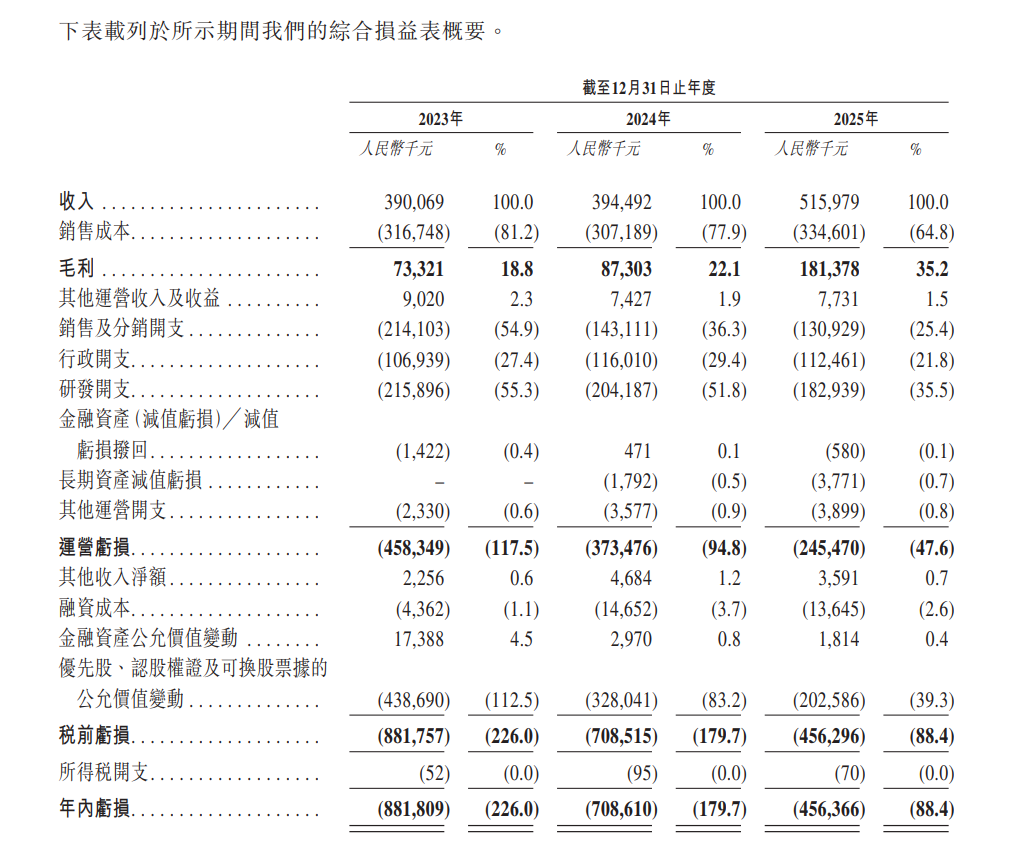
According to the prospectus, XREAL's revenue reached 516 million yuan in 2025, with a gross margin of 35.2%—a rare level of financial health in the smart hardware sector. However, the company is still operating at a loss, with adjusted net losses of 437 million yuan, 375 million yuan, and 250 million yuan over the period. Additionally, the prospectus notes that XREAL has held the top global market share in AR glasses for four consecutive years.
However, XREAL's seemingly strong data hides some 'regrets.' Its 516 million yuan in revenue is roughly on par with the annual revenue of a mid-sized restaurant chain.
Is this outcome due to XREAL not 'trying hard enough?' Clearly not.
From a revenue quality perspective, the company's gross margin climbed from 18.8% in 2023 to 35.2% in 2025, while adjusted net losses narrowed from 437 million yuan to 250 million yuan, indicating that XREAL is 'making significant strides forward.'
Behind the numbers in XREAL's prospectus lies the true awkward (awkwardness) of the AR glasses industry: Being the biggest fish in a small pond still means you're just a small fish.
Perhaps XREAL is already strong enough from a competitive standpoint. But in the broader consumer electronics landscape, the 'pool' for smart glasses remains too small.
Financial Breakdown: 'Sophisticated Poverty' Behind High-Growth Numbers
Opening XREAL's prospectus, the first thing that catches the eye is a set of impressive growth curves.
Financial data shows the company's revenue grew from 390 million yuan in 2023 to 516 million yuan in 2025, with a compound annual growth rate of around 15%. Gross margins doubled over three years, jumping from 18.8% to 35.2%. But when we drill down into the business fundamentals, a different story emerges.
First, there's the relatively single (singular) revenue structure. As a company selling smart glasses, XREAL's business truly 'only sells smart glasses.'
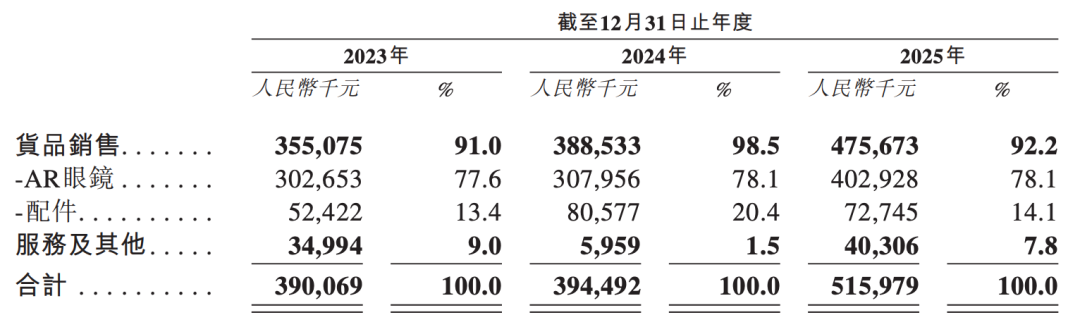
In 2025, out of XREAL's 516 million yuan in revenue, AR glasses sales accounted for 403 million yuan (78.1%), accessories for 73 million yuan (14.1%), and services and others for 40 million yuan (7.8%). This means the company relies almost entirely on hardware sales, with a heavy concentration on three product lines: the Air series (entry-level, average price ~1,656 yuan), the One series (mid-to-high-end, average price ~3,196 yuan), and the Light-Ultra-Aura series (flagship/developer edition, average price ~3,665 yuan). In 2025, the One series sold 111,000 units, accounting for most of the growth; the Air series sold only 17,000 units, a sharp decline from 104,000 units in 2024; and the Light-Ultra-Aura line sold 4,973 units for the year.
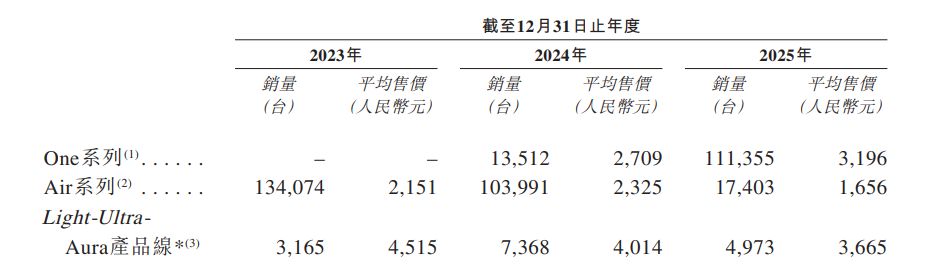
This sales structure—'entry-level shrinking, mid-to-high-end exploding'—explains the company's gross margin improvement, as the One series has a significantly higher margin than the Air series. But it also reveals a problem: XREAL is shifting from 'volume' to 'value,' a typical characteristic of small markets.
This market performance has been seen in many innovative hardware industries, such as early robotic vacuum cleaners. Generally, a healthy market sales structure should follow a 'pyramid' model, with the most sales at the entry level and fewer at mid-to-high tiers. But in small markets, entry-level products struggle to achieve scale to 'amortize' costs across the product line. To further boost revenue, manufacturers must enhance the experience of 'fully loaded' products, which naturally leads to price increases.
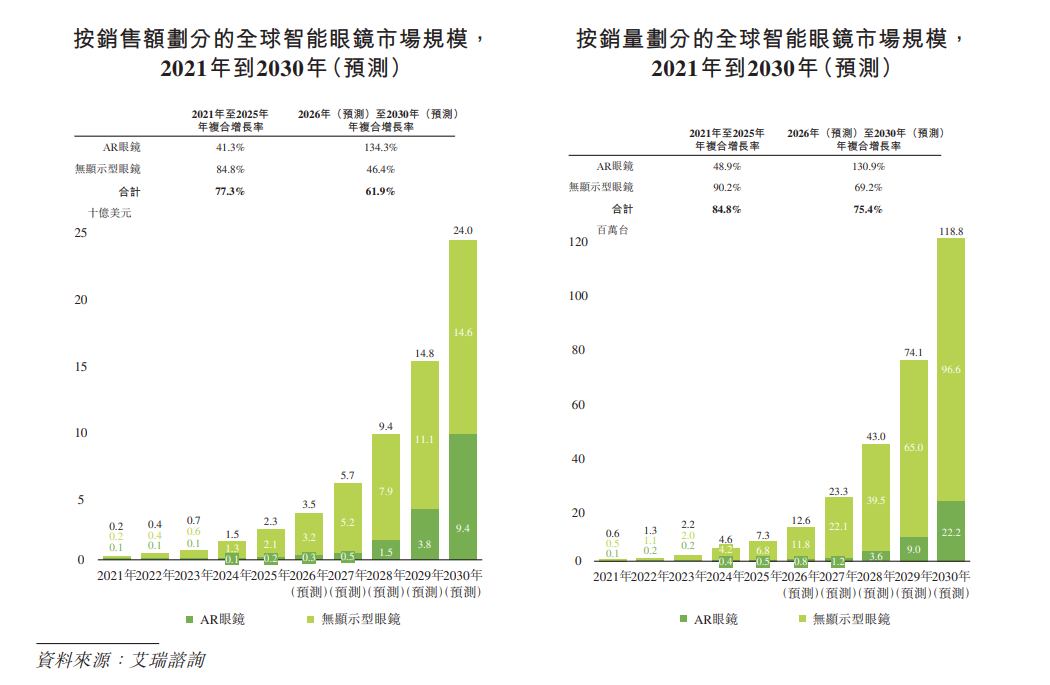
According to iResearch data, by sales revenue, XREAL ranked first globally in the AR glasses market for four consecutive years from 2022 to 2025. In the overall smart glasses market, including non-display smart glasses, XREAL ranked second globally and first in China by sales revenue in 2025. That year, XREAL held a 27.0% revenue market share and a 24.8% unit market share in global AR glasses, both ranking first.
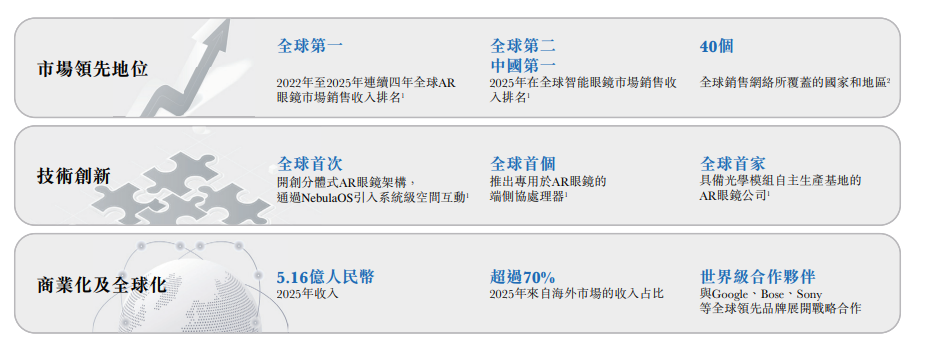
But from another perspective, XREAL's 516 million yuan in revenue proves just how small the overall market is. Compared to the TWS earphone or smartwatch markets, AR glasses are barely a fraction.
Though the market is small, the 'AR glasses battle' means companies can't afford to 'rest easy.' Research and development (R&D) and sales expenses must both be maintained.
The prospectus shows that from 2023 to 2025, XREAL's R&D expenses were 216 million yuan, 204 million yuan, and 183 million yuan, respectively. While the absolute figures declined, R&D as a percentage of revenue dropped from 55.3% to 35.5%. The prospectus attributes this to 'improved R&D efficiency,' but another interpretation could be that when the market ceiling is visible, increasing R&D becomes 'less cost-effective.'
As of the end of 2025, XREAL held 382 patents in China and 99 overseas, covering optical design, end-side coprocessor architecture, spatial perception algorithms, and other fields. However, in a small market, these technological barriers feel more like 'sophisticated toys'—you may have the best technology, but few consumers are willing to pay for it.
Moreover, while XREAL's 35.2% gross margin looks attractive, after subtracting sales and distribution expenses (131 million yuan), R&D expenses (183 million yuan), and administrative expenses (112 million yuan), the company's adjusted net loss still stood at 250 million yuan. In 2025, XREAL sold a total of 133,731 glasses, meaning it lost about 1,800 yuan per unit sold.
Thus, to maintain long-term competitiveness, XREAL has no time to 'hold firm.'
By the end of 2025, XREAL's cash and cash equivalents had dwindled to just 64 million yuan, down sharply from 205 million yuan in 2024. While the prospectus explains this as primarily due to increased inventory and operating cash outflows, it's clear to any observer that for a company still posting losses with tight cash flow, an IPO is now a 'must' rather than an 'option.'
The Moat and the Future: How Can the Big Fish in a Small Pond Swim to the Deep Sea?
Given how small the market is, what story is XREAL telling itself?
That story revolves around two keywords: technological positioning and ecosystem bets.
Unlike most AR glasses makers, which rely on an 'assembly model,' XREAL is one of the few players in the smart glasses space pursuing 'full-stack self-research.' From the X-Prism optical engine and X1 end-side coprocessor to the NebulaOS operating system and Real3D spatial algorithms, XREAL has built a vertically integrated technology system.
This deep integration results in a generational leap in product experience. Take Motion-to-Photon (MTP) latency, for example: XREAL's X1 chip reduces this metric to below 3 milliseconds, while the industry average typically ranges from 10-20 milliseconds. Its spatial anchoring algorithm achieves a jitter rate below 0.5mm, meaning virtual objects remain virtually 'motionless' in real space. To maximize its technological capabilities, XREAL established an automated manufacturing base in Wuxi in 2021, becoming the world's first AR glasses company with independent optical module production capacity.
Together, these technologies allow users to view spatial content 'as if holding a large screen steadily,' significantly reducing the 'motion sickness' often associated with AR viewing.
How will XREAL monetize these technological advantages? So far, the company has chosen a smart strategy: becoming a 'hardware partner' for tech giants.
XREAL's most notable strategic shift occurred between 2024 and 2025. The company moved from heavily promoting its self-developed NebulaOS to deepening cooperation with Google, becoming the 'chief hardware partner' for the Android XR platform. Its next flagship product, Project Aura, is expected to run on Android XR, integrating Google's Gemini AI and multimodal perception capabilities.
This is a pragmatic trade-off: while a self-developed OS offers control, in a small market, developers have little incentive to build apps exclusively for your platform. Embracing Android XR means surrendering some control in exchange for access to the entire Android ecosystem.
The prospectus reveals that XREAL is collaborating with ASUS ROG to develop 240Hz high-refresh-rate gaming glasses, exploring smart cockpit AR experiences with NIO, and launching custom AR glasses with leading Chinese smartphone makers. These partnerships reflect XREAL's willingness to pivot from NebulaOS to an 'open-source ecosystem' strategy.
This 'B-end empowerment + C-end exploration' dual-drive approach could be key to breaking through XREAL's revenue ceiling. In 2025, revenue from technology development services for enterprise clients reached 40 million yuan, accounting for just 7.8% of total revenue but with a significantly higher gross margin than hardware sales. This suggests XREAL may explore a subscription-based business model for AI software services—when hardware sales hit market capacity limits, software and services could become a second growth engine.
But before that, XREAL's top priority is to maintain its current position.
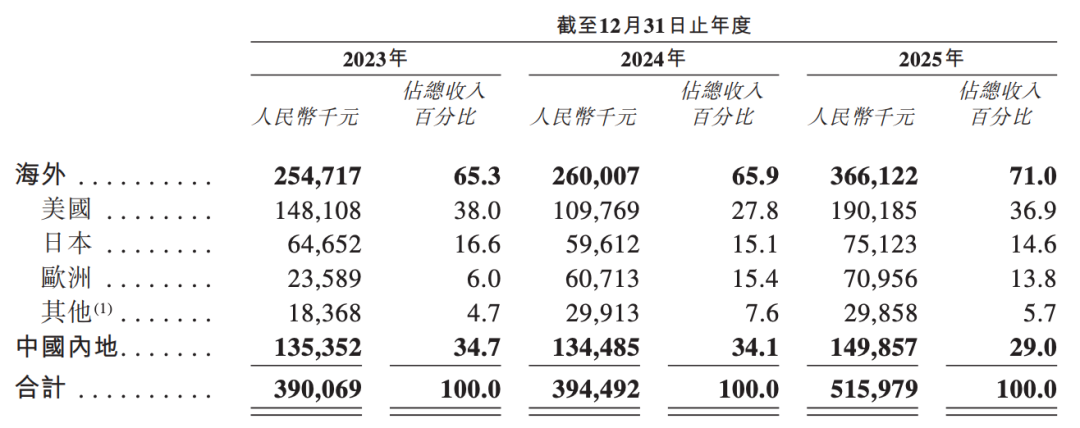
XREAL's global performance has been strong. In 2025, over 70% of its revenue came from overseas markets: the U.S. accounted for 36.9% (~190 million yuan), Japan for 14.6%, and Europe for 13.8%. The company operates in 40 countries and regions, with local sales and operations teams in North America, Europe, and Japan.
This ability to 'compete away from home' sets XREAL apart from many domestic competitors. While the domestic AR glasses market is mired in price wars, XREAL can command higher brand premiums overseas. The prospectus notes that 70.8% of XREAL's revenue comes from direct sales, meaning the company controls user data and brand perception, laying the groundwork for future software service monetization.
Conclusion
XREAL's prospectus offers a classic case study of a 'small but beautiful' company.
It proves that in China's hard tech entrepreneurship landscape, deep technological focus, global expansion, and partnerships with ecosystem giants can build a solid competitive moat in an early-stage market. But it also lays bare the harsh reality of the AR glasses industry: before market demand truly explodes, even the global leader cannot escape the constraints of a 'small market.'
According to iResearch projections, the global AR glasses market will reach $9.4 billion by 2030. If this comes to pass, XREAL could achieve exponential revenue growth by leveraging its first-mover advantage. But if market growth falls short of expectations, or if giants like Apple and Meta enter more aggressively, XREAL's 27% market share could quickly dilute.
Regardless, XREAL's choices deserve respect. In the marathon of hard tech, survival often depends not on explosive power but on endurance and a clear sense of direction.
-
![]()
Smartphone Prices Surge Amid Manufacturer Anxiety
-
![]()
Orbbec Soars to Record Heights, Eyes Further Capital Influx of 980 Million!
-
![]()
Tongding Interconnect Sets Up Shop in Shaoguan with 800 Million Yuan in Registered Capital
-
![]()
Before Kimi’s A-Share Debut, Zhipu Aims to Secure More 'Strategic Funding'
-
![]()
Innovative Leap | Fiber-Pluggable 1470nm Laser Source: Revolutionizing Precision Laser Weeding
-
![]()
73-Day Rapid Listing: Where Does Unitree's Wang Xingxing's 'Sense of Urgency' Come From?
-
![]()
AI Project Mindverse, Backed by Meituan, Faces Data Inflation Allegations Over Its Macaron Product
-
![]()
3000-word In-Depth Analysis | What Makes Physical AI So Magnetic? It Has Captivated Masayoshi Son, Jensen Huang, and Justin Sun All at Once