Can a Few Tesla Veterans Alleviate Lei Jun's Sales 'Worries'?
 04/08 2026
 458
458
Produced by Leida Finance | Text by Ding Yu | Edited by Meng Shuai
Rumors are swirling that Xiaomi Auto has 'poached' several former Tesla executives, potentially infusing its organizational structure with 'new energy'.
Recently, the market has been rife with news that Kong Yanshuang, the former General Manager of Tesla China, and Song Gang, the former Vice President of Manufacturing at Tesla's Shanghai plant, are set to join Xiaomi Auto.
Public information indicates that both individuals were pivotal figures in Tesla's China operations. Kong Yanshuang has long been instrumental in shaping Tesla's sales system and brand promotion in the Chinese market, while Song Gang oversaw the construction and ramp-up of Tesla's Shanghai Gigafactory.
Analysts suggest that if the rumors of Kong and Song joining Xiaomi Auto prove true, the company's sales and production systems could receive a substantial boost, potentially leading to new breakthroughs in market expansion and production capacity enhancement.
Reflecting on 2025, it was undoubtedly a landmark 'harvest' year in Xiaomi Auto's development. That year, Xiaomi Auto delivered 411,000 new vehicles, marking a staggering 200.4% year-on-year surge, and successfully propelling its smart electric vehicle business revenue up by 221.8% to RMB 103.3 billion.
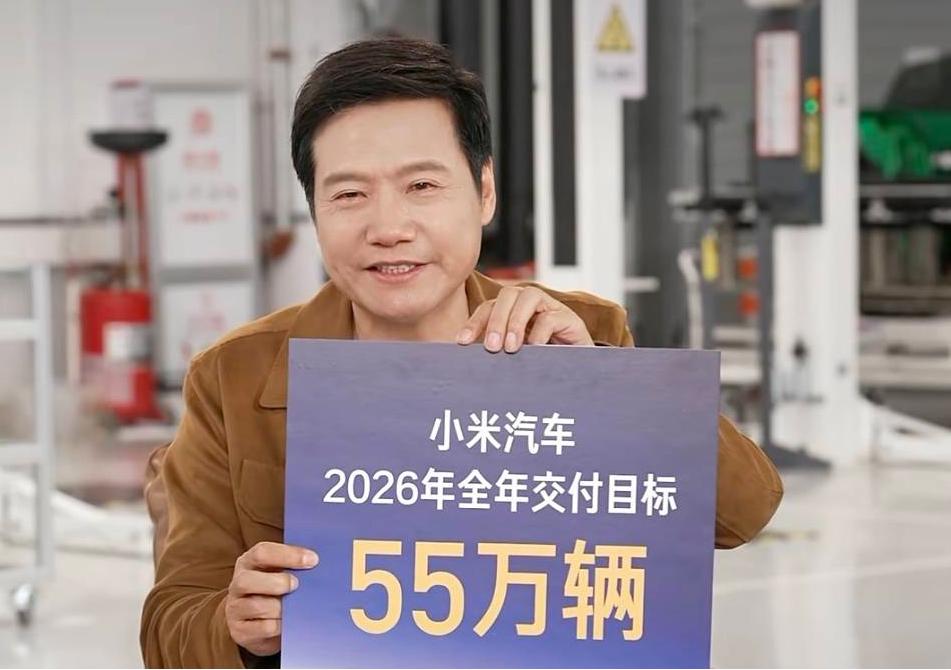
Looking ahead to 2026, Lei Jun has set an ambitious target of delivering 550,000 vehicles for the year. However, considering the cumulative deliveries of over 79,000 units in the first quarter, Xiaomi Auto needs to achieve an average monthly delivery of 52,000 units for the remainder of the year to meet this goal. Yet, last year, Xiaomi Auto only surpassed 50,000 deliveries in December.
'Poaching' Former Tesla Key Figures: Focusing on Both Sales and Production
According to a recent report by Jiemian News, Kong Yanshuang, the former General Manager of Tesla China, joined Xiaomi in early March and will assume automotive sales responsibilities from Li Xiaorui, the former Director of Xiaomi Auto. Currently, Kong is in the process of transitioning, and Xiaomi has not yet officially announced her specific position.
According to Sina Technology, Kong Yanshuang began her career at EF English and served as the store manager of Tesla's Jinqiao store in Shanghai before being promoted to Sales Director for Tesla's Shenzhen region.
Promoted by Wang Hao, the then General Manager of Tesla China, Kong Yanshuang rapidly ascended in her career, holding positions such as General Manager of Tesla's South China region and General Manager of China.
During her tenure at Tesla, Kong Yanshuang played a crucial role in shaping Tesla's sales system and brand promotion in the Chinese market. In November 2022, Tesla's monthly sales exceeded 100,000 units, with the Model Y becoming the best-selling model in the Chinese market.
In May 2024, following a management reshuffle at Tesla, Kong Yanshuang was transferred to the Shanghai region to replace the former sales head, continuing to participate in the management and expansion of Tesla's sales system in China.
According to Jiemian News, another Tesla veteran, 'Eason,' joined Xiaomi Auto around the same time as Kong, serving as the 'Political Commissar' of the automotive department and a member of Xiaomi's Staff Department.
The Xiaomi Group Staff Department is a core unit that assists the CEO in formulating and overseeing the implementation of the group's development strategies, holding significant influence within Xiaomi Group.
A source close to Xiaomi stated that it is rare for new hires to directly join the Staff Department, highlighting the exceptional capabilities of the individual in question.
Additionally, according to a recent report by Lanjing News, Song Gang, the former Vice President of Manufacturing at Tesla's Shanghai plant and a key figure in overseeing the construction and ramp-up of Tesla's Shanghai Gigafactory, is also set to join Xiaomi Auto.
Public information reveals that Song Gang previously worked at General Motors and Ford before joining Tesla in 2018 as Vice President of Manufacturing at Tesla's Shanghai Gigafactory, earning him the nickname 'Ace Plant Manager.'
On his LinkedIn page, Song Gang claimed to be the first employee at Tesla's Shanghai Gigafactory, having participated in the construction of the world's top-ranked vehicle assembly plant, battery factory, and drive unit factory.
On December 18, 2024, Song Gang departed from Tesla and swiftly joined Envision Energy a few days later as Senior Vice President of Integrated Supply Chain.
A source revealed that Song Gang's appointment at Xiaomi Auto could be as Plant Manager, partnering with Ji Guowei. The role of Plant Manager is highly critical, given the large workforce and heavy management responsibilities at Xiaomi Auto's factories.
Analysts believe that Song Gang's extensive experience at Tesla's Shanghai plant has equipped him with an efficient manufacturing methodology encompassing supply chain management, production line optimization, and quality control. This methodology could serve as a robust foundation for Xiaomi Auto to achieve high-efficiency, high-quality mass production and delivery.
Q1 Deliveries Exceed 79,000 Units, Annual Sales Target Remains Challenging
Amid the recent flurry of 'recruitment' news, Xiaomi Auto, despite its history of 'sales miracles,' is currently facing certain sales pressures.
Based on sales data from the first three months of this year, Xiaomi Auto sold over 39,000 units in January, over 20,000 units in February, and over 20,000 units in March, totaling over 79,000 units in the first quarter.
Compared to the approximately 76,000 deliveries in the same period last year, the growth in the first quarter of this year is not particularly significant.
Based on a rough estimate using the lower bound of Xiaomi Auto's disclosed monthly delivery figures, the company needs to achieve an average monthly delivery of over 52,000 units in the remaining three quarters of 2026 to ensure the successful attainment of the annual target of 550,000 units.
However, currently, Xiaomi Auto's monthly deliveries only surpassed 50,000 units in December last year, indicating that the tasks of ramping up production capacity and expanding the market remain arduous.
Nevertheless, considering that the first quarter coincided with the transition between the old and new generations of the Xiaomi SU7, sales may rebound in the subsequent period.
The new generation of Xiaomi SU7 commenced deliveries on March 23 this year. On April 1, Xiaomi Auto announced its latest monthly delivery figures: over 20,000 units in March, including 7,000 cumulative deliveries of the new generation SU7.
During the live teardown of the new generation SU7 on April 2, Lei Jun revealed that the lock-in orders for the new generation SU7 have exceeded 40,000 units.
However, compared to the launch of the initial SU7 in late March 2024, this figure does not represent a particularly impressive increase. On April 3 of that year, Lei Jun disclosed at the first delivery ceremony at the Xiaomi Auto factory store in Beijing that the Xiaomi SU7 had received over 100,000 reservations, with lock-in orders exceeding 40,000 units.
A Xiaomi Auto employee told Jiemian News that Xiaomi Auto's retail system was initially planned with reference to Tesla's model. Currently, a significant proportion of provincial company heads and regional managers have a Tesla background.
Xiaomi's previous channel model was '1+N.' '1' represents Xiaomi Auto's self-built and self-operated delivery centers, primarily focused on delivery and covering 'sales and after-sales service' businesses. 'N' represents agency sales (agent sales) and user service touchpoints.
A leading Xiaomi dealer also stated that in the past two years, Xiaomi Auto had focused more on product and brand development, neglecting the individual value of frontline sales. Since November last year, with the arrival of personnel from Tesla, there has been an emphasis on 'process optimization, data analysis, and comprehensive management of personnel, inventory, and venues,' resulting in a noticeable improvement in frontline sales capabilities.
In the dealer's view, Xiaomi Auto's orders are no longer following an 'explosive' pattern, necessitating the strengthening of the automotive sales team to navigate the upcoming period of stable sales. Tesla's systematic and structured approach to talent development aligns well with Xiaomi's current pace.
In addition to focusing on sales, to support the annual sales target of 550,000 units, Xiaomi Auto is also accelerating its production capacity layout (layout).
According to Lanjing News, a source revealed, 'Xiaomi Auto already has two factories in Beijing—one in operation and one awaiting licensing. A third factory is also planned.'"
'It is reported that the total production capacity of Xiaomi Auto's Beijing plants has reached 450,000 units. The Phase I and Phase II factories are operating at full capacity, with an annual production capacity of approximately 300,000 to 330,000 units. The Beijing Phase III factory commenced operations after the 2026 Spring Festival, with a designed annual production capacity of 150,000 units.
Furthermore, Xiaomi Auto's Wuhan plant is also scheduled to commence operations in May 2026, with an annual production capacity of 150,000 units.
'In-House' Foundations, 'External' Reinforcements Continue to Flow In
Leida Finance notes that during the preparatory and foundational stages of Xiaomi Auto, its core team primarily consisted of internal Xiaomi backbone (backbone members) and senior executives from traditional automakers.
Rewinding to March 2021, at the Xiaomi Spring New Product Launch Conference, Lei Jun officially announced Xiaomi's foray into the smart electric vehicle sector, describing it as the last major entrepreneurial venture of his life, for which he was willing to stake his entire reputation.
According to Tianyancha, Xiaomi Auto Co., Ltd. was registered in September 2021. At that time, Lei Jun personally took charge as Executive Director and Manager, underscoring Xiaomi's commitment to its automotive business.
From April to September of the same year, Xiaomi established a car team of several hundred members to conduct extensive user research and supply chain inspections. Meanwhile, the preparatory group for Xiaomi Auto had also taken shape.
Li Xiaoshuang, former General Manager of Xiaomi's Major Appliances Division, was primarily responsible for preparations related to vehicle manufacturing, supply chain, and factories. Yu Kai, former Deputy Chief of Staff, oversaw preparations for the cockpit business. The autonomous driving business fell under the purview of the Xiaomi Technical Committee, with its Chairman, Ye Hangjun, responsible for preparations.
A year later, the product department under Li Xiaoshuang's leadership was entrusted to Yu Liguo. Yu had previously served at BAIC for many years and held the position of President of BAIC's ARCFOX brand. In the latter half of 2021, he officially joined Xiaomi Auto, working in the Comprehensive Management Department of the Automotive Division.
Subsequently, leveraging his outstanding capabilities, Yu Liguo was appointed Vice President of Xiaomi Auto and Political Commissar of Xiaomi Auto's Beijing Headquarters, responsible for overseeing comprehensive management, advancing special projects, and organizing and developing talent at Xiaomi Auto's Beijing Headquarters.
During that period, Xiaomi Auto actively recruited outstanding executives from traditional automakers to bolster its team. For instance, Hu Zhengnan, former President of Geely Research Institute, joined Xiaomi's car-building efforts as a Senior Advisor, overseeing vehicle manufacturing.
In August 2022, Zhou Xing, former Deputy General Manager of SAIC-GM-Wuling's Sales Company, joined Xiaomi Auto as Marketing Head.
In May 2023, Wen Fei, former CEO of Great Wall Motor's Saloon Brand, joined Xiaomi Auto, succeeding Zhou Xing as Marketing Head.
In June of the same year, Huang Zhenyu, Vice President of Xiaomi's Automotive Division, concurrently served as General Manager of the Supply Chain Department within the Automotive Division. He had previously been Vice President of Magna's China region, a global supplier.
At the beginning of 2025, Xiaomi Auto underwent another round of personnel adjustments. Yu Liguo, Vice President of the Automotive Division, was placed in charge of the Smart Manufacturing Department, factories, and the System Operations Department. Huang Zhenyu, Vice President of the Automotive Division, continued to serve concurrently as General Manager of the Supply Chain Department and General Manager of the Quality Department. Yu Kai, previously responsible for preparations for the cockpit business, was appointed General Manager of the Product Department.
If Xiaomi Auto successfully recruits several key talents from Tesla, will it be able to smoothly achieve its annual sales target of 550,000 units? Leida Finance will continue to monitor the situation.
-
![]()
AIS-3700 Integrated Module | Synchronous Monitoring of PM2.5 and CO₂ for a High-Quality, Healthy Cabin
-
![]()
Alibaba and Google March Together in the Agent Era
-
![]()
"National Shrimp Farming": 50 Days of AI Arbitrage Frenzy and Its Sudden End
-
![]()
NetEase’s Timeless Classics Shine in Q1, Reinforcing Global Expansion
-
From 'Construction' to 'Effective Management': Shenzhen's Innovative Approach Tackles the 'Last Mile' Challenge in Telecom Governance
-
![]()
A New Yardstick in the AI Era Measures the Path of Tech Giants
-
![]()
Daily Earnings of $650 Million Fall Short: What’s Next for NVIDIA’s Growth Trajectory?
-
![]()
Industrial Integration: Kepler Chooses a Smarter Path