Optical Communication and Robot Vision: OFILM’s Bold Transformation Amid a 460 Million Yuan Loss
 07/10 2026
 455
455
Recently, Jiangxi OFILM Optical Micro-Nano Devices Co., Ltd. has been officially established. According to equity disclosures, OFILM Group holds a 99.5% stake in the company, while Jiangxi OFILM Optics owns the remaining 0.5%. The legal representative is Huang Lihui, who serves as the general manager and vice chairman of OFILM. The company’s business scope encompasses the manufacturing and sales of optical communication equipment, the sales of functional glass and new optical materials, as well as the production of optical instruments.
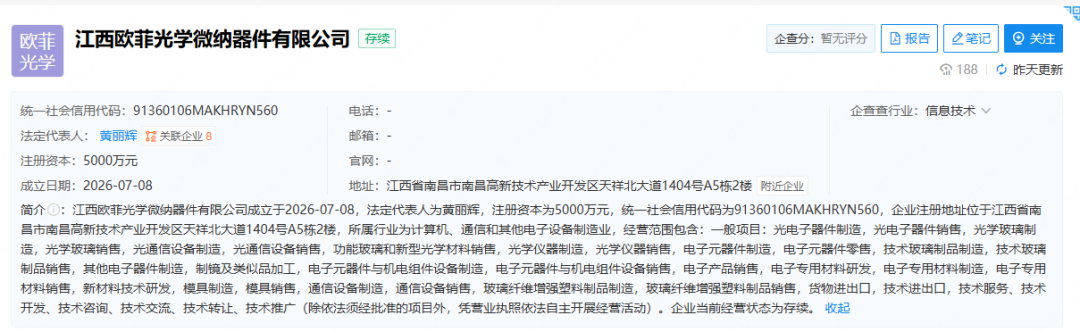
Image source: Qichacha
This move is not an isolated event. Earlier this year in June, OFILM Machine Vision Technology (Jiangxi) Co., Ltd. completed its registration with a registered capital of 50 million yuan. On July 7, OFILM announced the independent operation of its machine vision segment, which was previously part of the Microelectronics Division.
In terms of equity structure, OFILM Microelectronics (Nanchang) Co., Ltd. holds a 99.5% stake, with Jiangxi OFILM Optics Co., Ltd. owning the remaining 0.5%. This arrangement indicates that OFILM exercises indirect control over the company through its subsidiaries. It is reported that this business segment has already entered the supply chains of leading embodied intelligence companies such as UBTECH and Deep Robotics, while also serving as a core supplier for intelligent cleaning equipment companies like ECOVACS and Roborock.
This clearly demonstrates that OFILM is significantly accelerating its strategic adjustments, reflecting its urgency and determination during this critical transformation period.
From the perspective of optical communication, the micro-nano devices company focuses on optical passive components for optical modules and optical interconnection applications. Insiders reveal that the company plans to deploy substrate technology and packaging processes for advanced packaging, as well as multi-channel fiber optic component technology in the optical interconnection field. These initiatives will provide platform support for the evolution of next-generation high-speed optical communication interconnections, synergizing with OFILM's existing resources in the optical communication sector.
New Fiber Optic Communication Technology Co., Ltd., founded by OFILM's founder Cai Rongjun in 2020, specializes in the research, development, and manufacturing of high-speed optical modules. Recently, New Fiber Optic disclosed that it currently has a monthly production capacity of 100,000 units for 800G optical modules and 40,000 units for 1.6T optical modules, with plans to further expand its production lines.
The establishment of the micro-nano devices company essentially fills a gap in the upstream of the optical module supply chain—optical passive components and advanced packaging. This creates a division of labor where "New Fiber Optic produces finished optical modules, while micro-nano devices supply upstream components." This arrangement forms a complete chain from components to finished products both within and outside the OFILM ecosystem.
From a market perspective, this positioning aligns with the industry's explosive growth window. According to UBS forecasts, the global optical module market is expected to reach USD 37.37 billion by 2026, with a year-on-year growth rate of approximately 149%. OFILM's entry into the optical passive components and advanced packaging segments at this time clearly aims to secure a position for next-generation optical communication technology standards in advance.
However, in stark contrast to its strategic enthusiasm, the company faces real financial pressures, as reflected in its financial reports. On the evening of July 7, OFILM released its 2026 semi-annual performance forecast, projecting a net profit loss of 360 million to 460 million yuan for the first half of the year.
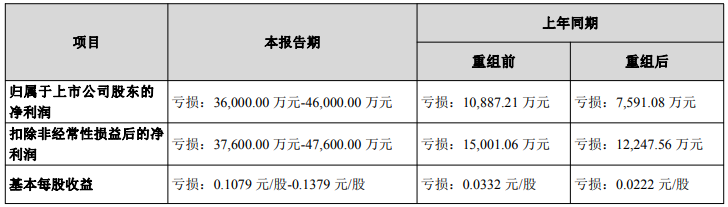
The company explained that factors such as significant price increases in memory chips and weakened downstream terminal market demand have led to a temporary reduction in sales order volume and narrowed gross margins for its main business. Additionally, the announcement indicated that factors such as a year-on-year decrease in government subsidies and an increase in minority shareholders' gains and losses also dragged down current profits.
Against the backdrop of growth pressures in its smartphone business, OFILM is attempting to open up new growth spaces through intelligent vehicle and new business areas. The latter includes handheld intelligent imaging devices, smart door locks, VR/AR, and other directions. Meanwhile, the company's ongoing merger and acquisition restructuring, which proposes to issue shares to purchase a 28.25% stake in OFILM Microelectronics, received registration approval from the China Securities Regulatory Commission in June 2026.
OFILM Microelectronics holds a global market share of over 46% in ultrasonic fingerprint recognition modules. If this transaction is successfully completed, it will further enhance the quality of core assets and profitability of the listed company in the biometric recognition field.
Reviewing the two recent strategic layouts, the micro-nano devices company targets the high-growth optical communication sector, aiming to secure a technological high ground in the upstream supply chain. The independent operation of the machine vision business represents a pragmatic step into the embodied intelligence supply chain, seeking value reassessment.
These two initiatives respectively extend OFILM's core technological main lines in "optics" and "vision," forming dual engines in parallel during the transformation period: one main line closely follows the optical interconnection demand driven by AI computing infrastructure construction, while the other bets on the explosive growth of visual perception in robots and intelligent devices. Additionally, the intelligent vehicle business is steadily climbing at a double-digit annual growth rate, and the ultrasonic fingerprint business is expected to further unlock profit contributions after the merger and integration.
OFILM is leveraging the growth potential of new businesses to buy time for the transformation of its traditional consumer electronics business, attempting to reconstruct its identity from a consumer electronics optics giant to a diversified optical technology platform. Whether this path succeeds depends on whether the new growth drivers—optical communication, machine vision, and intelligent vehicles—can take over the growth baton before the cash flow from its main business tightens further. We look forward to its subsequent market progress.
-
![]()
Li Bin Claims, 'Denying the Pure EV Trend is Like Ostrichism.' What's Li Xiang's Take?
-
Lenovo: Liu Jun Turns Left, Yang Yuanqing Turns Right
-
Lenovo: Liu Jun Goes Left, Yang Yuanqing Goes Right
-
![]()
MiniMax Shares Unlock: Cornerstone Shareholders Show Long-Term Optimism, Yet Stock Plummets Nearly 30% in Two Days; Zhipu Also Sees Nearly 20% Drop Today
-
![]()
Single-Day Plunge of 40%: The 'First AGI Stock' Faces More Than Just Share Price Concerns
-
![]()
Ricoh and Fuji Hike Prices on Legacy Edge; Insta360 Poised to Disrupt Mirrorless Camera Market
-
![]()
Ricoh and Fujifilm Raise Prices in Tandem, Relying on Established Reputations; Insta360 Poised to Disrupt Mirrorless Camera Market
-
![]()
Strategic Shift in Photoelectric Sensing: Maxvision Secures Controlling Stake in CAS Optotech