Tencent Releases Next-Gen 3D Large Model Hunyuan Hy3D 3.6, With API as Primary Entry Point
 11/27 2026
 554
On November 27, Tencent Hunyuan released its next-generation 3D large model, Hy3D 3.6. The official team has positioned the API on Tencent Cloud TokenHub as the primary entry point. New users receive 100 credits, and a limited-time 20% discount runs until January 3, 2027.
The model's journey began with open source in November 2024. In June 2025, version 2.1 opened up the weights, training code, and data processing pipeline together at CVPR, when Hugging Face downloads stood at 1.8 million. In November of the same year, the international version launched, downloads surpassed 3 million, and more than 150 mainland enterprises were already on Tencent Cloud, including Unity China, Bambu Lab, and Liblib. By the time of this release, cumulative downloads had reached 6.53 million.
Previously, open source served to gather developers; this time, the latest capabilities are first made available as cloud-based invocation credits. The API supports text-to-3D and image-to-3D, with calls going through the Token Hub pay-as-you-go account. According to the Tencent Cloud product page, 1,000 credits cost 100 yuan; Professional Edition Normal costs 20 credits per generation, adding PBR materials costs another 10 credits, and failed generations do not deduct credits.
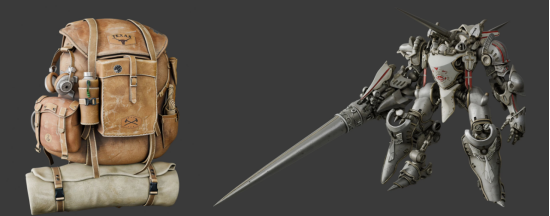
Image source: Tencent Cloud
The 3.6 generation did not pile on resolution and parameter count; the official team focused its efforts on high-poly models and PBR textures, and all four listed changes fall within downstream processes. For example, surfaces should be smooth and free of a clay-sculpt feel; part boundaries should be clear, with armor layering and accessory outlines visible; facial and clothing wrinkles should be stable enough to serve as a sculpting base; and textures should follow the form, with skin, metal, wood, and leather each having its own distinct texture.
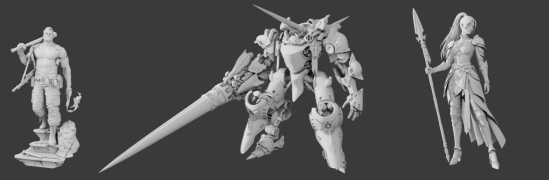
Image source: Tencent Cloud
These changes target three specific tasks. Game high-poly models first need retopology and baking; figures and 3D printing first need the overall shape and proportions to hold up; and the details and materials of film and television digital assets need to withstand close inspection.
Hy3D 3.6 adopts native 3D generation technology, directly learning the distribution of geometry, textures, and materials, and is better at shape and material generation for assets such as characters, creatures, clothing, and complex props.
Technically, Tencent's team uses VAE to compress geometry and textures into the same sparse latent representation, which is then handed to DiT to generate according to the reference image—equivalent to making textures grow on this form from birth. On the data side, a loop of evaluation, supplementing weak-spot data, running experiments, and feeding back was built. In the post-training stage, the team had multiple experts first produce a batch of candidates, then used winning samples and preference data for SFT and DPO.
According to the head of Tencent Hunyuan 3D, the focus of competition in 3D generation is shifting from looking good to being usable, and production usability—such as topology, part separation, UV, and PBR—is becoming increasingly critical. In specific applications, this means retopology and baking. A 500,000-face model with clean topology is more useful than a 1.5-million-face messy model. Hunyuan 3D currently follows two lines: one for high-quality high-poly models, and one for low-poly models that meet art specifications. 3.6 stands on the former.
According to Tencent, blind tests by hundreds of artists and modelers from internal Tencent organizations showed that geometry and texture quality are superior to similar models.
For teams already using Hunyuan 3D, whether this upgrade is worth switching to cannot be judged from screenshots. Take the most troublesome asset in the project—such as a character with wrinkles or a hard-surface prop with complex layering—run through the complete workflow once, and see whether the edge flow, part separation, and UV after retopology can be used directly, then calculate the cost of the PBR surcharge.
-
![]()
226 Trillion Tokens: Why Is DeepSeek Leading?
-
![]()
Can the Jones Matrix Not Handle Polarized Light? How Does the Mueller Matrix Handle It?
-
100,000 Units Is Just the Pass Mark — for Leapmotor to Truly Succeed, It Still Has One Weakness to Fix
-
From "Saying Nice Things" to "Getting Things Done": Big Tech's Personal AI Agents Have Arrived
-
![]()
Tencent Releases Next-Gen 3D Large Model Hunyuan Hy3D 3.6, With API as Primary Entry Point
-
Why Are Big Tech Profits Tightening Even as AI Revenue Rises?
-
![]()
Betting on AI and Embodied Intelligence! Zejing Co., Ltd. Signs Strategic Cooperation Framework Agreement
-
![]()
A High-Stakes Bet on Precision Optics: Yuxin Electronic to Acquire Huateng Optoelectronics for 160 Million Yuan