Can the Jones Matrix Not Handle Polarized Light? How Does the Mueller Matrix Handle It?
 11/27 2026
 475
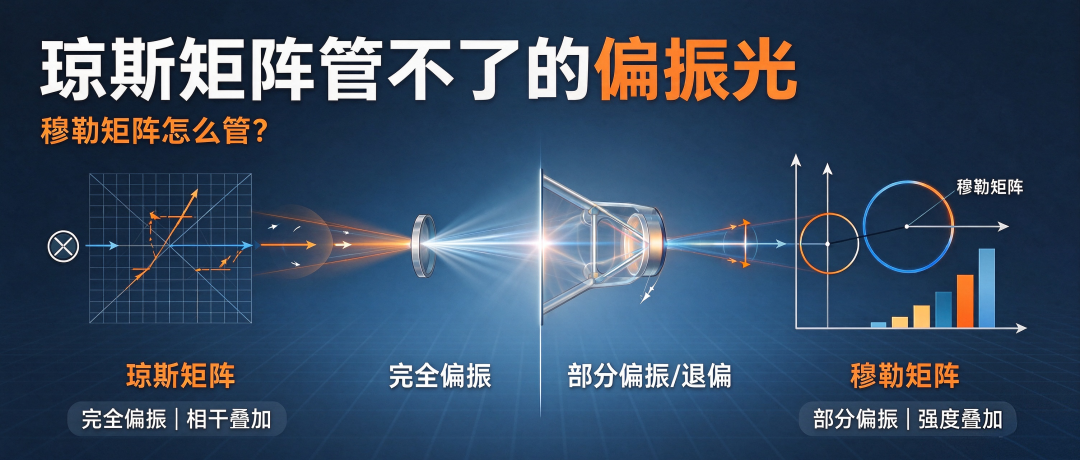
Abstract: The Jones matrix and the Mueller matrix are not interchangeable—each serves a distinct purpose. The Jones matrix is built on complex amplitudes and is only suitable for the coherent superposition of fully polarized light;
the Mueller matrix relies on Stokes parameters and can handle the intensity superposition of partially polarized and depolarized light.
The key boundary depends on whether the light contains components with uncertain phase.
In polarization optics, there are two sets of matrix tools: the Jones matrix and the Mueller matrix. Many optical engineers have heard the saying: Jones is used to describe polarization states, while Mueller accounts for both polarization and depolarization.
But few explain clearly why the Jones matrix cannot handle partially polarized light. The key difference lies not in the matrices themselves, but in the superposition logic: the Jones matrix performs coherent superposition of complex amplitudes, while the Mueller matrix performs incoherent superposition of intensities.
Partially polarized light contains components with random, uncertain phase. The complex-amplitude framework of Jones cannot accommodate this "uncertainty."
Jones Matrix — "Coherent Superposition" of Complex Amplitudes
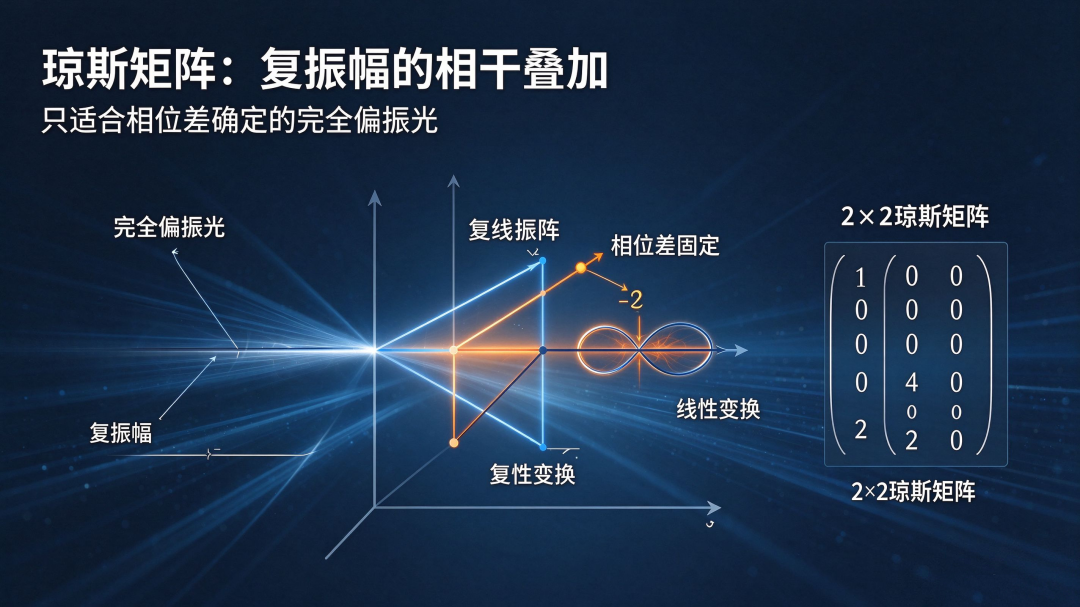
The Jones matrix is only suitable for fully polarized light. For fully polarized light, the phase difference between the two orthogonal electric field components is fixed: for linear polarization the phase difference is 0 or π, for circular polarization it is ±π/2, and for elliptical polarization it is another fixed value.
It is precisely because the phase difference is determined that we can describe it using complex amplitudes (amplitude + phase). The underlying premise of the Jones matrix is coherence.
The phase relationship between the two orthogonal components of the incident light is stable, and after passing through an optical element, the phase difference of the output components remains controllable. Matrix operations are essentially linear transformations of complex amplitudes. But this premise fails directly when encountering partially polarized light.
The "Phase Uncertainty" of Partially Polarized Light
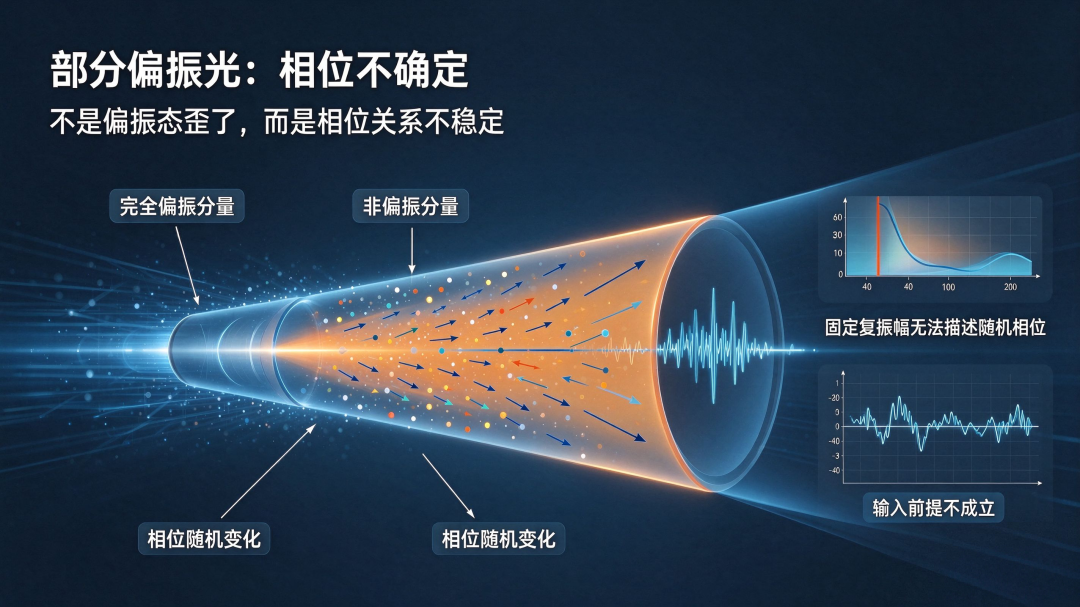
Partially polarized light is not simply a tilted polarization direction. It can be understood as two components superimposed in the same beam: one is a stable fully polarized component, and the other is a random unpolarized component.
The phase of the unpolarized component jumps randomly over time and cannot be characterized by a fixed complex amplitude. A Jones vector has a hard requirement: there must be a definite phase difference between the two orthogonal components.
Partially polarized light cannot satisfy this condition. It is not that the Jones matrix calculates the wrong numbers, but that its input premise itself does not hold. For example: you cannot use a fixed number to describe a quantity that is constantly changing randomly.
Mueller Matrix — "Incoherent Superposition" of Intensities
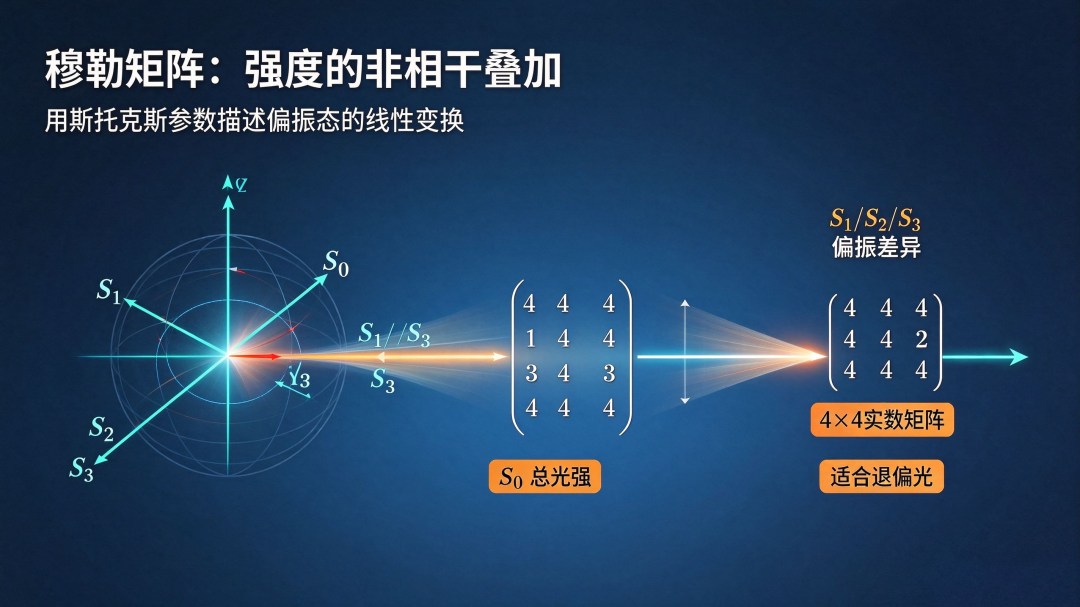
The Mueller matrix takes a different approach and no longer uses complex amplitudes. It relies on Stokes parameters (S₀, S₁, S₂, S₃) to describe light. S₀ represents total light intensity, and S₁, S₂, S₃ correspond respectively to the intensity differences of horizontal/vertical, ±45°, and left-/right-circular polarization.
All four parameters are intensity quantities. The Mueller matrix is a 4×4 real matrix acting on the Stokes vector to describe linear transformations of polarization states.
It does not require the incident light phase to be stable—the Stokes parameters themselves are composed of intensities and naturally carry no phase information. For depolarized light with random phase, this is not a loss of information but a choice of descriptive framework: phase originally has no definite value, so describing it only with intensity quantities is sufficient.
The Boundary — When Should Each Be Used?
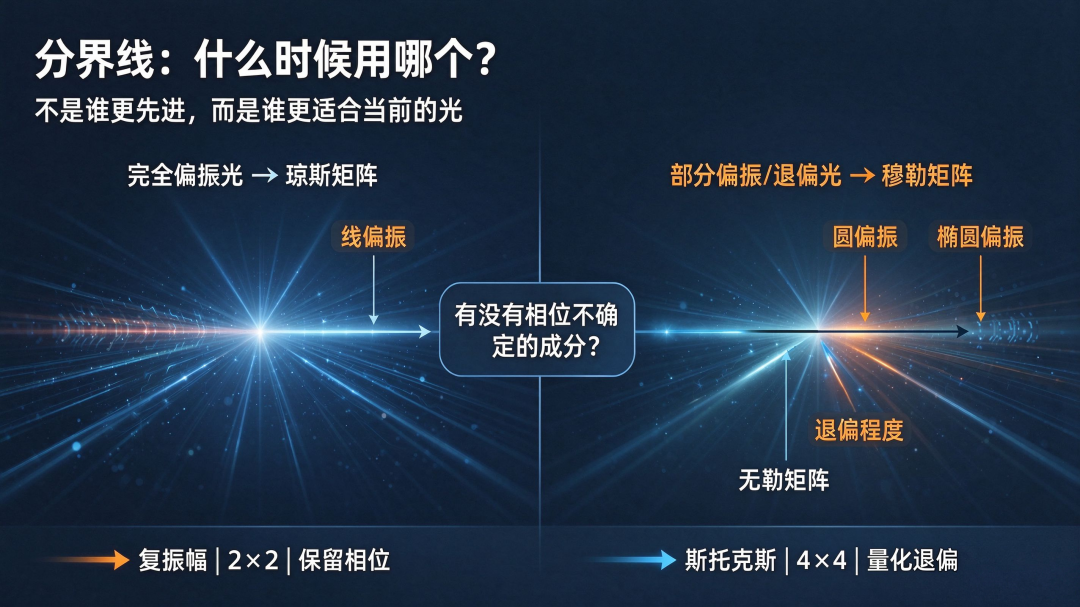
The criterion is straightforward: whether the light contains components with uncertain phase.
Fully polarized light (linear, circular, elliptical polarization) → Jones matrix complex-amplitude description, 2×2 matrix, low computational cost, fully preserves phase information, suitable for coherent optical path simulations such as gratings and waveguides.
Partially polarized light, depolarized light, unpolarized light → Mueller matrix Stokes parameter description, 4×4 matrix, higher computational cost, does not record phase, but can quantify the degree of polarization and degree of depolarization.
The two sets of tools cannot be mixed arbitrarily. Using the Jones matrix to simulate depolarized light will by default assume that the beam is always fully polarized, directly masking the depolarization effect; using the Mueller matrix to calculate ordinary fully polarized light can produce results, but the phase information is lost—a typical case of using a sledgehammer to crack a nut.
In AR Waveguides, Why Does This Boundary Matter?

In polarization management for AR waveguides, we often encounter partially polarized scenarios. Internal stress in waveguide substrates and adhesive layers introduces birefringence, and the originally designed polarization state gradually degrades while propagating in the waveguide, changing from fully polarized to partially polarized.
The polarization selectivity of PVG gratings was originally designed for ideal circularly polarized light, but the actual incident light has often already undergone depolarization.
In the polarization detection stage, the degree of depolarization directly determines the actual diffraction efficiency of polarization-sensitive elements such as PVG and is a core metric that must be quantified.
If the Jones matrix is still used to simulate such scenarios, it is easy to overestimate the effect of polarization management. Only the Mueller matrix can reproduce the true level of polarization degradation.
Closing remarks: there is no claim that the Jones matrix or the Mueller matrix is more advanced; there is only whether it is suitable.
Choose Jones for fully polarized light, and Mueller for partially polarized and depolarized scenarios. This boundary is hidden in the coherence of the light itself, not in the mathematical form of the matrices.
Choosing the wrong tool is not just calculating a wrong set of numbers; the essential problem is that the premise assumption is wrong—using a fully polarized framework to describe partially polarized light means the problem cannot stand from the very beginning.
Interactive topic: In your AR waveguide polarization analysis, have you encountered the situation where "the light has already been partially depolarized, but the Jones matrix is still being used for calculation"? Welcome to leave a comment and share your experience with tool selection.
[Risk note] This article is intended for popular science in AR optical engineering and does not expand the matrix derivations of Stokes vectors and Mueller matrices; simulation results of waveguide stress birefringence and grating depolarization need to be calibrated with measured polarimeters.
—— AR Andy | Focused on optical waveguides and the AR micro-display track, deeply unpacking the underlying logic of the optical industry
-
![]()
226 Trillion Tokens: Why Is DeepSeek Leading?
-
![]()
Can the Jones Matrix Not Handle Polarized Light? How Does the Mueller Matrix Handle It?
-
100,000 Units Is Just the Pass Mark — for Leapmotor to Truly Succeed, It Still Has One Weakness to Fix
-
From "Saying Nice Things" to "Getting Things Done": Big Tech's Personal AI Agents Have Arrived
-
![]()
Tencent Releases Next-Gen 3D Large Model Hunyuan Hy3D 3.6, With API as Primary Entry Point
-
Why Are Big Tech Profits Tightening Even as AI Revenue Rises?
-
![]()
Betting on AI and Embodied Intelligence! Zejing Co., Ltd. Signs Strategic Cooperation Framework Agreement
-
![]()
A High-Stakes Bet on Precision Optics: Yuxin Electronic to Acquire Huateng Optoelectronics for 160 Million Yuan