The AI Landscape Evolves: How Can Kimi Bridge the 'Dark Side of the Moon' Gap?
 09/23 2026
 420
420
Having a robust model is merely an entry ticket; there's still much to learn from the 'Dark Side of the Moon'.
In the dynamic AI arena, rules are made to be broken, as swift market changes often leave companies scrambling.
The 'Dark Side of the Moon' is a prime example of this phenomenon.
With a captivating story, the 'Dark Side of the Moon' initially leveraged long-form text to create a consumer-facing AI assistant, Kimi, boasting monthly active users on par with Doubao. Following a strategic pivot, it has consistently proven itself in the top tier of open-source models with Kimi K2 and K3.
However, recently, the 'Dark Side of the Moon' has been making unusually frequent strategic moves, signaling signs of urgency.
In September, the 'Dark Side of the Moon' accelerated its model and product development pace.
On the model front, on September 11th, it announced the full rollout of K2.8 Preview, bridging the 'cost-effectiveness' gap in its models by offering capabilities close to K3 at half the price. On the product side, Kimi Code Desktop was officially launched, targeting developers as a standalone app amidst OpenAI and Anthropic's trend of integrating entry points.
Simultaneously, the 'Dark Side of the Moon' is also intensifying its exploration of commercialization boundaries.
On September 10th, it officially launched the 'Moon Landing Plan,' collaborating with five system integrators in the FDE model. On September 18th, Kimi K3 made its debut on the Amazon platform, and the previously proposed open-source model revenue-sharing agreement finally came to fruition.
The underlying message of these frequent moves poses an industry-wide question: market expectations for AI model companies have shifted.
In 2026, large model companies must not only push the intelligence envelope but also demonstrate more product implementation possibilities.
This shift occurs because AI models have long transcended the stages of 'intelligence as value' and 'model as product.' When all leading companies can achieve sufficiently high model intelligence, cost-effectiveness becomes paramount for users/customers. 'Having it all' has become the most critical evaluation metric for AI model companies.
The 2026 market demands 'usability'—models must be both affordable and powerful. Company R&D must balance intelligence pursuit with engineering implementation. Products must be user-centric and intuitive. The logic differs between B-end and C-end: B-end requires stability, controllability, and implementation, while C-end demands simplicity and ease of use.
Faced with complex and diverse market demands, large model companies can no longer rely solely on a single strong model to dominate.
The 'Dark Side of the Moon' exemplifies this trend. As a company still in the top tier of large models, it is taking proactive steps to catch up on missed opportunities and meet current market demands.
Rumors have been swirling about the 'Dark Side of the Moon' preparing for an IPO. In September, some sources even indicated that it had secretly submitted an IPO plan. Submitting a prospectus means the 'Dark Side of the Moon' will have to lift its veil of secrecy.
In the AI circle, merely being 'good' is insufficient; one must outshine a group of smart leading companies.
This necessitates the 'Dark Side of the Moon' to bolster its product and commercialization layers to craft a more compelling narrative. Shifting from extreme performance to cost-effectiveness and from C-end dominance to B-end expansion, the company is accelerating to bridge its 'dark side of the moon' gap.
Cost-effectiveness Trumps Intelligence
A consensus is emerging in the large model industry: while model intelligence is a prerequisite, people are more inclined to invest in cost-effective models.
Users seek a 'seamless' experience—models must not only be intelligent but also affordable, fast, and capable of solving practical problems. This shift is evident on both the model and product fronts.
Thus, 2026 witnessed a surge in Flash models within the AI landscape.
Compared to domestic open-source models, MiniMax has consistently prioritized cost-effectiveness; Zhipu updates more frequently, with GLM-5.3 Flash priced at just one-fortieth of Claude Opus 4.8. As competitors slash prices, Kimi K3 initially faced challenges on the 'billing' front.
At the model level, the 'Dark Side of the Moon' remains in the top tier, as evidenced by K3's release. However, K3 also exposed an awkward reality—a sufficiently intelligent model is not necessarily a product that users find 'user-friendly'.
In terms of pricing, K3 set its API price at $3 per million tokens for input and $15 for output. Although this is half the price of Claude Opus 5, latecomers have slashed prices even faster. For instance, Step 5 Preview, a flagship model from recent entrant JieYueXingChen, has cut prices to one-eighth of Claude Opus 5.
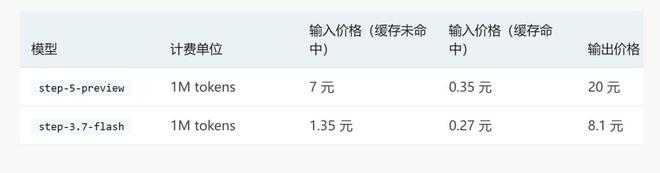
Why do users complain that Kimi K3 is 'pricey and slow'? Besides the high price, from an experience perspective, tests by Guangzhui Intelligence revealed that the K3 model exhibits noticeable 'internal debates' and 'drafting' phases during thinking. While a more rigorous thought chain aims for better results, it also leads to increased token consumption and longer task completion times, raising costs per task.
Realizing the lack of a 'cost-effective model,' the 'Dark Side of the Moon' acted swiftly. It first released a more cost-effective 'Flash' version of K3.
On September 11th, K2.8 Preview was launched and subsequently fully integrated into Kimi Code and Kimi Work. The naming caused some confusion—K2.8 sounds like a regression from K3. It is a high cost-effective model for programming and Agent scenarios, achieving capabilities close to K3 at a lower cost. Although the 'Dark Side of the Moon' has not officially announced the price, we can infer from WorkBuddy's usage fees that K2.8 Preview is priced at about half of Kimi K3.
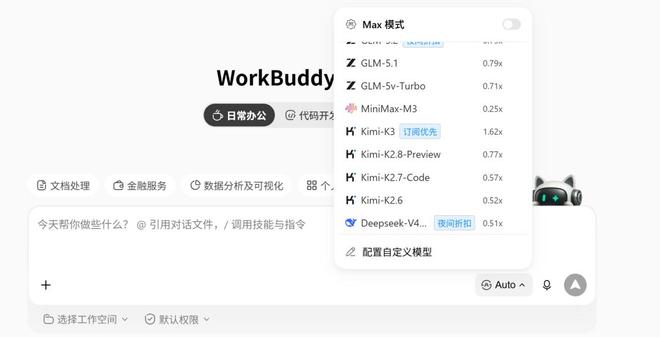
Cost-effectiveness means making flagship capabilities accessible to everyone at an affordable price point.
Meanwhile, the 'Dark Side of the Moon's new model continues to push the intelligence envelope. On September 18th, Kimi's official account on Zhihu posted a mysterious string of numbers starting with '4159265358...' Removing the first two digits reveals the decimal expansion of π. Almost immediately, everyone interpreted it as a signal—K3.1 is on the way.
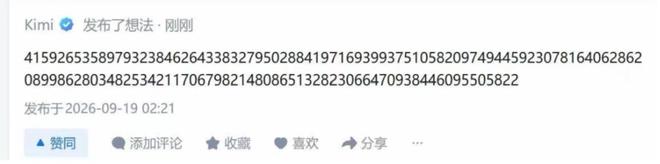
K2.8 focuses on cost control, while K3.1 pushes capabilities. The 'Dark Side of the Moon's current model strategy is clear: it aims to 'right the course' towards a better user experience.
While correcting the model's trajectory, the 'Dark Side of the Moon' is also waging a tough battle on the product front.
Let's start with the fiercely competitive AI office track in 2026. The 'Dark Side of the Moon's Kimi Work has a first-mover advantage, acting faster than giants like ByteDance and Alibaba. However, being first does not guarantee victory, as the competition rules in this track are still 'dictated' by the giants. Compared to the capabilities of Agents themselves, the core competition in AI office lies in scenario capabilities.
This is why giants can catch up later in the office track.
ByteDance boasts the full-scenario accumulation of Feishu, while Tencent has WeCom and document ecosystems, where users' work scenarios naturally reside. Additionally, the giants' collaborations with numerous enterprises allow them to quickly integrate professional tool capabilities, such as financial data processing and CRM system access.
In design, Kimi Work is less beginner-friendly than WorkBuddy and Doubao Work.
Taking skill ecosystems like plugins and Skills as an example, Kimi Work's dashboard appears relatively 'primitive.' In contrast, Tencent and ByteDance offer a 'comprehensive' range of reserved skills and scenario coverage, with detailed function introductions that fear users might not understand.

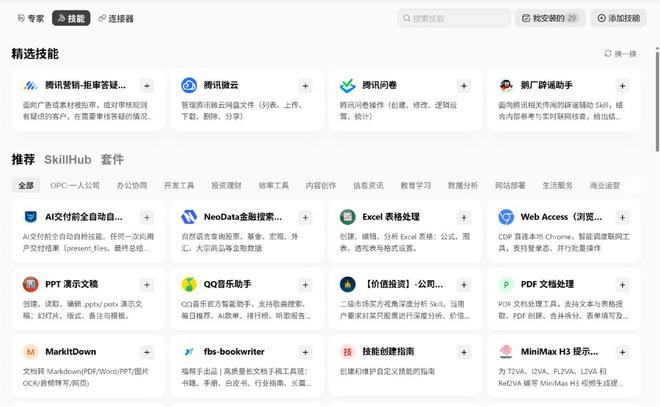
The skill interfaces of Kimi Work and WorkBuddy, from top to bottom
Where do the giants' advantages lie? Take the 'Expert' function as an example. WorkBuddy first launched this feature, while ByteDance created the 'Partner' for Doubao Work. It provides 'expert' capabilities for enterprise digital employees, such as niche functions in content creation involving Xiaohongshu, WeChat Official Accounts, tech reporting, and viral draft breakdowns.

The logic behind the giants' design is simple—users don't need to understand how Agents maximize their capabilities; needs and scenarios are the best 'instructions.' 'Click what you want,' and AI will get the job done.
However, Kimi Work holds its own ace—industry knowhow.
It natively integrates data sources like Tonghuashun and Tianyancha, covering financial data such as stocks, futures, and indices, as well as academic resources—embedding professional processes, data sources, and compliance requirements directly into the Agent's capabilities. Arguably, the 'Dark Side of the Moon' recognized the value of industry knowhow earlier than its peers and accumulated it into plugins and Skills within its products.
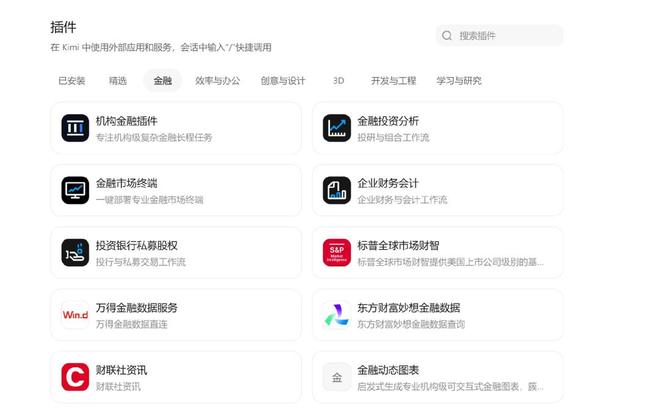
However, the wall built by knowhow can block peers but not ecosystems. Giants are catching up in niche scenarios through frequent updates, and ecosystems are their forte. Thus, the advantage built by model companies through industry knowhow may not last long.
In C-end competition, the 'Dark Side of the Moon' is essentially fighting an uneven battle. It must use products against the giants' ecosystems and knowhow against their traffic. The revenue and imagination space here will be a long, hard fight.
The truly promising scenario, as seen by the 'Dark Side of the Moon,' is AI Coding.
Because the experience of such products depends on the synergy between models and their own products. Large model vendors can accumulate professional developer users—who also consume the most tokens and have the highest willingness to pay—through model and product optimizations.
On September 21st, Kimi Code Desktop was officially released, with macOS and Windows versions launching simultaneously. The new product introduces two industry-standard capabilities: first, a planning mode where Agents first present an execution plan for tasks with wide-ranging impacts, which is then reviewed, fed back, and confirmed before action; second, 'folding' the thought chain to address the common user complaint of long wait times.
A noteworthy detail is that Kimi Code Desktop is separate from the Kimi desktop client, which integrates Work and Chat. In other words, Kimi Code is a standalone product. This design differs from OpenAI and Anthropic—both choose tool integration, hoping to attract users with a single entry point. However, for the 'Dark Side of the Moon,' it might be currently aiming to refine each product separately by targeting different scenarios.
Regardless of how these strategies ultimately progress, at least in terms of models and products, the 'Dark Side of the Moon' has expanded its footprint this year. Next comes the moment to validate commercialization results.
Filling Commercialization Gaps, Turning Hype into Revenue
While competing on models, with the explosion of the token economy, large model companies have started to emphasize ARR (Annual Recurring Revenue).
Tokens are the 'electricity' of the AI era. Once model capabilities cross from 'usable' to 'good enough,' market focus naturally shifts towards commercialization. Revenue has become the most intuitive indicator for external judgments of AI model companies' strength.
In terms of revenue, the 'Dark Side of the Moon' currently ranks mid-tier among domestic large model companies. According to internal disclosures, its ARR surged from $100 million in March to $300 million in June, breaking $1 billion in August. Bloomberg, citing insiders, reported that it could reach $2 billion by year-end. If realized, this would be a 20-fold increase in a year.
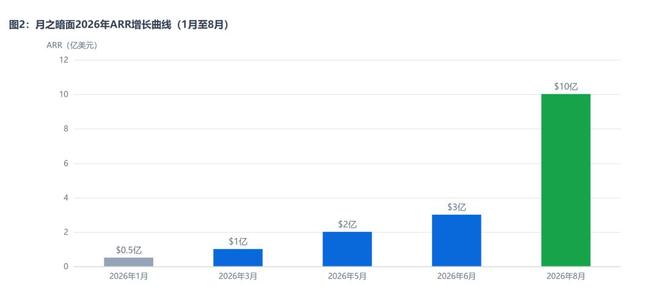
However, compared to peers, the gap becomes apparent: Zhipu's ARR reached $2 billion in August, matching the 'Dark Side of the Moon's year-end target; MiniMax stands at $800 million, with the 'Dark Side of the Moon' leading by only a small margin.
Technologically in the top tier but revenue-wise in the second tier—this position does not align with the 'Dark Side of the Moon's technical stature. The root of the gap is not hard to understand—previously, the 'Dark Side of the Moon's commercialization had only one leg to stand on.
From a business structure perspective, the 'Dark Side of the Moon' previously focused more on the C-end, being relatively 'less utilitarian.' In comparison, Zhipu has a dual-wheel drive of private deployment services and lightweight models, while MiniMax has AI video model products and overseas C-end offerings. The 'Dark Side of the Moon' only focused on promoting C-end subscriptions and overseas expansion.
With the improvement of K3's model capabilities, the 'Dark Side of the Moon's strategy brought a revenue surge—the steep increase in ARR from $300 million to $1 billion occurred after K3's release, proving that intelligence can directly translate into money. However, the current situation also proves that relying solely on intelligence for monetization has a low ceiling.
To improve commercialization channels, it can be confirmed that the 'Dark Side of the Moon' has recently added numerous projects. Meanwhile, it knows to avoid the pitfalls of AI 1.0-era customization, transforming its revenue structure from one leg to three—open-source royalties, FDE, and industry solutions.
Firstly, the concept of open-source royalties still adheres to the AI-era logic of treating the 'model as a product.' The Dark Side of the Moon endeavors to revise open-source licenses and engage in revenue-sharing collaborations with cloud service providers, thereby transforming open-source from a mere buzz generator into a revenue-generating business.
Since the open-source release of K3, Moonshot AI has implemented new regulations in its open-source model agreement. Specifically, it stipulates that if users offer inference or fine-tuning services via MaaS (Model as a Service) and the cumulative revenue of the enterprise and its affiliates surpasses $20 million over a 12-month period, a separate commercial agreement must be negotiated and signed with Moonshot AI. Reports indicate that Moonshot AI is also in the process of negotiating revenue-sharing agreements for K3-related services with tech giants Microsoft, Amazon, and Google, with the potential to secure up to a 30% share. According to Yicai, Moonshot AI has previously entered into a similar agreement with Alibaba Cloud BaiLian.
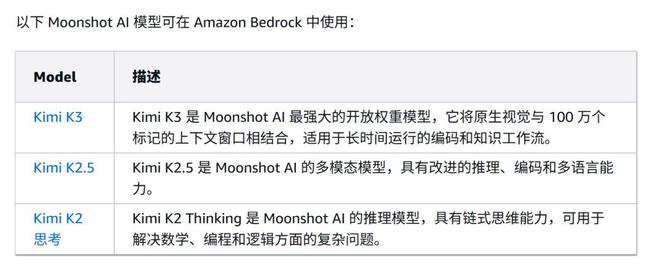
Image: On September 18, Kimi K3 made its official debut on Amazon Bedrock.
Currently, both Moonshot AI and Zhipu AI have declared the successful implementation of revenue-sharing agreements. AI intelligence has discovered a method to monetize through 'rent collection' strategies.
Concentrating on enterprise collaboration, Moonshot AI has commenced experimenting with the FDE (Frontline Deployment Engineer) model. On September 10, Moonshot AI officially initiated the 'Lunar Landing Program,' forming partnerships with industry system integrators in an FDE framework to establish frontline deployment teams. The initial signatories encompass Chinasoft International, Kingsoft Cloud, Teamsun, Akan Inc., and AsiaInfo Technologies.
A crucial aspect to note is that, although the FDE model may bear resemblance to customized projects from the AI 1.0 era in that both directly cater to user needs, there exists a distinction: Moonshot AI adopts a more streamlined approach by solely providing technical and product support, delegating the remaining tasks to its partners.
This implies that Moonshot AI is no longer required to be involved in every facet of customized tasks, as was the case in the past, where on-site presence, customization, delivery, and acceptance processes burdened the company with excessive staffing and escalating costs. This model enables Moonshot AI to maintain its current team size of 300-400 individuals. After all, in the software industry, 'productivity per employee' serves as an indicator of how much revenue a company can generate through its workforce.
Nevertheless, this 'light' approach comes with its own set of trade-offs. By solely providing technology, Moonshot AI's bargaining power hinges on whether its models maintain a leading edge. In a fiercely competitive model landscape, sustaining a consistent lead proves to be a formidable challenge.
In the realm of enterprise AI applications, Moonshot AI's industry solutions are being implemented. Its strategy revolves around deepening expertise in specific scenarios, leveraging professional skills and plugin advantages amassed in vertical domains to distinguish itself from the general-purpose office products offered by tech behemoths.
This embodies a model-driven productization route. While tech giants market 'all-in-one' solutions, Moonshot AI positions itself as the specialist in particular domains.
On September 17, Moonshot AI unveiled its financial industry solution, integrating over 10 authoritative data sources, nine financial skills, and five security compliance measures. It encompasses scenarios such as portfolio morning reports, earnings review commentary, project screening, in-depth research, and portfolio review. Initial clients include the Industrial and Commercial Bank of China and CITIC Securities.
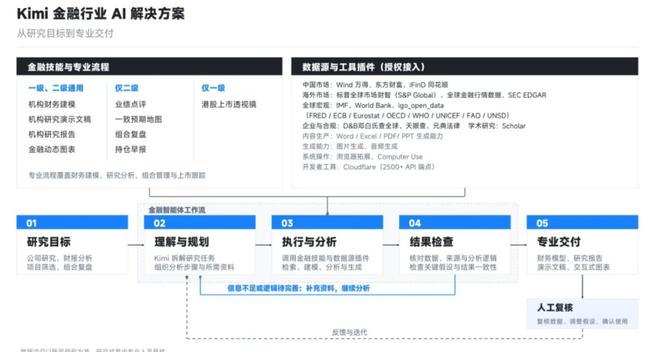
Admittedly, none of these three strategies—rent collection, FDE, or industry solutions—can be deemed true 'business model innovations.' However, for Moonshot AI, they serve as potent monetization tools that convert intelligence into B-side revenue. This aligns with the original intent of all AI players: leveraging technology to expedite human progress.
Racing Toward IPO: Cash In on Technical Assets Early
Let's redirect our attention to the capital markets.
Currently, AI investments are transitioning from scarcity to abundance. Zhipu AI and MiniMax have already gone public, while companies like OpenAI and Anthropic are expediting their IPO plans. As market options proliferate, AI premiums are being diluted.
The capital market landscape has undergone a transformation in just one year.
A year ago, nearly all renowned large model companies in China operated within the primary market. Investors eager to capitalize on AI had limited options, resulting in fierce competition for shares. It was within this environment that Moonshot AI's valuation skyrocketed from $4.3 billion in late 2025 to $50 billion.
However, by the second half of 2026, the situation had altered. Secondary market investors now have a growing array of AI options at their disposal. As scarcity diminished, valuation bubbles commenced deflating.
The bubble-bursting process is evident in the stock performance of listed companies. During Zhipu AI's IPO, the market initially hyped it as the 'Chinese Anthropic,' propelling its market cap beyond RMB 1 trillion.
Nevertheless, once the initial excitement subsided and investors refocused on financial fundamentals, Zhipu AI and MiniMax witnessed their stock prices plummet by half:
Take Zhipu AI as an illustration. Its financials revealed a 420% year-over-year revenue increase in the first half of the year, but net losses widened by 85% due to soaring computational costs that consumed the majority of the revenue. By mid-September, Zhipu AI's stock had plummeted 56% from its peak, erasing over HK$60 billion in market value.
These calculations elucidate one fact: AI monetization cycles are considerably longer than initially anticipated. The stock retreat mirrors a market correction from hype to financial reality.
This is the backdrop against which Moonshot AI opted to accelerate its IPO plans.
In late 2025, Moonshot AI founder Yang Zhilin stated in an internal letter, 'We're not short on cash. Compared to the secondary market, we believe we can raise more funds in the primary market... So we're not in a rush to go public, nor is that our goal.'—Yang Zhilin, Moonshot AI Founder, in an internal letter.
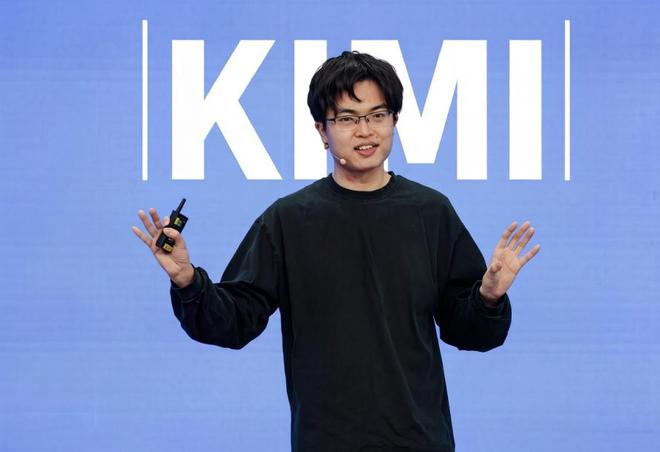
Yet, this same company, which professed not to require cash and had no sense of urgency, commenced dismantling its VIE structure nine months later and submitted a confidential IPO application to the Hong Kong Stock Exchange in early September. The core rationale: with the window of opportunity narrowing, there was scant time left to inflate its valuation.
Moonshot AI needs to secure sustained access to capital through an IPO while its technology remains at its zenith, ensuring it can continue competing in the top tier. This capital will ultimately be converted into computational power to uphold its leading position.
Zhipu AI's management has calculated that approximately RMB 30 billion in investment is equivalent to 100,000 P (PFLOPS) of computational power, with 40% allocated to training and 60% to inference—reflecting how the majority of current financing for large model companies is expended on computational resources.
Within 48 hours of K3's release, request volumes approached cluster capacity limits, compelling the company to suspend C-side subscriptions. Flagship model inference demands massive computational power, and training next-gen models necessitates even greater amounts.
To circumvent computational bottlenecks, Zhipu AI has escalated investments in self-developed and domestically produced AI chips, reducing per-token inference costs by 80% since the year's commencement while boosting revenue per unit of computational power by 14 times.
Moonshot AI confronts analogous challenges. While it previously leased substantial cloud computational resources, it accelerated self-purchases following K3's launch. However, chip procurement is a long-term endeavor that cannot yield immediate results.
Thus, Moonshot AI's predicament isn't a dearth of funds but securing a sustainable, low-cost channel for computational resources—to fuel enterprise AI narratives, stockpile computational power for next-gen models, and satisfy increasingly selective primary market investor demands.
This implies that Moonshot AI must propel its IPO narrative to a climax before the K3 technological dividend window closes.
Post-IPO, matters will become more manageable. After Zhipu AI's stock halved, it raised an additional $5 billion. After all, no investor desires to witness a technologically robust company flounder.
Moonshot AI's IPO sprint isn't indicative of financial distress but a race against time. It aims to list on the secondary market while AI investments remain abundant, valuation bubbles haven't fully deflated, and technological dividends are still within reach.
The race for AI intelligence supremacy persists, but as the industry demonstrates, model strength is merely an entry ticket.
At this nascent stage of commercialization and product development, Moonshot AI must ensure its 'dark side' also radiates brilliance.
-
![]()
OPPO Find X10 Pro Max Imaging Review: Perfect for Beginners in Street Photography, The Only 'All 200MP' Claim That Stands Up
-
![]()
QianWen Computers Have Arrived! When Thought Becomes a Tradable Good, Alibaba’s Ambitions Reach Farther Than You Think
-
![]()
AI Office Track: A Telecom Operator Makes Its Debut
-
![]()
The AI Landscape Evolves: How Can Kimi Bridge the 'Dark Side of the Moon' Gap?
-
![]()
Seres Chairman Addresses Huawei Cooperation Adjustment: Partnership Intact, Commitment Strong
-
Muse Leads the Charts, QianWen Joins the Race: The Dawn of the Personal Agent Era
-
vivo's Journey to the High-End Market: Focused on Imaging, Yet Constrained by It?
-
RSI: How Much Valuation Can It Support for Zhipu?