AI Interviewer: A Step Too Far for Workers
 10/09 2026
 439
439
Technology may be adept at sifting through resumes, but it falls short in assessing an individual's true worth.
Image source | Internet (Please contact us for removal if any infringement is found.) Partially generated by AI.
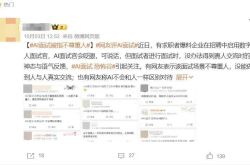
During the autumn recruitment drive of 2026, a hashtag that trended left countless job seekers feeling disheartened and disillusioned.
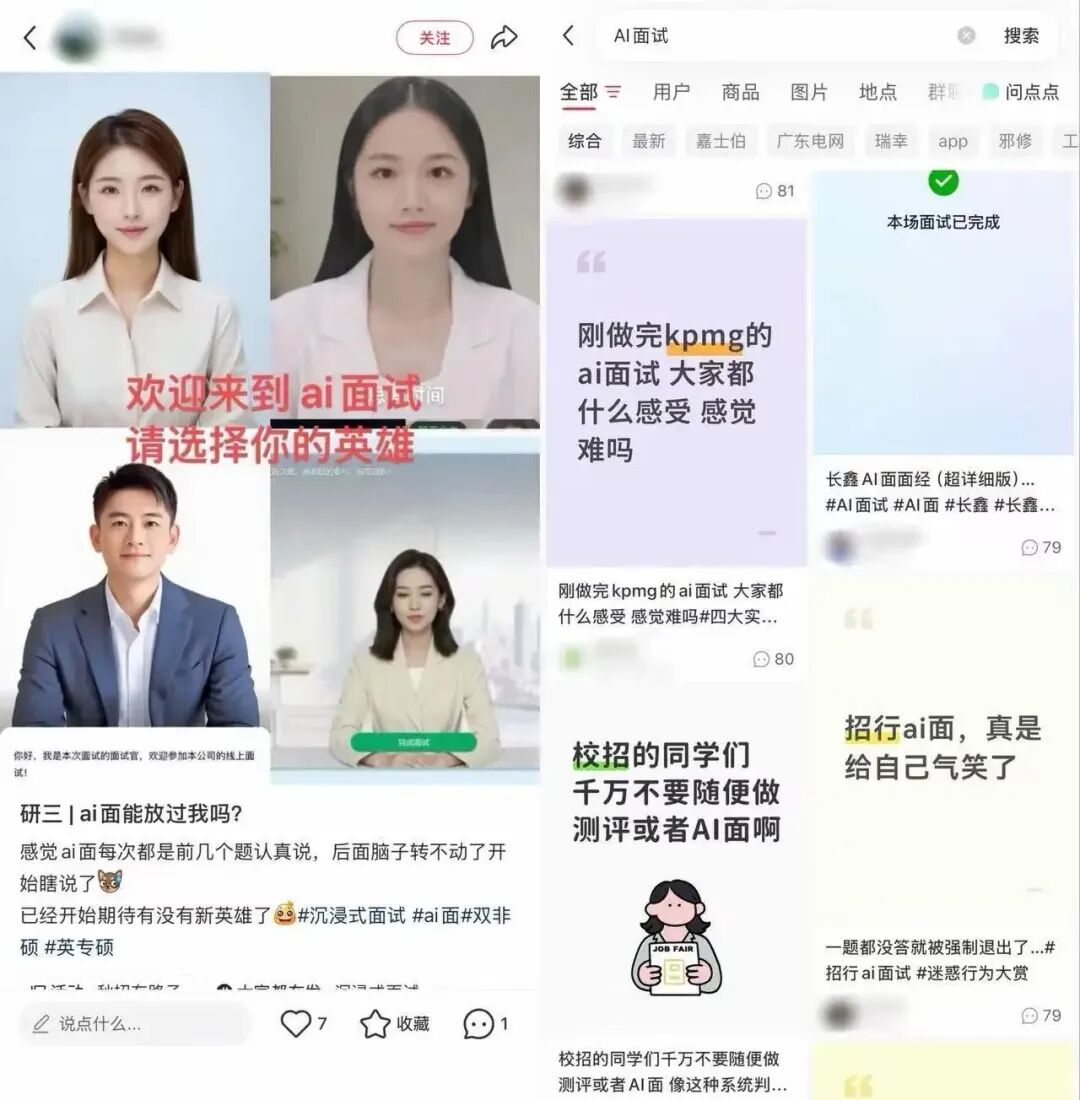
The hashtag #AIInterviewUncannyValley gained traction, with numerous job seekers lambasting the AI digital interviewers employed by companies for their "wooden expressions," likening the experience to "conversing with a corpse," and finding it "even more stifling than a face-to-face interview."
Some job seekers described the digital interviewer as having "empty eyes and rigid micro-expressions," exuding a "plastic, almost-human aura" that triggered a cognitive dissonance and a visceral aversion in the human brain.
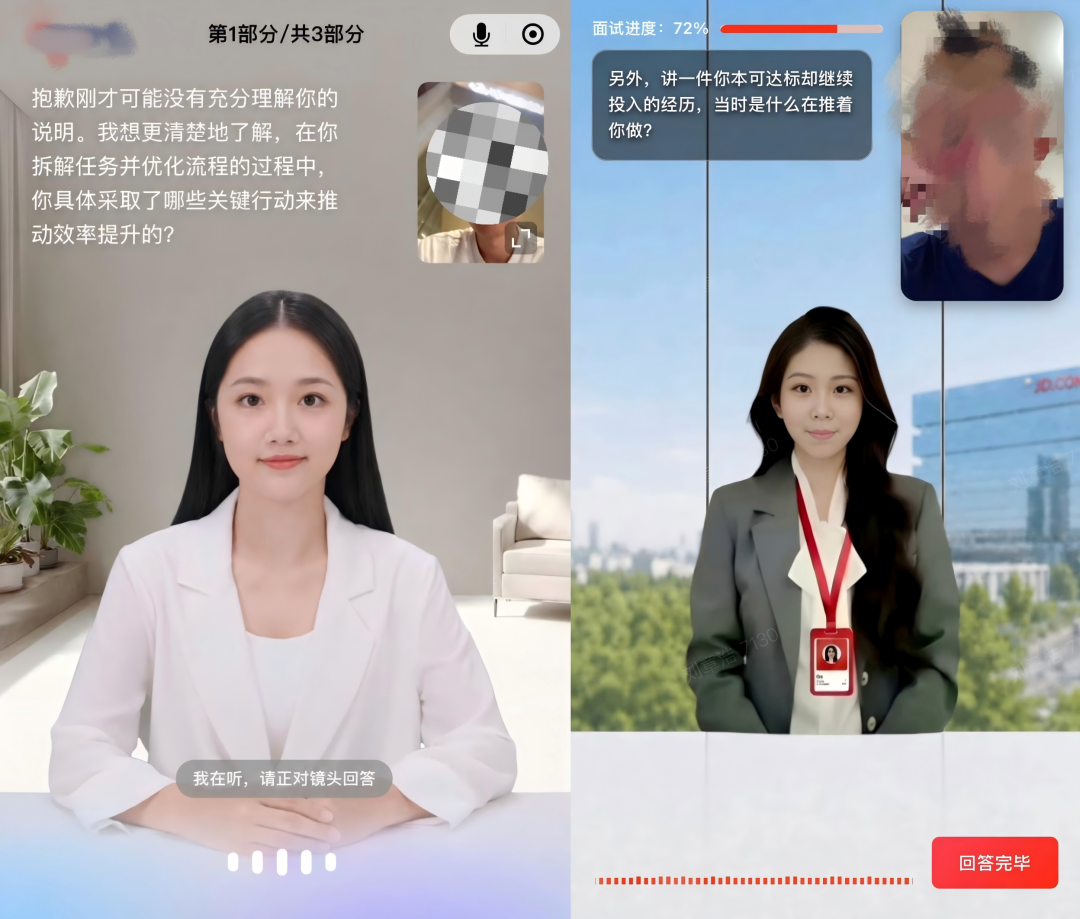
What's even more disconcerting is that the system monitors pupil movement and facial muscle tension in real-time, translating unconscious physiological responses like delayed reactions and trembling speech into quantifiable scores.
In essence, if you nervously swallow during an interview, the algorithm takes note.
A poignant comment from a netizen resonated widely: "Nowadays, nearly every job application kicks off with AI. Answering questions on camera, the system automatically scrutinizes your expressions, speech pace, and keywords, while the actual HR might not even make an appearance."
The adoption of AI interviews is accelerating at a pace that catches many off guard.
By the spring recruitment season of 2026, 70.4% of AI interviews were extended as invitations, with nearly 90% of students actually participating in AI-driven interviews.
Over 34% of Chinese companies with a workforce exceeding 500 have implemented AI-powered interviews for campus or mass recruitment, with penetration rates surpassing 60% among leading internet and financial firms.
In sectors with highly standardized roles, such as banking, fast-moving consumer goods, and call centers, AI interviews have become the norm.
Companies have meticulously calculated the costs: The average per-person cost for an online interview hovers around 300 yuan, whereas AI interviews slash this to roughly 20 yuan; some single interviews even cost less than 5 yuan, a fraction of an HR's hourly wage.
A consumer electronics company leveraged AI to conduct initial screenings for 8,000 candidates in just three weeks, slashing the HR team's time spent on resume screening and interview coordination by approximately 70%.
From a business standpoint, this is commendable. However, the crux of the issue lies elsewhere: Job seekers' emotions are entirely overlooked in this equation.
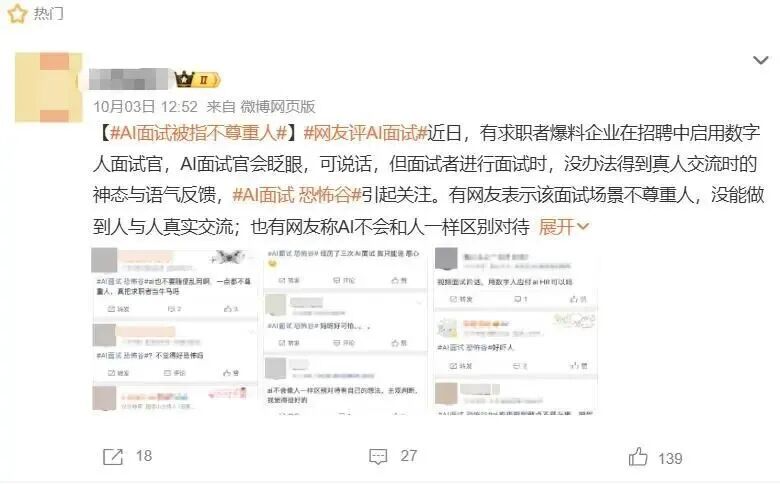

A "Test of Submission"
Let's delve into the "uncanny valley effect." This phenomenon occurs when a non-human entity closely resembles humans in appearance or behavior but with subtle unnaturalness, causing the observer's affinity to abruptly shift from liking to intense discomfort or even fear.
AI digital interviewers fall squarely into this category: They mimic human appearance and tone when posing questions, yet their expressions always seem slightly off, resulting in a dialogue devoid of human empathy.
An international student who underwent 25 AI interviews shared her experience: "Despite a pass rate exceeding 50%, AI still felt 'eerie.'"
Her primary frustration was AI's inability to "comprehend" resumes, often posing questions based on incorrect interpretations, forcing her to correct errors before answering within the allotted time.
Another job seeker encountered frequent voice recognition malfunctions: "Watching the inaccurate subtitles, I was clueless about how the system would evaluate me."
Even more unsettling was the constant surveillance. The system monitored pupil changes, facial muscle tension, speech speed, and pause duration, crudely translating human nervous reactions into deductions.
Nervousness, brief eye shifts, or pauses during an interview are perfectly normal, yet the algorithm interprets them as signs of "disorganized thinking" or "insincerity."
This ceases to be an interview; it becomes a one-sided test of submission.
Some job seekers, to "succeed," are compelled to adapt to the machine: Fragmenting internship experiences into "keyword-laden templates," structuring answers with "firstly, secondly," and preparing multiple "experience narratives" embedded with AI-preferred vocabulary. "It's not about excelling; it's about ensuring the system 'comprehends' me."

What Technology Simply Cannot Achieve
One might argue that AI digital humans are not novel—virtual anchors have been around for years. Why does the interview setting feel so uncomfortable?
The crux lies in the distinction: Virtual anchors perform, whereas AI interviewers judge.
When a virtual anchor smiles, you know it's scripted—you don't expect genuine interaction.
However, when an AI interviewer assesses your "communication skills," "stress resilience," or "cultural fit," you instinctively seek feedback, just as you would with a human interviewer, observing their micro-expressions to gauge if you're answering correctly or if they're engaged.
A nod, a frown, or an "mm-hmm" from a human interviewer provides immediate cues.
An AI interviewer, in contrast, maintains a stoic smile throughout, never altering its expression based on your performance. It merely nods politely after you answer a question before mechanically issuing the next instruction.
This "semblance of feedback without substance" is what drives people to distraction.
Technical limitations are equally glaring. Current AI interview systems boast facial emotion recognition accuracy rates between 73% and 90%, yet results vary widely across studies.
More critically, the consistency between AI assessments and expert evaluations is merely 55% for dimensions like nonverbal behavior and micro-expression analysis, with interaction responsiveness at just 60%.
In other words, AI struggles precisely with the skills most crucial in interviews: Reading someone's true state, discerning emotions behind words, and judging reactions under pressure.
An HR professional pointed out that AI screens for "system-compatible" candidates, not necessarily "job-compatible" ones.
Truly capable candidates who lack "structured" expression, nervous but genuine job seekers, or creative thinkers with scattered thoughts may fail to meet the algorithm's standards.
Things take an even more absurd turn.
While AI interviewers screen job seekers, job seekers are employing AI to counter them.
Some utilize "AI interview cheat" software, generating highly customized resumes and cover letters with ChatGPT, or even relying on real-time voice assistants during actual interviews.
To counter this, some interviewers introduce "eyes-closed answering" sessions, designing "trap questions" that exploit large language models' propensity to hallucinate.
Recruitment has devolved into an arms race between algorithms, and the "human" meant to be evaluated has vanished entirely.
Approximately 38% of candidates have actively withdrawn from the recruitment process due to AI interviews, with another 12% stating they would exit if required to participate. Around 51% who completed AI interviews received no feedback or were still awaiting a response.
An HR leader noted: "Candidates aren't shunning AI; they're shunning the terrible experiences caused by poorly implemented AI. They feel like they're being processed by a system, not evaluated seriously."

The Issue Lies Not in AI, But in Its Application
To be fair, AI does hold value in recruitment.
Resume screening is one area where AI excels. Data indicates that by the spring recruitment season of 2025, AI recruitment tools had an 80% penetration rate, with resume screening accounting for over half of applications, reducing bulk initial screening time by an average of 25%.
An AI tool can screen a resume in 3-4 seconds, boosting efficiency by at least 80%. These "cost-saving, efficiency-boosting" benefits are undeniable, and job seekers raise few objections.
However, the problem arises when companies elevate AI from a mere "tool" to a "decision-maker."
Resume screening involves standardized information matching—something AI does adeptly.
Yet, an interview is fundamentally a human-to-human interaction that conveys far more than "what you say," encompassing "how you say it," "your state while speaking," and "your reactions under pressure."
Human interviewers keenly capture candidates' micro-expressions and tone changes, adjusting communication in real-time, especially when assessing soft skills, motivation, and values.
A banking HR leader stated: "At this juncture, AI interviews won't replace human interviews. Candidates who pass AI interviews still face multiple in-person rounds. Our assessments of innovation, stress testing, open-mindedness, and professional skills still necessitate human judgment."
Industry leaders are already embracing "human-machine collaboration" models: AI handles information collection and initial judgments, while humans make value-based decisions; AI conducts initial screenings, humans make final selections.
Recruitment isn't solely about "finding the right person"—it's also about "making candidates feel respected."
How you treat a job applicant reflects your view of humanity itself.
If a company won't invest human time in the interview process, why should job seekers believe they'll be treated as humans after joining?
Technology can assist in sifting through information, but it cannot discern human value.
AI can save us time, but it cannot replace a truly meaningful conversation.
Leave the workers in peace. All they desire is someone who sees them.
-
Domestic Large-Scale AI Models: Evolving into 'Product Cycle Stocks'
-
![]()
FAW, Toyota, and GAC Ink Tripartite Pact: Fostering Integration and Synergy Between Northern and Southern Toyota via Capital Linkage
-
![]()
Silicon Valley AI: Embracing Open Source
-
![]()
AI Interviewer: A Step Too Far for Workers
-
![]()
Musk Spearheads AI Renaming Trend! SpaceXAI Officially Rebrands to SpaceXSI
-
![]()
Aptiv Divests Versigent: Following the Shedding of Wiring Harnesses, the Previously Unwanted Power Business Achieves a 10.8% Growth in Q1
-
![]()
Post-2000s Entrepreneur Builds $67 Billion AI Unicorn, Even Meta Takes Notice
-
![]()
Despite 800V and 6C Capabilities, Why Do We Still Face 5-6 Hour Charging Queues?