Manus Caught Between Tech Giants
 10/10 2026
 463
463

Produced by | RoboIsland
Manus' parent company, Butterfly Effect, is aggressively hiring in Beijing. Within a day of posting job openings, founder Xiao Hong received thousands of resumes.
All 17 positions, ranging from Agent Harness engineers to evaluation research interns, and from virtualization engineers to business analysts, cover the entire chain from agent operation and control layers to user growth and paid conversions.
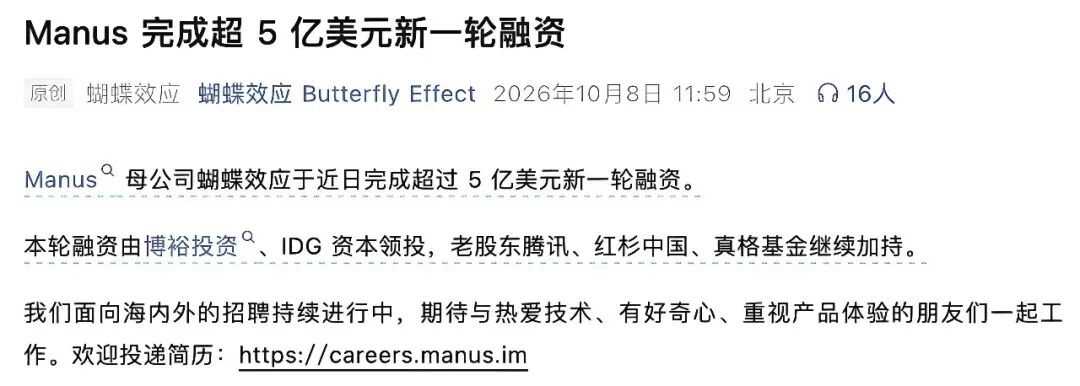
Image source: Butterfly Effect
Financing news landed almost simultaneously with the hiring spree. Butterfly Effect announced the completion of a new funding round exceeding $500 million, led by Boyu Capital and IDG Capital, with continued support from existing investors Tencent, Sequoia China, and ZhenFund. The corresponding valuation is approximately $4 billion, doubling from the $2 billion at the time of Meta's acquisition. This marks the largest single funding round secured by a domestic Agent-native startup to date.
Before the funding announcement, the product was already on the table. On September 28, Manus released version 2.0, replacing the underlying Agent execution framework with its proprietary Cascade. It launched a 7x24 cloud computer and automation workflows triggered by external events, while upgrading the desktop application to Manus Studio, covering video editing and game development.
The concurrently launched standalone app Cue equips each Agent with an independent email, phone number, wallet, and computer.
From the formal announcement of restored independent operations on September 1 to completing a $500 million funding round, a major product release, and the launch of a domestic team, the entire process took just five weeks.
However, the situation was vastly different more than a year ago. In 2025, Manus relocated its headquarters to Singapore, significantly downsized its Chinese team, and shifted its business focus overseas. This was followed by Meta's swift acquisition, regulatory investment bans, buybacks by existing shareholders at the original price, and seven months of user data deletion and restoration.
Now, this year-long saga has brought Manus back to where it started.
The returned Manus faces an Agent landscape that has undergone a complete transformation. When it left, the "general-purpose AI agent" was a new category defined by startups. Upon its return, Meta's Muse surpassed 5 million downloads within a month of launch, Tencent's WorkBuddy exceeded 20 million monthly visits for domestic PC-end AI office agents, and OpenAI and Anthropic had integrated Agent capabilities into their flagship products.
So, is Manus' $4 billion valuation justified? Can its $400–500 million in annualized revenue continue to grow independently of Meta's channels? For a company that doesn't train foundational models and built its business on Claude, where is its survival space in a market squeezed by tech giant ecosystems and open-source Agents?
1. Selling Agents Like Computers
Setting aside the dramatic events of going viral, acquisition, suspension, buyback, and independence, Manus' core business is straightforward: users provide a goal, Manus spins up a virtual machine in the cloud, mobilize (utilizes) browsers, code editors, file systems, and other tools to complete tasks from start to finish.
Essentially, Manus is a company selling execution services—users pay for the Agent's ability to get things done on their behalf. The core requirement is simply getting things done more efficiently than if the user did them manually; users don't care whether Claude or GPT is powering it behind the scenes.
Manus employs a subscription-based billing model, meaning its revenue structure is simple: users pay monthly, and Manus provides services monthly.
Under this business model, revenue growth depends on two factors: whether users are willing to continue paying and whether the cost per execution can be reduced sufficiently.
Based on this, Manus' founding team has a clear understanding, which Xiao Hong illustrates by comparing the company's business to "selling computers": people buy computers primarily for work, but a computer that can't stream videos or play games would be boring.
This metaphor naturally extends the commercial logic of "execution services" and has two layers of meaning.
The first layer is product logic. The same computing power can support diverse needs like office work, creativity, and entertainment—writing documents today, editing videos tomorrow, gaming the next day—giving the product broader usage scenarios.
The second layer is commercial logic. If Manus only sold single-task executions, it would be no different from outsourcing; users would leave after completing one task without a reason to keep paying. But by selling a "computer"—including computing resources, software environments, and continuous uptime—users will pay for long-term use, just like buying a computer.
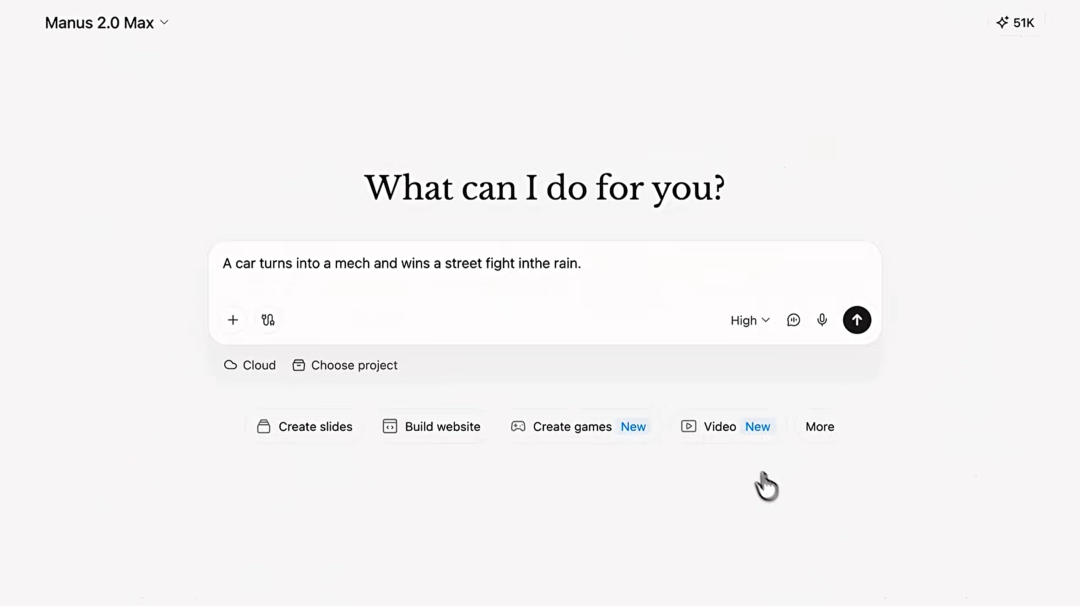
Image source: Butterfly Effect
This positioning explains a series of product decisions in Manus 2.0: the cloud computer is a permanently hosted Ubuntu virtual machine where files, installed software, and running processes remain intact. Even if the user's own computer shuts down or loses internet, the Agent can continue working.
Manus Studio upgrades the desktop application into a shared workspace for humans and AI, covering documents, spreadsheets, PDFs, presentations, websites, code, video, and games. For example, after receiving an AI-generated draft, users can edit it directly on the timeline or send it back to AI for further processing.
Cue extends this approach to personal life scenarios, equipping each Agent with an independent email, phone number, wallet, and computer. Agents can send messages, answer calls, make payments within budget, and multiple Agents can collaborate in group chats.
2. Manus' Independence Stress Test
From a revenue structure perspective, Manus' ARR grew from $100 million in December 2025 to the $400–500 million range by June 2026. This growth curve is rare in the SaaS industry; traditionally, SaaS companies take 5–7 years to grow ARR from zero to $100 million, whereas Manus achieved it in just eight months.
However, this growth curve raises an unavoidable question: it occurred during the seven months after Meta's acquisition. Within two months of completing the acquisition, Meta integrated Manus into Ads Manager, making it available to over 10 million advertisers, and later expanded it to WhatsApp Business and Instagram ecosystems.
Manus' fastest revenue growth occurred precisely during its seven months as part of Meta. This leaves a core question for the newly independent Manus: how much of its past growth came from the Agent itself, and how much came from Meta-provided traffic and distribution?
Guo Tao, an expert advisor to the Wuhan Municipal Commerce Bureau, stated in an interview that Manus' explosive growth occurred during Meta's acquisition window and displayed clear "event-driven" characteristics, requiring careful distinction of organic growth.
He judged that if revenue was highly concentrated in a single source (Meta), the original high-growth trajectory would likely slow significantly after the acquisition ended, requiring Manus to revalidate its commercialization capabilities.
The independent Manus must now prove how much of its $400–500 million ARR represents organic growth versus channel-injected revenue. If ARR collapses after removing Meta's influence, the $4 billion valuation loses its foundation.
Moreover, "wrapper" remains the most persistent label attached to Manus.
Since Manus lacks a self-developed foundational large model and relies on calling Anthropic's Claude model API for core capabilities, the open-source community replicated a functionally similar OpenManus within three hours of Manus going viral, using the MIT license. Anyone can freely use, modify, or even commercialize its code without paying royalties or open-sourcing modifications, further intensifying doubts about its technical barriers.
This label oversimplifies the reality. An easily overlooked fact is that during the seven months of acquisition, investigation, and forced divestiture, Manus never halted product iteration, and its internal order did not collapse.
Financially, Manus maintains a gross margin of approximately 50%. Reports from The Information indicate that when using Anthropic's Claude, Manus pays an average of $2 per completed task to Anthropic.
This margin level means roughly half of Manus' $100 in revenue covers primarily computing costs. Traditional SaaS typically achieves 75–80% gross margins, but Agent cost structures are changing this paradigm: as user numbers and task complexity increase, revenue may rise, but model and computing costs will increase proportionally.
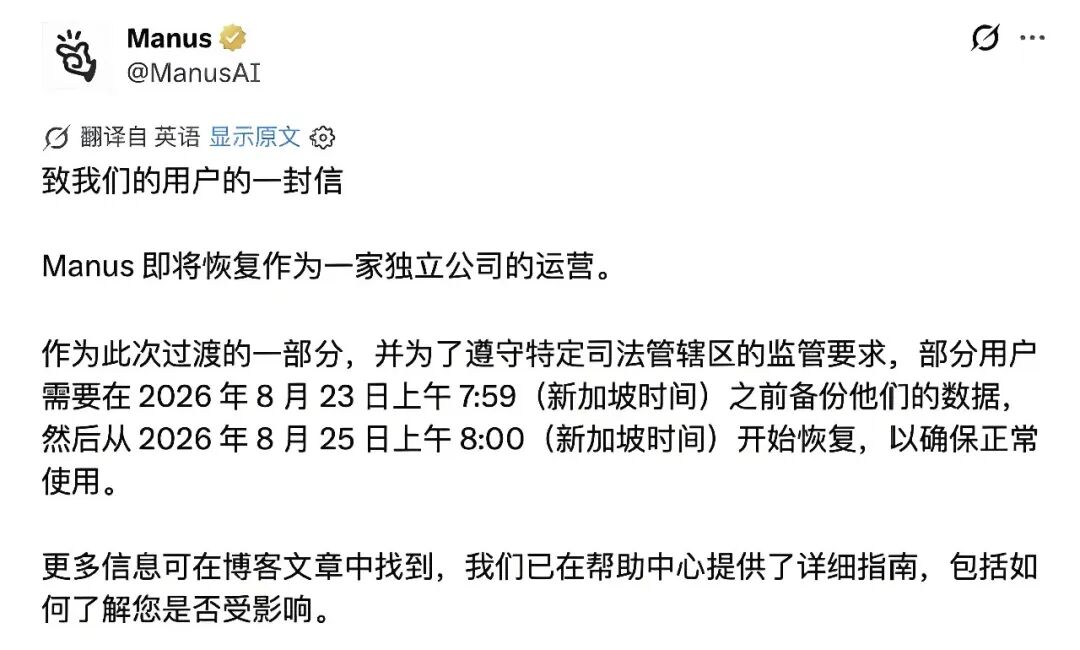
Image source: Jike
Next, considering valuation: numerically, Manus does appear twice as expensive, but incorporating revenue changes the picture—Manus actually became cheaper than during Meta's acquisition.
Before Meta's acquisition, Manus' ARR was approximately $100 million, with a $2 billion acquisition price representing about 20x ARR. By June 2026, ARR had grown to $400–500 million, and the $4 billion valuation corresponds to 8–10x ARR—making it half as expensive relative to revenue.
Of course, this assumes the ~$500 million ARR holds. If a significant portion came from Meta's channel referrals, the actual revenue base after independence might be substantially lower than reported.
Thus, Manus must now prove two things:
First, whether its $400–500 million in annualized revenue can continue growing. This depends on two factors: user willingness to keep paying for "execution services" and Manus' ability to acquire customers independently after separating from Meta.
Second, whether costs can decline to a level supporting profitability as users and tasks increase. The Cascade framework reduced operating costs by 32%, but whether cost growth from expanding user scale can be offset by continuous optimization remains to be verified.
From announcing restored independent operations on September 1 to completing over $500 million in funding by October 8—just five weeks later—capital markets have sent a clear signal. How long capital patience lasts depends on whether Manus' post-independence data can continue telling a growth story.
3. Writing the Next Chapter: The Third Pole in a Crowded Race
As Manus restarts, commercial judgments about it have diverged.
Some critics argue the company missed a critical window for Agent development amid its turmoil. As model vendors and application companies increasingly integrate task execution capabilities into their products, with general-purpose Agents becoming a shared direction, opportunities for independent startups are narrowing.
This year, Tencent, Alibaba, and ByteDance consolidated internally developed Agent products from multiple teams under WorkBuddy, Qianwen Office, and Doubao Work, respectively. By June, WorkBuddy exceeded 20 million monthly visits among domestic PC-end AI-native office agents. Overseas, Meta launched its personal Agent product Muse in September.
Agent competition is gradually becoming a war among tech giants. From a product lifecycle perspective (rather than company lifecycle), Manus' challenge isn't "missing the window" but "finding its place in an already crowded track ( track : track/field)".""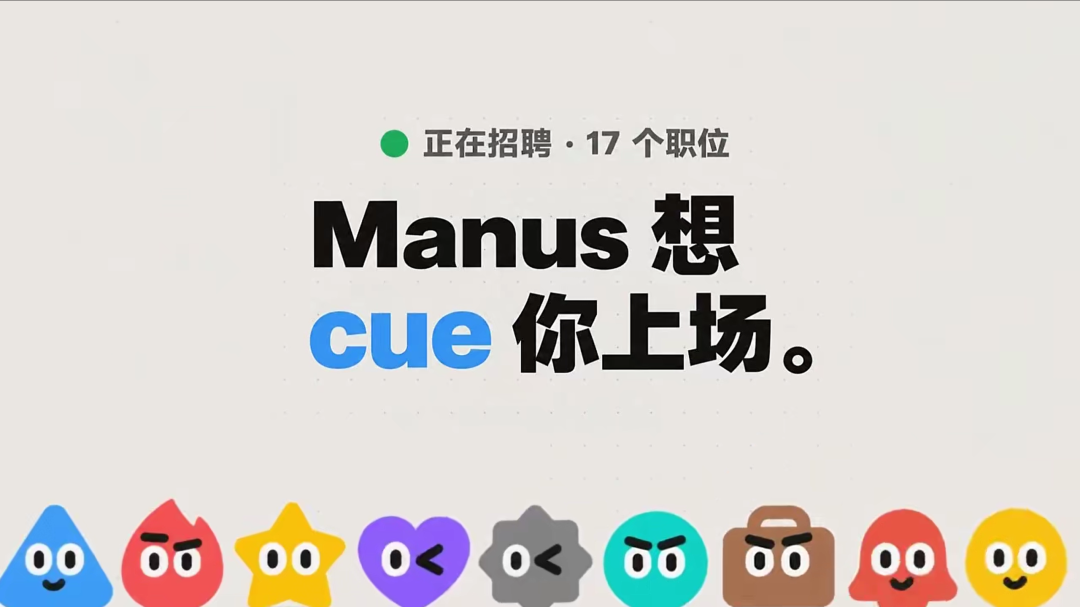
Image source: Butterfly Effect
The 17 positions Manus advertised cover product, R&D, operations, and growth, requiring this team to participate in the entire process from product development to user operations, with some roles also handling global business.
The roadmap revealed by these 17 positions is clear: Manus aims to build a complete chain from Agent operation and control layers to user growth and paid conversions. It's not just bringing Manus 2.0 and Cue to the domestic market but finding a sustainable business model in a market with weak consumer payment willingness.
However, domestic market data repeatedly shows that C-end payment willingness is weak, and B-end represents the primary field for Agent commercialization. IDC projects the domestic enterprise AI Agent market will reach 44.9 billion yuan by 2026, while the C-end market is worth only billions.
To commercialize domestically, Manus may need a product logic entirely different from its overseas approach—shifting from individual-oriented to enterprise-oriented organizational Agents. This precisely targets the area where domestic tech giants have the deepest ecosystem barriers and represents Manus' first real challenge after returning: while tech giant Agents have entry points, ecosystems, and models, what does Manus have?
Tencent's WorkBuddy derives its core from Tencent's programming tool CodeBuddy, while Qianwen Office and Doubao Work integrate tightly with DingTalk and Feishu, respectively. These products' common trait—and advantage—lies in their entry points and distribution.
Startups like Manus differ significantly from tech giant-backed products in product design, user experience understanding, and technology application.
Thus, Manus' potential position may be as an independent execution gateway across models and services. Unbound to any single large model vendor, it can dynamically route among multiple open-source and closed-source models. Independent of any internet platform ecosystem, it can connect to the various services users actually use. This independence itself constitutes differentiation.
However, this position also means that Manus needs to address, one by one, the connectivity issues that large-company Agents inherently possess. Behind a shopping Agent are products, merchants, and payments; behind an office Agent are files, communication records, and organizational permissions.
Large companies only need to transform their existing business relationships into the Agent's execution capabilities, whereas Manus needs to establish these connections from scratch.
Image source: Butterfly Effect
Currently, Tencent plays a pivotal role in Manus's capital structure. Caijing reported that Tencent led the push for Manus's buyback, becoming the largest external institutional investor. By acting as a lead investor rather than a takeover party, Tencent's approach resembles strategic investment rather than strategic integration, aligning with its consistent strategy of 'investing in the ecosystem without seeking control.'
If Tencent acquires Manus, it would fill the missing piece of 'general-purpose task execution' in its portfolio. Tencent has already integrated scenarios such as WorkBuddy, Yuanbao, ima, and Tencent Docs, forming an Agent matrix that covers office work, dialogue, and knowledge management. The addition of Manus would enable Tencent to possess, for the first time, the capability to independently complete complex cross-application tasks in the cloud.
Meanwhile, Tencent provides access and an ecosystem, not a reason for users to pay. Manus still needs to prove that users are willing to continuously pay for a standalone general-purpose Agent product—a proposition that won't automatically hold true just because of Tencent's investment.
IV. Conclusion
The drama of Manus's story lies in its near-complete collection of sensitive elements: AI technology, core talent, cross-border intellectual property flows, and U.S.-China tech competition.
The market for general-purpose Agents is larger and more competitive than when Manus first debuted. Going forward, users will compare it with other products: for the same task, which performs better; for the same mundane life task, which is more trustworthy.
Manus's next chapter will unfold through these specific choices.
After the new product launch, Xiao Hong wrote: 'I originally thought our journey would end with just a footnote, but now it seems we might have the chance to write a chapter.'
From regaining independent operations to launching new products and preparing a domestic team, Manus has already begun writing its next chapter.
The success of this chapter does not hinge on dramatic narrative tension but returns to the most fundamental question: after users entrust their computers, contact information, and some payment permissions to AI, can it get things done?
Cover image source: God of Gamblers 2
Header image source: Manus page
Disclaimer: The content of this article is for reference only and does not constitute investment advice. Investors act at their own risk.
Copyright Mech Island. All rights reserved. Unauthorized reproduction is prohibited.
-
![]()
Manus Caught Between Tech Giants
-
![]()
Starting at 329,800 Yuan! BAIC Unveils New Car: Official Launch on September 28 with an Impressive 1,456 km Range!
-
![]()
Starting at 80,800 Yuan! Volkswagen Unveils New Car Model: Official Release in October, with Top Variant Priced at Only 99,800 Yuan
-
![]()
Design Verification of Auto Parts Using Traditional Methods: How Traditional Automakers Develop, Verify, and Release a 'Brake Pedal'
-
![]()
Defying Expectations! Xiaomi Pengcheng's Locked-In Orders Soar During National Day, Alongside HiCar Smart Travel's Order Surge Over the Holiday
-
![]()
Capital Sets Sights on New Model Pathway: Matrix Partners, Shunwei, and Legend Capital Jointly Invest in DiffuSpace
-
AI: Pioneering New Horizons for Smartphones
-
![]()
China Successfully Orbits 27 Satellites for Its Internet Constellation: Long March 12’s 671st Mission