AI-Generated Comic Drama Concept Stocks Surge: Is ByteDance the Sole Profit-Maker?
 10/16 2026
 419
419
ByteDance Takes the Lead in AI-Generated Comic Dramas
On the evening of October 11, at Beijing's National Speed Skating Oval, affectionately known as the "Ice Ribbon," Tim Pan, the founder of Film Storm, graced the stage with a paper airplane in hand. As he input a text description onto the screen, AI promptly crafted a room from the vantage point of a tiny figure. This figure then soared on the paper airplane, navigating freely around the room. With a push, a "magic door" opened, seamlessly transitioning the figure from indoors to the vast expanse of outer space... The official Douyin Group WeChat account confirmed that this represents the world model currently under development by ByteDance.
On the same stage, the 67-year-old Yang Liping danced in perfect harmony with an AI-generated "digital peacock," while Hu Yanbin played "Moonlight" on "laser strings" formed by five beams of light. Doubao Aixue transformed poems from textbooks into captivating stage visuals... The live broadcast of the entire event amassed over 230 million views.
More significant than the performances themselves was a subtle yet notable shift: this event, now in its eighth year, underwent a name change from "Douyin Wonderful Night" to the more streamlined "Wonderful Night." Classic IP medleys from Fanqie Novels, actors from Hongguo Short Dramas, and signed artists from Qishui Music took turns gracing the stage. At the core were the computing power and cloud services provided by Volcano Engine, with Seedance, Seedream, and the world model forming the middle layer, and tools like Doubao, Jimeng, and the Trae community at the forefront.
ByteDance is weaving together models, computing power, cloud services, content platforms, and consumer products into a cohesive ecosystem. Fanqie Novels supplies a wealth of story IPs, Seedance and Seedream handle video and image generation, Volcano Engine offers computing power support and model orchestration, Doubao connects to a broader AI user base, Douyin and Hongguo Short Dramas manage content distribution and user engagement, and Qishui Music complements the audio soundtracks.
While not all these businesses directly cater to AI-generated comic dramas, they are strategically positioned across multiple key sectors of the industry, forming ByteDance's core competitive edge through mutual reinforcement.

AI-Generated Comic Dramas: A Capital Magnet
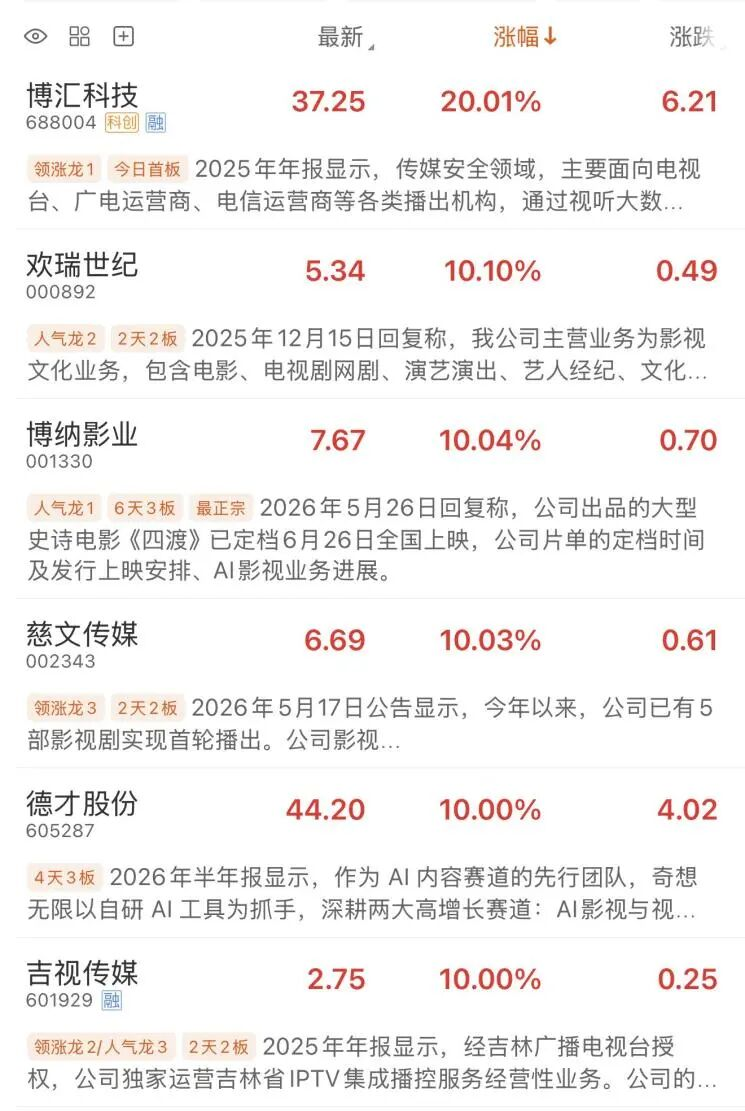
Following the National Day holiday, the A-share market experienced increased volatility, yet the "AI-generated comic drama concept" continued to gain momentum. In the six trading days from October 8 to the morning of October 15, concept stocks like Ciwen Media achieved five consecutive daily limits, Huanrui Century three daily limits in five days, and Guomai Culture surged over 52% during the same period.
On the news front, Tencent's discreet launch of "Green Bubble Short Dramas" was uncovered by the market. Leveraging WeChat Mini Programs, it requires no separate download, features viewing interactions akin to WeChat Channels, and adopts a free-with-ads monetization model, directly challenging ByteDance's Hongguo Short Dramas, which boast 168 million daily active users.
Hongguo Short Dramas' commercialization path has also been successfully replicated in ByteDance's overseas short drama app, PineDrama. According to Sensor Tower data, PineDrama surpassed 100 million downloads in just over nine months, with approximately 7 million daily active users and over 12 million downloads in September alone. Among the seven independent short drama apps with over 100 million global downloads, PineDrama is the only new release launched within the past year.
With major players continuously upping their stakes, AI-generated comic dramas are poised for explosive growth. CCTV Finance data indicates that the domestic AI-generated comic drama market is expected to exceed 40 billion yuan in 2026, with a year-on-year growth rate of 138%, and the overseas market is projected to surpass US$4 billion, accounting for nearly 70% of the global micro-short drama market. DataEye's "2026 H1 AI Drama and Comic Drama Data Report" reveals that domestic AI drama and comic drama users have surpassed 600 million.
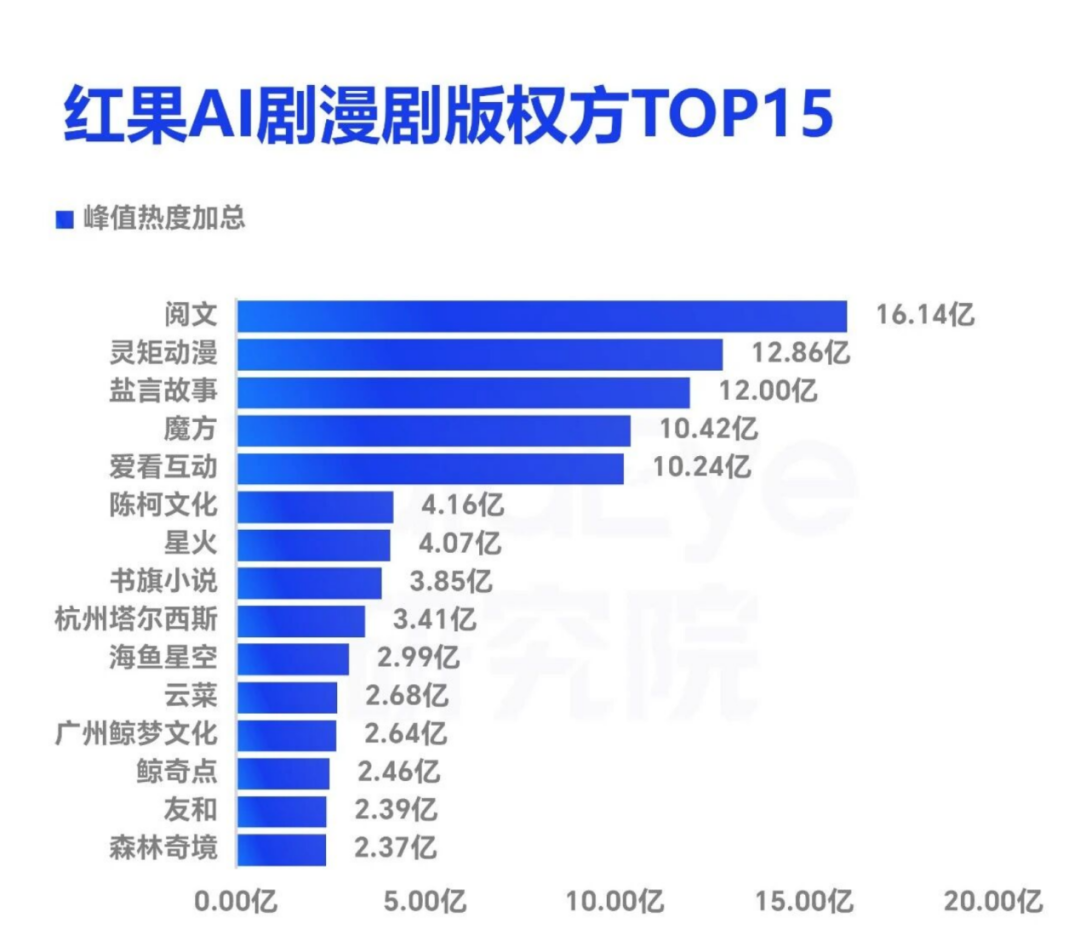
Furthermore, ChineseAll disclosed in an "Investor Relations Activity Record" that 55% of domestic AI token consumption is dedicated to short dramas and video generation, 24% to e-commerce advertising, and only 15% to research and development. Token consumption for AI short dramas and video generation has more than doubled that of software development, becoming the largest core consumption scenario in the entire token economy.
Behind the capital frenzy lies the advancement of AI video generation capabilities and the market's reevaluation of changes in content production methods. Traditional animation production involves scriptwriting, storyboarding, art, modeling, voice acting, post-production, and other stages, requiring significant time investment from teams to complete a work. With the introduction of AI tools, the efficiency of generating certain visuals and assets has improved dramatically, enabling smaller teams to explore genres that were previously cost-prohibitive.
This makes AI-generated comic dramas appealing from both the supply and demand sides. On the supply side, lower production barriers allow more teams to enter the market; on the demand side, short dramas have cultivated user habits for rapid consumption of serialized content, while animated expressions can cover fantasy, wuxia, and sci-fi genres that are challenging to present in live-action short dramas. The third season of "Nuonuo Descends the Mountain, and the Senior Brothers Panic" is a prime example, with a peak viewership of 114 million and 139 million effective views on its debut day.
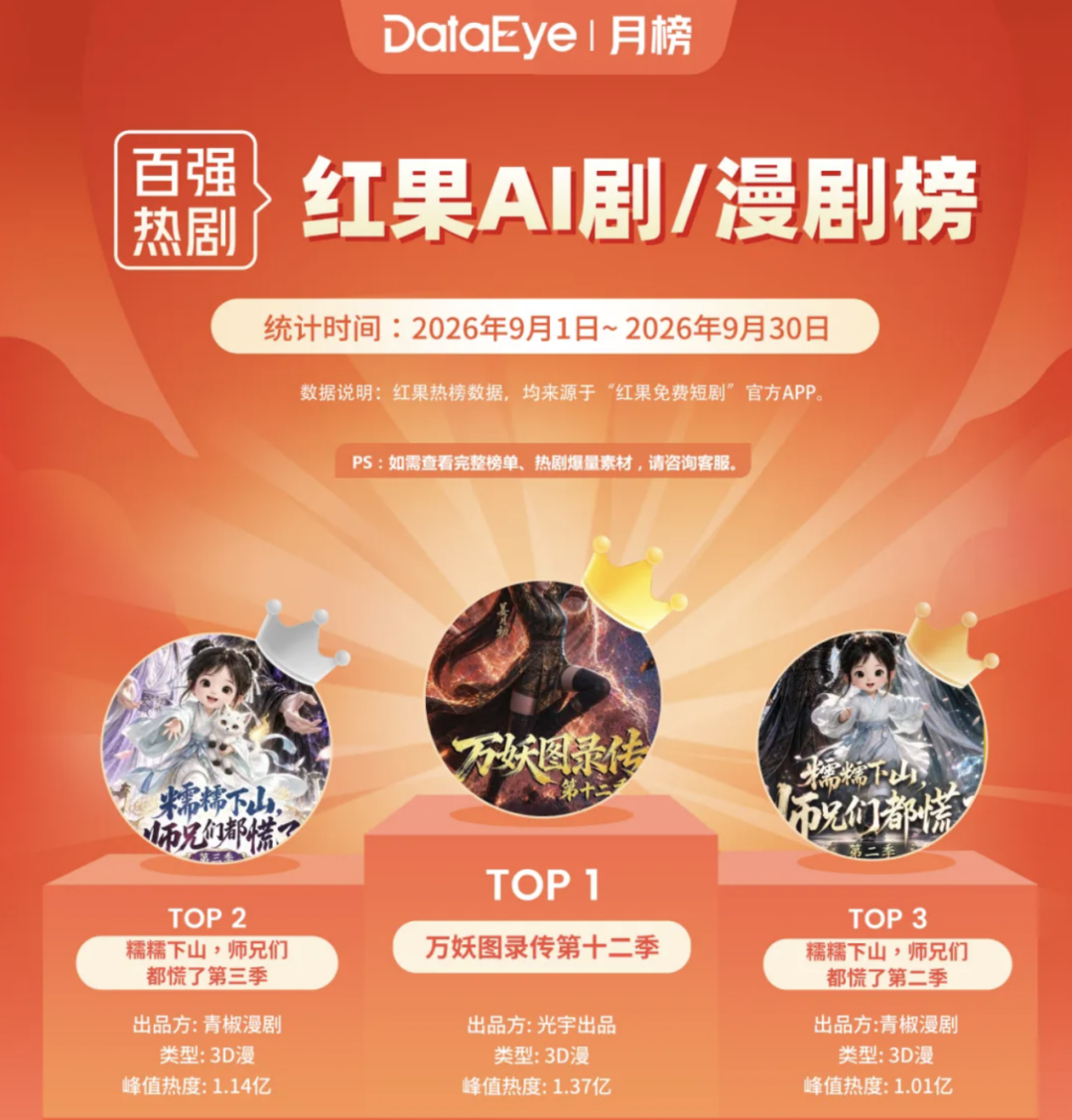
DataEye data shows that in the first quarter of this year, total views of AI drama and comic dramas reached nearly 130 billion—surpassing the total for all of 2025. In September 2026, the top 100 Douyin AI drama and comic drama list saw a combined monthly view increase of 76.46 billion for listed works. Among them, 3D comic dramas accounted for approximately 36.7 billion views, while AI-simulated human dramas contributed about 39.76 billion, with the two content types now comparable in scale.

ByteDance's Edge Extends Beyond Seedance
When discussing ByteDance's AI-generated comic dramas, the focus often centers on Seedance, its video generation model. However, this perspective is overly narrow. The competition in AI-generated comic dramas is not merely about individual models; a work's journey from concept to commercialization involves script development, visual production, voice acting and editing, distribution and promotion, and commercial monetization. Issues in any of these stages can affect the final return. ByteDance's strength lies in its diverse business布局 (layout) across these stages.
First is content (IP) supply. Fanqie Novels has amassed a vast library of online literature, serving as ByteDance's content reservoir. In March, Douyin's Short Drama Copyright Center launched a comic drama IP library, opening over 500,000 original Fanqie IPs for creators to adapt directly. "Legend of the Ten Thousand Demons," which consistently tops Hongguo's comic drama charts, is adapted from a Fanqie Novels work of the same name, with the series surpassing 6.08 billion cumulative views. In January 2026 alone, over 2,400 comic dramas adapted from original short story IPs were released.
Next are production tools. Seedance handles video generation, while Seedream manages image generation. As model capabilities continue to improve, production teams can reduce significant repetitive work. According to DataEye estimates, Seedance holds a dominant 69% share in the AIGC video large model market, valued at over 20 billion yuan; Nomura Securities estimates that Seedance is used in 80-90% of AI short drama production processes.
Then there's computing power and cloud services. At Volcano Engine's Force Conference this year, Tan Dai, head of Volcano Engine, revealed that in the public cloud MaaS (Model as a Service) market, Volcano Engine's token share rose to 49.5%; the number of members in the "Trillion Tokens Club" increased from 100 in December last year to 200. Additionally, he disclosed in interviews that half of Volcano MaaS's revenue this year comes from Seedance.
Notably, on September 27, Volcano Engine launched the Seedance Film and Television Cooperation Program, offering token subsidies, promotional resources, and technical and tool support to global professional film and television projects. Individual project incentives can reach up to 1 million yuan, with one requirement being that "100% of the video generation process must be realized by Seedance, with the model deeply involved in creation." This means ByteDance is not only developing models but also attempting to translate model capabilities into services for film and television producers.
Distribution and user reach are another area. In the domestic market, Douyin and Hongguo Short Dramas form a dual matrix. Douyin leverages its recommendation algorithm to reach a vast user base, while Hongguo Short Dramas cater to short drama consumption demand. According to Nomura Securities' "China Internet and New Media" monthly report, in July 2026, Douyin surpassed WeChat for the first time, capturing 19.4% of user time share compared to WeChat's 18.8%, becoming China's single app with the longest user engagement.
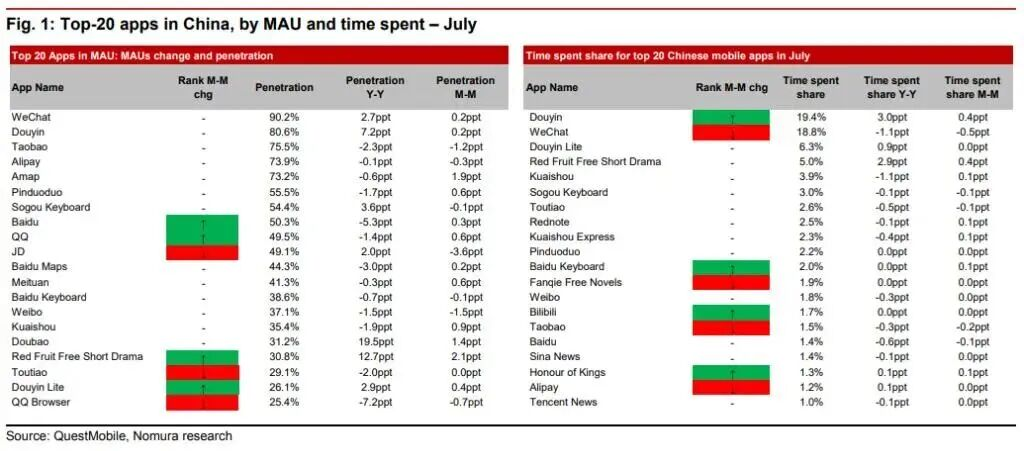
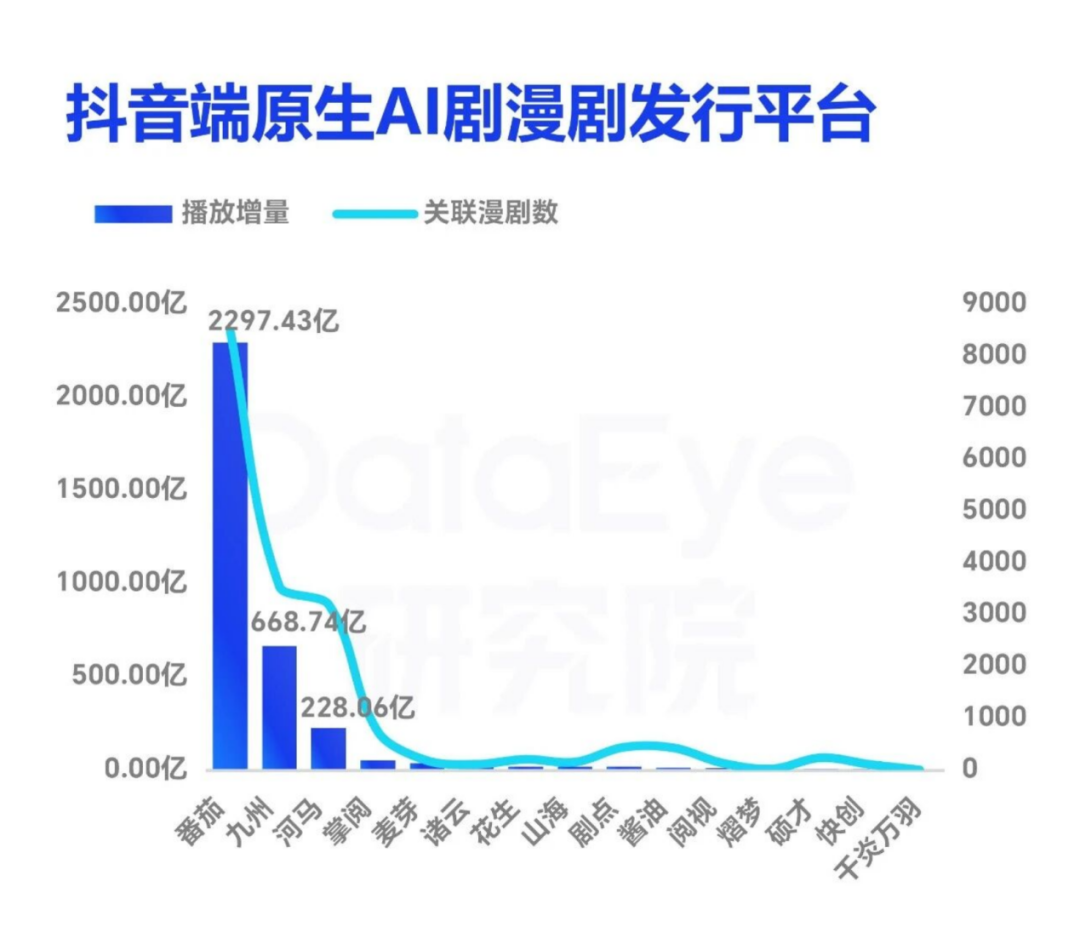
During the same period, QuestMobile data showed that Hongguo Short Dramas reached 168 million daily active users, a 107% year-on-year increase, surpassing the combined 155 million daily active users of iQIYI, Youku, Tencent Video, and Mango TV. DataEye's "2026 H1 Domestic AI Drama and Comic Drama Data Report" also noted that among native AI drama and comic dramas on Douyin, Fanqie (ByteDance's own comic drama platform) ranked first with 229.7 billion view increments, accounting for approximately 67.9% of the top 15 platforms' total, exceeding the combined total of second to fifteenth place.
Finally, there's commercial monetization. ByteDance has established a complete loop of "traffic Import (import) - content playback - ad revenue sharing - reinvestment in production." Creators earn revenue through ad unlocks and paid unlocks based on view counts, with earnings reinvested in IP procurement and creator subsidies to drive more content production. The platform also helps creators gauge work popularity based on metrics like views, completion rates, interactions, and payments. ByteDance is arguably the company with the strongest capability for a complete AI-generated comic drama business closed loop (loop) in the industry, with traffic, content, monetization, and feedback circulating efficiently within the same ecosystem.
These layers of capabilities combine to form ByteDance's greatest advantage in the AI-generated comic drama track (sector): it possesses not just a single model but a matrix of interconnected and synergistic industrial resources.

The Flip Side of Dominance
While AI-generated comic drama concept stocks continue to strengthen, a closer look at the limit up (limit-up) announcements reveals a different picture.
DeCai Group issued an abnormal fluctuation announcement on the evening of October 12, stating that its comic drama-related holding (holding) subsidiary, Fujian Qixiang Infinite, generated 24.5709 million yuan in revenue and a net loss of 5.6217 million yuan in H1 2026. The subsidiary is still in the business development stage, with relatively small revenue scale and no profitability yet. Ciwen Media also noted that its AIGC platform is still under construction and has not yet generated related revenue. Huanrui Century disclosed that its AI short drama business accounted for less than 1% of revenue in H1 2026. Jishi Media similarly stated that its AI micro-short drama business "has not yet generated stable revenue."
While capital markets are voting for AI-generated comic dramas, the only ones consistently earning money in this chain are those selling computing power and controlling traffic.
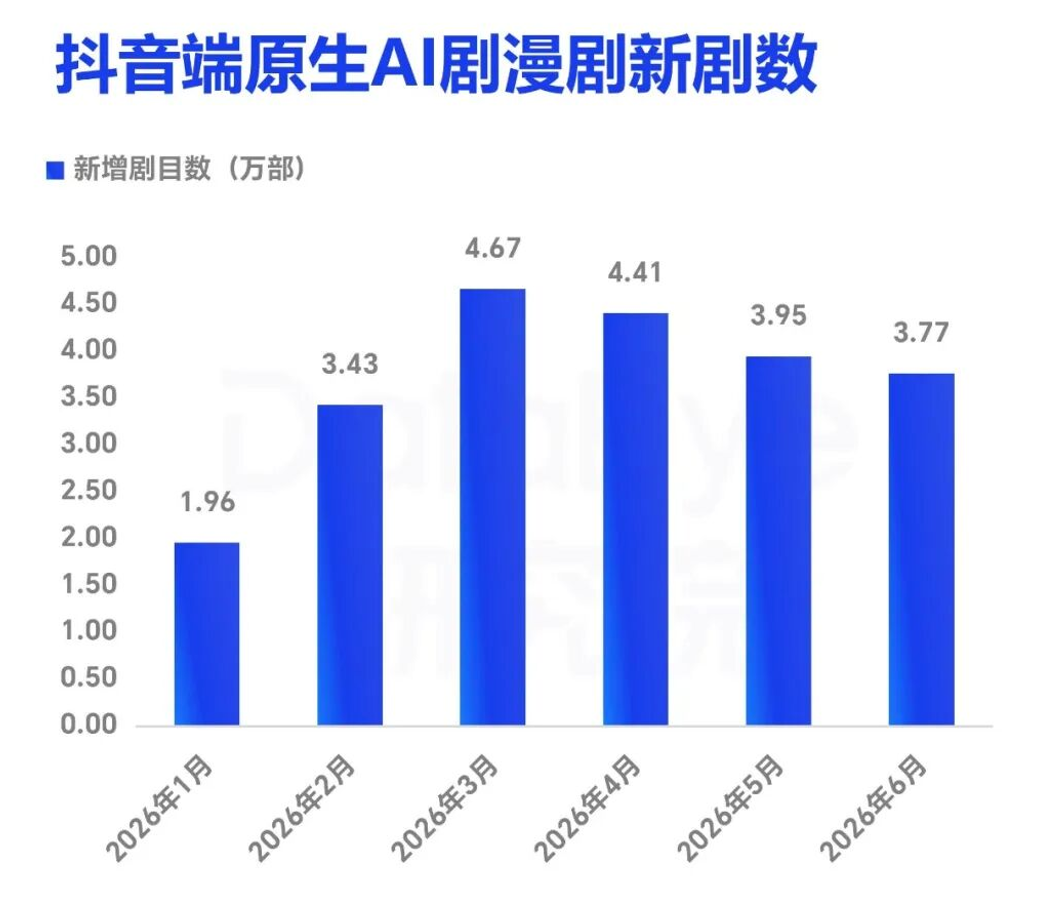
According to DataEye's "2026 H1 AI Drama and Comic Drama Data Report," in H1 2026, a total of 221,900 new AI drama and comic dramas were released on Douyin, but only 1,055 surpassed 100 million views, a success rate of 0.48%—less than one hit per 100 releases. Using the industry-recognized 50 million views as the breakeven line, less than 1.3% of projects recouped costs. The core profitability metric "revenue per 10,000 views" plummeted from 30-100 yuan in H2 2025 to 5-10 yuan in 2026, a nearly 90% drop.
The money hasn't disappeared; it has simply shifted pockets. Cost savings in production have flowed into computing power and traffic acquisition. According to industry data, daily spending on short drama traffic acquisition has reached 150-170 million yuan, with costs continuing to rise. Meanwhile, the official price for Seedance 2.0 (excluding video input) is 46 yuan per million tokens. Generating a standard 15-second video (720p, 24fps) with Seedance 2.0 consumes approximately 308,880 tokens, translating to a cost of about 14.21 yuan in pure video generation mode (excluding video input), or roughly 1 yuan per second.
When a platform connects creators, IPs, computing power, tools, and users, it gains the power to shape industry rules: it can lower production barriers by providing open tools or guide content direction through traffic incentives. This influence over industrial rules is ByteDance's true dominance in the AI-generated comic drama sector.
A October research report by Nomura Securities pointed out that ByteDance leads China's AI-generated short drama industry chain. However, the report also noted that switching costs between model tools are low, leaving room for competition from other players.
In contrast to Seedance's high costs and absence of third-party discounts, Kuaishou's Kling has embraced a competitive pricing strategy, at one point offering discounts of 70-80% to entice customers. MiniMax's H3, which is open-source, is priced at 0.8 yuan per second for 2K resolution and 0.5 yuan per second for 768p. Given that video model iteration cycles are measured in months, a price war could break out rapidly once competitors achieve similar capabilities. ByteDance's current premium pricing is based on its temporary advantage in the market.
Content homogenization is also a significant issue. While models enhance production efficiency, they do not ensure quality. With numerous teams utilizing similar tools, visual styles and narrative approaches may converge, leading to criticism of "template faces" and "a thousand dramas looking alike." Data from Hongguo Short Dramas supports this observation: the peak completion rate for AI-generated comic dramas fell from 42% to 19%, with user daily viewing time decreasing by over 20% month-on-month. In response, Hongguo Short Dramas has carried out multiple large-scale purges of low-quality content, removing 14,357 non-compliant AI-generated comic dramas in June alone—a figure far exceeding the number of non-compliant live-action short dramas.
More notably, starting in July, Hongguo Short Drama initiated a small-scale grayscale test by eliminating the standalone comics-drama section within the app. It also integrated comics-dramas with live-action short dramas into a unified leaderboard, removing the traffic isolation mechanism between the two content types and allowing AI-generated comics-dramas to compete for traffic alongside live-action works.
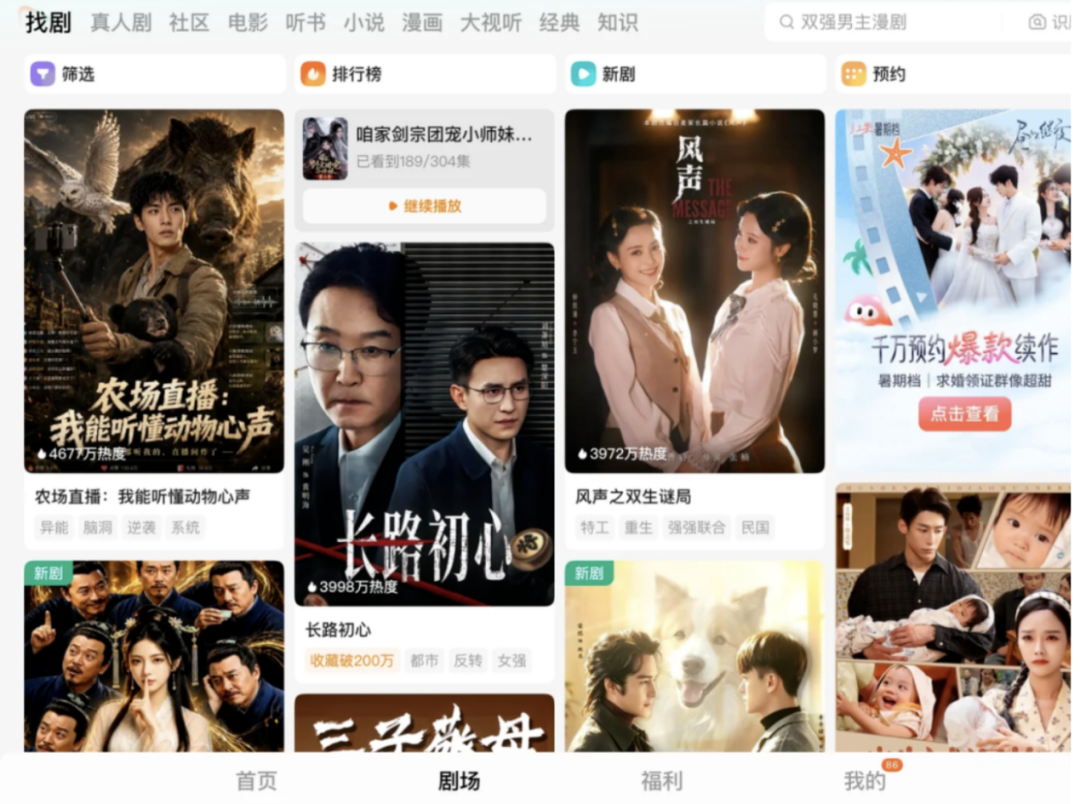
When a platform begins to conceal its main content category, it signals that the traffic efficiency of that category can no longer justify a standalone entry point. Huaxin Securities assesses that the supply of new dramas on Douyin has transitioned from rapid expansion to a contraction phase. The AI-generated comics-drama track is entering a phase of survival of the fittest, with industry competition shifting from "production capacity" to "assets" and "quality." Companies with high-quality content are anticipated to be revalued in the second wave of content.
There is also the pressure of regulatory compliance. The "Administrative Measures for the Development of Micro-Short Dramas," which took effect on September 1, explicitly mandates that each episode of AI-generated micro-short dramas must be clearly labeled, and the final product must undergo manual review. "AI alterations" are strictly prohibited. According to the accompanying classification and tiered standards, live-action micro-short dramas with investments exceeding RMB 3 million are subject to the strictest supervision, while the threshold for AI micro-short dramas is RMB 800,000, with stricter control measures.
Furthermore, copyright disputes are commonplace: Several voice actors have publicly accused their voices of being used without authorization in AI-generated comics-dramas. Instances of celebrities' likenesses being "face-swapped" into dramas are also prevalent. A progress report on a special rectification campaign released by Fanqie in June revealed that out of over 300 micro-short dramas examined, more than 70 were confirmed to be infringing, with cumulative compensation exceeding RMB 2.8 million and the highest single payout exceeding RMB 500,000.

The Endgame Has Not Yet Arrived: Advantages Are Real, But Also Temporary
Returning to the viral gala, Tim's paper airplane soared gracefully, and Hu Yanbin's "laser strings" resonated enchantingly, but a single gala cannot resolve two fundamental questions: How long can the model's advantages be sustained? What happens when audience aesthetic appreciation fatigue sets in?
ByteDance's strength lies in its ability to integrate IP, tools, computing power, and distribution into a cohesive ecosystem, then monetize every interaction, with the sound of coins clinking at every step. This represents a more stable business model than content production. External estimates suggest that Seedance has a gross margin of 70%, while 98.7% of AI short drama projects fail to recoup their costs within six months. These two figures, when juxtaposed, illustrate the point more effectively than any praise.
However, the issue is that ByteDance controls the audience's attention channel, not their emotional loyalty. Channels can be replaced, and attention can be diverted: Tencent's "Green Bubble Short Dramas" leverage mini-programs to offer download-free access, Kuaishou relies on its下沉 (grassroots) community to maintain its base, Bilibili has upgraded its "Awakening Comics-Drama Plan" to compete for creators, and China Literature boasts an IP library of 14 million works... No single link is exclusively monopolized.
More importantly, AI replaces the execution layer, not the creative layer. Take China's first AIGC long drama, "Journey to the West: The Next Chapter," as an example. The cost per episode is approximately RMB 900,000, with computing power accounting for only about one-fourth to one-fifth, with the majority still being labor costs. As the generation quality of large models gradually levels out, the deciding factors will revert to the timeless questions: Who has the compelling stories? Who possesses the aesthetic judgment?
Thus, a more accurate statement might be: ByteDance holds the most complete hand in the current stage of AI-generated comics-dramas. The advantages of this hand are real but also temporary. It can dictate how the industry produces content today and distributes it tomorrow, but it cannot guarantee that audiences will still be eager to click on the next episode three years from now.
The most candid moment of the gala may not have been when the paper airplane took flight, but the latter half of Tim's statement—"Only stories beyond imagination exist." Tools are responsible for "being able to film," but stories must ultimately be crafted by people. And in this regard, ByteDance has yet to demonstrate that it can monopolize the creative process.
-
![]()
Thousand-Kilometer Range BMW i3, Ioniq V Priced Under RMB 100,000: Chinese Automakers Must Guard Against Joint Venture Encroachment in Global Expansion
-
![]()
Competition Among Cities Enters the Second Half: The Outcome Lies Beneath the Surface
-
![]()
AI-Generated Comic Drama Concept Stocks Surge: Is ByteDance the Sole Profit-Maker?
-
iPhone 18 Pro Series Sees Price Reductions—Apple Can't Afford to Stay Idle During Double 11
-
![]()
A Whopping 550 Million Yuan Investment! Fanchuangwei’s High-Transparency Optical AR Lens Project Takes Root in Taizhou
-
![]()
Domestic Triumph in Glass Substrate Lithography! Optical Firm Lands Major Orders
-
![]()
AI-Powered Alternatives Offer Free Substitutes, Posing Threat to Adobe's 'All-in-One' Suite
-
![]()
McKinsey Report: AI Inference to Account for 60% of Computing Power by 2030