Computing-Power and Electricity Synergy: The Most Hardcore 'New Infrastructure' in the AI Era is Rewriting the Relationship Between Computing Power and Electricity | Golden Eye
 10/22 2026
 462
July 2026, Shanghai Lingang Intelligent Computing Valley.
Over three days, an unprecedented cross-provincial computing power dispatch test was quietly completed. Computing centers in Shanghai, Xinjiang, Anhui, and Hubei were unified into a dispatch system that 'monitors electricity prices,' with autonomous decision-making by electricity price-sensitive controllers: determining which AI inference requests remain local and which are 'moved' to lower-cost western nodes. Over the three days, 280,000 inference requests were dispatched, outputting 33.03 million tokens, reducing the electricity cost per token by approximately 31% and increasing the average utilization rate per card by 40%.
This marked the nation's first full-scale real-world test of computing-power and electricity synergy, signaling its transition from policy concept to industrial practice.
Just two months earlier, in Zhongwei, Ningxia, the nation's first large-scale computing-power and electricity synergy project with direct green power supply officially went live. The 500,000-kW photovoltaic power station at Datang Zhongwei Cloud Base directly transmitted desert sunlight to computing park cabinets via four dedicated transmission lines, bypassing the main grid and ensuring clear green power traceability and stable supply.
From the northwestern deserts to eastern cities, a new infrastructure network deeply coupling computing power and electricity is accelerating its formation.
01 Why Now?
The electricity consumption curve for AI computing power is climbing at an exponential rate.
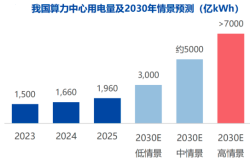
By 2025, the total electricity consumption of computing centers nationwide will reach 170 billion kWh, accounting for 1.6% of total societal electricity use. By 2030, this figure is expected to exceed 700 billion kWh, with its share rising above 5%. A fully loaded large AI data center consumes as much electricity as the combined domestic and industrial use of a medium-sized town.
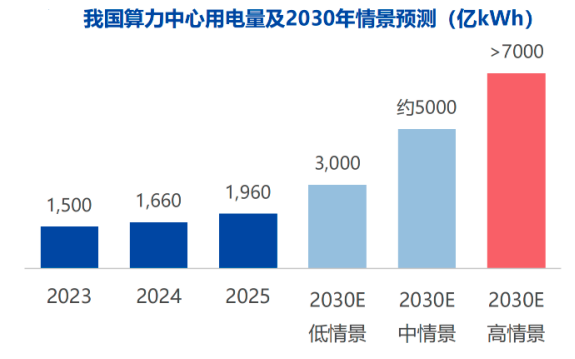
Source: China Academy of Information and Communications Technology's 'Research Report on Collaborative Development of Computing Power and Electricity (2025)', National Energy Administration
Meanwhile, China's daily large model token calls surged from 100 billion in early 2024 to 100 trillion by the end of 2025, breaking 140 trillion in March 2026—a more than 1,000-fold increase in just over two years.
This demand surge collides with a structural mismatch: China's computing demand is concentrated in the east, while its renewable energy resources are abundant in the west. Eastern computing demand is exploding, but power supplies are tight and costly; western 'wind and solar' resources are plentiful, but local consumption capacity is limited, and New energy (new energy) output is highly random, creating a natural gap with computing infrastructure's long-cycle, high-certainty electricity needs.
This mismatch has given rise to computing-power and electricity synergy.
In 2026, computing-power and electricity synergy was written into the government work report and included in the '15th Five-Year Plan' outline. 'Implement new infrastructure projects such as ultra-large-scale intelligent computing clusters and computing-power and electricity synergy, strengthening national integrated computing power monitoring and dispatch'—this is the exact wording from the government work report.
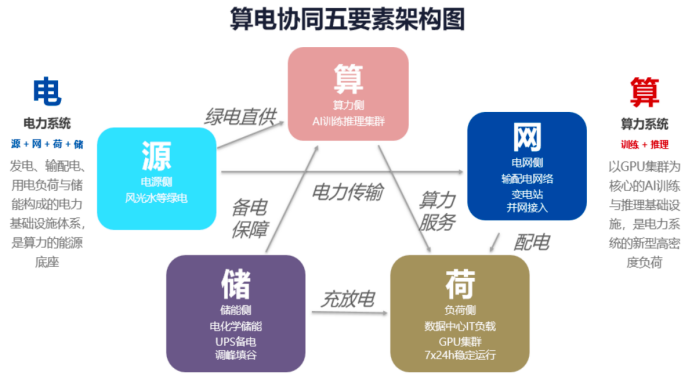
The policy language is precise. Computing-power and electricity synergy is not about 'building more power plants' or 'building more data centers,' but a systemic collaboration: relying on the national integrated computing power network and new power systems, it achieves dynamic matching and optimal allocation of computing power and electricity in planning, construction, operation, dispatch, regulation, and market transactions through technological integration, mechanism innovation, and market alignment.
In plain terms: Let computing power follow green electricity, and let green electricity find computing power.
02 The Economics on the Books: Electricity Price Differentials Equal Profits
The most intuitive way to understand computing-power and electricity synergy is through an electricity bill.
For a 10MW data center, assuming a PUE of 1.2 and a stable-state load rate of 90%, every 0.1 yuan/kWh reduction in electricity price saves approximately 9.46 million yuan in annual electricity costs. For intelligent computing centers often reaching tens of megawatts, every cent reduction in electricity price translates to tens of millions in profit potential.
But low electricity prices don't come for free.
The core value of direct green power connections lies in purchasing price differentials—direct connection volumes replace grid purchases at lower energy prices. The levelized cost of electricity (LCOE) for wind power in regions like Ulanqab, Inner Mongolia, has dropped to approximately 0.15 yuan/kWh. After weighted averaging with storage costs to smooth volatility, the actual electricity price is around 0.25 yuan/kWh, significantly lower than the grid's comprehensive price of 0.35 yuan/kWh.
However, achieving low electricity prices requires infrastructure investments. Dedicated lines, substations, energy storage, and metering systems all represent substantial costs. Shenwan Hongyuan's calculations provide three scenarios: When reusing existing access facilities, the project's internal rate of return (IRR) is 10.8%; adding 35kV infrastructure reduces IRR to 8.4%; and adding 110kV infrastructure lowers IRR to just 5.9%.
The conclusion is clear: The economic viability of direct green power connections depends on whether 'saved electricity costs' can cover 'infrastructure investments for low-cost power.' The asset-light model of reusing existing access is optimal. This explains why the Zhongwei project innovatively adopted a dual-track model of 'physical direct supply + bilateral trading'—dedicated lines for incremental loads and virtual direct supply via power market bilateral trading for existing loads, significantly reducing transformation investments.
03 From 'Separate Paths' to 'Unified Grid Dispatch'
The most hardcore aspect of computing-power and electricity synergy lies in dispatch.
In July 2026, State Grid Shanghai Electric Power organized 16 data centers from enterprises including Shanghai Telecom, GDS, INESA, and Alibaba to complete the nation's largest single-city computing power load regulation call to date, reducing maximum load by 97,800 kW within two hours.
This call was the first to unify three regulation paths in the same timeframe: 'flexible load regulation,' dynamically adjusting resources like air conditioning, energy storage, and computing facilities; 'backup diesel generator switching,' using diesel generators to partially or fully replace grid power; and 'cross-domain computing power transfer,' shifting computing tasks across spaces via point-to-point or multi-to-multi strategies.
Different resources have varying response speeds and regulation characteristics. Integrating them into a single dispatch system tests not just technology but also systemic mastery of dispatch strategies, safety boundaries, and multi-stakeholder collaboration.
A deeper transformation lies in market mechanism integration. Previously, computing power users could only passively accept fixed electricity prices, lacking incentives to adjust task operations based on power supply-demand changes. Now, through electricity price-sensitive dispatch, elastic tasks like offline batch inference can run during low-price periods, while real-time tasks like online interactive inference prioritize service quality.
China Southern Power Grid's Digital Research Institute independently developed (independently developed) the nation's first electricity-carbon-computing collaboration (collaborative) operation platform, creating an intelligent matching mechanism similar to 'Taobao for computing power'—automatically matching computing power users with optimal nodes based on electricity price signals, green power ratios, and computing performance, with green power consumption response times reaching minute-level speeds.
04 Where Are the Industrial Chain Opportunities?
The industrial chain for computing-power and electricity synergy can be understood along three main lines.
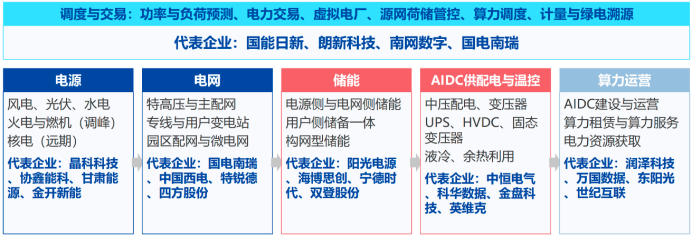
Overview of the Computing-Power and Electricity Synergy Industrial Chain Source: Company Announcements
Line 1: Facility Upgrades—The First Hardware Demands to Materialize
The most immediate hardware upgrade demands are in power supply and distribution, liquid cooling, and energy storage.
In power supply and distribution, AI cabinet power is evolving from 120kW to 1MW, rendering traditional 400V AC architectures inadequate. 800V high-voltage direct current (HVDC) has become the industry consensus. Zhongheng Electric is the domestic leader in HVDC power supplies, with its Panama power system entering the core supply chain for AIDC. Jinpan Technology's dry-type transformers have been bulk-delivered to NVIDIA's supply chain, with orders extending to 2027.
Solid-state transformers (SSTs), the core equipment for 800V DC architectures, are accelerating industrialization. Megmeet's SST products can directly convert grid high voltage to 800VDC with over 98.5% efficiency, supporting megawatt-scale computing cluster centralized power supply and helping computing centers maintain PUE below 1.1. Sungrow's Ener Neo SST, based on silicon carbide high-frequency power electronics, achieves 98.5% system efficiency and reduces footprint by 50%.
In liquid cooling and temperature control, leaders like Invitech provide data center liquid cooling solutions compatible with high-density computing clusters, reducing PUE below 1.2. For energy storage, companies like CATL and Sungrow offer peak-shaving and frequency-regulation services for intelligent computing centers.
Line 2: Resource Operations—From Contract Signing to Deployment
The profit logic for data center operators is shifting from 'selling cabinets' to 'selling computing power + energy services.' Runze Technology, one of the nation's largest AIDC infrastructure operators, has 70,000 high-power cabinets in its Langfang A Zone and is deeply involved in the 'East Data, West Computing' green power direct connection project, with 85% of its data center power coming from green sources. Dongyangguang is expanding its computing power service Layout (layout) by investing in Dongshu No. 1 to participate in Chindata's IDC business.
In power resources and project execution, GCL Energy Technology has initiated AIDC intelligent computing cluster development in multiple core hubs. China Energy Engineering Group's Qingyang A2 data center was activated in May 2026.
Line 3: Dispatch and Interfaces—The Most Imaginative Software Layer Long-Term
Energy software and computing-power interface enterprises participate in computing-power and electricity synergy through system construction, ongoing operations and maintenance, and trading support services. Longshine Technology collaborated with Lingang Computing Power to complete a 100-card cluster cross-provincial migration real-world test. Guoneng Rixin's innovative products have generated revenue, with its subsidiary expanding into multi-region load aggregation access. State Grid Nari Group, a leader in grid intelligence, provides grid dispatch automation systems that serve as the core grid-side hub for computing-power and electricity synergy.
Commercialization progress in this area will be slower than in hardware, but once established, its recurring revenue potential and cross-project replicability will create higher valuation ceilings.
05 A 2 Trillion Yuan Market Has Just Begun
CITIC Securities provides a quantitative anchor point: It forecasts China's data center incremental scale during the '15th Five-Year Plan' period at 78.5GW, corresponding to 10.7 trillion yuan in capital expenditures. Computing-power and electricity synergy, as the primary means of coupling electricity and computing power, corresponds to a total investment scale of approximately 2 trillion yuan, with an investment CAGR of around 42%.
The National Energy Administration projects China's data center electricity consumption to reach 800 billion kWh by 2030. Zhang Lin, Director of the Planning and Development Department at the China Electricity Council, stated that 'during the 15th Five-Year Plan period, national computing power electricity consumption will increase by over 100 billion kWh annually.'
The growth pace of this market depends on the realization speed of several key variables: the implementation scope of direct green power connection policies, the maturity of electricity spot markets, the advancement of computing power dispatch technologies, and the establishment of cross-departmental coordination mechanisms.
Judging by the results of the Shanghai real-world test, the direction is clear. From the launch in Zhongwei, Ningxia, the path is open. From the order backlogs of industrial chain enterprises, hardware-end certainty is strongest, while software-end elasticity is greatest.
06 Conclusion
The essence of computing-power and electricity synergy is not simply 'supplying power to data centers' but a systemic resource reallocation.
It connects western wind and solar resources with stable super-buyers, provides eastern computing demand with cheaper green power supplies, equips the grid with adjustable flexible loads, and evolves computing centers from 'energy-consuming units' into 'flexible regulatory resources for the grid.'
This transformation has just begun. 2026 marks the acceleration year for computing-power and electricity synergy from 'concept' to 'implementation.' The real stress test may come in 2030—when national computing power electricity consumption exceeds 700 billion kWh and AI data center loads account for over 5% of total societal electricity use, testing the limits of computing-power and electricity synergy's dispatch capabilities, market mechanisms, and business models.
But the direction is certain. At the end of AI lies electricity, and the future of electricity belongs to those who can account for both bits and watts simultaneously.
- END -
-
![]()
Xiaopeng 'Soars' into the European Market
-
![]()
How Does China's Intelligent Driving Elite View the 'Second Half of Global Autonomous Driving' at WICV 2026?
-
xEV Multi-route Strategy Unveiled in Aachen: Can Hyundai-Kia's Bet on Diversified Powertrains Succeed?
-
![]()
Computing-Power and Electricity Synergy: The Most Hardcore 'New Infrastructure' in the AI Era is Rewriting the Relationship Between Computing Power and Electricity | Golden Eye
-
![]()
Max Compensation Reaches 4.87 Million Yuan! BMW’s Mass Layoff of 8,000 Sparks Online Frenzy, Luxury Auto Titan Invests Heavily to Preserve Reputation
-
![]()
Why Can't Large Model Companies Decide Their Position in Embodied AI?
-
![]()
The Story Behind One Grasp: Understanding 'Measurement' in Intelligence and How Token Economics Aggregates 'Computing Power, Models, and Corpora'
-
![]()
China's Commercial Remote Sensing: A New Chapter in Sky Allocation