The Largest IPO Ever: Anthropic’s Prospectus Reveals a Valuation Nearing $2 Trillion, Blending Cutting-Edge Tech with Business Strategy
 10/27 2026
 539

On October 26, 2026, Anthropic officially filed its S-1 prospectus, drawing attention with two striking figures: a revenue of $16.286 billion and a net loss of $80.748 billion for the first half of the year. With a valuation nearing $2 trillion, this IPO is set to become the largest in history.
To fully grasp the significance of this filing, we must delve into the product offerings, revenue streams, and financial details.

Claude: More Than a Model, It’s a Workflow Solution
The prospectus describes Claude Code as a "virtual collaborator," capable of planning, writing, testing, and debugging code. The company emphasizes that Claude’s effectiveness stems not only from its model but also from continuous reasoning, tool invocation, an execution environment that maintains task state, and seamless integration with existing systems.
To function effectively, the AI agent must be able to break down tasks into manageable steps, utilize various tools, verify results, and resume work seamlessly after interruptions. While the model sets the upper limit of Claude’s capabilities, the engineering system ensures these capabilities are delivered reliably.

Anthropic is transforming its models into business-integrated products. However, the company’s self-assessment does not replace independent evaluations of effectiveness.
Revenue Surge Driven by Usage
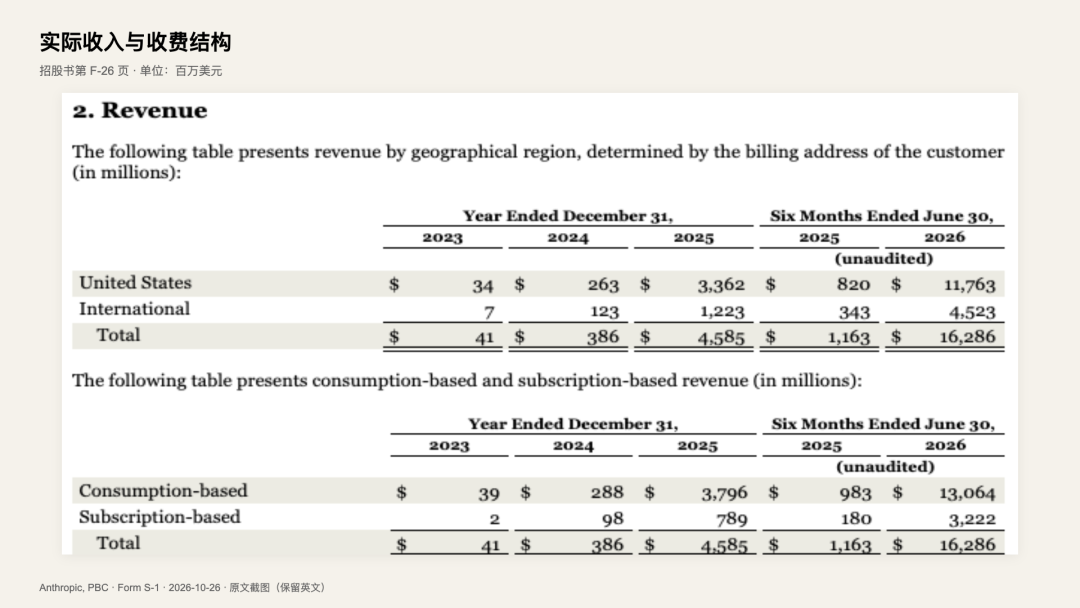
In the first half of 2026, Anthropic’s revenue skyrocketed from $1.163 billion in the same period the previous year to $16.286 billion, marking a year-on-year increase of approximately 1300%, or 14-fold.
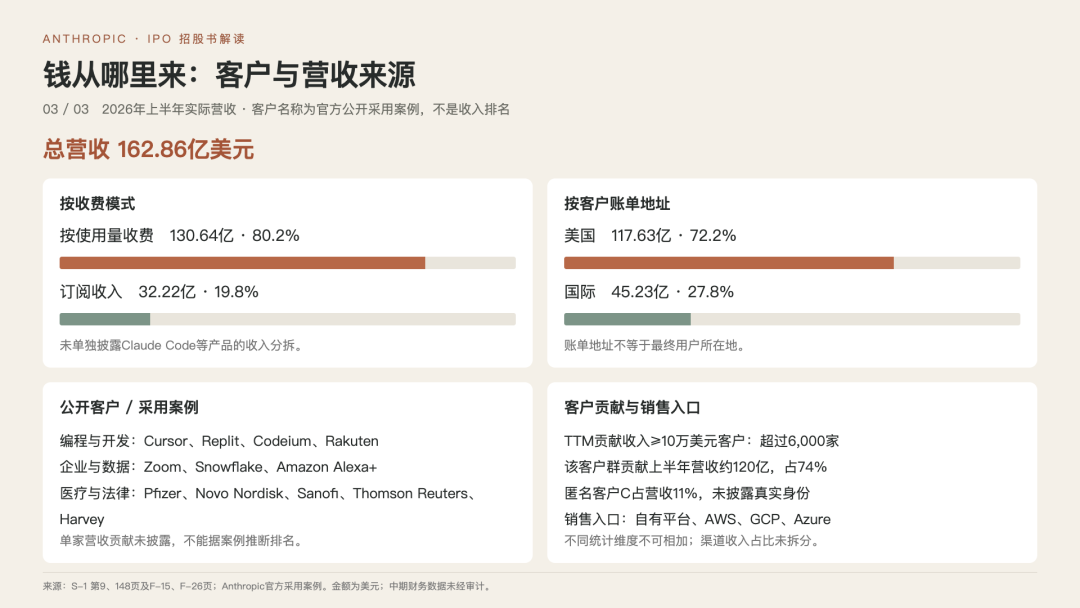
Breaking this down, usage-based charges contributed $13.064 billion, while subscription revenue accounted for $3.222 billion, with the former making up roughly 80% of total revenue. This indicates that understanding Anthropic’s business requires analyzing not just subscription numbers but also the extent to which clients utilize its services.
Growth in business integration and task execution is fueling increased usage. Claude delivers services both through its proprietary platform and via channels like AWS, Google Cloud, and Azure, broadening its customer base.
It’s important to note that the $16.286 billion figure represents actual revenue recognized over six months. This differs from "annualized revenue," which projects a single month’s or a point-in-time revenue figure over a full year. The two metrics should not be confused or mistaken as indicators of full-year performance.
Expansion of Major Clients: A Key Indicator
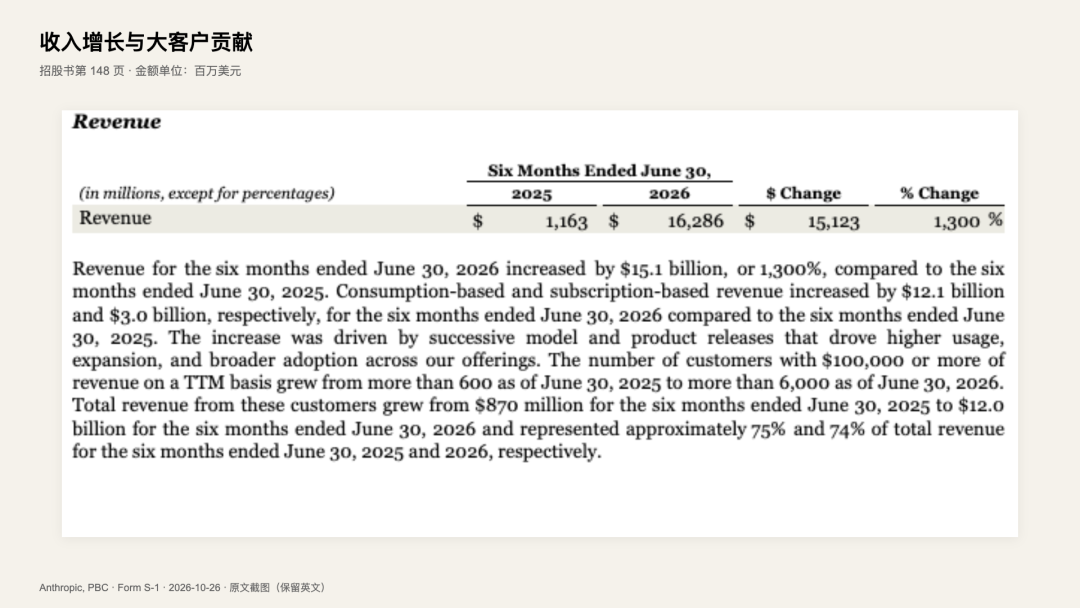
As of the end of June 2026, over 6,000 clients generated at least $100,000 in revenue over the preceding twelve months, up from over 600 a year earlier. These clients contributed approximately $12 billion in revenue during the first half of the year, accounting for about 74% of the total.
Publicly disclosed case studies include Cursor, Replit, Zoom, Snowflake, Pfizer, and Novo Nordisk. These examples highlight client adoption rather than revenue rankings, and individual client revenues remain undisclosed.
Notably, an anonymous Client C mentioned in the prospectus contributed 11% of first-half revenue, though its identity should not be speculated upon.
U.S. clients accounted for $11.763 billion, or about 72.2% of revenue, while international clients contributed $4.523 billion, or roughly 27.8%. Regions are classified by billing address, which may not necessarily reflect the location of end-users.
An $80.7 Billion Net Loss ≠ $80.7 Billion in Cash Burn
Computing and infrastructure expenses for the first half of the year reached $8.945 billion, roughly 55% of revenue. Operating losses narrowed to $693 million, down from $2.135 billion in the same period the previous year, despite rapid revenue growth.
However, the net loss also includes $72.388 billion in fair value changes from convertible debt, derivative liabilities, and future equity simple agreements. The prospectus clarifies that this was primarily driven by rising enterprise valuations and the increased fair value of outstanding convertible debt, and should not be interpreted as equivalent to cash expenditures during the same period.
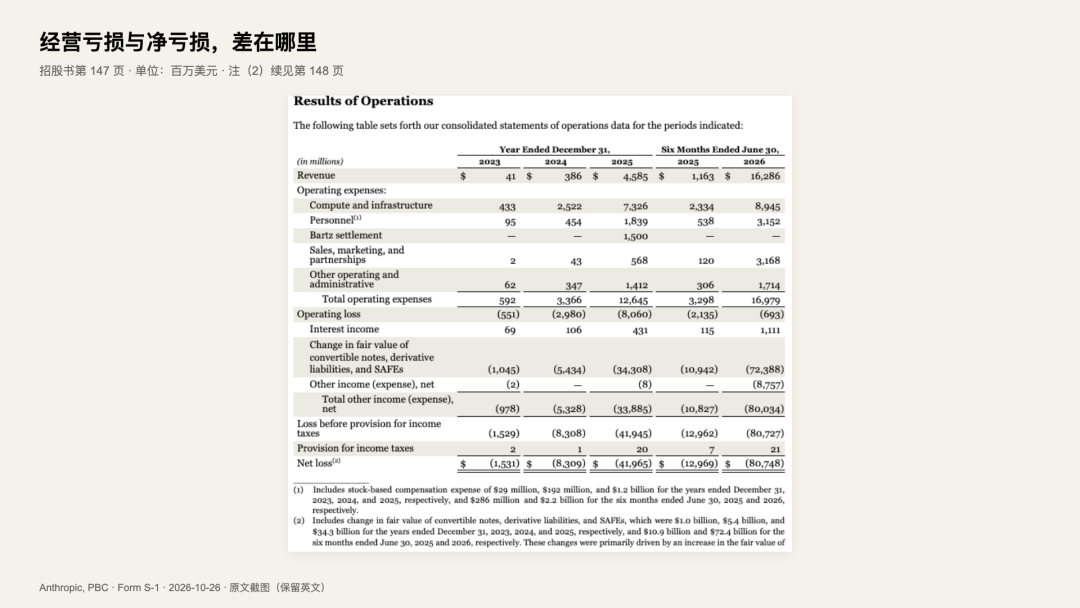
The cash flow statement offers additional insight: net cash inflows from operating activities were $3.929 billion in the first half of the year. However, cash flow is also influenced by changes in prepaid expenses, payables, and deferred revenue, and should not be viewed as evidence of stable profitability.
The real challenge lies ahead. The company typically secures computing power 12 to 18 months in advance, making short-term costs relatively fixed. While demand growth can help dilute these costs, slowing growth could turn pre-locked resources into a financial burden.
Who’s Fueling This Growth?
As of the end of June 2026, Anthropic had raised a cumulative total of $141.1 billion in funding.
Official announcements reveal $3.5 billion in Series E funding and $13 billion in Series F funding in 2025. In 2026, Series G raised $30 billion, and Series H secured $65 billion. The prospectus discloses an additional $15 billion raised in the second quarter of Series G, emphasizing that cumulative funding should not be calculated by simply adding up news headlines.
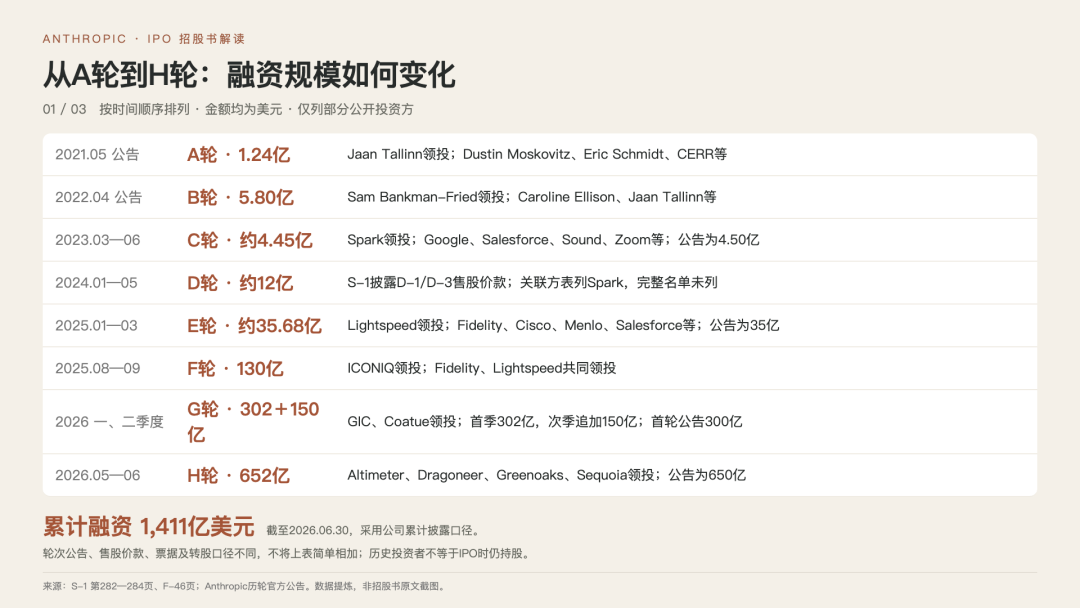
Investors include Lightspeed, ICONIQ, GIC, Coatue, Sequoia, and others. Amazon invested $5 billion in May 2026, and Google invested $10 billion, both included in Series H funding and not to be double-counted. Unused committed amounts are not yet received funds.

Technological Edge Must Withstand Financial Scrutiny
The prospectus highlights clear progress: Claude is evolving from a model with capabilities to a workflow solution, and widespread adoption by major clients is driving revenue growth.
Looking ahead, key questions include: How much computing power is required to complete each effective task? Will clients continue to pay for these services? Can new revenue cover ongoing R&D and infrastructure investments? The answers to these questions will determine how much profit remains as the company grows.
All content is sourced from publicly available information and represents personal opinions only.
-
![]()
Why Has the Underestimated HDD Become the 'Data Terminal' for AI?
-
![]()
Survey | With Shanghai Factory Nearing Completion, Lexus Embarks on Electric Redemption
-
![]()
The Largest IPO Ever: Anthropic’s Prospectus Reveals a Valuation Nearing $2 Trillion, Blending Cutting-Edge Tech with Business Strategy
-
![]()
The Spectacle of the Flying Car Can't Rescue Tesla's Core Operations
-
![]()
Seagull vs. Starwish: A Clash of Titans in the Electric Compact Car Market
-
Capital Reevaluation of the 'Battery King'
-
![]()
Audi China Undergoes Division: Splitting the Brand, Taking a Risk on Destiny
-
![]()
SpaceX Secures $40 Billion in GPU Financing, Wagering on Market Growth Over the Next Five Years