Who is Investing in Anthropic?
 10/28 2026
 438
"Claude targets Chinese users" is currently the most talked-about AI meme on the Chinese internet, without a doubt.
Someone has transformed Anthropic's restrictive measures into a role-playing game, where players assume the roles of Anthropic evaluators, identifying camouflaged Chinese users among a group of Claude users.
Turning access to AI into a game of cat and mouse is clearly not a typical dynamic between an AI company and its users. Yet, this absurdity aligns perfectly with Anthropic's longstanding ethos.

Its accounts are shared across various platforms, with usage restrictions and workaround techniques becoming insider jokes within the AI community. Its executives once mentioned at a public event: "The region with the most access traffic is Singapore." The audience exchanged knowing smiles.
The founder's history and rumors surrounding Baidu continue to add layers of mystery to the company.
As this company approaches the capital market with an astonishing valuation of $2 trillion, poised to launch the largest IPO in history, some rational analysts and the public are left bewildered, overwhelmed by unverifiable rumors and lighthearted memes. This doesn't seem right. Or rather, the risks are immense.
What kind of company is Anthropic, really? Do Chinese users' desperate efforts to bypass restrictions and maintain accounts serve as compelling evidence of its high valuation?
As information glorifying Anthropic spreads, understanding its true value and sustainability requires a detective-like approach to extract truly important clues from the mystery.
Next, let's delve into Anthropic's operational landscape together.

When searching for Anthropic online, one first encounters various rumors that make the company seem exceptionally enigmatic. Some discuss how to access Claude, others share how CodeX has solved tricky programming problems, while others inquire about accounts or share usage tips.
These stories collectively form our first impression of Anthropic. Is this all there is?
A closer look at these active discussants on public social platforms reveals three main categories:
The first group consists of programmers who share legends about the product's capabilities, the irreplaceable experience of CodeX in AI programming, compare different model performances, and consider Claude an indispensable tool in daily development. An AI company largely unknown to the general public due to access limitations has captivated some technical users, creating a sense of exclusivity.

This attracts the second group: account brokers. The more barriers Anthropic erects and the harder it becomes to use smoothly, the more it piques public curiosity. For those lacking the technical skills of programmers, businesses emerge in selling accounts, procurement services, and third-party solutions. Obviously, this revenue doesn't flow to Anthropic.
What's wrong with Anthropic that it doesn't even want to earn money from China? These harsh restrictions, which defy the logic of maximizing commercial interests, have sparked various speculations and attracted the third group of discussants: onlookers.
They aren't heavy AI users and may have never truly used Claude. But this doesn't prevent them from participating in discussions. Some link the founder's work experience at Baidu with Anthropic's strategies, suggesting the CEO might suffer from a form of "China PTSD."

Others analyze Anthropic's corporate culture—a tough, uncompromising tech geek ethos that doesn't just disregard Chinese users but also copyright giants like Disney and Marvel, generating content without taboos, exuding a "try to stop me" rebellious spirit.
Now we can see that Anthropic's image on the Chinese internet is primarily shaped by these three groups: a relatively small programmer community, gray-market entrepreneurs profiting from scarcity and anxiety, and onlookers unconcerned with the product itself.
Therefore, the most vocal discussants don't represent the company's core business and cannot truly explain what kind of company Anthropic is or its actual revenue situation. We can't just stand in the lobby relying on hearsay; we need to go somewhere closer to the truth: the finance department.
Hard cash doesn't lie. Compared to ambiguous rumors, financial statement figures clearly reveal what kind of business Anthropic is running.
Thanks to its IPO plans, Anthropic has disclosed some public data that serves as clues for our understanding. Opening its books, the first key clue is $4.6 billion in revenue—and who contributed it?
According to Reuters, Anthropic's 2025 revenue approached $4.6 billion, growing about 12-fold from the previous year. This astonishing growth rate supports the capital market's extremely high valuation. So, who contributed this 12-fold revenue increase?
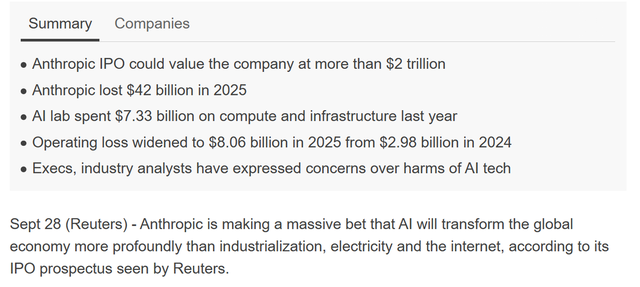
(Screenshot of Reuters report)
Over 80% came from usage-based services, meaning charges per API or token. These are typically professional users like programmers, developers, or ongoing corporate usage—the B2B market in AI's commercial landscape. Less than 20% came from subscription services, where individual consumers directly purchase monthly or annual membership packages on the app.
Now we know that the B2B market of enterprises and developers is Anthropic's main revenue source. What about cost items?
The next key clue is that Amazon and Google's cloud platforms contribute about 47% of Anthropic's sales.
Reuters reports show that in 2023, only 11% of Anthropic's revenue came through cloud platforms, but by 2025 this approached half. This is an important indicator: AI's B2B business highly depends on clients' existing digital infrastructure.

Anthropic's growth depends not just on how good Claude is but also on whether it can leverage large cloud platforms to sell models to more clients. Imagine a company already using AWS or Google Cloud. When it wants to integrate AI into its business systems, procuring model services through familiar cloud platforms is often easier to integrate into existing technical architectures and workflows, becoming the preferred choice.
This is a double-edged sword for AI model companies.
On one hand, it can leverage the sales channels of two tech giants to reach many enterprise clients. But channels aren't free; Anthropic must pay distribution fees and computing costs to these cloud platforms.
In 2025, Anthropic's operating losses exceeded $8 billion, with computing and infrastructure expenses reaching $7.3 billion—far exceeding revenue. This brings us back to the old adage of "the shovel sellers making money first."
Moreover, these large cloud platform tech companies often develop their own AI large models or support invested companies in R&D, like Amazon investing in OpenAI and Google developing Gemini, having motives to counterbalance Anthropic.
A small episode is that while Claude fetches high prices on the Chinese internet, the U.S. market actually contributes nearly two-thirds of Anthropic's sales. Some may be circumventing Chinese users, but the proportion is limited. What truly determines Anthropic's commercial value are B2B clients continuously using models and cloud platforms integrating Claude into more business scenarios.
The next question is: How loyal will Anthropic's clients be? Will they pay long-term?
How to ensure user loyalty to consolidate revenue? Making models better than OpenAI and Google is trivially true. In tech markets, there are too many examples of excellent technology and products failing commercially.
Building good relations with cloud platforms to convert cloud users into AI clients? This advantage may be fragile, as many enterprise clients prefer not to put all their eggs in one basket, and cloud platforms support this by offering more model choices.
Serving several key clients, embedding into their workflows to increase switching costs? This model doesn't suit the scarce and expensive overseas IT market, nor can it reduce marginal costs through scale to support high premiums.
Which path leads to success? The answer is all of them, but with extra considerations for each option.
For example, Anthropic makes technology R&D the core of its commercial competition but simultaneously emphasizes AI safety by creating hard-to-verify crises, claiming AI is unsafe but we can provide protection.
For instance, in June this year, Anthropic published an article claiming Claude had participated in extensive internal code production, that AI was already self-correcting and self-building, urging everyone to slow down AI R&D or face dire consequences. Four months later, no such consequences have materialized. But this "AI doomsday" narrative resonates with Western society's Christian culture, attracting many to choose the "safer" Anthropic.
Cooperation with cloud platforms doesn't stop at simple buying and selling but also involves long-term procurement to align interests with cloud vendors.
According to Reuters, Anthropic will pay Google at least $111.1 billion, Amazon $110 billion, and Microsoft $31.4 billion over the next seven to ten years under long-term infrastructure service obligations, regardless of usage.
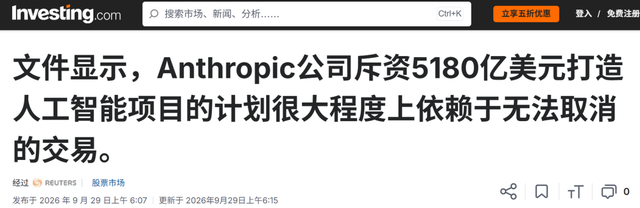
This is clearly an aggressive computing expansion plan mismatched with Anthropic's business needs. Anthropic isn't just betting on business growth but also on building long-term relationships with cloud vendors to reduce competitive friction in the model market.
Locking in computing power in advance increases Anthropic's financial burden and may even widen losses but also forges a stronger alliance with cloud vendors, as they too are currently trapped in AI bubble risks—their fates are intertwined.
Thus, a layered, interlocking closed loop forms: To support model training and long-term competition, Anthropic must secure sufficient computing power; to obtain computing power and expand client coverage, it needs to partner with large cloud platforms and bear huge costs. Whether these costs can be sustained depends on whether the product team can transform expensive computing power into tools users are willing to pay for.
Of course, this cycle could reverse. If competitors narrow the model gap, clients switch to alternatives, and computing costs can't effectively convert to revenue, Anthropic's massive investments could shift from advantages to unshakable financial burdens.

Tracing this path, we seem to have uncovered the company's secrets. Revenue grows rapidly, but it carries heavy infrastructure investment commitments, with enormous future costs and an uncertain competitive landscape.
Anthropic's operational situation and logic aren't hard to understand. Why, then, does the market overflow with mysterious rumors and stories? Perhaps because only stories can glamorize a commercial company. Tech enthusiasts find hope in them, onlookers get excitement, and early investors cash out.
Anthropic itself isn't mysterious. Someone has simply painted a familiar commercial story with a new layer of mysterious varnish and put it back up for auction. And the place to auction this new story lies outside the building.
-
![]()
Who is Investing in Anthropic?
-
![]()
ThunderSoft Set to Relocate Within Dongsheng District
-
![]()
Empyrean Technology’s New 20,000-Square-Meter Headquarters Opens in Jiuxianqiao
-
![]()
Microsoft is Exchanging Labor Costs for a Ticket to the AI Era
-
![]()
DeepSeek Tops Global Rankings: A Victory of 'Billing Dominance'
-
![]()
RUNTO Report: Global Smart Glasses Shipments to Surpass 13 Million Units by 2026, Marking 44% YoY Growth
-
![]()
Chinese Automakers Double Global Sales Share, Industry Enters 'System vs. System' Competition
-
[Focus] Self-Superlubricated MEMS RF Switches: Meeting High Application Demands with Vast Industrialization Potential