RUNTO Report: Global Smart Glasses Shipments to Surpass 13 Million Units by 2026, Marking 44% YoY Growth
 10/28 2026
 434
On October 27, the '2026 Global Smart Glasses Industry Summit,' a two-day event, commenced with grandeur at the Shenzhen International Convention and Exhibition Center.
Organized by Shanghai LEXPO Exhibition Co., Ltd. and ARinChina, the summit was co-hosted by RUNTO, alongside notable entities such as the China Virtual Reality Technology and Industrial Innovation Platform, the Virtual Reality and Smart Wearable Devices Branch of the China Video Industry Association, the Shenzhen Virtual Reality Industry Association, the Shenzhen Nanshan District New Quality Productivity Industry Association, the Chengdu Virtual and Augmented Reality Industry Association, the Xiamen Virtual and Augmented Reality Industry Association, and the Tianjin Virtual Reality and Augmented Reality Technology Application Association.
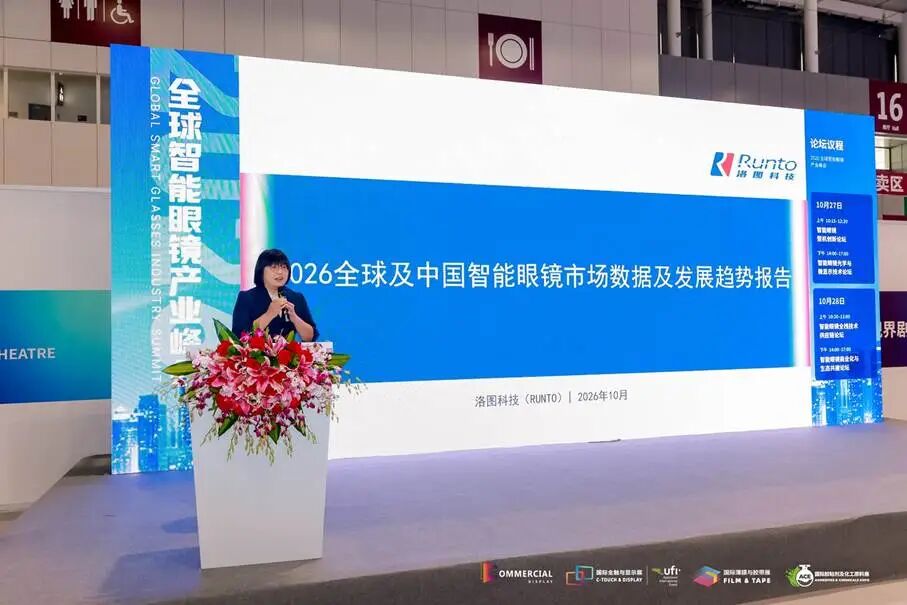
During the summit, Ms. Zhu Yuanyuan, the General Manager of RUNTO, unveiled the '2026 Global and Chinese Smart Glasses Market Data and Development Trends Report.'
According to RUNTO's data, global smart glasses shipments stood at a mere 830,000 units in 2023 but surged to 9.01 million units in 2025, marking a nearly tenfold increase over three years.
Based on current market trends, RUNTO predicts that by 2026, excluding ultra-low-cost white-label products, global smart glasses shipments will exceed 13 million units, representing a 44.3% year-on-year increase. The industry is set to officially cross the 'scale' threshold in developed markets, transitioning from niche to mainstream consumer adoption.
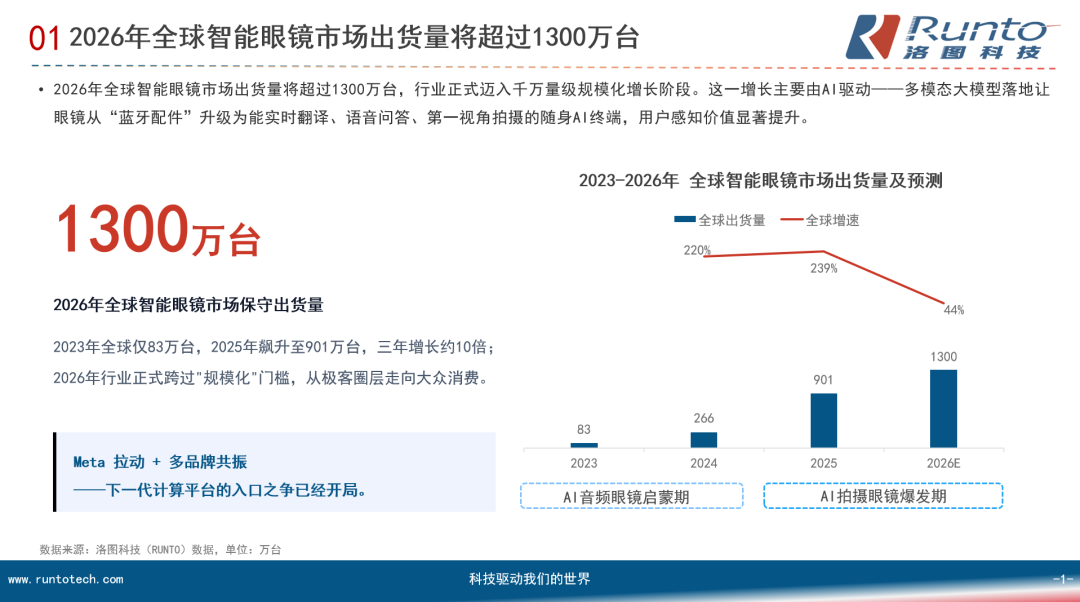
Notably, while global shipments in 2026 are projected to exceed 10 million units, the growth drivers, regional patterns, and market player structures exhibit significant diversity.
RUNTO classifies smart glasses into three categories: AR glasses with displays, audio glasses without displays, and camera glasses. In essence, these two markets—display-equipped and non-display—are nearly selling parallel universe products.
From a sales structure perspective, the combined global shipments of audio and camera glasses are expected to account for 83% of the market in 2026, with North America leading at 48% and Europe following at 28%. Consumers in these regions primarily purchase AI-enabled sunglasses. Conversely, AR glasses will represent just 17% of global shipments but will capture 41% of the Chinese market, where consumers show a preference for display-equipped AR glasses.
Overseas Markets:
Meta's Matrix Expansion and Apple's 2027 Entry as Key Variables
The North American market's growth is primarily propelled by Meta. At its Connect 2026 event in September, Meta introduced a three-product smart glasses matrix: the Ray-Ban Meta Audio, its inaugural audio-only glasses priced at $349; the best-selling Ray-Ban Meta (Gen 3) at $449; and the $799 Ray-Ban Meta Display featuring a monocular color display, which launched in the U.S. on September 30.
RUNTO believes Meta is transitioning from a 'one-hit wonder' approach to a platform strategy of 'everyone owning a pair.' It forecasts that combined shipments of Ray-Ban Meta and Oakley Meta will reach 9 million units in 2026.
Meanwhile, Google's Android XR ecosystem is gaining momentum, with its first AI audio glasses released in May and partnerships forged with Warby Parker, Gentle Monster, XREAL, and others for Android XR glasses. Samsung is pursuing a dual-track strategy, preparing to launch lightweight AI glasses and investing in next-gen microdisplay technologies for future AR glasses with displays.
In 2027, Apple will emerge as the biggest variable in overseas markets. Its AI glasses, internally codenamed N50, have been delayed to a 2027 release. RUNTO believes Apple's entry will shift market competition from 'features' to a comprehensive dimension encompassing 'safety + experience + ecosystem.'
Chinese Market:
The World's Fastest-Growing Market, with H1 Sales Up 85.5% YoY and Full-Year Growth Forecast at 77.5%
China stands as the fastest-growing single market for smart glasses globally. According to RUNTO's omnichannel data, retail volume in the Chinese smart glasses market reached 909,000 units in H1 2026, up 85.5% YoY, with sales revenue at RMB 1.88 billion, up 98.7% YoY. For the full year, shipments are expected to reach 3.2 million units, with retail volume at 2.58 million units, up 77.5% YoY.
Policy incentives are a major driver in the Chinese market. In 2026, smart glasses were included in national subsidies for the first time, directly boosting channel stocking and mid-to-high-end demand. Meanwhile, supply chain maturity has driven the popularity of sub-RMB 1,000 models, with mainstream products now commonly featuring offline large models.
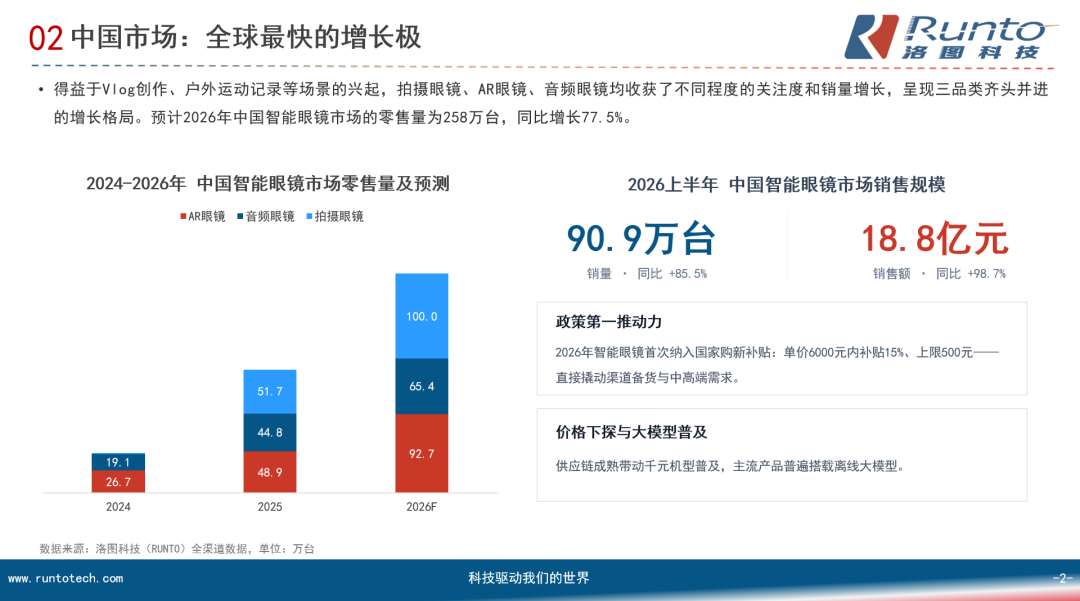
In terms of competition, China's 'hundred-glasses battle' continues unabated. In 2026, smartphone makers, internet giants, automakers, startups, and cross-industry newcomers all entered the fray, pursuing distinct paths: ecosystem players focus on entry points, professional players on technology, and new forces on niche scenarios.
Segmentation Trends: Stable AR Pricing, Declining Audio Prices, Concentrated Camera Price Bands
According to RUNTO data, China's e-commerce platforms exhibit distinct growth patterns across the three segments.
In Q2 AR glasses online sales, the 2000+ RMB segment accounted for 58.3% of volume, with the 2000-3999 RMB price band expanding to 39% of the quarter's share.
The audio glasses market is undergoing consolidation. Participants surged from 35 in Q1 2024 to a peak of 132 in Q3 2025 before declining, reflecting a shift from rapid expansion to survival of the fittest. Leading brands are pivoting to AI camera glasses, while audio glasses' price bands shift downward. The sub-500 RMB segment jumped from 11% in Q1 2024 to 71%.
Camera glasses are experiencing explosive growth. Participants exploded from 3 in Q1 2025 to 90 in Q4 2025, falling to 64 in Q2 2026. Prices are highly concentrated, with mainstream sales in the 1000-1999 RMB and 2000-2999 RMB bands, indicating significant homogenization.
Product Trends: Lightweight Design Shifts from 'Selling Point' to Industry 'Baseline'
The rise of China's domestic supply chain is driving rapid performance upgrades. In waveguide technology, array waveguides dominate the high-end market with high color accuracy and brightness, while diffractive waveguides lead in consumer-grade thinness and light transmission. Micro LED technology is transitioning from monochrome mass production to full-color small-batch production. In chips, Qualcomm's Snapdragon AR1 series sets the high-end standard, while domestic solutions from BES and Rockchip achieve high-end breakthroughs and mid-range coverage.
As noted in RUNTO's previous report, 'Lightweight Breakthroughs in Smart Glasses: The Subtraction Era Begins in 2026,' lightweight design is now the industry's top consensus, with subtraction-based design becoming the priority.
All three segments continue to reduce weight, but at differing rates: AR glasses face the toughest weight reduction due to waveguide optics, declining from 61g in 2024 to 41g in 2026; camera glasses fall from 44g to 36g; and audio glasses from 34g to 27g.
Average Weight Range Changes in Mainstream Smart Glasses
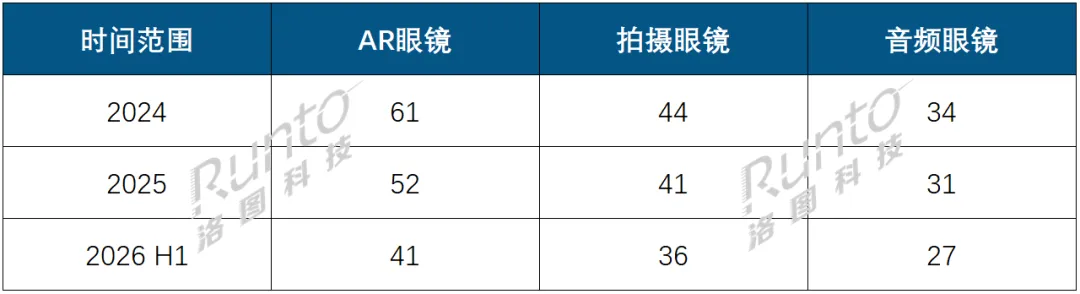
Source: RUNTO calculations, in grams
By 2026, many flagship models have reduced total weight to the 30g range, approaching the wearability of ordinary civilian eyeglasses.
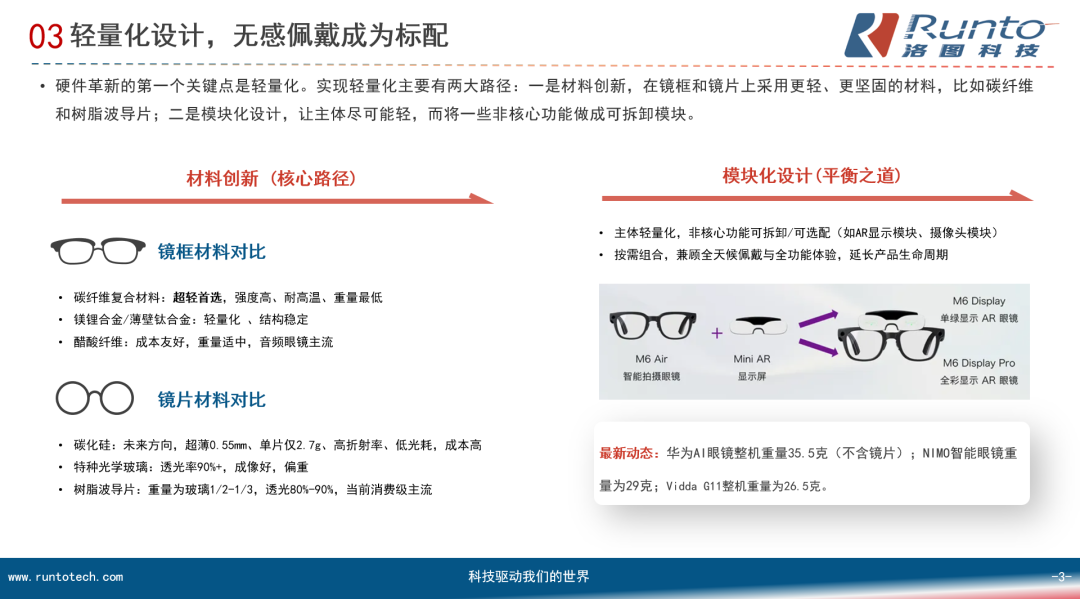
RUNTO believes lightweight design has shifted from a 'selling point' to an industry 'baseline.' Product design now prioritizes vertical scenarios over all-in-one functionality.
Global Outlook:
Three Critical Questions Before the 2028 30-Million-Unit Inflection Point
RUNTO optimistically forecasts Apple's smart glasses to exceed 6 million units in their first full shipment year of 2028, driving global shipments past 30 million units, possibly reaching 35 million, and marking a full-scale inflection point.
However, three critical questions remain before this inflection point: 1) 'Easy to try, hard to wear daily'—current mainstream products at 40-80g are heavier than ordinary glasses, and advertised 4-8 hour battery life drops to 2-3 hours with multiple functions enabled, making wearability and battery life the first hurdle. 2) Privacy and regulatory standards are lacking, with cameras and microphones posing data leakage risks; the industry lacks unified safety standards, making compliance a key differentiator. 3) No killer app has emerged yet, with fragmented product forms, weak ecosystems, and cross-platform compatibility issues. While translation and other high-frequency needs are validated, a 'can't-live-without' scenario remains elusive.
-
![]()
Who is Investing in Anthropic?
-
![]()
ThunderSoft Set to Relocate Within Dongsheng District
-
![]()
Empyrean Technology’s New 20,000-Square-Meter Headquarters Opens in Jiuxianqiao
-
![]()
Microsoft is Exchanging Labor Costs for a Ticket to the AI Era
-
![]()
DeepSeek Tops Global Rankings: A Victory of 'Billing Dominance'
-
![]()
RUNTO Report: Global Smart Glasses Shipments to Surpass 13 Million Units by 2026, Marking 44% YoY Growth
-
![]()
Chinese Automakers Double Global Sales Share, Industry Enters 'System vs. System' Competition
-
[Focus] Self-Superlubricated MEMS RF Switches: Meeting High Application Demands with Vast Industrialization Potential