Google Cloud Revenue Doubles, Why Did the Stock Price Still Drop?
 10/29 2026
 360
Cash Is Bleeding
Author|Yixiu
Editor|Xiaobai
Illustration|AI Generated
Produced by|QiangdiaoNext
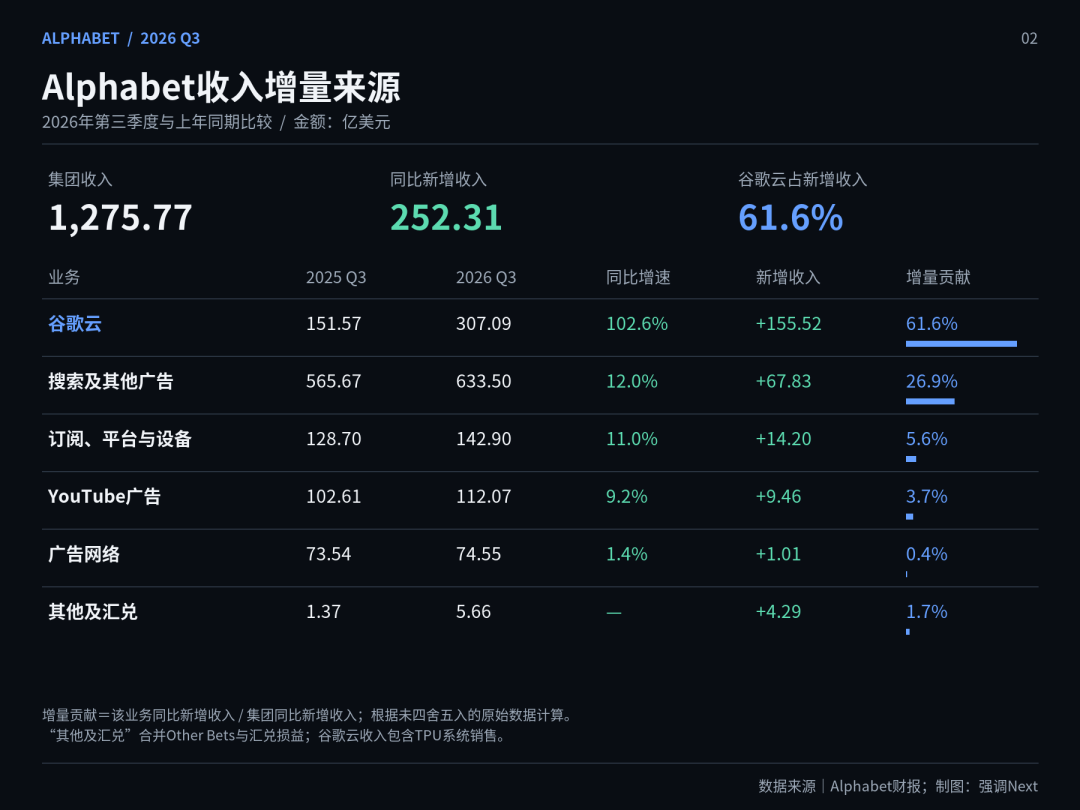
The more AI orders Google has, the more money it needs to pay upfront. Shareholders are concerned about when this round of growth will improve cash returns. On October 28, after the market closed, Alphabet, Google's parent company, released financial results showing a 103% increase in cloud business revenue, yet its stock price fell by more than 10%. In the third quarter, Google Cloud's revenue reached $30.7 billion, with operating profit exceeding $11.1 billion. The entire group's operating profit increased by 30% year-on-year. Despite these operating results, the market's disappointment with cash flow persisted: free cash flow was negative $9.07 billion for the quarter, whereas the market had expected it to be close to break-even.
Google has converted AI demand into revenue. The next test is how much capital this revenue will occupy and how much cash it will leave behind. Google Cloud is expanding TPU system sales. It has begun to shoulder more of the capital requirements for hardware stocking and delivery. Meanwhile, to fulfill cloud customer orders as quickly as possible, Google also needs to rent third-party computing power. Both paths of growth come with their own costs. As Google's AI business grows larger, investors increasingly need to reassess the value of each dollar of revenue.
Profit Growth Can No Longer Cover the Cash Shortfall
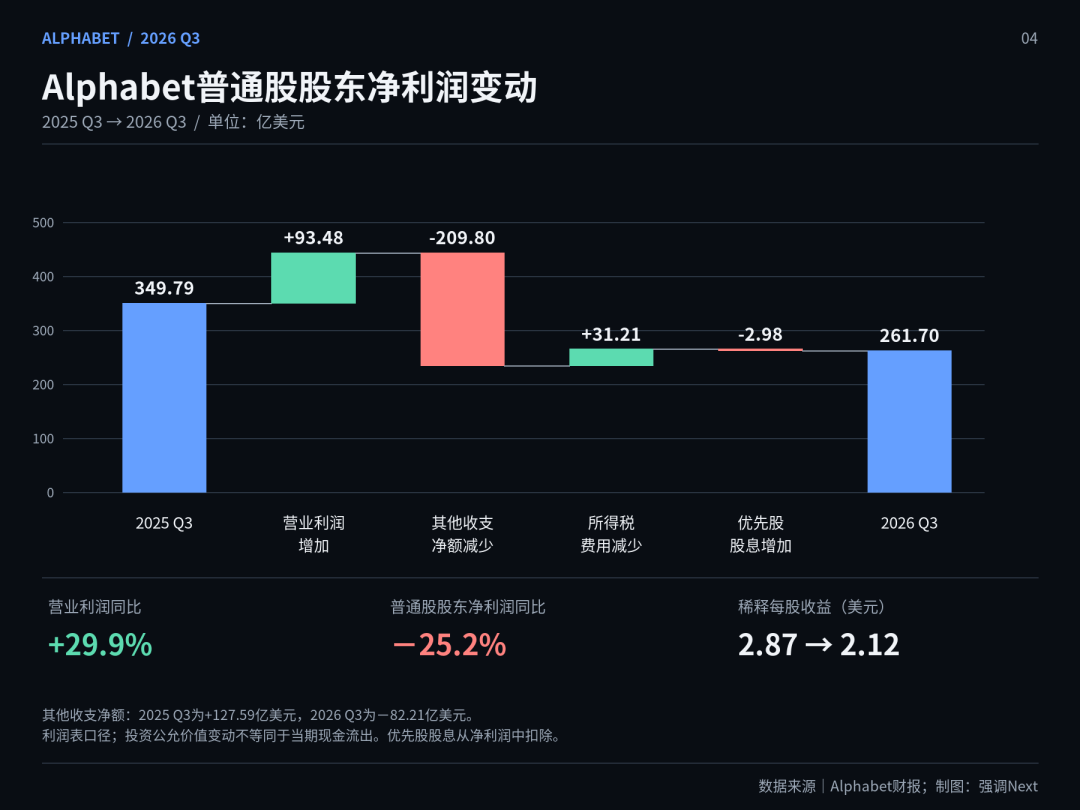
Alphabet's revenue for the quarter was approximately $127.6 billion, with operating profit around $40.6 billion. However, net profit attributable to ordinary shareholders fell by about 25% year-on-year to $26.2 billion.
The company explained during the earnings call that there was a net loss of about $8.2 billion in other income and expenses, primarily due to unrealized losses on its SpaceX stake. This affects current net profit but does not mean Google paid out an equivalent amount of cash this quarter.
The cash flow issue has a different source. In the third quarter, Alphabet's operating activities generated about $42.3 billion in cash, while spending on property and equipment was about $51.4 billion. Subtracting the two, free cash flow showed a shortfall of about $9.1 billion. According to the financial report, capital expenditures reached 121% of operating cash flow for the quarter.
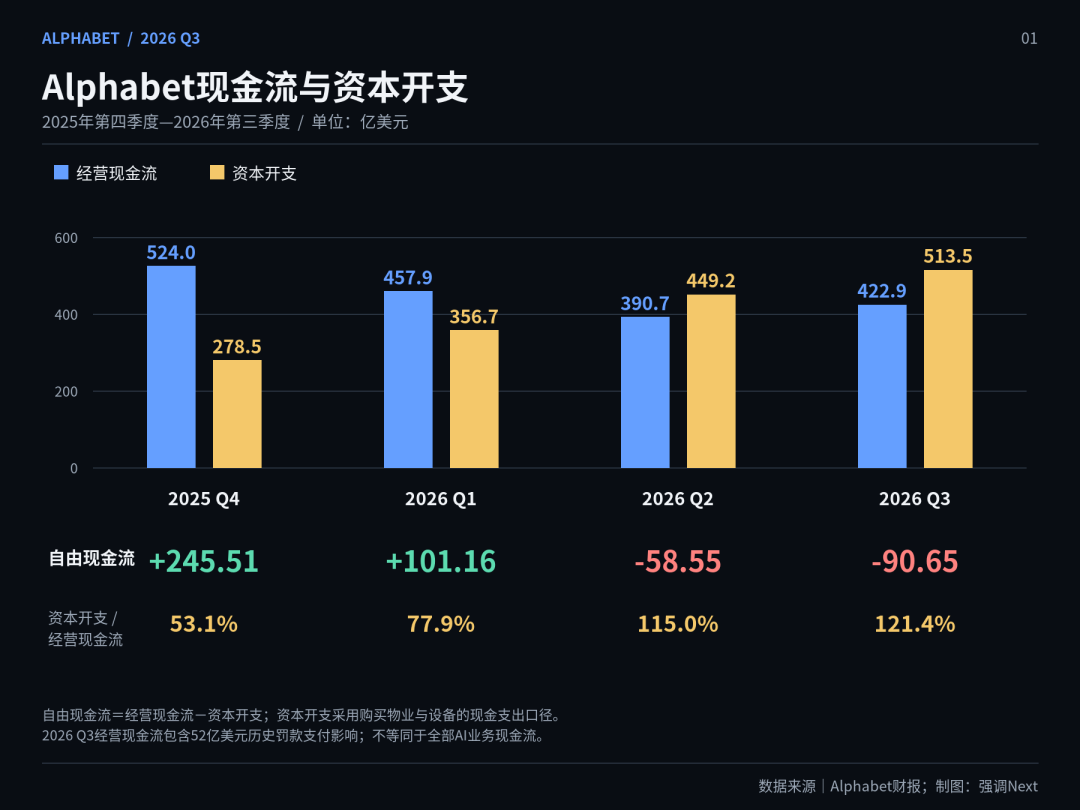
Operating profit is still growing, but cash is being spent first. Expenditures on data centers and servers will be gradually reflected in the income statement through depreciation over many years. However, funds are already occupied during construction and procurement. Therefore, current profit margins do not fully reflect the impact of this expansion on shareholder cash returns. This quarter also included one-time disruptions. The company paid $5.2 billion in historical EU fines, and TPU system stocking also occupied operating cash flow. Even if we mechanically add back this fine with other factors unchanged, free cash flow would still be approximately negative $3.9 billion.
This indicates that the funding shortfall does not come solely from fines. More alarmingly, the market has already taken this shortfall as the norm. According to analyst expectations compiled by Fiscal.ai, free cash flow is expected to remain negative until the quarter ending in September 2027.
Looking back at the announcement on June 1, Alphabet announced an equity financing plan totaling $80 billion, including a $40 billion at-the-market (ATM) offering expected to begin in the third quarter of 2026, along with a $10 billion private placement subscription from Berkshire Hathaway.
A company with quarterly operating cash flow still exceeding $40 billion needs to raise money from the market, indicating that the pace of AI infrastructure investment has outstripped the main business's ability to generate cash. This money can be interpreted in two ways. One is that orders are real, spending is reasonable, and dilution is just a transition. The other is that the marginal return on investment is declining, but it just hasn't been reflected in the income statement yet. The third-quarter results do not provide a definitive answer, only indicating that shareholders will have to wait longer than before.
The More TPUs Are Sold, the More Attention Must Be Paid to Stocking and Payment Collection
Google Cloud's 103% growth rate includes different types of business. The financial report explicitly states that TPU system sales have significantly contributed to revenue growth but does not separately disclose the revenue and profit margins of this business.
TPUs are AI computing chips developed by Google. The systems delivered to customers now also include supporting hardware, networking, and software. Customers can use them on Google Cloud or deploy the systems in their own data centers. This sales model expands the market Google can reach but also changes the timing of cash flow. Chief Financial Officer Anat Ashkenazi explained during the earnings call that the company begins stocking up after signing contracts, resulting in cash outflows first, followed by gradual fund recovery as deliveries and invoicing occur.
She also emphasized that related stocking is supported by signed contracts. Having contracts reduces the risk of blind production, but there is still a time lag between procurement payments and customer payments. During rapid business expansion, new orders may first drive up inventory and capital occupation before converting into cash revenue. This is also why Google Cloud's valuation requires more detailed breakdowns. Continuously providing cloud services and delivering a hardware system differ in revenue recognition, payment collection timing, and subsequent capital requirements. Doubling total revenue does not directly mean doubling recurring revenue.
System sales also have potential capital efficiency advantages. If equipment is deployed in the customer's data center, Google can reduce the need to build its own hosting facilities. This approach has the opportunity to replace some longer-term infrastructure investments with shorter stocking cycles.
However, these advantages will only become apparent after delivery and payment collection. At this stage, Google has not provided sufficiently detailed disclosures to allow investors to calculate the returns from system sales and cloud services separately. Growth is already visible, but the quality of growth still requires more data.
36% Cloud Profit Margin Must Still Withstand the Test of Rented Computing Power
Google Cloud's operating profit margin reached approximately 36.2% this quarter, compared to about 23.7% in the same period last year. This is a substantial improvement, indicating that revenue expansion has already brought profit growth.
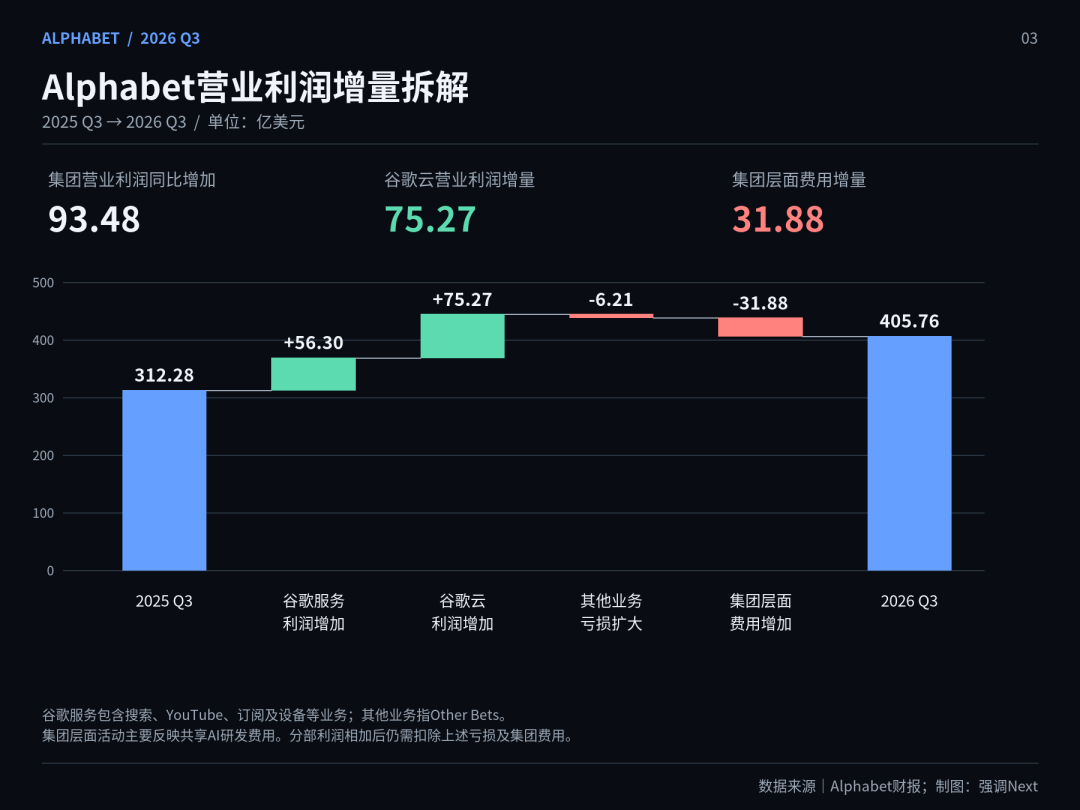
However, Google also provided a clear cost warning: third-party transitional computing power only began to be used at the end of the third quarter, with limited impact on the quarter's profit margins. Usage will expand in the fourth quarter, and profit margins will face pressure in the near term.
This means that the third quarter's profit margins cannot simply be used as a benchmark for the next few quarters. Google faces a choice regarding delivery timing. Waiting for its own facilities to be built may delay revenue; renting external computing power allows faster order fulfillment but requires payments to suppliers. Technical self-developed advantages must also pass through real-world production capacity and delivery arrangements to become profits.
For the same cloud order, running it on its own facilities or relying on external resources may leave Google with different profits. Strong order demand only indicates that services are in demand. Shareholders also need to know how much revenue Google must forgo to fulfill these orders. Capital expenditures have not clearly peaked. Management maintains its capital expenditure guidance of $195 billion to $205 billion for 2026 and expects a significant increase in 2027.
Thus, Google is still in the stage of expanding supply. Renting computing power addresses immediate delivery needs, while building its own infrastructure meets longer-term demand. Spending on both parts may coexist for some time. How much investors must pay for new revenue depends on how long this cost overlap period lasts. This quarter's high profit margins and management's hints about subsequent costs should be priced together.
Search Determines How Long Google Can Wait
No matter how fast the cloud business grows, Google's main source of existing profits remains consumer businesses like search. In the third quarter, Google Services, which includes search, YouTube, subscriptions, and devices, contributed approximately $39.2 billion in operating profit, about 3.5 times that of the cloud business. This division includes multiple businesses, and not all profits can be attributed to advertising, but it still provides crucial support for Alphabet's large-scale investments.
Meanwhile, advertising revenue was about $82 billion, about $1.4 billion lower than market expectations compiled by LSEG. When capital expenditures are increasing rapidly, such expectation gaps become more sensitive. Every dollar less generated by existing businesses means new businesses will take longer to make up the difference. Google's AI progress in search is evident. Pichai stated that the year-on-year growth rate of search query volume has reached its highest level in the past five years, with commercial queries also increasing. However, his statements about product advancement still focus on improving the experience before pursuing monetization.
Usage is outpacing monetization. Users are asking longer, more complex questions, increasing computing costs, while the placement and format of ads are still being redesigned. Management also warned that the fourth quarter will face continued growth pressure due to the high base of accelerated search growth in the same period last year. Google also plans to introduce agents into more consumer products to help users complete tasks like reservations and shopping. For the advertising business, how tasks are completed affects where ads appear and users' decision-making processes.
Increased usage can create new business opportunities but also requires Google to redesign its pricing and advertising mechanisms. Therefore, the significance of search has not diminished with the doubling of the cloud business. It still affects how aggressively Google can invest and how long shareholders are willing to wait. The post-earnings drop reflects the market raising its requirements for growth delivery conditions. The cloud business's achievements have already entered the income statement, but TPU payment collection, rented computing power costs, and ongoing expansion capital expenditures are still determining how much cash these profits will ultimately leave behind.
For Google, the most significant progress in the next earnings report will be narrowing the cash shortfall while continuing to fulfill AI orders. Shareholders want to see that the money paid out today starts returning to accounts as customer deliveries occur.
Note: The data in this article comes from public sources and does not constitute investment advice.
- END -
-
![]()
Google Cloud Revenue Doubles, Why Did the Stock Price Still Drop?
-
Will the New Li Auto i6 Sustain the Triumph of Its Predecessor?
-
![]()
Fuyao Glass Reports 14.97% Drop in Net Profit to 6.006 Billion Yuan for First Three Quarters, While Dimming Glass Yield Soars from 10% to 90%
-
![]()
GPS is Vulnerable to Interference, This Startup Aims to Provide a Centimeter-Level Alternative with 258 Satellites
-
![]()
Desay SV’s Q3 Revenue Hits 9.519 Billion Yuan, Up 23.75%; Overseas Gross Margin at 31.34%, Domestic at 17.58%
-
![]()
Automotive Parts Behemoth Huayu Reports 45.5 Billion Yuan in Q3 Revenue, Net Profit Dips 6.4% to 1.687 Billion Yuan, Yet Stays Robust
-
![]()
Li Auto Shifts Focus: Can Chips, Batteries, and L4 Tech Drive the Next Phase of Competition?
-
Suzhou: Not Just Aiming for Daily Access to Driverless Cars, but Transforming the Entire City into a 'Testing Ground' for Embodied AI