Zhongji Innolight's Net Profit Triples: The Cash Flow Test Behind the AI Frenzy | Q3 Report
 10/30 2026
 430

On the evening of October 29, Zhongji Innolight (300308.SZ) released an impressive third-quarter report.
In the first three quarters of 2026, Zhongji Innolight's revenue reached 69.547 billion yuan, up 178.13% year-on-year, while net profit attributable to shareholders hit 22.238 billion yuan, up 211.81% year-on-year.
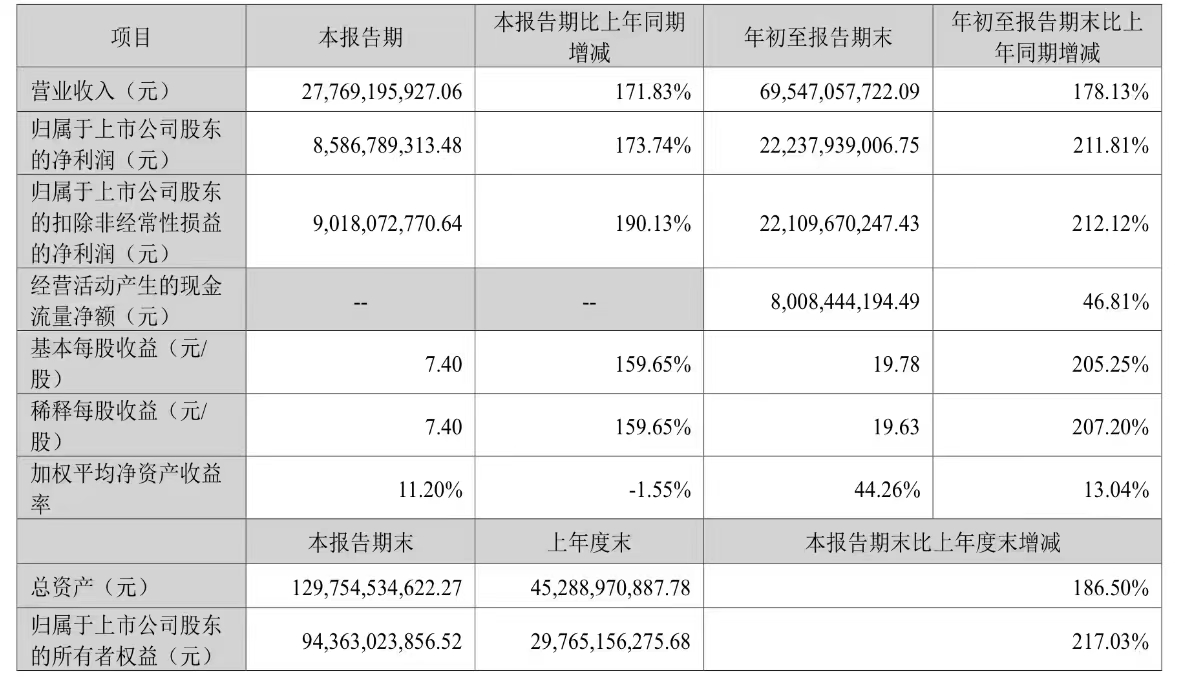
Image source: Zhongji Innolight announcement
Global investment in AI computing power continues to expand, driving explosive demand for high-speed optical modules. Yet even as profits surged, Zhongji Innolight's operating cash flow growth clearly lagged behind its profit growth—prompting the market to ask: how long can this round of high growth last?
Profits Surge
In the first three quarters of 2026, Zhongji Innolight achieved revenue of 69.547 billion yuan, up 178.13% year-on-year; net profit attributable to shareholders of 22.238 billion yuan, up 211.81% year-on-year; and net profit excluding non-recurring gains and losses of 22.110 billion yuan, up 212.12% year-on-year. Net profit for the first three quarters has already more than doubled the full-year 2025 figure of 10.797 billion yuan.
In the third quarter alone, the company achieved revenue of 27.769 billion yuan, up 171.83% year-on-year, with net profit attributable to shareholders of 8.587 billion yuan, up 173.74% year-on-year.
However, the quarter-on-quarter data reveals another signal: third-quarter revenue grew about 24.6% quarter-on-quarter, while net profit attributable to shareholders grew only 8.5%—a clear slowdown in profit growth.
This gap mainly stemmed from non-operating factors. In the third quarter, exchange losses amounted to about 678 million yuan, and losses from changes in the fair value of equity investments reduced net profit attributable to shareholders by about 440 million yuan. Nevertheless, the company's core business profitability remains strong, with a comprehensive gross margin of 46.39% in the first three quarters, up 5.65 percentage points year-on-year.
More noteworthy than profit is cash flow.
In the first three quarters of 2026, Zhongji Innolight's net operating cash flow was 8.008 billion yuan, up 46.81% year-on-year. Net operating cash flow in the first half of 2026 was only 1.8 billion yuan, before rebounding to about 6.2 billion yuan in the third quarter alone—a clear improvement in cash collection.
As of the end of September 2026, Zhongji Innolight held monetary funds of 53.532 billion yuan, with negligible interest-bearing debt and ample cash on hand.
The mismatch between cash flow and profit growth is closely tied to the funding needs brought about by rapid expansion.
With the rapid ramp-up of 800G and 1.6T products, Zhongji Innolight needs to procure key raw materials such as optical chips and electrical chips in advance and build up inventory to ensure order delivery.
This does not necessarily mean deteriorating earnings quality, but it does show that rapid growth is tying up more working capital.
For Zhongji Innolight, the test in the next stage is not only earning more profit, but also how to convert profit into cash faster.
Orders Booked into Next Year
Zhongji Innolight is a major global supplier of high-speed optical modules, with products widely used in AI computing clusters, cloud data centers and communication networks.
Simply put, GPUs handle computing, while optical modules enable massive amounts of data to be transmitted at high speed between servers and switches. As the scale of AI clusters expands, demand for data exchange between chips surges, and optical interconnection is becoming a key link affecting computing efficiency.
At present, 800G and 1.6T high-end optical modules are the core drivers of the company's growth.
In the first half of 2026, Zhongji Innolight's overseas business revenue was about 39.615 billion yuan, up 209.9% year-on-year, accounting for 94.8% of total revenue, with performance deeply tied to the AI infrastructure investment of leading global cloud vendors.
Product upgrades are also driving profitability improvement. From 400G to 800G and then to 1.6T, the transmission rate of optical modules continues to increase, and technical difficulty and customer certification requirements rise accordingly.
In particular, silicon photonics technology reduces the power consumption and manufacturing costs of some optical components through integrated design, becoming an important technology direction for high-speed optical modules.
Zhongji Innolight has widely applied silicon photonics solutions in its 800G and 1.6T products and continues to advance technological iteration.
But what truly constitutes the competitive barrier is not only product speed, but also large-scale mass production and stable delivery capability.
On October 23, Zhongji Innolight disclosed an announcement on its operating conditions, stating that the supply chain is currently stable and customer order demand is strong. Orders from major overseas customers have extended into 2027, and some key customers have provided demand guidance for 2028.
However, order demand guidance does not equal confirmed revenue, and the future still depends on customers' procurement pace and actual delivery.
To support this delivery pace, Zhongji Innolight has already made obvious moves in inventory preparation.
As of the end of September 2026, the company's inventory stood at 23.878 billion yuan, up 88.30% from the end of the previous year. The third-quarter report explained this as "continuous increase in orders on hand, and corresponding increase in material preparation to meet order delivery."
At the same time, Zhongji Innolight is laying out 3.2T and higher-speed products, advancing next-generation optical interconnection technologies such as NPO and XPO, and striving for a broader AI network market. The company revealed that products such as NPO and XPO have already entered cooperative research and development and sample delivery with some customers.
The Next Stop for Growth
Behind Zhongji Innolight's profit explosion is the continued expansion of global AI infrastructure.
In the past, AI industry investment mainly revolved around computing chips such as GPUs. But as the construction of large-scale computing clusters advances, how to make tens of thousands or even more chips work efficiently together is becoming a new technical challenge.
The larger the computing scale, the more data chips need to exchange, and the importance of network bandwidth, power consumption and connection efficiency rises accordingly.
China Insights Consultancy predicts that the global datacom optical interconnection market is expected to grow from US$19.4 billion in 2025 to US$98.6 billion in 2030, with a compound annual growth rate of 33.8% during the period.
Zhongji Innolight also proposed that as AI network architectures continue to evolve, optical interconnection's share of global AI capital expenditure is expected to rise from about 5% to 10% or more in the long term.
This means that future growth in the optical module industry will come not only from upgrades in transmission speed, but also from the expansion of optical connection applications in AI infrastructure.
It should be noted that high growth is also accompanied by high risk.
On the one hand, industry technology iteration continues to accelerate. Demand for 800G remains strong, 1.6T has entered the stage of large-scale ramp-up, and new technologies such as NPO, XPO and CPO are also continuing to advance. New technologies may expand the market, but may also change the value distribution of the industrial chain.
On the other hand, Zhongji Innolight has a high proportion of overseas revenue, and its performance is highly dependent on the capital expenditure of large cloud vendors. Once downstream customers adjust the pace of data center construction, related orders may be affected.
This is also the core divergence in the capital market: optimists focus on technological advantages, customer resources and order visibility, while cautious investors worry about whether the boom can continue and the impact of intensifying competition on gross margin in the future.
The net profit of 22.2 billion yuan in the first three quarters has already proved that global AI computing power investment can be converted into huge industrial profits.
But for the capital market, past growth is only the basis for valuation; future earnings sustainability is what determines enterprise value.
Next, the market needs to focus on changes in gross margin after the ramp-up of 1.6T products, the commercialization progress of next-generation technologies, and whether operating cash flow can continue to improve.
As global AI competition shifts from stacking computing power to improving computing efficiency, Zhongji Innolight has already stood at the core of the optical interconnection industry. But more important than orders booked into 2027 is how to transform this round of AI investment boom into long-term, stable profitability.
-
![]()
Apple Actually Went Ahead and Made a Touchscreen MacBook, Exactly 16 Years After Steve Jobs Said It Wouldn't Work
-
![]()
Exclusive: The Two Turning Points That Sealed Xiaodu's Fate
-
![]()
Zhongji Innolight's Net Profit Triples: The Cash Flow Test Behind the AI Frenzy | Q3 Report
-
![]()
The $5 Billion Rumor and the $20 Million Floor Price: Character.AI's Death Ledger
-
[Insights] New Energy Vehicles and Energy Storage Market Drive Accelerated Development of the High-Voltage High-Current Connector Contact Industry
-
![]()
Top 10 Automotive Technology Trends for 2027: Half in Validation, Half in Implementation
-
Profit Structure Reshaped as BYD's Q3 Profit Rebounds | Q3 Report
-
Geely Q3 Net Profit Up 28%: Premium Overseas Expansion Drives Earnings Recovery | Q3 Report