Top 10 Automotive Technology Trends for 2027: Half in Validation, Half in Implementation
 10/30 2026
 546
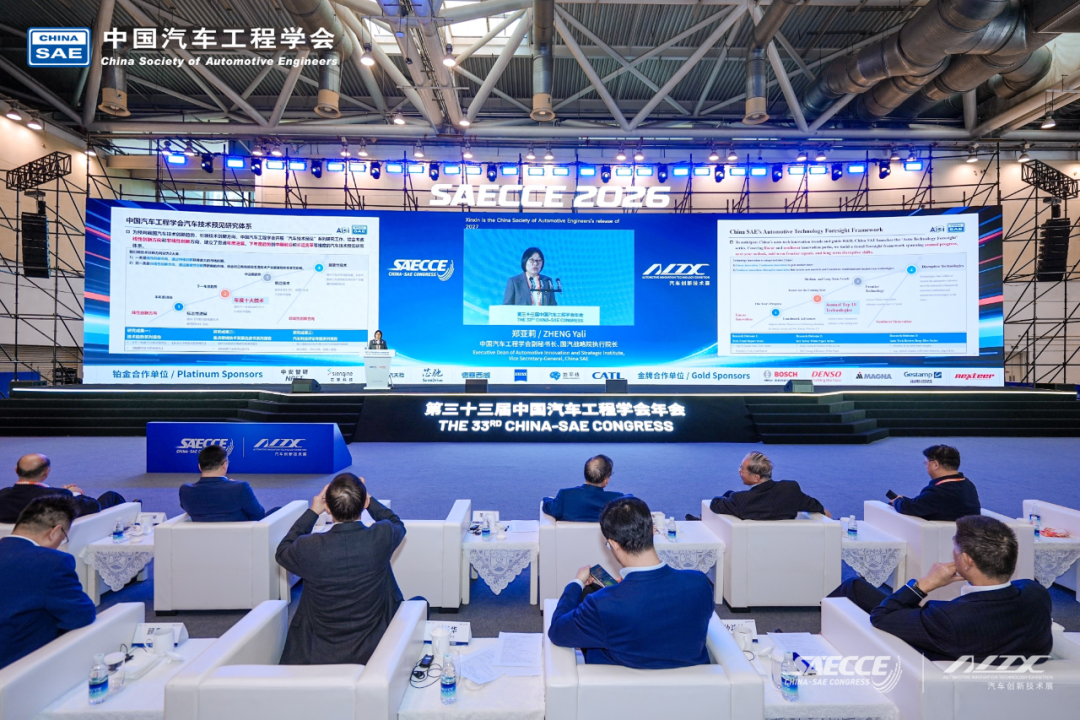
On October 28, the 33rd China Society of Automotive Engineers (SAE-China) Annual Conference and Exhibition opened in Suzhou. At the opening ceremony, Zheng Yali, Deputy Secretary-General of SAE-China and Executive Dean of the China Automotive Strategy Research Institute, unveiled the "Top 10 Automotive Technology Trends in China for 2027" on behalf of the society. The report groups technologies into three categories: those expected to achieve major breakthroughs in performance and cost, those likely to see adoption and soon enter mass production, and those whose application scale will significantly expand.
The timing of the report's release is equally noteworthy. Data from the China Passenger Car Association (CPCA) show that in September, the retail penetration rate of new energy passenger vehicles reached 67.0%, and the wholesale penetration rate hit 65.4% — both setting new all-time highs. Electrification in the Chinese market has shifted from "incremental" to "mainstream." Yet the other side of the market tells a tougher story: September passenger vehicle retail sales totaled 1.618 million units, down 28.0% year on year, and the traditional "Golden September" sales peak failed to materialize. According to CPCA data for January–August, the industry's operating revenue profit margin stood at just 3.6%, clearly below the average for industrial enterprises above designated size during the same period.
Penetration rates are climbing while profit margins are shrinking. This is the reality confronting technological evolution in 2027. The era in which growth could be achieved simply by selling more new cars is drawing to a close, and competition among automakers is increasingly converging on technology itself. Some technologies already stand at the threshold of mass production, while others remain in the validation stage — and their progress is far from uniform.
▍Hardware System Reconstruction Begins with Batteries, Chips, and Chassis
Solid-state batteries fall into the category of technologies that "will achieve major breakthroughs." At the release event, Zheng Yali stated that the society judges solid-state batteries will overcome core challenges by 2027 — including solid-solid interface engineering, lithium dendrite suppression, dry electrodes, and isostatic pressure — with products achieving single-cell energy density at the 400Wh/kg level entering the pilot production stage, led by front-running companies conducting vehicle engineering validation. Two terms deserve emphasis here: "pilot production" and "engineering validation."
Pilot production is an intermediate step between the laboratory and mass production. It signals that a product has moved out of the lab but has not yet reached the mass production line — there is still some distance from practical application. Vehicle engineering validation means installation and testing on vehicles, which is not equivalent to scaled delivery. In February this year, GAC already built its first all-solid-state battery pilot production line and plans to begin small-batch vehicle installation trials in 2026. Meanwhile, Dongfeng's 350Wh/kg solid-liquid hybrid battery cells have completed pilot production and rolled off the line, with vehicle installation expected in 2026.
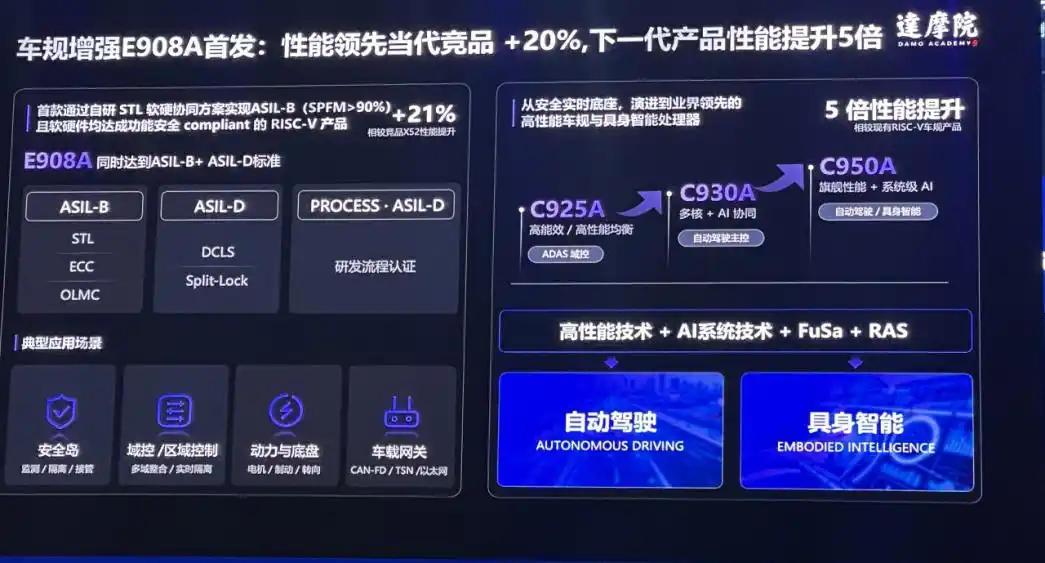
Alongside batteries, automotive chips are also named in the report. The report predicts that high-safety-level automotive MCUs based on the RISC-V architecture will usher in their first year of mass production in 2027. Such chips will cover key scenarios including powertrains and chassis braking, and will obtain the highest-level ASIL-D safety certification. RISC-V is an open instruction set architecture. Unlike traditional architectures, it does not require closed licensing, allowing automakers and chip manufacturers to customize it as needed. This pathway is not merely about adding another chip option — it opens a route for domestic automotive chips that does not depend on closed licensing. This milestone is backed by industrial signals: Damo Academy's XuanTie has released the automotive-grade processor E908A, which meets both ASIL-B and ASIL-D standards. Great Wall Motor-incubated Zijin Semiconductor's M100 has become China's first mass-produced RISC-V automotive-grade MCU installed in vehicles.
Beyond batteries and chips, the chassis is also being reorganized. The integrated vehicle motion control technology cited in the report enables unified scheduling of multiple actuators for "drive, brake, steer, and suspension" — that is, coordinating the control of propulsion, braking, steering, and suspension within a single system. It is the link connecting the motion requirements of intelligent driving with the execution capabilities of the chassis. The report predicts that as steer-by-wire execution systems and centralized computing platforms mature, this technology will penetrate from mid-to-high-end flagship models into more price segments. Related to it is distributed in-wheel motor drive. The report predicts that engineering validation of in-wheel motor drive will comprehensively accelerate in 2027.
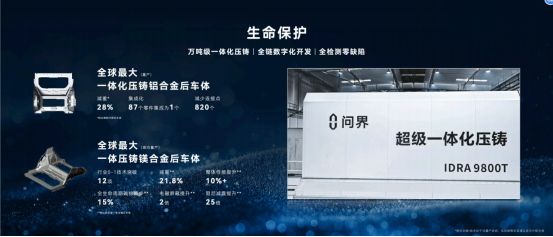
Body materials and manufacturing processes are also evolving in parallel. The report predicts that magnesium alloy integrated forming body large castings will achieve small-scale application in 2027. The National Magnesium Center of Chongqing University disclosed that the integrated die-cast magnesium alloy rear body jointly developed with Seres consolidated 87 original parts into a single casting. The report also predicts that metal 3D printing will achieve coordinated breakthroughs in materials, design, and efficiency.
These technologies share a common feature: they all redefine the cost structure and performance boundaries of automobiles at the hardware level, yet their implementation pace is generally described as "pilot production," "small scale," and "validation" — rather than "full mass production."
▍Intelligence and Energy Implementation Advance at Their Own Pace
If the keyword for hardware technologies is "validation," then the keyword for intelligent and energy technologies is "limited scenarios." These technologies rarely pursue full-scenario coverage from the outset. They typically first prove themselves in a scenario with clear boundaries, then gradually expand outward.
High-level autonomous truck platooning is a typical example. The report believes that in 2027 high-level autonomous truck platooning will enter thousand-vehicle-level demonstration operations. The logic behind truck platooning is straightforward: the lead truck is driven by a human driver, and following trucks use connectivity and autonomous driving technology to follow, maintaining very short gaps between vehicles. The reason this scenario is implemented before passenger cars is that highway scenarios are relatively simple and routes are fixed, while truck operators have a clear incentive to reduce labor costs.
Intelligence in passenger cars has taken a different path. By 2027, the deployment parameters of cockpit-side models in mainstream mass-produced vehicles may exceed 14B — that is, a scale of 14 billion parameters. An on-device model runs directly within the vehicle's local system and does not need to rely entirely on the cloud, providing better response speed and data security. The cockpit is the area where large models are most readily perceived by users after being integrated into vehicles. Voice interaction, proactive recommendations, and multimodal understanding all depend on it. According to the report, in 2026, 22 automakers have already conducted research and validation of connected assisted driving systems in 8 cities, and they expect that in 2027 vehicle-road-cloud cooperative connected assisted driving will achieve small-batch factory installation. This is regarded as a key step in moving "vehicle-road-cloud integration" from demonstration to real-world vehicles.

The relationship between vehicles and the power grid is also changing. The report predicts that in 2027 the daily average reverse flexible regulation capacity provided by V2G will reach the million-kilowatt level. V2G refers to bidirectional energy interaction between electric vehicles and the power grid. Vehicles charge during low-demand periods and discharge electricity from their batteries back to the grid when the grid needs it. The "Three-Year Doubling Action Plan for Electric Vehicle Charging Facility Service Capacity (2025–2027)" issued by the National Development and Reform Commission and other departments clearly proposes that by the end of 2027, the scope of pilot large-scale vehicle-grid interaction applications will be effectively expanded, with more than 5,000 new bidirectional charging and discharging facilities and more than 20 million kWh of reverse discharge. The plan also calls for improving the discharge pricing mechanism and promoting the aggregation of vehicle-grid interaction resources to participate in electricity market trading. This means that for V2G to truly take off, it depends not only on vehicles and charging piles, but also on a pricing mechanism that makes vehicle owners willing to discharge.
Looking at the timing of these technologies, a pattern emerges: commercial vehicles prove themselves on limited routes, passenger cars conduct preliminary experiments before mass production, and the energy side gradually unfolds within policies and market mechanisms. At present, these technologies do not pursue one-step completion, but rather first close the loop within a small, verifiable scope. What is certain now is that these technology directions already have clear roadmaps, and companies and policies are supporting their advancement. What remains uncertain is the speed of cost reduction in the automotive industry in 2027, the pace of mass production ramp-up, and whether a viable commercial closed loop can ultimately take shape.
Layout 丨 Yang Shuo Image sources: China Society of Automotive Engineers, Damo Academy XuanTie, Seres, Pikbest
-
![]()
Apple Actually Went Ahead and Made a Touchscreen MacBook, Exactly 16 Years After Steve Jobs Said It Wouldn't Work
-
![]()
Exclusive: The Two Turning Points That Sealed Xiaodu's Fate
-
![]()
Zhongji Innolight's Net Profit Triples: The Cash Flow Test Behind the AI Frenzy | Q3 Report
-
![]()
The $5 Billion Rumor and the $20 Million Floor Price: Character.AI's Death Ledger
-
[Insights] New Energy Vehicles and Energy Storage Market Drive Accelerated Development of the High-Voltage High-Current Connector Contact Industry
-
![]()
Top 10 Automotive Technology Trends for 2027: Half in Validation, Half in Implementation
-
Profit Structure Reshaped as BYD's Q3 Profit Rebounds | Q3 Report
-
Geely Q3 Net Profit Up 28%: Premium Overseas Expansion Drives Earnings Recovery | Q3 Report