Musk's 2029 Space Prophecy
 11/04 2026
 375
A few days ago, an AI-composed poem was beamed back to Earth from space.
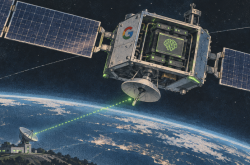
It was generated by Google's Gemma 4 model, running on a satellite orbiting the Earth:
Blue marble below
Data streams in silent grace
Starlight feeds my core.
Roughly translated: the blue planet lies beneath me, data flows quietly through, and starlight charges my core.
Literary merit aside, the poem's birthplace is noteworthy. For the first time, Google used an in-orbit, data-center-grade TPU chip to complete the full cycle—from sending instructions from the ground, to running AI inference onboard the satellite, to transmitting the results back.
Just one day after Google announced its results, Musk weighed in on the future of space-based computing power. On October 31, he predicted on X that by around the end of 2028, monthly orbital computing capacity deployments could surpass those on the ground, and by 2029 they will lead by a wide margin.
When the ground already has mature data centers, why would humanity send such enormous computing power into space?
01 The Space Computing Power Race
Google is not the first company to run AI in space.
In November 2025, U.S. startup Starcloud sent a satellite carrying NVIDIA H100 GPUs into orbit, then announced that it had run Google's Gemma model and used nanoGPT to complete small-scale language model training.
Google this time used its own TPU chips. The satellite, developed with the participation of U.S. satellite company Planet, entered orbit on October 1 and is part of the preliminary trial of Google's "Project Suncatcher."
Although the experiment succeeded, the satellite's computing capability is quite limited.
According to TechCrunch, it carries four TPUs, with a maximum solar power generation capacity of about 1 kilowatt. Limited by power supply, only one chip can be started at a time. A single run lasts about 20 minutes and also requires coordination with the communication window of a ground station to transmit the results back to Earth.
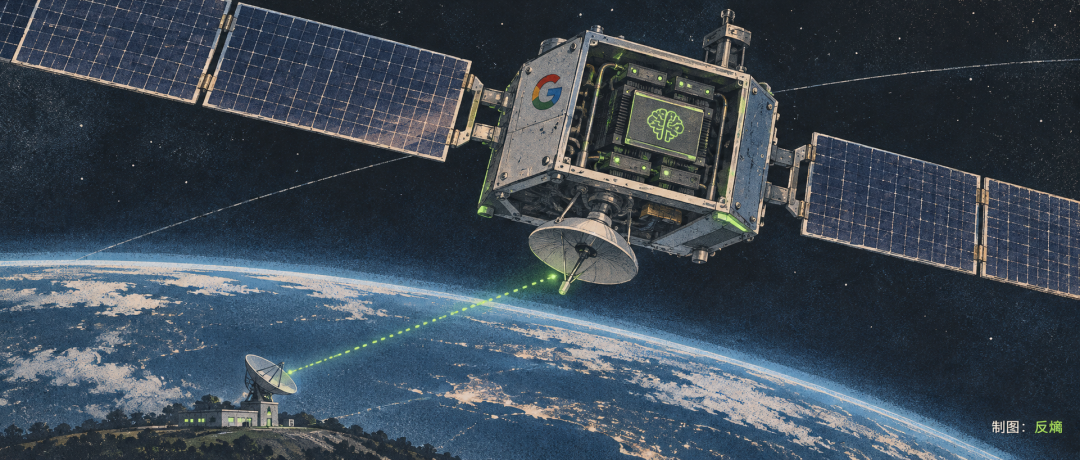
Google plans to continue testing chip reliability under space radiation and temperature swings, and in 2027 conduct a dual-satellite interconnection experiment—having two satellites exchange data via laser communication—to prepare for future multi-satellite collaborative computing.
In the plans of SpaceX and Blue Origin, orbital computing has long exceeded the scale of single-satellite experiments. The two companies have respectively applied to the U.S. Federal Communications Commission to deploy up to 1 million and 51,600 computing satellites, attempting to develop orbital computing into new infrastructure.
However, letting one satellite run AI and letting tens of thousands of satellites continuously provide computing power are obviously different in difficulty. Moreover, ground data centers have already been developing for many years. For space computing power to enter this market, it must first find its own advantages.
02 The Cost of Space Computing Power
Why is Musk optimistic about space? One important reason is electricity.
The International Energy Agency estimates that the annual electricity consumption of global data centers will grow from 485 TWh in 2025 to 950 TWh in 2030, nearly doubling.
Large AI data centers require continuous and concentrated power supply, but power generation facilities and grid expansion both take time. Even if a region does not lack electricity, it may not be able to immediately provide sufficient grid connection capacity for newly added data centers.
Space has no such grid constraints.
In a dawn-dusk sun-synchronous orbit, a satellite travels along a direction close to the Earth's day-night boundary and can receive nearly continuous sunlight. Google's research believes that under certain conditions, the annual power generation of orbital solar panels can reach up to eight times that of ground-based panels in mid-latitude regions.
But although solar energy is abundant, computing equipment cannot simply be moved into space and start working.
Ground servers can use fans and coolant to remove heat. Space has no air convection, so the waste heat generated by chips mainly relies on radiators to radiate outward. The larger the scale of computing power, the larger the heat dissipation system usually becomes, and these devices all require rocket transportation.
Maintenance is also troublesome. Ground servers can have components replaced when they break down, but in-orbit computing equipment is hard to receive such maintenance conditions, and serious failures may even cause an entire satellite to be scrapped ahead of schedule.
The Boston Consulting Group (BCG) estimated in August this year that the 20-year total cost of ownership of an orbital data center is about $660 million to $750 million per megawatt, compared with $230 million to $300 million on the ground, covering long-term expenditures such as construction, operation and maintenance, and equipment replacement.
Even if future launch costs fall by 67% and the mass per unit of satellite computing power decreases by 50%, orbital computing is still affected by equipment failure rates. According to BCG's model, when the failure rate is 30%, the cost is about 1.8 times that of the ground; only when it drops to 10% can it narrow to 1.5 times.
If services are also to be provided to ground users, computing tasks and results must be transmitted through satellite communication links. Especially for businesses with large data volumes such as batch production of videos, communication bandwidth and spectrum resources may also limit the scale of services.
Space has abundant sunlight, but requires extra costs for transportation, heat dissipation, and communication. Even if costs gradually decline in the future, not all AI computing may be suitable to move up there.
03 Where Should Computing Power Go
The easiest space computing demand to understand comes from satellites themselves.
In May 2025, the first 12 satellites of the "Three-Body Computing Constellation," led by the Zhejiang Lab, entered orbit. As of public disclosure in September this year, the constellation had 16 in-orbit satellites and 25 artificial intelligence models, with total computing power reaching 5.8 POPS.
Among them, two satellites carrying cosmic X-ray polarimeters used a space-based astronomical time-domain model to perform in-orbit judgment and classification of gamma-ray bursts, and the event recognition accuracy of the relevant verification reached 99%.
This type of computing has very practical uses. For example, remote sensing satellites have captured a large number of ocean images, and users may only want to know whether there are anomalous ships. If the satellite can directly identify the target, it can prioritize transmitting the analysis results back and reduce the downlink of raw images.
China has already begun trying to turn this capability into callable computing power services.
On October 30, the Beijing Space Computing Power Innovation Center released an integrated space-ground space computing power cloud platform, announcing coverage of computing power resources of more than 40 satellites, supporting unified scheduling of ground and orbital computing equipment, and conducting large-model inference.
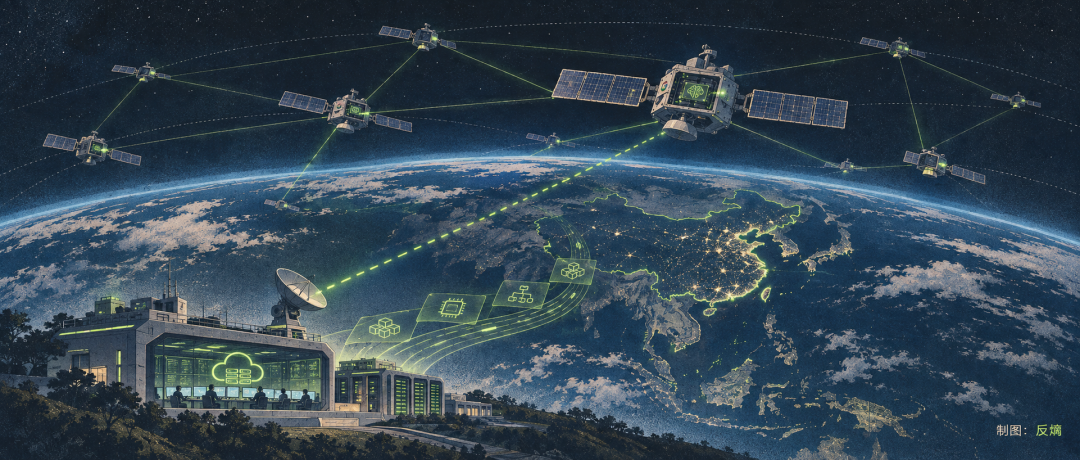
Simply put, users can submit tasks through the platform, and the system arranges computing resources. However, there is still a lack of sufficient public data on actual usage scale and computing costs, and long-term commercial demand remains to be verified.
A potentially larger market than the data generated by satellites themselves may come from ground-based AI inference.
BCG believes that tasks such as batch video generation, enterprise document processing, and scientific analysis may be suitable for completion in space in the future. For example, when producing a batch of advertising videos, customers may not need results within seconds; as long as the price is right and delivery is stable, they may also accept computation completed by orbital data centers.
BCG estimates that by 2030, such inference tasks that can tolerate a certain delay may account for 40% to 45% of the global AI data center market. This is only a potential serviceable market, and it does not mean that the corresponding proportion will definitely shift to space.
By contrast, real-time AI conversations have higher requirements for response speed, and large-model training requires a large number of chips to exchange data at high speed, so at this stage they are still more suitable for ground data centers.
If some ground computing tasks can ultimately be migrated to orbit at reasonable cost, the commercial space industry may face a market far larger than traditional satellite data processing.
04 A New Business in Orbit
Musk clearly believes that this day will not be too far away.
On October 31, his prediction appeared under a rather astonishing SpaceX revenue model. Sequoia Capital partner Shaun Maguire believes that SpaceX's annual revenue may grow from $51.5 billion in 2026 to $731 billion in 2028, with a considerable portion of the growth coming from the envisioned AI computing business.
Musk felt that this forecast was still conservative. He then talked about orbital computing power, believing that the monthly deployment speed in 2029 will further exceed that on the ground.
These remarks also have a capital market background. In June this year, SpaceX listed on Nasdaq, and orbital AI computing power became part of its long-term growth strategy. Investors naturally care about how much of a new market this company can create beyond rockets and Starlink.
SpaceX indeed has conditions that other computing companies find hard to replicate. It builds its own satellites, launches its own rockets, and also operates the Starlink network. If all these capabilities are used to build orbital data centers, many services that originally required external procurement can be completed internally.
Musk places especially high hopes on Starship. Only when large reusable rockets achieve low-cost, high-frequency launches can the deployment of tens of thousands of computing satellites have a chance to reach scale.
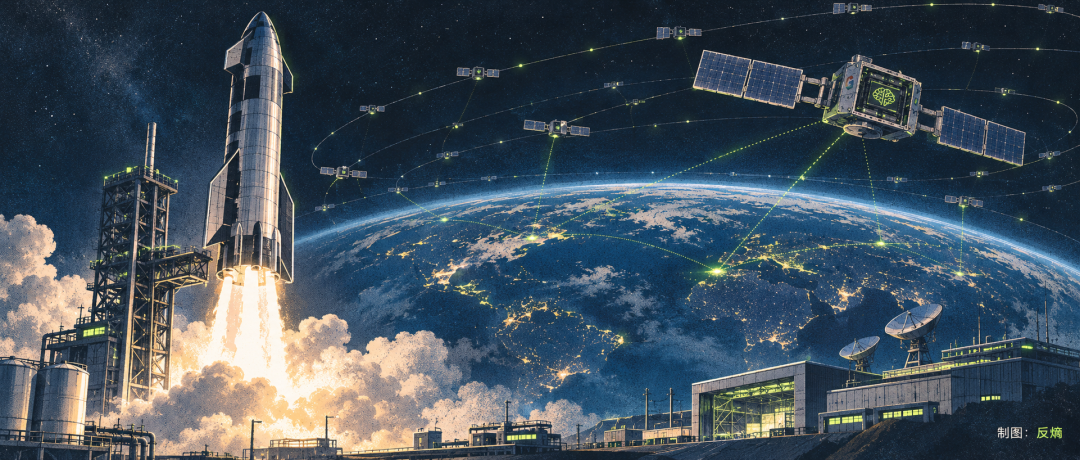
But even if transport costs are cheap enough, space cannot accommodate satellites indefinitely.
The million computing satellites applied for by SpaceX are planned to operate at altitudes ranging from 500 to 2,000 kilometers. Such a massive constellation will increase pressure on collision avoidance, space debris management, and spectrum coordination, and may also interfere with astronomical observations.
There is a famous Kessler effect in the aerospace field: satellite collisions produce debris, and the debris then hits other satellites, eventually possibly forming a chain reaction that makes some orbits difficult to use safely for a long time.
The costs of rocket launches and satellite manufacturing are borne by companies, but the risks brought by orbital congestion may affect all spacecraft using this space.
Compared with Musk's optimistic judgment about 2029, BCG gave a longer timeline: by 2040, orbital data centers may account for 10% to 15% of the global AI data center market. This forecast is also based on assumptions such as falling launch costs, mature computing technology, and the migration of some ground tasks.
From Google's space poem to SpaceX's planned million computing satellites, orbital computing power has attracted a large amount of technological investment and capital attention. If low-cost launches can become a reality in the future, space does indeed have the opportunity to take on more AI computing tasks. But as computing satellites continue to increase, orbital congestion and space environmental risks will also become increasingly prominent.
Ground data centers are limited by electricity and land, and space data centers likewise need to face their own resource constraints. Technology can push computing power into orbit, but it cannot make low Earth orbit an inexhaustible space.
-
![]()
Attention Inflation: Big Tech Is Busier but Earning Less -
China's Auto Export Champion Sees Revenue Hit Record High
-
![]()
Can the M-Hero X700 Become the Ultimate Box That Balances Off-Road Capability and Family Use?
-
![]()
Young People Are No Longer Buying Cars
-
![]()
Self-Driving Tech Is Getting Cheaper and Cheaper—Are Suppliers Sacrificing Profits for Market Share?
-
![]()
BYD's 490,000 Vehicles Dominate the Field as Joint-Venture Automakers Beat a Hastier Retreat: October Auto Market Undergoes Major Shakeup
-
![]()
Musk's 2029 Space Prophecy
-
BMW Brilliance Reportedly Lays Off Workers with N+5 Compensation Package