Attention Inflation: Big Tech Is Busier but Earning Less
 11/04 2026
 556

The "Time War" in the Stock Era
Author | Yixiu
Editor | Xiaobai
Images | AI-generated
Produced by | Emphasize Next
In 2026, China's internet has no new users—only time being reallocated.
Who took the time, and who turned time into money, is the same variable in big tech's books this year. QuestMobile's Fall 2026 major report shows that in September, China's mobile internet MAU was 1.281 billion, up 0.9% year-on-year, and per capita monthly usage time was 189.8 hours, up 6.5% year-on-year. In August, this figure was 200.1 hours, crossing 200 hours for the first time.
Users are barely increasing, yet the time each person spends on their phone is still rising. Once the only increment left is time, seemingly unrelated events—Douyin catching up with Tencent, AI users doubling while time remains flat, smartphone shipments hitting a 14-year low while Apple tops the list—are in fact different facets of this "time war."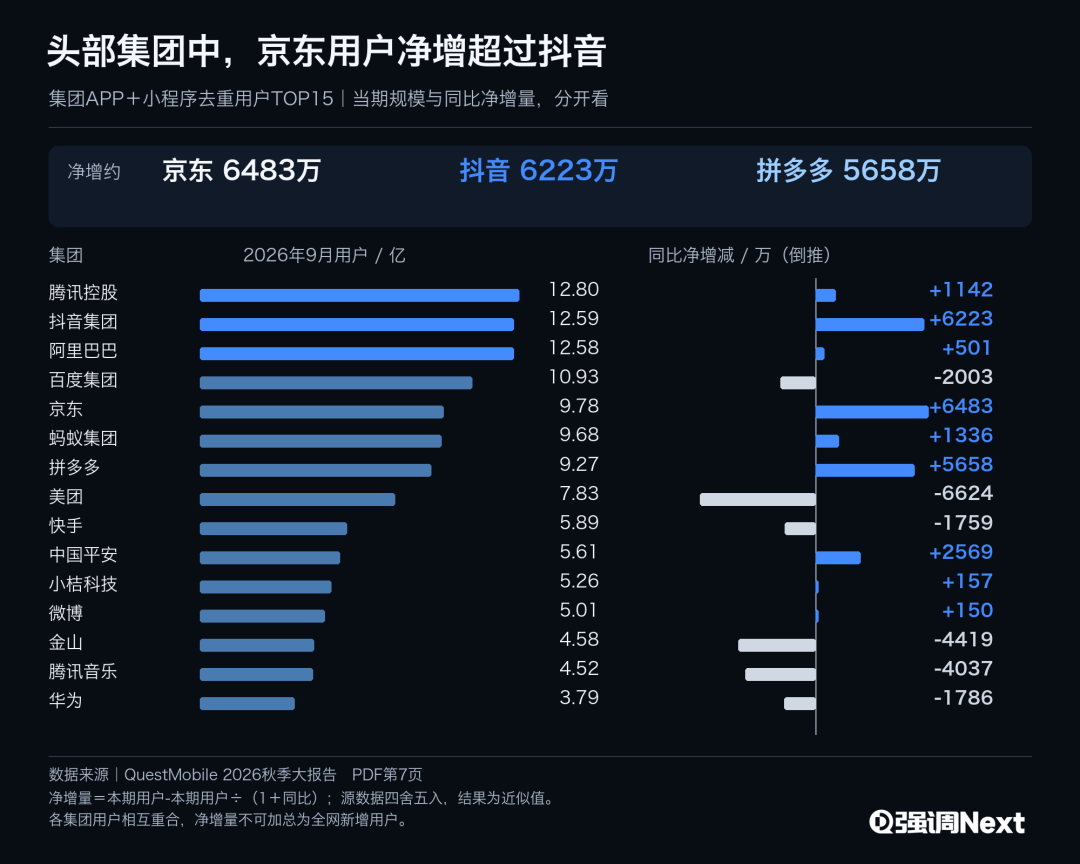
Newly added time flows mainly to short dramas and short videos
Based on the industry net increase in time disclosed in the report, in September the whole network had about 17.1 billion more hours than the same period last year, of which short dramas accounted for 13.329 billion hours and short videos for 5.717 billion hours. Together they exceeded the total net increase, while all other tracks combined were negative. The biggest losses were online video (down 1.380 billion hours), general news (down 1.307 billion), and search engines (down 984 million). Short dramas alone accounted for about 78% of the newly added time.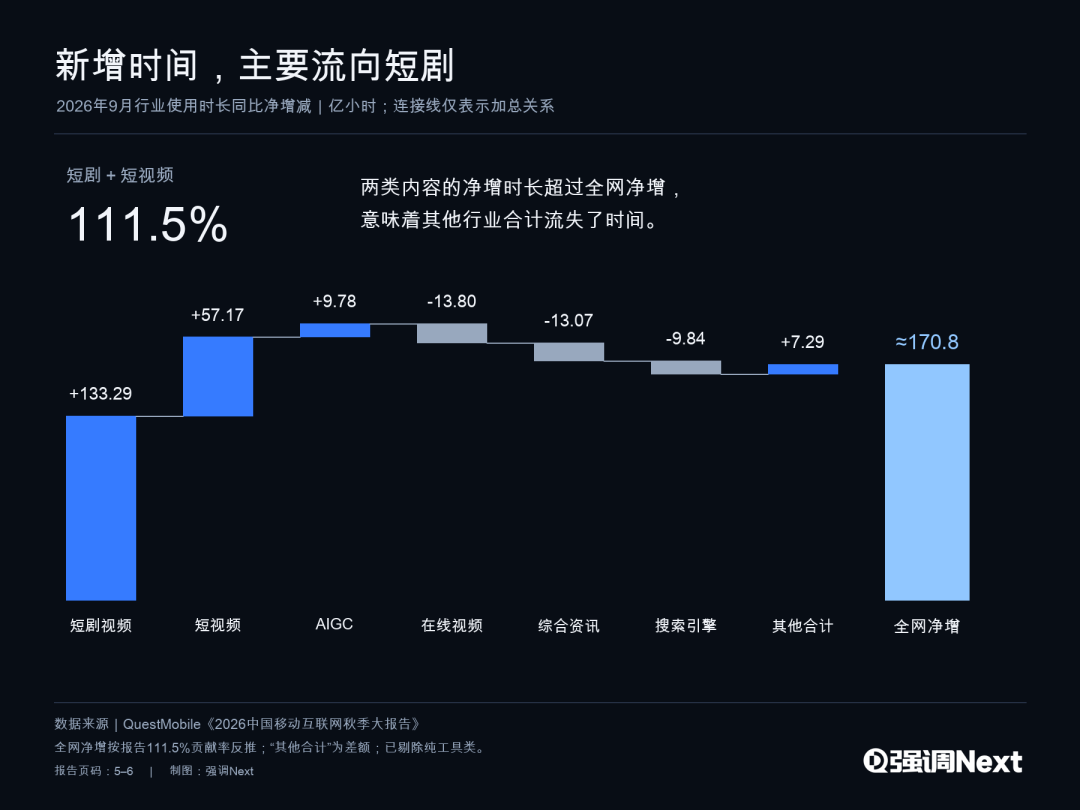
Who is supplying this time becomes clearer when looking at the app rankings of Douyin Group. Last September, its top three were Douyin (936 million MAU), Toutiao (389 million), and Douyin Lite (305 million). This September, they became Douyin (1.029 billion), Hongguo Free Short Drama (430 million), and Doubao (419 million).
The two positions that used to exchange time through news and subsidies were given up to short dramas and AI. Nearly 90% of Hongguo users (88.5%) also use Douyin at the same time; the two apps are competing for the same group of people's time, while online video fell by 1.380 billion hours over the same period. In September, Douyin Group's deduplicated total users were 1.259 billion, up 5.2% year-on-year; Tencent Holdings had 1.280 billion, up 0.9%, a gap of 21 million. Back-calculating by their respective growth rates, the gap a year ago was about 70 million.
Tencent's own disclosed combined MAU for WeChat and WeChat International is 1.439 billion, including overseas users, under a different methodology. Whichever ruler is used, both companies already cover more than 98% of all internet users under QuestMobile's methodology. After catching up, user numbers no longer distinguish the two companies; what distinguishes them is what they can sell in the same minute.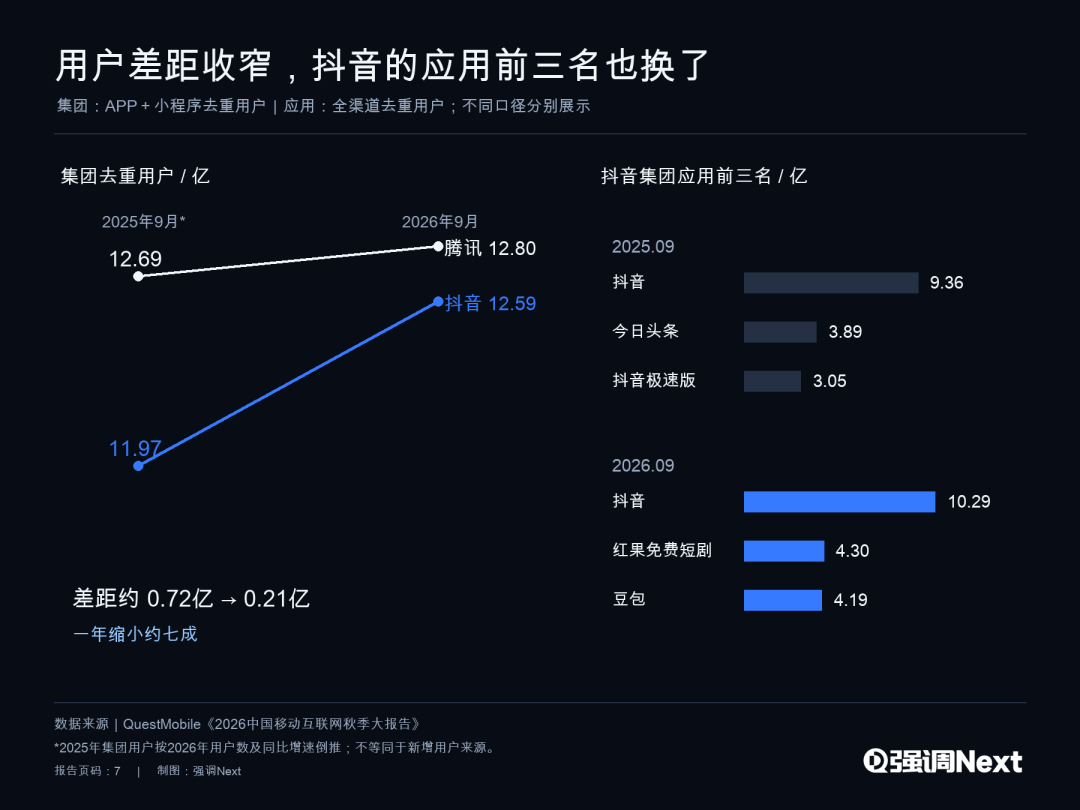
There is currently only one line of inference about which people the incremental time comes from. The report shows that users aged 46 and above exceeded 40%, up 2.6 percentage points year-on-year, while those aged 25 to 45 fell to 39%; the positions of the two groups have reversed. CNNIC data shows that in December 2025, nationwide internet penetration was 80.1%, and the usage rate among netizens aged 60 and above was 53.7%, 26.4 percentage points lower, making it the largest remaining gap. The report does not provide the age structure of short drama users; "middle-aged and elderly users are supporting short dramas" is only two phenomena that appeared at the same time, and confirmation would require user profiles from platforms such as Hongguo.
Time has moved house, but money only recognizes transactions
Time can no longer be directly "converted into money." In Q3, the internet advertising market was 193.24 billion yuan, up 3.1% year-on-year, less than half of the time growth rate, while Q2 growth was still 8.1%. The number of advertisers increased from 7,594 to 8,356, up 10%, implying a rough decline of about 6% in average spending per advertiser. Money neither increased in sync with time nor was distributed evenly. The top three media by hard ad placement spending were Douyin (17.4%), Taobao (15.8%), and Qianchuan (15.6%), totaling 48.8%, all venues where advertisers can directly see transactions.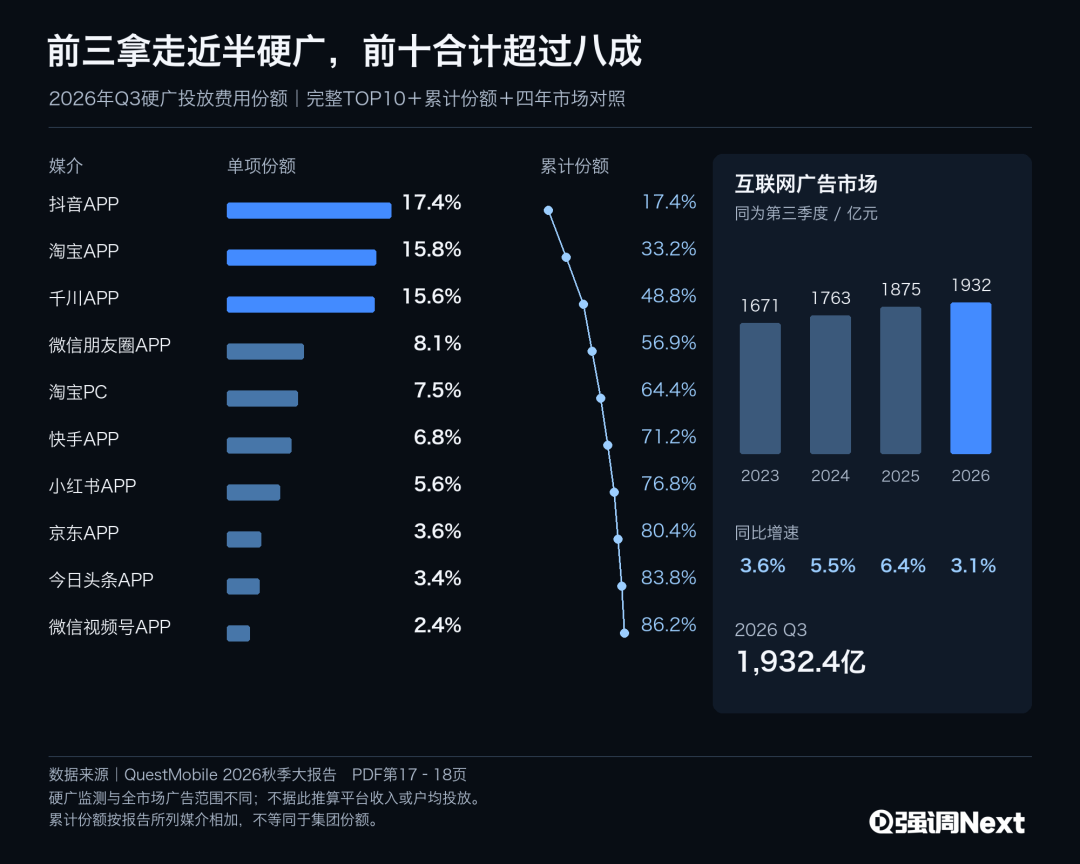
Two Q2 earnings reports illustrate the issue even more clearly. Tencent's Q2 marketing services revenue was 43.6 billion yuan, up 22% year-on-year, and its share of total revenue rose from 19% to 21%, while the overall market growth rate in the same period was 8.1% (QuestMobile).
Management attributed this to AI recommendation models and AIM+ placement products, as well as WeChat mini shops, mini games, and other in-WeChat services increasingly being placed through Tencent's advertising platform. In this chain, seeing an ad, placing an order, repurchasing, and advertising again all happen in the same place. Time is only one step away from transaction, so advertisers are willing to pay a higher price.
The fact that Tencent's user numbers are about to be caught up by Douyin does not prevent its advertising revenue growth from being nearly three times the overall market. Baidu's online marketing revenue in the same period was 13.1 billion yuan, down 19% year-on-year. Search was originally the most expensive stretch before a transaction: users come in with clear demand, and advertisers bid for that demand by click.
On the earnings call, Luo Rong, president of the Mobile Ecosystem Group, gave two reasons: intensifying competition for users' time and attention, and Baidu's deliberate restraint in commercializing AI search. He also expected the advertising business to remain under pressure in the second half. But the overall market grew 8.1% in the same period, which also shows that Baidu's decline was not only due to market weakness.
The time lost by search corresponds to ad slots with the clearest intent and the most expensive bidding, while the time added by short dramas corresponds to a free model that recovers content costs through advertising. The price of one minute is not the same on the two sides. Paid membership and user scale show similar signs. Tencent's Q2 number of subscribed members for fee-based value-added services was 259 million, down 2% year-on-year and down 3% quarter-on-quarter.
In terms of user scale, QuestMobile data shows Tencent Music's deduplicated users were 452 million, down 8.2% year-on-year, while Qishui Music's MAU was 172 million, up 43% year-on-year.
AI has not yet captured attention, but it has already changed the path to making money
AI is the smallest piece in this time ledger. In September, AI-native apps had 546 million MAU, up 82.1% year-on-year, but the AIGC industry's net increase in time was only 978 million hours, about 5.7% of the whole network's newly added time, less than one-tenth of short dramas, and only enough to make up 43% of the time lost by search and news. The reason lies in how it is used.
Doubao had 72.0 uses and 132.5 minutes per capita per month, about 1.8 minutes per use; Qwen had 17.8 uses and 22.7 minutes, about 1.3 minutes per use; DeepSeek had about 2.1 minutes per use. A report released by CNNIC on September 29 shows that 76% of users mainly use generative AI to answer questions, and one-question-one-answer is the most common usage. Even calculated approximately against the whole network's per capita 189.8 hours per month (about 11,400 minutes), Doubao users on average spend only about 1.2% of that time on it (Doubao users' own total online time is not disclosed).
Short time does not mean unimportant. The faster this kind of product is used, the higher its value. But the internet's past revenue model depended on time, and AI compresses time. Divergence within AI is also accelerating, and scale and depth have become decoupled. Qwen had 158.17 million MAU, 38% of Doubao's, with per capita monthly time only 17% of Doubao's, and MAU down 5.4% quarter-on-quarter. Yuanbao's MAU fell 25.1% quarter-on-quarter, but per capita usage count and time rose 32.6% and 34.1%, respectively; DeepSeek's MAU fell 15.2% year-on-year, while per capita count and time rose 5.8% and 9.5% quarter-on-quarter.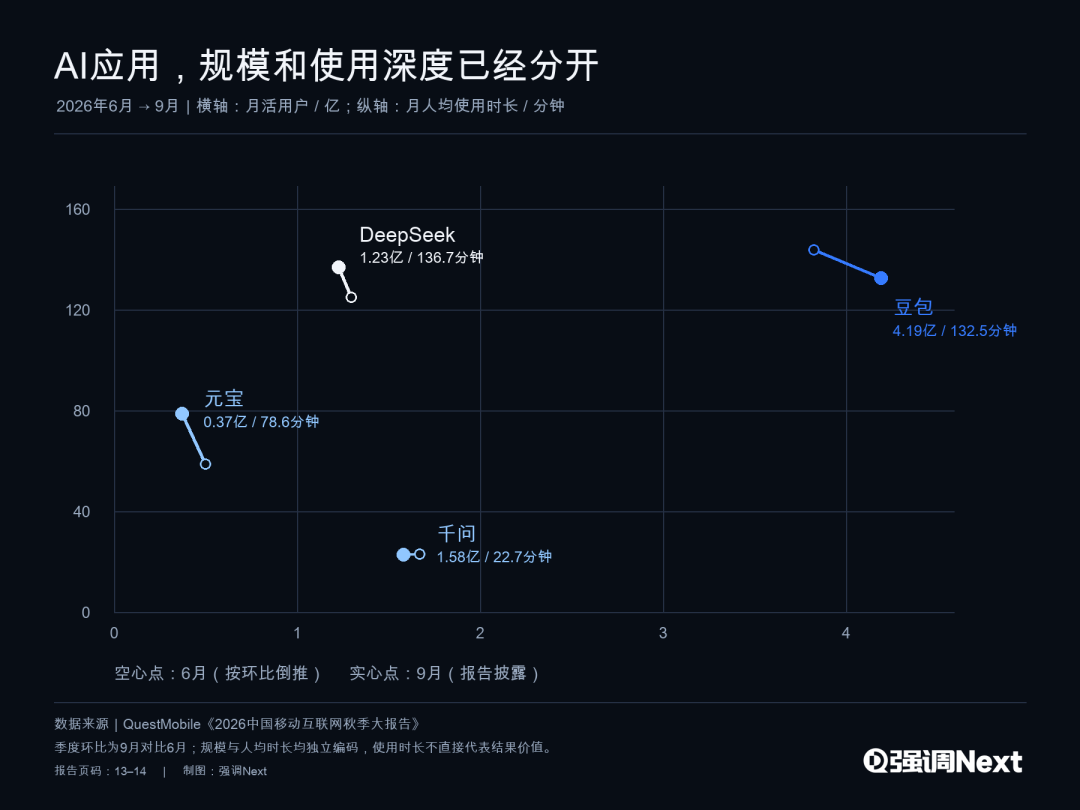
Users are decreasing, but those who remain use it more frequently; the shallow users brought in during the user acquisition stage are exiting. Doubao is a different case: MAU rose 9.6% quarter-on-quarter, while per capita count and time fell 6.1% and 7.8%, as scale diluted usage depth. Entrances are also concentrating toward two ends.
Self-contained AI-native apps added 246 million MAU in a year. System-level AI (built into the operating system, no download required) added 111 million, reaching 592 million, up 23.0%. AI plug-ins within apps, caught in the middle, fell by 119 million, and PC web pages fell by 21 million. Smartphone makers' AI assistants had 616 million MAU, growing only 6.5% in a year. Assistants that require users to actively invoke them did not win; standalone apps that are directly accessible and system capabilities that require no invocation won.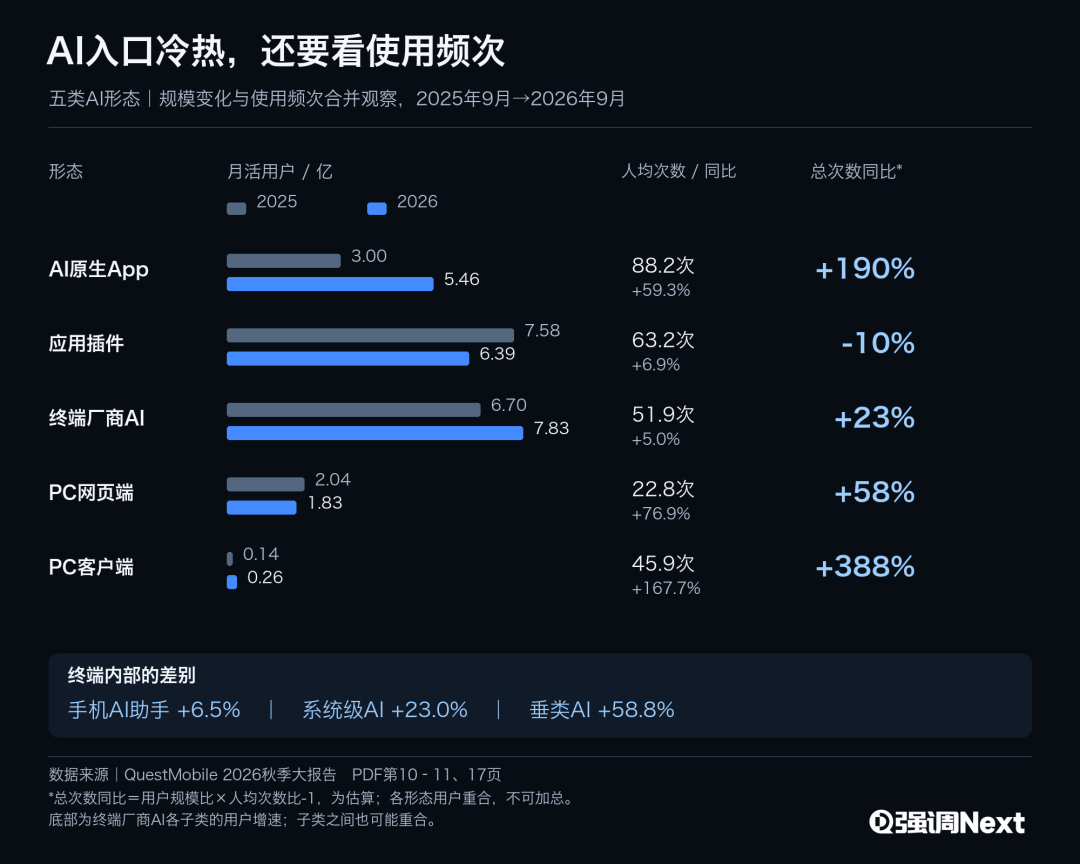
After time is compressed, AI can only charge in a different currency, and currently the only clearly calculable end is selling computing power. Baidu's Q2 earnings report disclosed that of 12.5 billion yuan in AI business revenue, AI cloud infrastructure was 7.3 billion yuan, up 50% year-on-year, of which GPU cloud grew 283%. AI application revenue was 2.5 billion yuan, up only 3% year-on-year. AI-native marketing services were 2.6 billion yuan, basically flat.
Tencent's earnings report said WorkBuddy users have a strong willingness to pay by purchasing tokens through subscriptions and top-ups. Public information does not show Doubao or Qwen disclosing paid user numbers or renewal rates. This is the biggest gap at present: if the paid rate does not rise, the result of AI will be to compress search advertising revenue without equivalent new revenue to replace it.
The smartphone stock battle: manufacturers begin allocating new demand entrances
Counterpoint data shows that in Q3 2026, China's smartphone shipments fell 10% year-on-year, the lowest for the same period since 2012. IDC's figure is about 57.9 million units, down 15.4% year-on-year, with a decline of about 4% in the first half. The main reason is that rising memory chip prices pushed up device prices. IDC expects little improvement in Q4 and continued decline for most of 2027. Share, however, is concentrating toward high-end models.
Counterpoint statistics show Huawei ranked first with a 21.3% share, with shipments up 19% year-on-year, and Apple ranked second with 19.5%; together they accounted for about 40%.
Sales of the iPhone 18 Pro series in the first three weeks after launch were 23.5% higher than those of the iPhone 17 Pro series, driven by the delayed release of the base iPhone 18. In Apple's earnings report released on November 3, iPhone revenue was 57.58 billion dollars, up 17.5% year-on-year, and Greater China revenue was 17.54 billion dollars, up 21% year-on-year.
QuestMobile data shows that in September, Apple's active share was 20.92% and Huawei's 20.87%. Apple fell 0.3 percentage points year-on-year, while Huawei fell 1.7 percentage points; Huawei fell faster, yet Huawei led Apple on the shipment list. Active share reflects installed base, while shipments reflect additions. The opposite order of the two lists shows that Apple's lead is built on a slower replacement cycle, that is, an advantage within the installed base.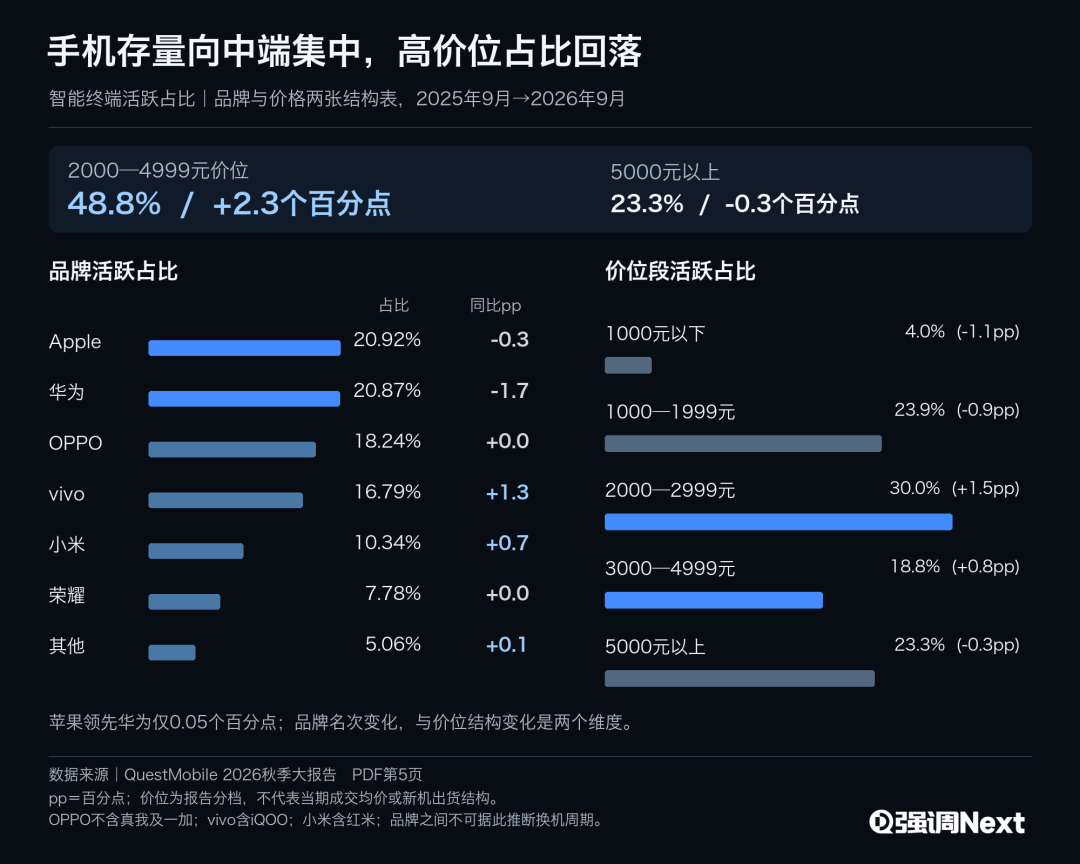
The growth of system-level AI must also be viewed within the installed base. Replacing a phone merely replaces an old device with a new one and does not create new users. System-level AI's addition of 111 million MAU in a year can only come from system upgrades and features enabled by default. Apple Intelligence in mainland China is taking exactly this path.
It was officially announced on October 31, starting with the iOS developer Beta on November 4 and officially launching with iOS 27.3 in December, supporting iPhone 15 Pro and later models. Qwen is integrated into Siri, Writing Tools, and Visual Intelligence. Users need to log in to a Qwen account or use Sign in with Apple, and can choose whether to activate it. Apple also stated that these features do not include Siri AI. Taken together—the threshold, authorization, and feature scope—it is in fact an account entrance that users must actively enable and will not automatically bring default traffic.
Over the past two decades, the pricing power of attention has had to be renegotiated every time the medium changed. Portals sold by impression, feeds sold by click, and transaction platforms sold by commission. What is special about this round is that the new medium has two sides: one has time but no stable shelf. The other has an entrance but no time. Which side prints the price list first will determine who prices attention in the next decade.
Note: The data in this article comes from public information and does not constitute investment advice.
- END -
-
![]()
ZTE Rumored to Sell Phone Business at 40 Billion Yuan Valuation, with a Major Internet Company Set to Take Over? Official Response Arrives
-
![]()
Prompt Engineering in Practice: Giving Six AI Characters Distinct Speaking Styles
-
![]()
Xingyu Co., Ltd.'s Q3 Net Profit Falls Nearly 40%: Chinese Automotive Lighting Has Won on Styling, but the Profits Are Gone
-
![]()
More like twins: the growth paths of these two automakers are strikingly similar
-
![]()
Chinese Automakers Go Global: Entering the "Export Quota Competition" Phase
-
![]()
New Energy Vehicle Exports Surge, but Smart Driving Remains an Overseas Weak Spot
-
![]()
"Rush-built cars" face regulatory crackdown
-
![]()
Long Gone From View, These New Forces Are Still Fighting to Come Back