Can Li Jiaqi Help Chen Yusen Land a Big Result?
 11/04 2026
 554

Chaoyong AI Editorial Department
This year's Double 11 spotlight arrived a little late.
On the evening of November 2, an intangible product went on sale in Li Jiaqi's livestream.
The comment section was flooded with "3, 2, 1 — drop the Tokens."
The 0.01-yuan QwenWork personal membership monthly card sold 50,000 units in 10 minutes and nearly 100,000 in half an hour, representing a nominal AI compute quota of roughly 2 trillion Tokens.
It was the first time a top-streamer livestream had sold AI compute products.
The man behind the pitch was Chen Yusen, Vice President of Alibaba Group, CEO of QwenWork, and the youngest business unit head at Alibaba.
Born in 1992, he is the same age as Li Jiaqi.
The last time an Alibaba executive made a memorable appearance in Li Jiaqi's livestream was during Double 11 in 2018, when Jack Ma and Li Jiaqi faced off in a lipstick-selling livestream PK. Li Jiaqi sold 15,000 lipsticks in that showdown, and the moment became iconic.
Eight years later, lipsticks have become Tokens, and the person standing beside Li Jiaqi has changed from Jack Ma to Alibaba's youngest vice president.
The question is: can nearly 100,000 one-cent monthly cards translate into the big result Chen Yusen needs?
Five Months to Deliver: The Midterm Exam for the No.1 Project
Chen Yusen's schedule is punishing.
On June 11, DingTalk founder Wuzhao (Chen Hang) resigned amid the controversy sparked by his long essay "Inside DingTalk," and Chen Yusen succeeded him as DingTalk CEO while taking charge of Alibaba's AI office business.
This post-90s founder, who started the cybersecurity company Changting Technology at 22 and built MuleRun through internal entrepreneurship after Alibaba Cloud acquired the company, thus became Alibaba's most closely watched newcomer.
In July, Alibaba "technologically merged" its three internally competing Agent products — QoderWork, Wukong, and MuleRun — to launch QwenWork. Public beta began on August 3, and the flagship model Qwen3.8 was released the same day. On September 4, QwenWork announced that it had surpassed 30 million users within 30 days of launch, with enterprise users accounting for more than half, 120 versions shipped in 30 days, and an average of four iterations per day.
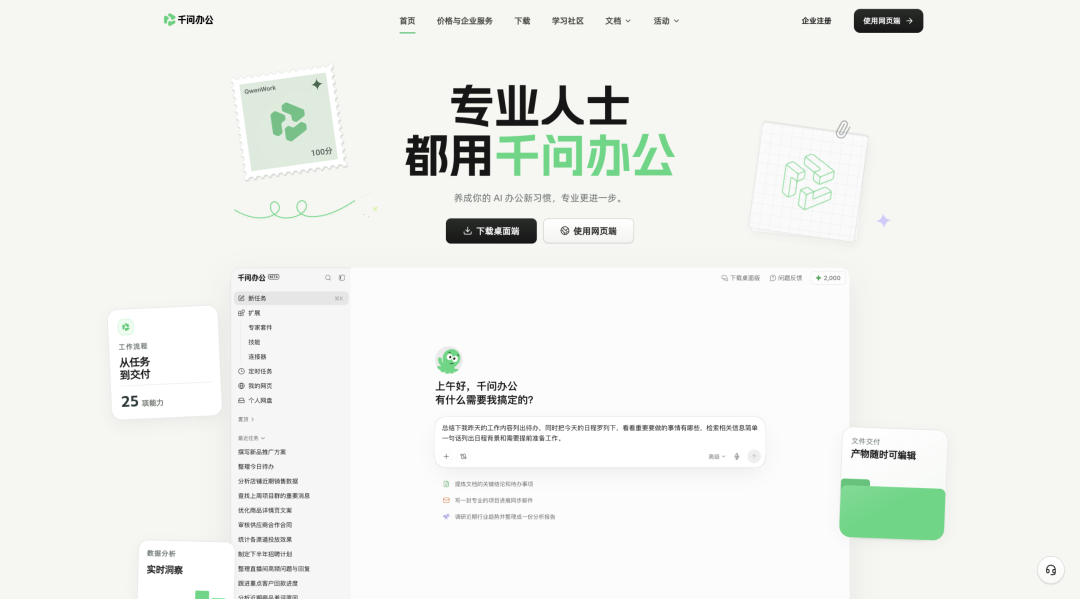
Screenshot of the QwenWork official website
On September 22 at the Yunqi Conference, QwenWork held a dedicated session. Chen Yusen made his first public appearance about 100 days after taking office, with the speech theme set as "Context Is All You Need," and launched an enterprise-oriented "Enterprise Context" product.
Behind the rapid-fire moves, the hand he was dealt was not exactly strong.
Analysys statistics on 17 mainstream desktop AI-native office agents show that in June 2026, Tencent WorkBuddy had 20.97 million visits and ByteDance's TRAE IDE domestic version had 12.79 million. Alibaba's QoderWork and Wukong combined had 9.19 million visits, of which QoderWork accounted for 7.88 million.
Tencent's products combined had 32.62 million visits, while Alibaba's were about 30% of that.
Tencent President Liu Chiping said on the second-quarter earnings call that WorkBuddy's user retention rate and willingness to pay are both very high.
On August 25, ByteDance spun the "work tasks" feature out of the Doubao App and released an independent AI office product, "Doubao Work," promising that basic functions would be permanently free. On September 15, ByteDance held a 3,000-person launch event in Beijing, with CEO Liang Rubo personally present, positioning Doubao as the group's "AI main business," while Feishu was simultaneously restructured into a business line under the AI product department.
All three major tech giants have entered the arena, and the landscape has not yet taken shape.
QuestMobile data shows that in September, the AI office track had a total of 142 million active users, a year-on-year increase of 50.6%. WorkBuddy ranked first among office agents with 32.353 million active users, more than three times that of the second place. Tencent Group Senior Executive Vice President and CEO of the Cloud and Smart Industries Group Tang Daosheng publicly stated that more than 50% of China's top 500 enterprises are already using WorkBuddy, and among the top 100 enterprises, coverage has reached 60%.
Clearly, Tencent has already achieved a "big result" in the AI office field, and the late-entering QwenWork has not shown particularly outstanding performance.
The window of opportunity left for Chen Yusen is visibly narrowing.
More importantly, the 30 million announced by QwenWork is the cumulative user count in the first month of launch, and the company has not disclosed monthly active users, retention, or payment data. This metric cannot yet answer whether the product has truly entered users' workflows.
Pressure also comes from within Alibaba.
Chaoyong AI previously reported in the article "Exclusive | QwenWork Becomes Alibaba's 'No.1 Project,' All Talent and Computing Power from Alibaba Cloud + DingTalk Will Be Integrated into the Product" that QwenWork is a company-level strategic product in the second half of 2026, with senior group executives personally participating in its key meetings, and the flagship model Qwen3.8 released on the same day as QwenWork and integrated first.
The other side of resource tilt is that expectations are simultaneously maxed out.
In addition, the two products with the same name — the To C Qwen App and the To B QwenWork — have blurry boundaries in target users. Self-media Lianxian Insight once reported that the two products "poaching users" from each other is no longer a secret.
Double 11 therefore became a node that had to be fought.
Tmall this year for the first time listed Token as an independent promotional category, and launched the "AI Space Station" recharge center on September 3.
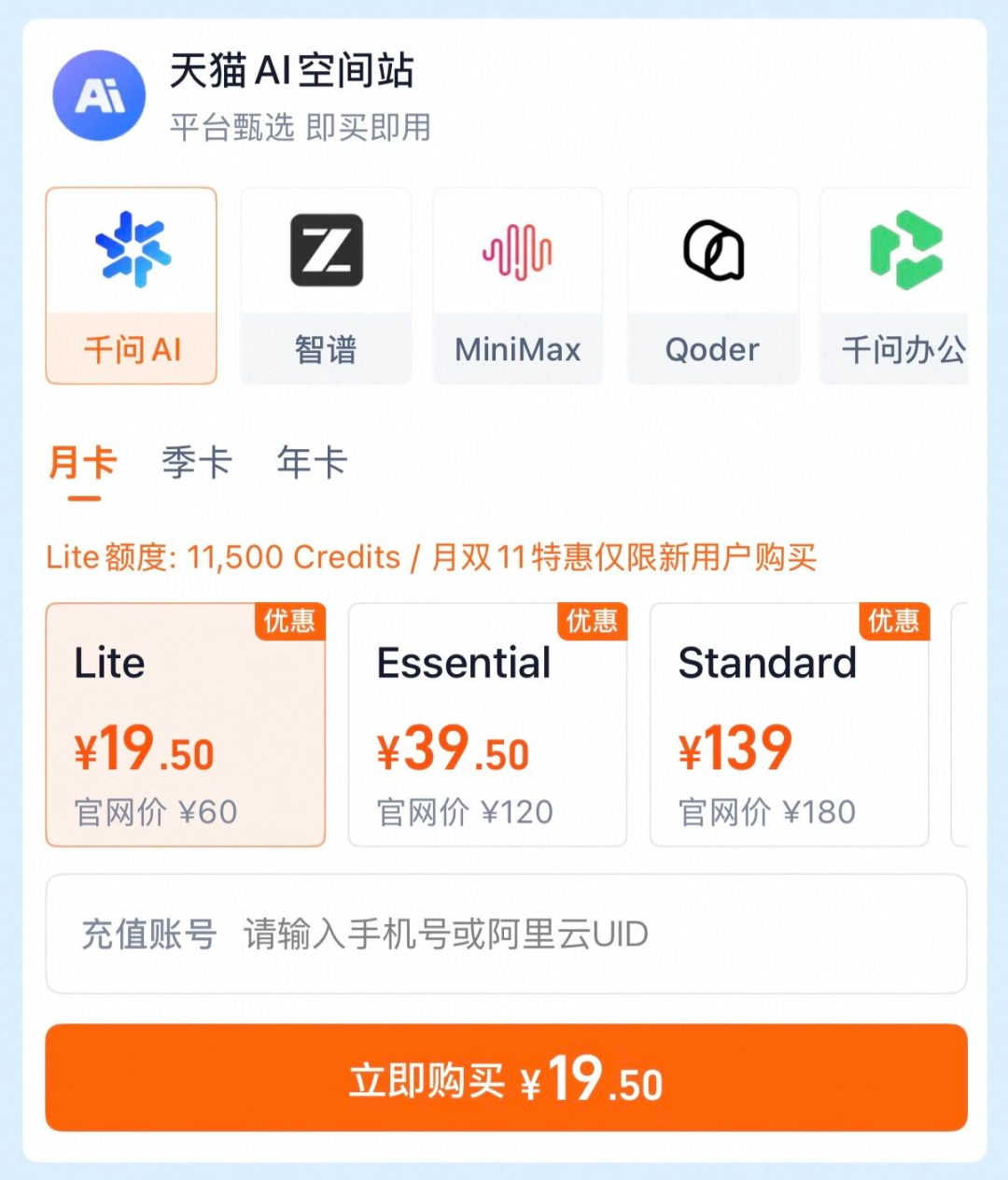
For QwenWork, this is a direct conversion venue to turn user volume into activity and momentum into payments, and it is also the first big test after Chen Yusen took office.
All the Girls, and the One-Cent Monthly Card
Back to the livestream.
Li Jiaqi asked Chen Yusen: "Can you help me make an AI clone to chat with the girls 24 hours a day?" Chen Yusen's answer became the most widely shared clip of the night: "AI cannot replace Li Jiaqi. I more hope to help fans use AI to solve trivial matters, get off work on time, accompany cats and dogs, and take care of family."
This livestream did not start with model parameters, but broke the product down into several concrete things.
Li Jiaqi used QwenWork to generate a globally accessible fishing map supporting multiple users; QwenWork collected public information about assistant Wangwang on social media and generated a work report; parents can use it to organize their children's homework and test papers and create targeted training mini-games.

Li Jiaqi's livestream
Alongside the Tokens, three AI computers with QwenWork built in (Lecoo Air, Machenike Shuguang 16S Youth Edition, Lenovo Zhaoyang Yue Plus), AI recording cards, and desktop robots were also listed, all belonging to the "Tmall QwenWork AI Computer Plan." This Double 11, 70 computer hardware products equipped with QwenWork will make their debut.
This livestream completed an effective translation of demand.
Token, a technical term that originally mainly appeared in developer discussions and subscription pages, was translated into the mass language of "use AI for a month for 1 cent," selling nearly 100,000 monthly cards in half an hour.
The problem is hidden precisely in these nearly 100,000 monthly cards.
Li Jiaqi's traffic ability needs no proof; he is still the undisputed top livestream seller in the current market.
Behind him, the base of "all the girls" shows that the livestream audience is mainly women aged 18 to 35, with students, ordinary white-collar workers, and mothers accounting for a considerable proportion. Their consumption decisions are concentrated in categories such as beauty, snacks, and daily necessities, and they are highly price-sensitive.
So when they encountered AI office and Tokens, it was fresh. In the livestream and in social media clips, many users marveled at the functions of AI office.
But the payment logic of AI office is completely different. The standard personal version of QwenWork is priced at 98 yuan/month, the advanced version at 198 yuan/month, and the enterprise version at 198 yuan/month/seat. For such products to succeed, they rely on users' real daily workflows: writing documents, making spreadsheets, running data analysis, and calling enterprise knowledge bases.
The heavier the use, the greater the token consumption, and the more stable the renewal.
The livestream sales report did not disclose the new customers' previous AI office usage habits, nor can it prove which work tasks they will continuously hand over to QwenWork.
After the one-cent monthly cards expire, how many people will renew or upgrade to full-price plans is still unanswered.
This is the part Li Jiaqi can help Chen Yusen solve: short-term downloads, registrations, and nationwide brand exposure, plus the mind education that "even Li Jiaqi is selling Tokens."
The part he cannot solve is equally clear: monthly active users, retention, continuous token consumption, and deep penetration into enterprise-level scenarios.
Using subsidies to exchange for scale is the playbook most familiar to the previous generation of internet companies.
QuestMobile's judgment on the AI office track is that "the shorter the path, the stronger the stickiness; the lower the decision cost, the higher the usage frequency."
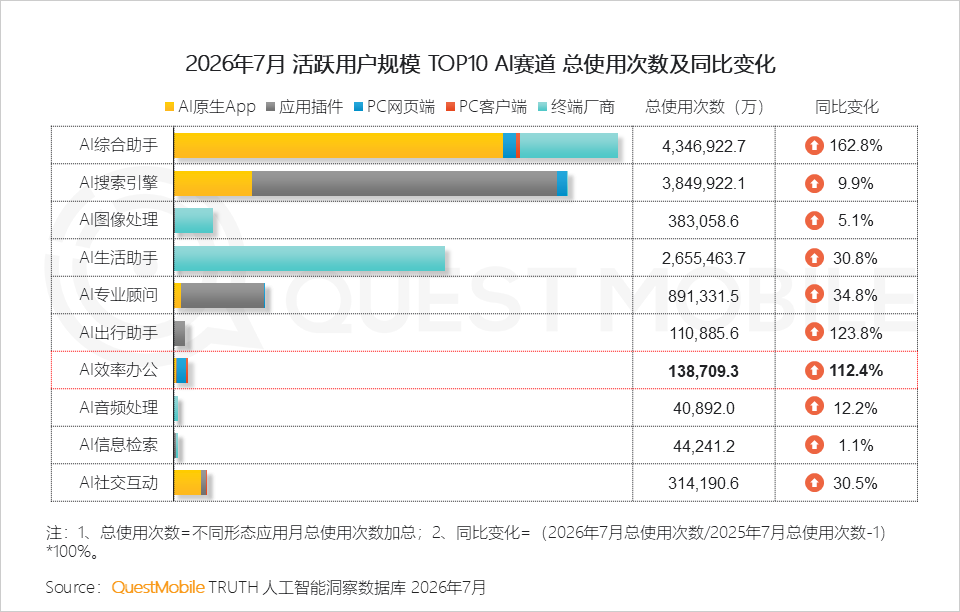
Source: QuestMobile
And the livestream path is precisely the shortest and shallowest one in the entire e-commerce ecosystem. Users click in from the livestream, spend 1 cent, and leave after use.
For AI office, continuous consumption explains product value better than one-time ownership. In between lies a gap from novelty to work habits, which Li Jiaqi cannot cross; only the product itself can cross it.
Tokens on the Shelf
Chen Yusen is not the only one putting Tokens on e-commerce shelves.
On September 2, Zhipu was the first to open an official flagship store on Tmall, selling GLM Coding Plan subscription packages: Lite version 118 yuan/month, Pro version 538 yuan/month, Max version 1,078 yuan/month, and team version 598 yuan/month/seat.
Subsequently, MiniMax, Alibaba Cloud Bailian, Moonshot AI, StepFun and other vendors successively settled in Tmall's "AI Space Station," with Token packages displayed centrally as monthly cards, annual cards, and recharge packs.
QwenWork in the livestream is just the most conspicuous position on this shelf.
Platform data looks lively.
Within 48 hours of Zhipu's settlement, brand search volume increased 50-fold month-on-month, driving Tmall AI Token subscription product transactions to increase by more than 160% month-on-month; Tmall data shows that on October 20, the first day of Double 11 sales, Taobao Token category transaction value surged 450% compared with the previous month. However, the platform did not disclose the absolute transaction base of this round of growth.
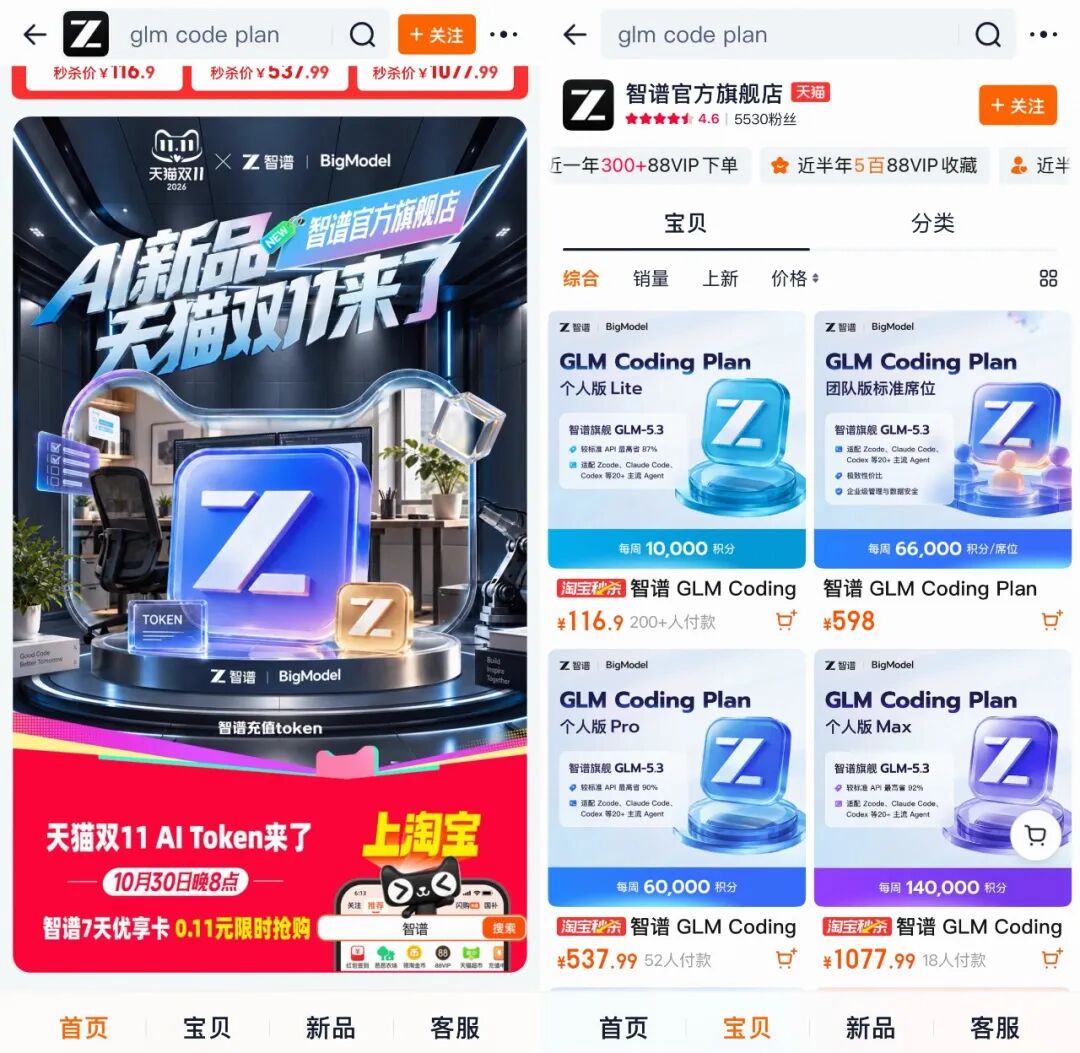
Another set of data is much colder.
In the early days of Zhipu's flagship store opening, the four product pages did not show sales volume; Barron's Hong Kong stock report said that as of September 18, the three personal version packages had cumulatively sold more than 144 units. At least judging from the performance of this store at that time, search heat had not yet been synchronously converted into transaction scale.
The real value of official channels may lie elsewhere.
On e-commerce and second-hand trading platforms, gray industries such as API relay, group buying and sharing, and proxy recharge and proxy invocation have long existed, and the settlement price of some relay services is only about one-tenth of the official price.
China News Weekly reported that a Shanghai relay station operator stated in a shutdown notice that he was criminally detained for 37 days for illegally obtaining API models and later released on bail pending trial; the gray industry chain involved also included account pools and overseas server forwarding. The Ministry of State Security also issued a risk warning in June regarding AI relay stations.
Putting official stores on the shelf is to give "where to buy Tokens" a compliant answer.
From API wholesale to e-commerce retail, Tokens are being packaged into mass commodities similar to data packages.
The quotas of different models and packages cannot yet be simply equated, but consumers can already stock up on a period of AI usage quota during major promotions, just like stocking up on tissues and laundry detergent.
Chaoyong AI Viewpoint
Li Jiaqi can give Chen Yusen nearly 100,000 monthly cards, but cannot give retention rate.
The approximately 2 trillion Token quota corresponding to nearly 100,000 monthly cards is a beautiful sales report. It can let the young but under-pressure group vice president breathe a sigh of relief, but it is only the sales report of a marketing event, not the answer sheet of commercial validation.
The true test for QwenWork is not how many one-cent monthly cards were sold on the night of Double 11, but what happens three months down the line: how many of these new customers remain active, how many Tokens are actually consumed, and whether they are willing to renew at full price.
Chen Yusen's real examination room is not in the livestream.
Qianwen Office's cards are stacked on the enterprise side: DingTalk's existing enterprise customers, the "enterprise context" unveiled at the Yunqi Conference, and capabilities in data security and permission management.
That is a slow path—and one that can accumulate barriers over time.
The livestream is a shortcut, but a shortcut only solves the problem of arrival, not retention.
For Alibaba, the organizational mobilization significance of this livestream may outweigh its commercial significance: it demonstrated to the market the "No. 1 Project's" ability to mobilize group resources, and also flexed muscle in front of Tencent and ByteDance.
But when it comes to the proposition of "Token universalization," nearly 100,000 one-cent monthly cards have only completed the "being seen" stage—they are still far from "being used up."
Whether this user acquisition has translated into business is the key.
Big results are not achieved overnight.
-
![]()
ZTE Rumored to Sell Phone Business at 40 Billion Yuan Valuation, with a Major Internet Company Set to Take Over? Official Response Arrives
-
![]()
Prompt Engineering in Practice: Giving Six AI Characters Distinct Speaking Styles
-
![]()
Xingyu Co., Ltd.'s Q3 Net Profit Falls Nearly 40%: Chinese Automotive Lighting Has Won on Styling, but the Profits Are Gone
-
![]()
More like twins: the growth paths of these two automakers are strikingly similar
-
![]()
Chinese Automakers Go Global: Entering the "Export Quota Competition" Phase
-
![]()
New Energy Vehicle Exports Surge, but Smart Driving Remains an Overseas Weak Spot
-
![]()
"Rush-built cars" face regulatory crackdown
-
![]()
Long Gone From View, These New Forces Are Still Fighting to Come Back