"Rush-built cars" face regulatory crackdown
 11/04 2026
 554
Automakers piling on gimmicks? No longer allowed.
"In martial arts, speed is the only undefeated principle." But this competitive rule from the consumer electronics field does not apply to the automotive manufacturing industry.
Hidden door handles, zero-gravity driving modes, unconventional steering wheels, blue lights for intelligent driving, rotating seats in cars... In recent years, new car iterations have continued to accelerate, and various fancy configurations have emerged in clusters, but many of these innovative designs lack sufficient safety verification, planting hidden safety hazards. Now, the eye-catching "cool" features on many new cars are about to face clear restrictions in certain usage scenarios.
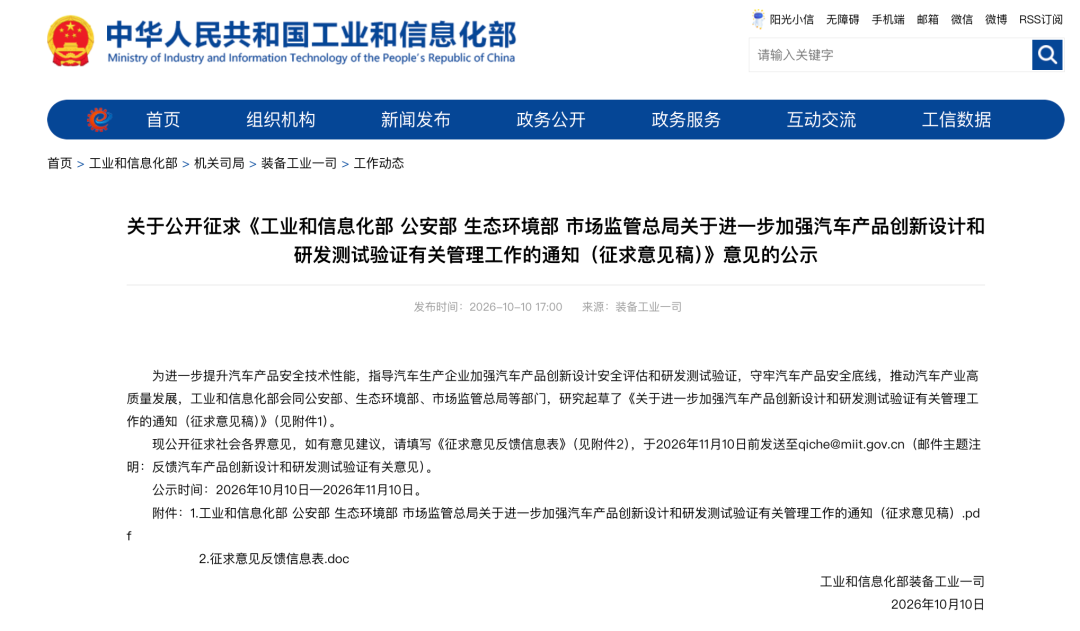
Recently, the Ministry of Industry and Information Technology, the Ministry of Public Security, the Ministry of Ecology and Environment, and the State Administration for Market Regulation jointly issued the Notice on Further Strengthening the Management of Innovative Design and R&D Test Verification of Automotive Products (Draft for Comments) (hereinafter referred to as the "Notice"), clarifying that new cars must complete "two winters and one summer" environmental adaptability testing and at least 30,000 kilometers of reliability verification before launch, prohibit fully hidden door handles, and ban the use of "zero-gravity" seats while driving, among other designs.
After the document was released for public comment, the four ministries immediately convened a symposium with more than 30 mainstream domestic automobile manufacturers, requiring automakers to shoulder their primary responsibilities, hold the bottom line of product safety, and engage in rational market competition.
This draft for comments was released to the public on October 10 and set transitional arrangements: starting from January 1, 2027, newly declared vehicle models must meet all testing requirements; existing models that have already obtained access licenses need to complete verification materials before July 1, 2027, and models with safety hazards that fail to rectify within the deadline will be ordered to stop production and recalled in accordance with the law.
Regulation implemented, filling rule gaps
This "Notice" is not an isolated document. Simultaneously released for public comment alongside it are three other documents: a newly added list of 51 vehicle technical parameter declarations, the Technical Guide for Innovative Design of Automotive Products (hereinafter referred to as the "Guide"), and the Technical Specification for R&D Test Verification of Automotive Products (hereinafter referred to as the "Specification").
The "Guide" clarifies that safety controls such as emergency escape, emergency braking, and drive power cut-off shall retain physical structures and be marked with conspicuous signs; door handle design must verify stability in extreme environments and emergency operability, have mechanical redundancy and hand operation space, and fully hidden door handles that rely entirely on electronic unlocking are prohibited; zero-gravity seats, rotating seats, or functions that recline seats into beds must not be used while driving; central control large screens, large-area displays, and complex head-up displays need to be evaluated for their impact on driving safety, reliability in extreme environments, and subjected to safety assessments such as collision tests.
The "Specification" clearly states: automakers must not directly use test reports provided by suppliers to replace whole-vehicle self-developed verification. High-frequency iterative systems such as intelligent driving and intelligent cockpits must complete real-vehicle testing in extreme scenarios. Regarding the OTA (over-the-air upgrade) iterative optimization model commonly adopted in the industry, automakers must conduct sufficient testing and verification, and subsequent software upgrades cannot make up for the lack of prior R&D verification. All original test verification records, reports, ledgers, and other materials must be retained for no less than six years to support regulatory authorities' production consistency verification and traceability investigations.
From document publication to enterprise symposiums, the pace of advancement has been rapid. On October 15, the four ministries organized a symposium with more than 30 mainstream domestic automakers to interpret the new regulations and report on common industry problems found in previous supervision and inspections: some enterprises follow trends in launching new products, substitute simulation for real-vehicle testing, insufficient consistency between submitted sample vehicles and mass production, and blur the boundary between assisted driving and autonomous driving in publicity. The meeting required enterprises to fulfill their primary responsibilities and resist irrational competition.
On October 20, Wang Weiming, chief engineer of the Ministry of Industry and Information Technology, clearly stated at a press conference of the State Council Information Office that the current domestic automotive industry is active in innovation and product iteration has significantly accelerated, but "problems have indeed emerged, such as some enterprises following trends in launching new products and insufficient test verification." He explicitly emphasized that safety is the lifeline of automobile enterprises, and no R&D innovation can come at the expense of safety. Regulatory authorities will resolutely prevent unreasonable innovative designs and products without sufficient R&D test verification from entering the market.
In addition to tightening whole-vehicle access and R&D testing rules, supporting mandatory national standards have also been launched for revision simultaneously, further filling the regulatory gaps for smart cars. On the same day, the Ministry of Industry and Information Technology publicly solicited comments on five mandatory national standards, including the Automotive Data Security Requirements and the Installation Requirements for External Lighting and Light-Signaling Devices of Motor Vehicles and Trailers. Among them, new rules were set for autonomous driving identification lights: only vehicles equipped with L3-level and above autonomous driving systems are allowed to be equipped with blue-green ADS autonomous driving dedicated signal lights, thoroughly rectifying the current chaos of excessive use of intelligent driving blue lights on a large number of L2 assisted driving models; the new standard is planned to be officially implemented from January 1, 2028 (currently still in the public comment stage).
From product access rules and technical parameter lists to mandatory national standard revisions, a whole set of regulatory combination punches targeting "rush-built cars" is building a solid safety boundary for the rapidly expanding automotive industry.
Full-chain tightening, bidding farewell to the rush-build model
In the past few years, the pace of new car releases has become increasingly similar to consumer electronics.
The traditional whole-vehicle development cycle is generally 36–48 months, including the full-process testing of project initiation and trial production, extreme environment road testing, and whole-vehicle durability verification. However, after improvements in the modularization of electrification platforms and software iteration capabilities, some enterprises have compressed this cycle to 18 to 24 months, with some models even shorter. A shortcut has emerged in the industry: launch hardware first and rely on OTA remote upgrades later to patch defects.
But cars are by no means mobile phones. Hardware structural fatigue, door handles freezing and jamming, anti-pinch failure of electric suction doors, battery and domain controller degradation under high and low temperatures, and seat belt restraint failure after seats are reclined—these are underlying problems that remote upgrades cannot cover, and consumers are invisibly playing the role of "long-term testers."
At the same time, disorder on the marketing side further amplifies risks. Some automakers deliberately blur the boundary between assisted driving and autonomous driving in communication, demonstrate functions in scenarios that violate traffic regulations such as hands off the steering wheel, and induce users to underestimate driving risks. In response, the "Notice" explicitly prohibits false and exaggerated publicity, prohibits demonstrating functions in illegal scenarios, and prohibits weakening the driver's safety responsibility.
Standard upgrades bring different impacts to different automakers. Leading whole-vehicle enterprises with complete R&D verification systems have internal processes basically aligned with the new regulations, with low marginal compliance costs, and instead benefit from reduced price pressure from "semi-finished" models due to raised thresholds. However, small and medium-sized enterprises that rely on rapid supply chain integration and have weak verification capabilities face greater pressure. The 30,000-kilometer reliability test, the one-year "two winters and one summer" environmental adaptability verification, and the six-year ledger retention requirement mean that enterprises must establish or purchase corresponding testing capabilities, which will directly push up per-vehicle R&D costs and lengthen the launch cycle of new models.
Technological innovation can accelerate, but test verification cannot be cut corners. True industrial competitiveness does not lie in how fast new cars are released or how flashy the configurations are, but in the stability, safety, and reliability of vehicles during long-term use. Today, China's automotive industry ranks first in the world in scale, new energy vehicle exports maintain high-speed growth, and the advantages of the electrification and intelligentization industrial chain are significant. As a large number of domestically produced cars go global, the bottom line of product safety is directly related to the long-term international reputation of Chinese brands. In this sense, regulation setting red lines for "rush-built cars" is not restricting innovation, but pulling industry competition back from "competing on launch speed" to the benign track of "competing on whole-vehicle reliability."
-
![]()
ZTE Rumored to Sell Phone Business at 40 Billion Yuan Valuation, with a Major Internet Company Set to Take Over? Official Response Arrives
-
![]()
Prompt Engineering in Practice: Giving Six AI Characters Distinct Speaking Styles
-
![]()
Xingyu Co., Ltd.'s Q3 Net Profit Falls Nearly 40%: Chinese Automotive Lighting Has Won on Styling, but the Profits Are Gone
-
![]()
More like twins: the growth paths of these two automakers are strikingly similar
-
![]()
Chinese Automakers Go Global: Entering the "Export Quota Competition" Phase
-
![]()
New Energy Vehicle Exports Surge, but Smart Driving Remains an Overseas Weak Spot
-
![]()
"Rush-built cars" face regulatory crackdown
-
![]()
Long Gone From View, These New Forces Are Still Fighting to Come Back