Chinese Automakers Go Global: Entering the "Export Quota Competition" Phase
 11/04 2026
 341
According to Cailianshe, citing multiple people familiar with the matter, several domestic automakers recently traveled to Beijing to negotiate with relevant departments over the allocation of hybrid vehicle export quotas to the EU. "The total is limited, and no company will get a very large share. Everyone is fighting to secure more," one person familiar with the matter said.
The first half of this negotiation took place at the second meeting of the China-EU Trade and Investment Consultation Mechanism on October 8–9. China and the EU reached an understanding on hybrid vehicle trade consistent with WTO rules; on October 12, the Ministry of Commerce confirmed that the quota would be "arranged upward" from the 2025 baseline of 302,000 Chinese hybrid vehicles exported to Europe, ensuring Chinese companies' export space and stable growth.
The key change lies in the nature of the rules: additional tariffs are a price issue—each exported vehicle incurs an extra tax that can be absorbed through profit margins. Quotas are an export volume issue—vehicles exceeding the quota cannot enter the EU no matter how cheap they are.
Therefore, when China and the EU reached a "quota-based" arrangement on hybrid vehicles, the first layer of competition for Chinese automakers going global shifted from who has lower costs to who can secure quotas. And country-specific quotas, once allocated to China, require secondary distribution—which is why automakers collectively went to Beijing.
It should be noted that the specific first-year quota figures, annual increment rates, local assembly exemption rules, and other details remain industry estimates and media disclosures; the official allocation plan has not yet been made public.
Automakers are also building localized production capacity in Europe
Quotas govern the act of "exporting from China," while vehicles produced locally in the EU do not count toward quotas. This provision has directly pushed Chinese automakers' European factory construction pace forward by a big step. Since 2026, mainstream automakers have been rolling out simultaneously through three paths: self-built, joint venture, and contract manufacturing.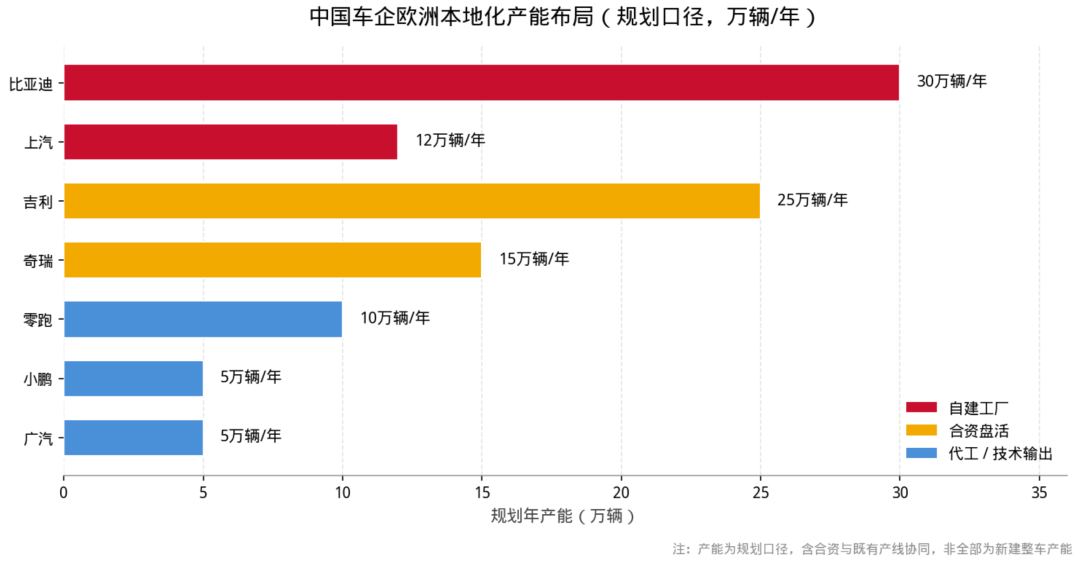
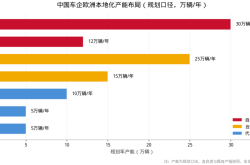
From a planning perspective, BYD (300,000 units/year) and Geely (250,000 units/year) form the first tier and are currently the only two automakers with "hundred-thousand-level" independent production capacity plans in Europe; Chery (150,000 units/year) is quickly filling the gap by revitalizing Nissan's Barcelona plant through a joint venture; Leapmotor, XPeng, and GAC are taking the contract manufacturing and technology export route, entering with lighter assets.
The difference among the three paths is not cost but speed. Self-built capacity is heavy and long-cycle but fully autonomous; joint ventures revitalizing idle factories can compress the production ramp-up cycle to within two years; contract manufacturing requires almost zero upfront investment, but capacity control is not in one's own hands. Once quotas tighten, the bargaining disadvantage of the third path will be amplified.
According to progress announced by automakers, by the end of 2025 Chery's EBRO had already begun mass production in Barcelona; in Q4 2026, BYD's Szeged plant will start trial production and Leapmotor's Zaragoza plant will begin mass production; in 2027, Geely's Valencia plant will operate; and in 2028, SAIC's Galicia plant will start production. Clearly, 2026 to 2028 is precisely the window for Chinese automakers' overseas factories to be concentrated into operation.
The urgency of this window comes from quotas. Local factories take two to three years to become operational, while quota rules could be implemented at any time; if factory construction only starts now, it will most likely miss the first round of production switching. This is also why Geely and BYD are simultaneously accelerating multiple projects in 2026—they are competing not just for capacity, but for the time gap before the quota era arrives.
Market restructuring in the quota era
In the past, the bottlenecks Chinese automakers encountered going global were mainly production capacity, certification, and channels; now there is an additional layer of administrative resources. Under a framework of limited total quotas, automakers will prioritize high-margin hybrid models after securing quotas, rather than pursuing export volume.
If quota allocation references historical export scale, localization investment, and compliance capability, the moats of first-mover automakers will deepen further. Companies such as BYD, Geely, Chery, and SAIC that already have real production capacity in Europe will clearly have more room to maneuver; smaller automakers that cannot secure sufficient quotas may be forced to turn to "borrowing ships to go to sea" or wait for local factories to begin production.
The deeper change in this round of European deployment is that Chinese automakers are no longer just selling cars.
Leapmotor is exporting electric drive and software architecture to Stellantis, GAC is building a local design center in Milan, and CATL is supporting a 100GWh battery base in Hungary—China's technology, supply chains, and R&D systems are all going over together.
From "tariff confrontation" to "quota negotiation" and then to "local factory construction," China-EU automotive trade is completing a rules upgrade. Going to Beijing to compete for quotas is about securing tickets to the European market for the coming years; and those factories building cars locally in Europe will determine who can still stay at the table after those tickets expire.
-
![]()
ZTE Rumored to Sell Phone Business at 40 Billion Yuan Valuation, with a Major Internet Company Set to Take Over? Official Response Arrives
-
![]()
Prompt Engineering in Practice: Giving Six AI Characters Distinct Speaking Styles
-
![]()
Xingyu Co., Ltd.'s Q3 Net Profit Falls Nearly 40%: Chinese Automotive Lighting Has Won on Styling, but the Profits Are Gone
-
![]()
More like twins: the growth paths of these two automakers are strikingly similar
-
![]()
Chinese Automakers Go Global: Entering the "Export Quota Competition" Phase
-
![]()
New Energy Vehicle Exports Surge, but Smart Driving Remains an Overseas Weak Spot
-
![]()
"Rush-built cars" face regulatory crackdown
-
![]()
Long Gone From View, These New Forces Are Still Fighting to Come Back