It's Not That Robin Isn't Trying Hard
 11/09 2026
 358
Text/Liu Yong
Editor/Zhang Xiao
"We are confident in accelerating AI iteration and bringing Ernie back to the first tier of foundation large models."
In August this year, on Baidu's second-quarter earnings conference call, when discussing the Ernie large model, Baidu founder Robin Li made this statement.
For Baidu, and for Robin, "returning to the first tier" is not an easy thing to say—
especially for a tech company like Baidu that began laying out AI more than a decade ago, was among the first movers in the early days of the generative AI wave, and at one point stood at the forefront and led the pack. Admitting that it is no longer leading and needs to catch up is itself meaningful.
To some extent, this also reinforces the outside impression that Baidu always "gets up early but arrives late."
Of course, you can't say Baidu's AI is doing too badly. In the second quarter, its core AI business revenue reached 12.5 billion yuan, up 25% year on year, of which AI cloud infrastructure revenue grew 50%.
But Baidu is clearly encountering more and more phased challenges.
The search entrance that once occupied an important position is facing continuous competition for user attention from short videos, social and content platforms; traditional advertising business is under pressure, and Baidu has to look for new growth engines. In the second quarter of 2026, Baidu's online marketing services revenue fell 19% year on year, and Baidu's general business revenue fell 4% year on year.
On the AI application side, Baidu continues to be weak. Second-quarter AI application revenue was "only" 2.5 billion yuan, up 3% year on year.
Baidu's decline on the AI application side seems to show no obvious signs of improvement.
In September, ByteDance's Doubao monthly active users already exceeded 400 million, and second-place Qwen had 158 million. As for Baidu's AI assistant Ernie Bot, it wasn't even included in the statistics; among the top ten AI native applications by monthly active users in the same period, Baidu only barely held tenth place with Baidu Dazi, with 8.49 million monthly active users.
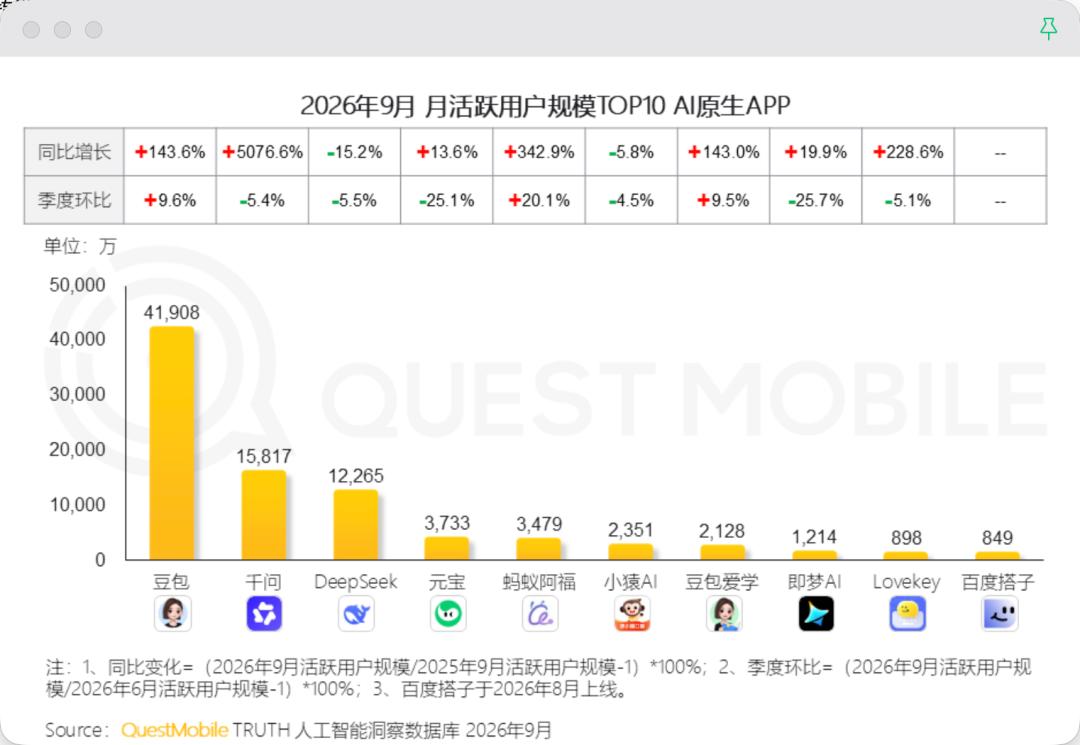
Chart/QuestMobile
But at this stage, Baidu Dazi also cannot help Baidu win more in the AI office track. Tencent's Workboddy, Alibaba's Qwen Office, and ByteDance's "Doubao Work" each have greater momentum than it.
Looking back, to some extent this is the awkward situation Baidu has repeatedly faced over the past few years: it often sees trends early, but may not always be able to turn first-mover advantages into market advantages. The same is true for large models, and the same is true for AI applications.
It's not that Robin isn't trying hard.
Over the past two or three years, perhaps no one has wanted to do AI applications well more than Robin Li. He has repeatedly and foresightedly said not to focus on models, not to focus on models, but to focus on applications. Unfortunately, the subordinates leading the troops may have limited capabilities and did not fully carry out the boss's will.
Robin is still promptly adjusting the direction of Baidu, this big ship.
Over the past year, changes at Baidu have begun to become dense. From adjustments to the foundation model R&D system to the redivision of business in the intelligent cloud business group; from adjustments to the Baidu App product and R&D teams to the rotation of the head of Xiaodu Technology, and then to the departure of multiple executives and the continuous upgrading of AI products, Baidu seems to be reorganizing its organizational and business relationships in the AI era.
These changes point to the same question: as AI competition enters a new stage, can Baidu regain its rhythm through organizational adjustments? Having gotten up early, can Baidu avoid arriving late again this time?
01 Sorting out the battlefield, adjusting the structure, changing generals—Baidu is still looking for its rhythm
In July last year, in an internal speech titled "Seeking Truth and Being Pragmatic," Robin Li reflected on Baidu's development over the past few years.
Robin Li mentioned that not all games are ones Baidu can play or win. Companies need to figure out what they should do and should not do, and proactively reduce the directions in which they put effort.
Behind Robin's statement, Baidu does not lack sensitivity to new technologies and new trends. From the mobile internet to artificial intelligence, from autonomous driving to large models, Baidu is often an early player. But in many tracks, first-mover investment has not naturally translated into a leading market position.
As we said above, in the AI era, this old problem has clearly appeared again.
So we have seen that over the past nearly a year, Baidu has entered a period of intensive organizational restructuring, trying to regain its rhythm.

In November 2025, Baidu newly established the Foundation Model R&D Department (BMU) and the Application Model R&D Department (AMU), headed by Wu Tian and Jia Lei respectively, with both departments reporting directly to Robin Li. Baidu's idea at the time was "separate advances and coordinated attacks": on one hand strengthen general foundation model R&D, and on the other explore specialized models around business scenarios.
But this structure did not last long. In May this year, Wu Tian no longer served as head of the Foundation Model R&D Department and subsequently became deputy director of Baidu Research; in July, Sun Tianxiang, who had participated in the R&D of large models such as MOSS, joined Baidu, took over as head of BMU, and entered Baidu's model committee.
Then on October 29, just past, Baidu confirmed that Wu Tian had left and ended her tenure at Baidu. In just one year, the foundation model R&D system experienced changes from splitting, adjusting heads, to a new manager taking over.
Changes also occurred in the Intelligent Cloud Business Group (ACG).
In August 2026, Baidu Intelligent Cloud completed a round of product and R&D organizational adjustments: the former Platform Product Business Unit was renamed the Agent Business Unit, and the MaaS business, Qianfan brand and related product systems were transferred to the Infrastructure Business Unit; the former Application Product Business Unit was renamed the Intelligent Application Business Unit. After the adjustment, ACG formed three major business units: Infrastructure, Agent, and Intelligent Applications, headed by Hou Zhenyu, Yin Dawei and Ruan Yu respectively, all reporting to Shen Dou.
The core of this round of adjustment was to redraw the boundaries of the AI cloud business. The Infrastructure Business Unit is responsible for AI Infra and Agent Infra, the Agent Business Unit focuses on Agent products such as Baidu Dazi, Miaoda, and Famou, and the Intelligent Application Business Unit takes on Baidu Yijian, Hogee, and industry applications in transportation, finance and other sectors.
In other words, at that time Baidu tried to split underlying computing power and platform capabilities, agent products, and industry-oriented application delivery more clearly, so that different businesses could each focus.
However, two months later, ACG underwent another round of adjustment. Related businesses of the former Intelligent Application Business Unit were transferred according to their attributes to the Infrastructure Business Unit, the Agent Business Unit, and the Service Delivery and Quality Engineering Center, with the latter renamed the Industry Application and Technology Service Center.
Baidu responded that this adjustment is organizational evolution oriented toward the AI era. In the future, ACG will form a two-layer structure of "infrastructure and agents," focusing on the two core battlefields of AI cloud and agents. At the same time, Ruan Yu rotated to serve as organizational head of Xiaodu Technology, continuing to report to Shen Dou.
From three major business units to a two-layer structure, ACG's organizational boundaries contracted again in a short period. Rather than saying this is a simple department renaming, it is more accurate to say that Baidu is rejudging which businesses should be placed together and which capabilities should become independent product directions.
In particular, Ruan Yu's move from the Intelligent Application Business Unit to Xiaodu Technology further strengthened the organizational connection between Xiaodu and the intelligent cloud system. However, the rotation itself cannot explain Xiaodu's specific future business positioning; the real changes will depend on how products and resources are reconfigured.
Similar changes are also taking place in the mobile ecosystem.
In March this year, Baidu merged its PC and mobile search businesses and newly established the Baidu App R&D Center and the Experience and Quality Assurance Center. Subsequently, Zhao Shiqi, former head of the Baidu App R&D Center, left for personal reasons, and He Jingzhou from the former Foundation Model R&D Department rotated to serve as organizational head of the center, reporting to Luo Rong.
Behind this round of executive changes, what Baidu wants to ease is actually the growth pressure on Baidu App. In the second quarter, Baidu App's monthly active users were 644 million, but it has been continuously declining, down 91 million year on year and down 11 million quarter on quarter.
Jiemian News previously reported that since last year, Baidu has been exploring a revamp of its search product. A person close to Baidu said the core idea is to integrate large models with search to improve user experience.

But from Zhao Shiqi to He Jingzhou, the change of heads to some extent also means that this process has not been smooth.
Media reports said that Zhao Shiqi carried out the biggest revamp of Baidu Search's product form in 10 years, but before his ideas for the content ecosystem and services could be implemented, he left.
At the end of last month, He Jingzhou delivered an answer sheet. In Baidu App's new round of product upgrades, upgrades were made around directions such as the search box, AI camera, GUI visualization, and AI interactive applications, claiming that "search is naturally the Personal Agent that understands you best."
Of course, whether these changes are effective remains to be seen.
02 The dilemma of AI applications: Is the only bright spot the one given by Shen Dou?
If the adjustment of the model R&D system reflects that Baidu is re-finding the rhythm of technological competition, then at the application level, the problem Baidu faces is more direct:
It does not lack AI products, but it always needs to prove that it can turn technological accumulation into applications with real market influence.
This was once the direction Robin Li valued most. Baidu proposed "don't focus on models, focus on applications" in the early days of the large model wave, and has a large number of business scenarios such as search, Wenku, Wangpan, and maps.
In theory, these businesses have both a user base and accumulated data and service capabilities, and should become Baidu's natural advantage in developing AI applications. But from actual performance, Baidu's product layout has so far not formed a clear market perception.
Ernie Assistant is almost certainly defeated, so there's no need to waste too many words on it.
Focus on the AI office track. Over the past year, Baidu has gradually formed two relatively independent product lines in the AI office field.

One comes from the Intelligent Cloud Business Group ACG, headed by Shen Dou. Products such as Baidu Dazi, Miaoda, and Famou are being integrated into the product matrix of the Agent Business Unit.
Among them, Baidu Dazi is positioned as a general agent entrance, attempting to help users complete the full task from information retrieval, analysis and judgment to content production and final delivery by invoking different professional capabilities; Miaoda provides application development capabilities, and Famou targets professional scenarios such as enterprise business decision-making. At the end of October, Baidu merged the Miaoda operations team into Baidu Dazi, and Miaoda was integrated as a vertical application development workbench, further strengthening synergy among products.
The other comes from the Personal Super Intelligent Business Group (PSIG).
In January this year, Baidu integrated Wenku and Wangpan into a new business group, headed by Wang Ying, reporting directly to Robin Li. In April, Baidu Wenku and Baidu Wangpan jointly released GenFlow 4.0 and upgraded Office Agent, attempting to integrate capabilities originally scattered across documents, spreadsheets, PPT and Wangpan into an AI workbench capable of invoking multiple Agents. In August, Baidu also officially announced GenFlow's Chinese name Kuku AI.
The differences between these two product lines actually correspond to Baidu's two understandings of AI office: Baidu Dazi emphasizes the task execution and cross-tool collaboration of a general agent, while Kuku AI relies on the existing users and content assets of Wenku and Wangpan to extend into office and learning scenarios.
The former hopes to become the entrance for users to complete tasks, and the latter hopes to upgrade existing office tools into an AI workbench.
But a rich product matrix does not mean Baidu has established application advantages.
After its official debut in March this year, Baidu Dazi has actually maintained rapid product iteration and seems to have some impressive performance. Baidu disclosed at its August launch event that its average daily questions had increased 60-fold from the initial launch period; data from the AI Product List desktop ranking show that Baidu Dazi's monthly active users in July 2026 reached 6.743 million, up 1063.79% quarter on quarter.
By September, in QuestMobile's statistics on multi-terminal monthly active users of typical office Agents, Baidu Dazi reached 9.77 million, up 1567.5% quarter on quarter, ranking first in growth on the list.
The growth rate is certainly impressive, but the scale gap is equally hard to ignore—by September, WorkBuddy's multi-platform monthly active users had already reached 32.353 million.
In October this year, Baidu Dazi sharpened its business focus on enterprise production and operations. Baidu disclosed that its enterprise customer count grew 83% quarter over quarter, while demand for deliverables surged 4.3-fold over the same period.
This is precisely the differentiation Baidu Dazi is striving to carve out against other AI office products: it doesn't just answer questions—it plugs into enterprises' existing workflows to help users actually get things done. For Baidu, with Baidu Intelligent Cloud, its MaaS platform, and industry customer resources behind it, this approach has a solid foundation for business synergy.
But whether that's enough to count as differentiation is debatable. It's already 2026, and talk of Agents entering enterprise scenarios has become tiresome to the ear.
From this vantage point, whether it can become Baidu's next growth pillar is clearly no easy feat.
Granted, this is already one of the few impressive products Baidu has rolled out on the application side—but a general picked from among dwarfs is still a general.
03 It's Not That Robin Isn't Trying
From the split of the Foundation Model R&D Department and the Application Model R&D Department, to the Intelligent Cloud Business Group's contraction from three major business units down to two core directions—infrastructure and agents—and then to the integration of Wenku and Wangpan into the Personal Super Intelligent Business Group, Baidu is clearly attempting to reorganize technologies, products, and resources that were previously scattered across different business lines.
At the same time, Baidu Dazi is integrating product capabilities such as Miaoda, and the organizational ties between Xiaodu and the intelligent cloud system have been further strengthened.
Behind these moves lies Baidu's reassessment of how the AI competition will unfold.
In the past, Baidu's AI layout had a distinct characteristic: numerous investment directions and extremely broad coverage of business scenarios. From large models and autonomous driving to intelligent cloud and intelligent hardware, from search and Wenku to Wangpan, Baidu had a presence in virtually every AI-related direction.
Such a layout made sense during the technology exploration phase, but once AI competition enters the stage of product implementation and commercialization, the problems of scattered resources and complex organizational coordination gradually surface.
This is especially true for a company that still relies on traditional businesses for cash flow. AI investment cannot be judged solely by technological reserves and the number of products—it must also answer which businesses can build competitive moats, which products are worth continued investment, and which directions should be appropriately scaled back.
Baidu's current organizational adjustment, then, is less a simple redrawing of business departments than an attempt to establish a clearer resource allocation mechanism—underlying model R&D needs focus, AI Cloud needs clear core business boundaries, agent products need to develop independent product capabilities, and mature businesses like Baidu Wenku and Baidu Netdisk need to find new growth space through integration.
But organizational focus is only the first step. For Baidu, the bigger test lies in how to create genuinely effective synergy across different businesses.

This is also why the intelligent cloud system led by Shen Dou deserves attention.
Compared with AI assistants that mainly target individual users, Baidu AI Cloud has relatively clear commercial customers and business scenarios. When enterprises purchase AI services, they are often not looking to try out a new tool but hoping to solve specific problems in R&D, production, marketing, management, and other areas.
Baidu's accumulation in cloud infrastructure, model services, and industry solutions can theoretically form a complete chain from underlying technology to application delivery. Baidu Dazi's extension into enterprise production and operation scenarios is likewise an attempt to embed agent capabilities into real workflows.
That said, this is clearly not an easier path.
Enterprise AI projects often involve complex system integration, data security, business process transformation, and ongoing operations and maintenance. Moving products from customized delivery for individual customers to standardized replication requires a long process.
Revenue growth in Baidu AI Cloud also cannot be directly equated with the agent business having proven its business model. The rapid growth of AI cloud infrastructure shows there is market demand for computing power and cloud services; but whether agent products can bring higher average transaction values, better renewal rates, and sustainable profit contributions still requires more operating data for verification.
This is also the key question Baidu Dazi will need to face next: can it truly evolve from a fast-growing AI product into a productivity tool that enterprises are willing to pay for continuously?
Finally, Baidu cannot afford to ignore competition for the consumer entry point.
The Baidu App still has a massive user base. For a company that started with search, the search entry point is both an important asset of its traditional business and a key channel for AI applications to reach users. Baidu's recent upgrade of the App attempts to extend search from "one question, one answer" to "one task, one delivery," and introduces capabilities such as AI camera and GUI—in effect redefining the boundaries of the search product.
But the value of the search entry point will not automatically endure just because AI features have been added. Whether users are willing to entrust more tasks to the Baidu App, whether usage frequency will increase because of AI capabilities, and whether advertising and service revenue can find a new balance—all these need to be answered by product experience and market data.
Baidu's past traffic advantages are certainly important, but in the new competitive environment, the entry point itself does not equal a moat; only products that can continuously meet user needs do.
In summary, Robin is not slacking off, and Baidu is not without effort.
It's just that competition in the AI era has long entered a more brutal stage, and the market will not automatically reward a company simply because it entered early, invested heavily, and adjusted frequently.
Header image / Baidu official website
-
![]()
TV Distortion vs. Optical Distortion: How Exactly Do You Convert Between Them?
-
Analysys: China's GEO Service Provider Market Reached Approximately RMB 2.2 Billion in Q3 2026, with Industry Competition Accelerating Toward Comprehensive Service Capabilities
-
![]()
It's Not That Robin Isn't Trying Hard
-
![]()
Analysis of AI Industry Development in Key Cities of the Yangtze River Delta
-
![]()
Media Reports: Maserati to Partner with Zunjie — JAC to Manufacture, Huawei to Provide Tech Support
-
![]()
Can Opponents Hit the Pause Button? Has China's AI Window of Opportunity Opened?
-
![]()
All Models Feature a Rear Screen! Honor 700 Series Delivers Uncompromised Battery Life: 7.96mm Thin with the Largest Battery in Its Class
-
![]()
Thailand Begins to Settle Old Scores with Chinese Automakers