Thailand Begins to Settle Old Scores with Chinese Automakers
 11/09 2026
 556
Produced by I Xiaohai fallsea
Written by I Hu Buzhi
July 2025, Srinakarin Road, Bangkok. At a Neta Auto showroom, most of the lights and air conditioning are off, and in the empty lot out front, new cars sit plastered with liquidation prices cut in half. In 2024, the brand sold 7,969 vehicles in Thailand's pure electric market, holding an 11.4% share; now its dealer network has shrunk from more than 60 to about 20, and 18 of them have jointly taken the manufacturer to court.
Half a year later, what they got was a clawback claim of more than 2 billion Thai baht. Thailand's Ministry of Finance launched proceedings in January 2026 to recover subsidies granted to Neta since 2022. The money had already been paid out, and the factory had been built on Thai soil, but the accounts did not add up: more than half of the cars promised to be produced in Thailand had not been produced.
This is not just Neta's story. Rewind a few months, and Chinese automakers in Thailand had just reached a historic peak.
Surge to the Top
In January 2026, Chinese brands' share of Thailand's pure electric market surged to 47.3%, surpassing Japanese brands for the first time in history. That month, 45,668 pure electric vehicles were registered, up 210.4% year-on-year—a buying rush ahead of the phased reduction of purchase subsidies, which the industry called the last train. BYD sold 12,800 vehicles in a single month, with the Atto 3 and Dolphin filling the streets of Bangkok.
The tide receded faster than it rose. In February, Chinese brands' share fell to 11.6%–12%, and BYD was left with only 295 vehicles for the month, down 97.7% from January; in March it climbed back above 2,000 vehicles, but the January height was never reached again.
The buying rush explains one month, but not the four-year climb before it. From 2020 to 2025, Chinese automakers' overall market share in Thailand rose from 3.2% to 21.2%; by 2026, they had captured about 85% of Thailand's electric vehicle market—four years earlier, that figure had been close to zero. Japanese brands are retreating: Subaru and Suzuki closed their Thai factories in 2024 and 2025 respectively, and Nissan and Honda cut output. In the first seven months of 2026, electric vehicles accounted for about one-third of Thailand's new car sales, of which two-thirds were imported vehicles. Supavud Saicheua, chairman of Thailand's National Economic and Social Development Council, told The New York Times: "It happened much faster than we expected."
The market grew even faster than market share. According to PwC, in the first half of 2026, Thailand's hybrid and pure electric vehicle sales totaled 206,000 units, up 47% year-on-year, with penetration rising from 32% in the first half of 2024 to 53%; PwC also noted that Chinese automakers' share in the six ASEAN countries rose from about 11% in 2025 to 16%. Everyone worked together to make the cake bigger, but the bulk of the growth went to Chinese brands.
Winning too fast is the foreshadowing of all the reversals in this story. The reversal did not start with tariffs; it started with a contract signed three years earlier.
Two Fates
On December 28, 2023, Thailand's Excise Department announced EV3.5. On the surface, it was a concession: purchase subsidies of up to 100,000 Thai baht, import tariff reductions of up to 40%, and excise tax cut from 8% to 2%. The consideration was written into the same document: starting in 2026, for every 1 vehicle imported, 2 must be produced in Thailand; starting in 2027, 1:3. The conversion ratio for imported battery cells tightened all the way—before the end of June 2026, at most 10% of the factory price could be counted toward the local procurement rate; from July onward, it dropped to zero, and to get the incentives, you had to buy Thai-made battery cells.
This contract did not become stricter out of thin air. Its predecessor, EV3.0, also carried production commitments, but with looser ratios: 1:1 in 2024, 1:1.5 in 2025. By EV3.5, the ratio rose to 1:2, and the subsequent 1:3 was about to double—Neta's arrears from 2024 onward were incurred under the old ratios, and the new contract settled the old accounts along with the new.
When the contract was signed, Thailand wanted to become an electric vehicle manufacturing base. Chinese automakers lined up to enter: by September 2026, 7 Chinese automakers had built factories in Thailand, with cumulative investment exceeding US$3 billion and planned total annual capacity exceeding 600,000 vehicles. Over two years, the two phases of the policy registered 238,000 vehicles in total, with industrial investment of 140 billion Thai baht. The money and the cars were in place; the problem lay in the accounts.
The same contract, two fates.
Neta was the one that did not catch up. Its production target in Thailand was about 19,000 vehicles for 2025; by mid-2025, actual output was about 4,000 vehicles, a completion rate of less than 25%. In June 2025, it was stripped of its EV3.0 subsidy eligibility, and about 400 million Thai baht in remaining subsidies was frozen; in January 2026, the Ministry of Finance launched a clawback claim of more than 2 billion Thai baht, about 440 million yuan. According to Nikkei's cumulative figures, Neta received nearly US$84 million in subsidies in total—including the frozen and undisbursed portion, this account matches the more than 2 billion Thai baht claimed by the Ministry of Finance. The lights and air conditioning turned off in the showroom were the overdue notice of this contract.
Wuling in Indonesia was the one that caught up. The Bingo's measured local content was 47.5%, verified by a third-party institution, exceeding Indonesia's current 40% threshold and unlocking the value-added tax reduction: of the 11% VAT, the government bears 10 percentage points for consumers, so they can drive the car away by paying just 1%. But open this account—the battery production line Wuling put into operation at the end of 2024, with an investment of 40 million yuan, does battery pack assembly: cell stacking, laser welding, charge-discharge testing, five processes, none of which makes battery cells.
For those who meet the standard, the ceiling of localization is assembly.
Behind the numbers are ordinary people. Nisana, a female worker at a parts factory in Toyota's supply chain, earned US$440 a month; the factory went bankrupt and closed in 2024, and about 900 workers did not receive severance pay. Now she shelves products at a supermarket, earning US$11 a day. "To be honest, we thought that day was still far away."
The Rules Reverse
In 2026, the rules changed tack. Beyond "subsidies for commitments," Thailand struck three more blows.
The first blow was aimed at battery cells. The full ladder for the conversion ratio of imported battery cells is 15%, 10%, and zero: before the end of June 2026, at most 10% of the factory price could be counted; after July, not a single cent. A New York Times reporter walked into BYD's Rayong factory in October this year and saw that the battery cells were also imported from China. Rayong is BYD's first overseas blade battery pack base, with 3 production lines and an annual output of 150,000 battery packs, capacity exactly matching the vehicle plant—but what matches is assembly, not manufacturing. Thailand currently has no large-scale battery cell capacity; to meet the standard, one must re-procure or reinvest. The reward ladder is also kept: for every 5 percentage point increase in the local parts procurement rate, the excise tax is cut by 0.5 percentage points, down to zero at most; if the local procurement rate of key systems such as batteries, inverters, and thermal management exceeds 40%, imported batteries are exempt from tariffs. But the other end of the ladder is tied to Thai-made battery cells.
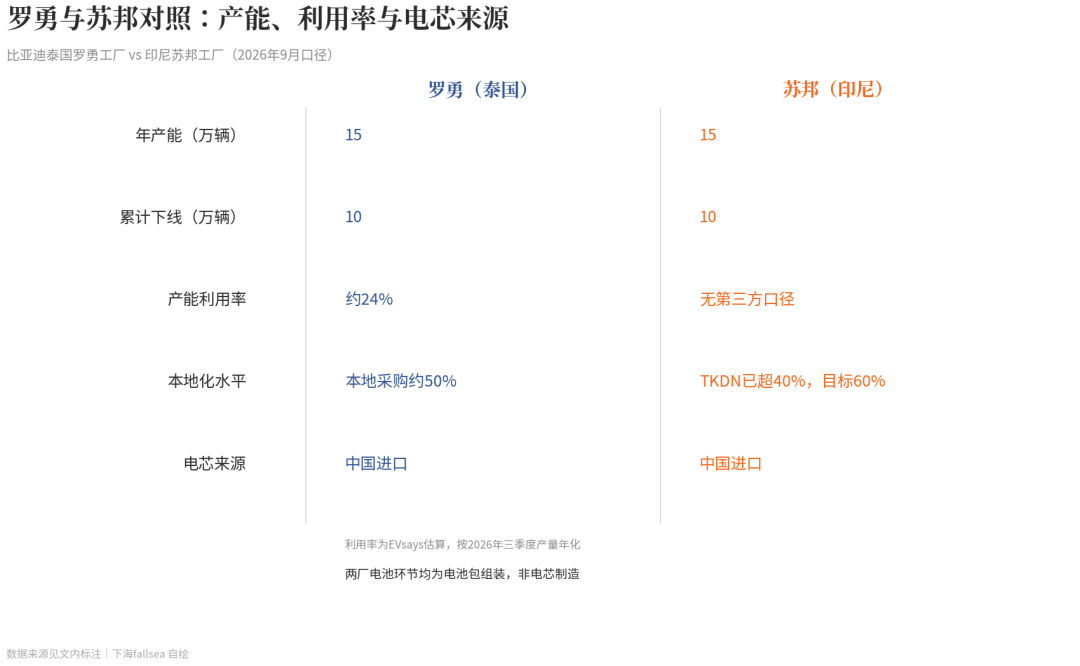
This factory itself is a milestone: it opened in July 2024 with an investment of about 32 billion Thai baht (about US$900 million); on September 21, 2026, the 100,000th complete vehicle rolled off the line, about 26 months after production began. Of its more than 6,000 employees, 95% are Thai nationals, local procurement is about 50%, and of its 266 suppliers, 125 are local companies. The output curve traced a hook: according to figures compiled by EVsays, cumulative output broke 10,000 vehicles in November 2024, 70,000 in November 2025, and 100,000 in September 2026—monthly output fell from about 5,000 vehicles back to about 3,000, and the inflection point in growth was not on the demand side but at the policy switch in February 2026. With annual capacity of 150,000 vehicles, utilization is about 24%—on the same basis, annualized from third-quarter 2026 output. The capacity that meets the standard sits cold on one side, and the rules have already changed the table.
The second blow is the tax rate. The excise tax on locally assembled vehicles is 2%, and on pure imports 10%—that was the old dual track; on November 3, 2026, Thailand's cabinet approved new rules: starting January 1, 2027, imported pure electric and extended-range vehicles will uniformly face 35%. When the finance minister floated the idea in September, he mentioned about 30%, and the final approval landed at 35%, hitting only complete vehicles "not produced in Thailand and not using Thai parts"; local assembly remains unchanged at 2%. Excise Department Director-General Boonchai summarized the policy principles as three: investment-driven imports, making the country a regional and global green vehicle hub, and increasing high-value-added local content. Put plainly, the old tax rate collected a registration fee, and the new tax rate collects an identity fee.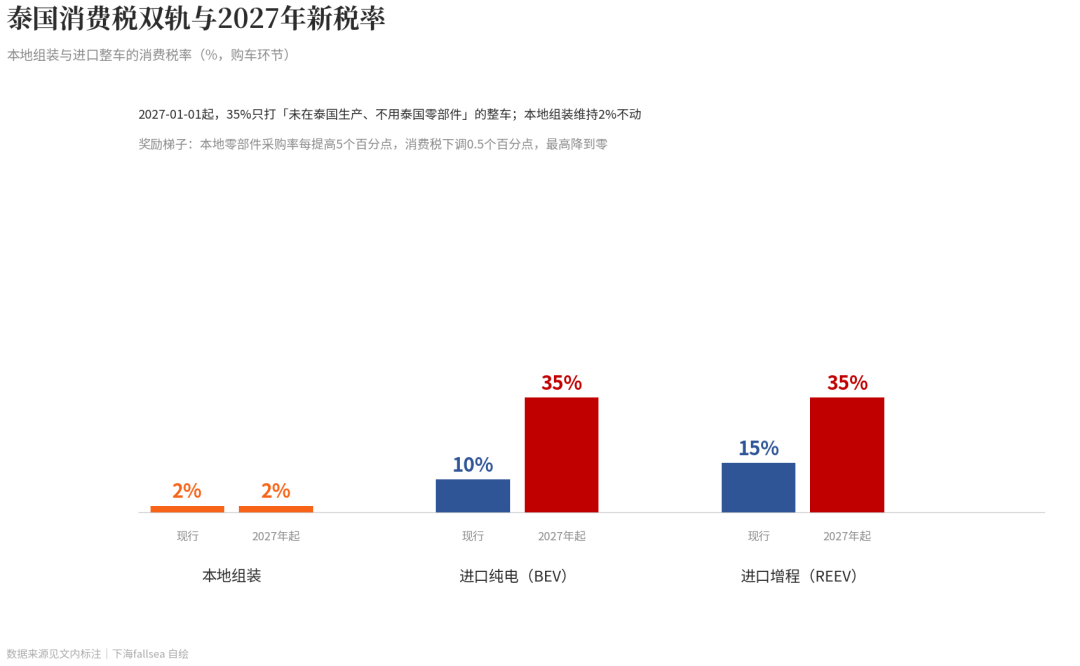
There is a ready-made calculation. The Leapmotor B10, a pure imported vehicle with a landed price of 470,000 Thai baht, under the current 10% excise tax, faces total import-stage taxes of 94,385 Thai baht; when the new policy takes effect in 2027 and there is no quota, this rises to 271,024 Thai baht, an increase of 176,639 Thai baht, about 35,000 yuan at a simplified exchange rate; the retail price rises from 698,600 Thai baht to 874,600 Thai baht, about 35,200 yuan (converted at a simplified exchange rate; at the actual exchange rate, about 39,000 yuan). This is a self-calculation cited by Autohome from Stockstar.
Ask this account another way: the extra tax is nearly 40% of the original landed price, and about a quarter of the retail price. For the same car, for the word "imported," would you be willing to pay 25% more?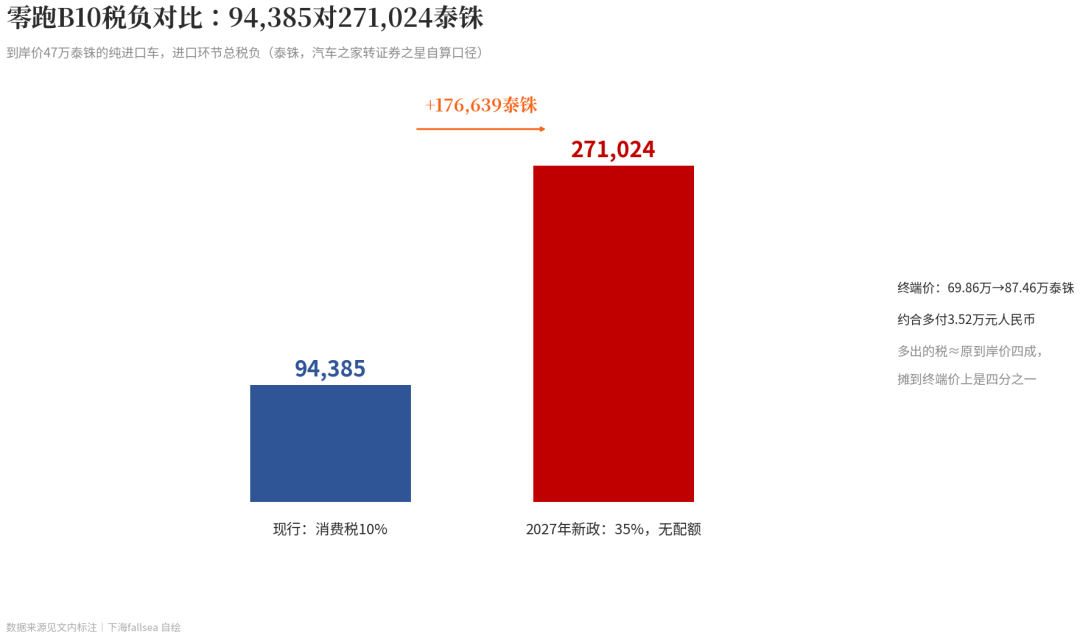
The third blow changes the arithmetic. In the draft published at the end of September 2026, the local content formula was rewritten: operating expenses, labor costs, and profits are excluded, and the weights of engines, motors, drive systems, and R&D in Thailand are increased. Industry body BMA commented: for the first time, value is calculated by what is installed in the car, not by the screws turned in Thailand.
These three blows were not a unilateral surprise attack by the government. In May, 10 industry organizations including EVAT and TAPMA (representing more than 1,500 companies) put forward 8 proposals: an excise tax of at least 32% on imported electric vehicles, an import volume cap set at 10% of local output, and a local content requirement of 80%; the Federation of Thai Industries proposed a range of 32% to 50%. Their math is easy: in the first eight months of 2026, Thailand's total vehicle sales were 466,000, pure electric passenger cars about 145,000, and locally produced pure electric vehicles only about 61,000, with imports accounting for 58% of sales. Selling more and making less, local suppliers could no longer wait.
The blade that stuck in Indonesia fell earlier and more finely. Presidential Regulation 79/2023 set the statutory ladder in stone: a minimum of 35% from 2019 to 2021, 40% from 2022 to 2026, 60% from 2027 to 2029, and 80% from 2030 onward. For companies that had received complete vehicle import incentives, the window closed at the end of 2025—at the registration deadline, six companies were on the list: BYD, VinFast, Geely, XPeng, Aion, and Ora. Article 19A of the regulation states clearly: if production commitments are not fulfilled, the incentives already received are confiscated in proportion to the unfulfilled volume, with bank guarantees as collateral; in 2026-2027, for every 1 vehicle imported, 1 must be produced; if arrears remain into 2028, the government begins to liquidate the guarantees and reconcile vehicle by vehicle.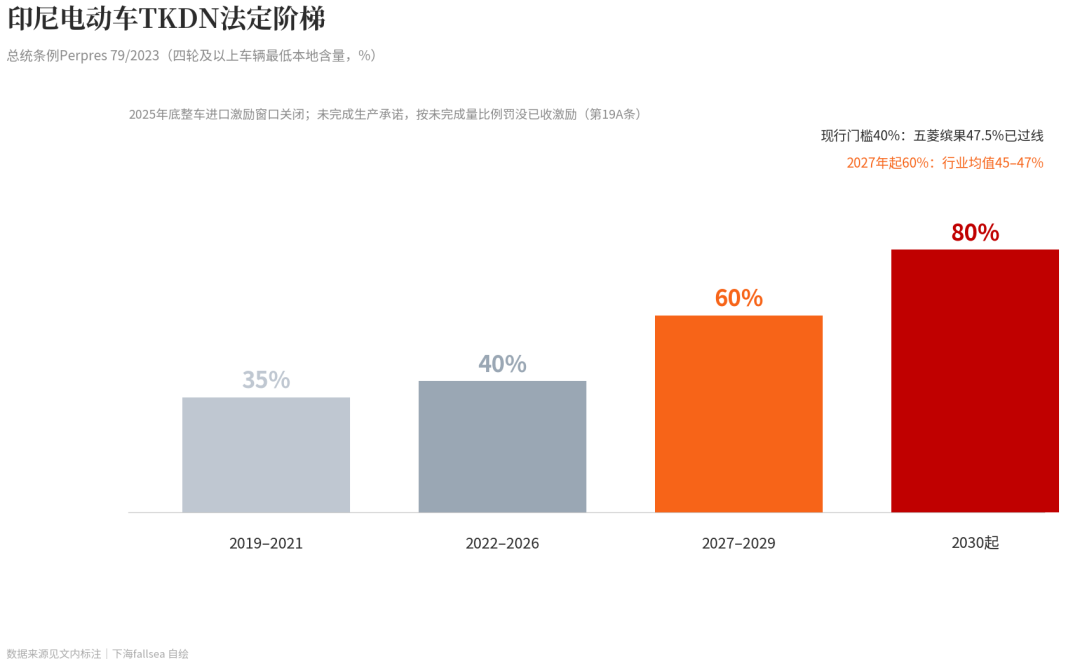
BYD's Subang factory is stuck on this timetable. It opened on September 3, 2026, with annual capacity of 150,000 vehicles, its 13th factory worldwide; on the opening day, the 100,000th vehicle produced locally in Indonesia rolled off the line. Subang's M6 Standard is priced at 395 million Indonesian rupiah, about 175,000 yuan, and the price of local assembly stands there. According to a Hong Kong stock exchange announcement, Subang's localization rate already exceeds 40%, with the goal of raising each production line to 60% by January 2027—the regulatory 60% is calculated by model, and the company's standard is finer than the regulation. But at this stage, the battery segment is still battery pack assembly, and the battery cells are still imported from China.
Indonesia's Ministry of Industry itself has made it plain: the director-general in charge of production said that if it remains at knocked-down assembly, it cannot reach 60%; the director-general in charge of standards certification said that what most drives the TKDN figure is battery cell and module production. The official ramp-up path has three steps: knocked-down assembly in 2026, more complete knocked-down kits from 2027, and to reach 80%, one must manufacture part by part. The roadmap is drawn, but the most valuable components are still at sea.
Indonesia's market appetite is also growing. From January to August 2026, Indonesia's electric vehicle sales reached 101,171 units, accounting for 16.88% of total new car sales. The industry's average TKDN currently sits between 45% and 47%; more than 100 models have obtained certification, and across Indonesia there are 88,000 certified products and 15,000 companies. The threshold is rising and the market is growing, both at the same time. Industry Minister Agus Gumiwang Kartasasmita said in late October that he is confident the industry will have no trouble reaching 60% by 2027.
Officials are well aware that "assembly is enough." The secretary-general of the parts industry association said that under the current TKDN composition, the assembly process accounts for about 30%—reaching 40% relies mainly on assembly, and that is the industry reality. Thailand's Department of Land Transport offers a matching estimate: in 2025, more than 116,000 Chinese-brand new energy vehicles were registered, of which 78.8% were locally produced; for BYD (including Denza), that proportion was 82.6%. The substance of "produced in Thailand" is mostly assembly. Going from 40% to 60% is not simply double the effort; it is an entirely different craft.
There are also clear benchmarks in the incremental account. Changan's Rayong factory began production in May 2025, with phase-one capacity of 100,000 vehicles; its supply chain localization rate is already nearly 40%, with the goal of raising it above 70% in 2027–2028 through deep cooperation with 35 Thai suppliers. The gap between 40% and 70%, and the route to close it, are all laid out in the open. Pioneers have also proven that meeting the standard is possible: Wuling Bingo's 47.5% cleared the 40% line, the VAT reduction has been delivered, and car owners can pocket the benefit by paying just 1%—except that the battery line is still doing assembly.
Indonesia also provided a lower-threshold side channel: a new algorithm effective December 11, 2025 abolished the old rules that had been in use for 14 years, adding 25 percentage points for domestic factory construction and 10 percentage points for local employment, with 15 factors totaling up to 38 percentage points—making it easier to reach 40%. The Minister of Industry specifically clarified that the revision was not prompted by Trump's tariffs; it was launched a month earlier than the tariffs. The other side of the algorithm loosening is that the hard threshold for battery cells remains unchanged.
Deposit or entry fee
On January 1, 2027, two blades fall on the same day: Thailand's import excise tax on electric vehicles takes effect at a flat 35%, and Indonesia's 60% local content threshold begins to ramp up. The same batch of companies that moved production capacity here must submit their answers on the same day.
Three accounts combined: in the stock account, BYD Rayong's 150,000-unit capacity utilization rate is about 24%, and battery cells are still imported from China; in the incremental account, each Leapmotor B10 costs an extra 177,000 Thai baht; in the comparison account, Neta is being pursued in Thailand for more than 2 billion Thai baht, while in Indonesia it holds a 44% TKDN certification—the same player feels different pain in the two countries. All three accounts actually rest on the same fact: so-called localization currently has assembly as its ceiling. Assembly cannot build a truly local car, and both countries know it very well.
This is not entirely "fraud" by Chinese automakers. The timing of the rules is right there: first give the assembly-period dividend, and only after capacity lands and the market picks up does the formula suddenly change. Wuling's battery line involves only 40 million yuan of investment, because investing in a battery cell plant four years ago made no sense—the threshold grew later. The important thing is the next question: after the dividend is gone, what will the capacity that has been bet on become?
The New York Times asked this question even more sharply. Rus Banomyong, a supply chain management professor at Thammasat University, studies the closed ecosystems of Chinese automakers: core technology stays in China, and Thai companies find it very difficult to enter the supply chain; his team estimates that if electric vehicles dominate the market, Thailand could lose 300,000 jobs in the next five years, with spillover benefits to other industries minimal. Thosapol Khunsi, chairman of the Thai Auto Labor Congress, puts it more bluntly: "We are standing at a crossroads: should we become a true automobile manufacturing base, or be reduced to a sales market for cheap Chinese electric vehicles?"
Companies themselves are also recalculating this account. Nikkei quoted an executive at an automaker: "We came at the invitation of the Thai government, but because household debt ratios are high, sales have remained weak, and the market environment is not what we expected." Since the second half of 2024, several Chinese automakers have applied to the Thai government to relax production ratios. Steve Yang, PwC Thailand's automotive leader, judges that the industry has entered a new stage—success or failure depends on localization rather than imports, and "companies investing today are making long-term bets."
It is also a bet, but what is being bet on is different. Some are betting on assembly lines: knock-down parts are shipped over, and once the screws are tightened it counts as production. Some have begun betting on what lies behind the production line—BYD is adding battery assembly in Subang, and Changan has brought 35 suppliers to settle in Rayong. The four words "invest and build a factory" contain different assets. Betting is a more accurate word than entry fee. Once the entry fee is paid, it is over; a deposit is judged by performance: if standards are not met, it is forfeited in proportion to the unfinished amount, guarantees are liquidated, subsidies are clawed back, and accounts are checked vehicle by vehicle. BYD's 150,000-unit capacity stares at the 60% threshold in 2027, Wuling's 47.5% still falls short at the battery cell hurdle, and Neta's reorganizers plan to inject 3 billion yuan to take control, with resumption of production focused overseas—defaulters have not been eliminated, and the show is not over.
Back on Srinakarin Road in Bangkok, the lights in that showroom are still off. The places that are lit have changed: the battery pack workshop in Cikarang, the welding line in Rayong. Every part installed into a car under those lights will have to be repriced starting January 1, 2027.
After January 1, 2027, every one of these numbers will move. By then, what matters is not who is present, but who is building.
-
![]()
Thailand Begins to Settle Old Scores with Chinese Automakers
-
![]()
Why Did It Take smart Seven Years to Perfect a Small Car Priced at 99,900 Yuan?
-
![]()
Tesla's All-Electric Pickup Cybertruck Is About to Be Discontinued: 70,800 Units Sold in 33 Months, Production Line to Be Freed Up for Cybercab in Mid-2027
-
![]()
OpenAI Account Bans Are Just the Tip of the Iceberg: The "Reckoning" of AI Compute Is Unfolding Simultaneously in Washington and Wall Street
-
![]()
Multiphoton Microscopy Imaging Technology No. 55: Self-localized Ultrafast Pencil Beams for Volumetric Multiphoton Imaging
-
![]()
China and the US have already settled their AI competition—and it's not even close: Multiple US states move to halt data center construction
-
![]()
Huguang Shares: Revenue Down 8.05%, Profit Plummets 80.25% Amid Wave of New Designations, Gross Margin Falls 3.74 Points
-
![]()
BYD Executive Responds to Maserati Acquisition Rumors: BYD's Cars Are the Fastest in the World