Baidu Begins Building Factories
 11/12 2026
 534
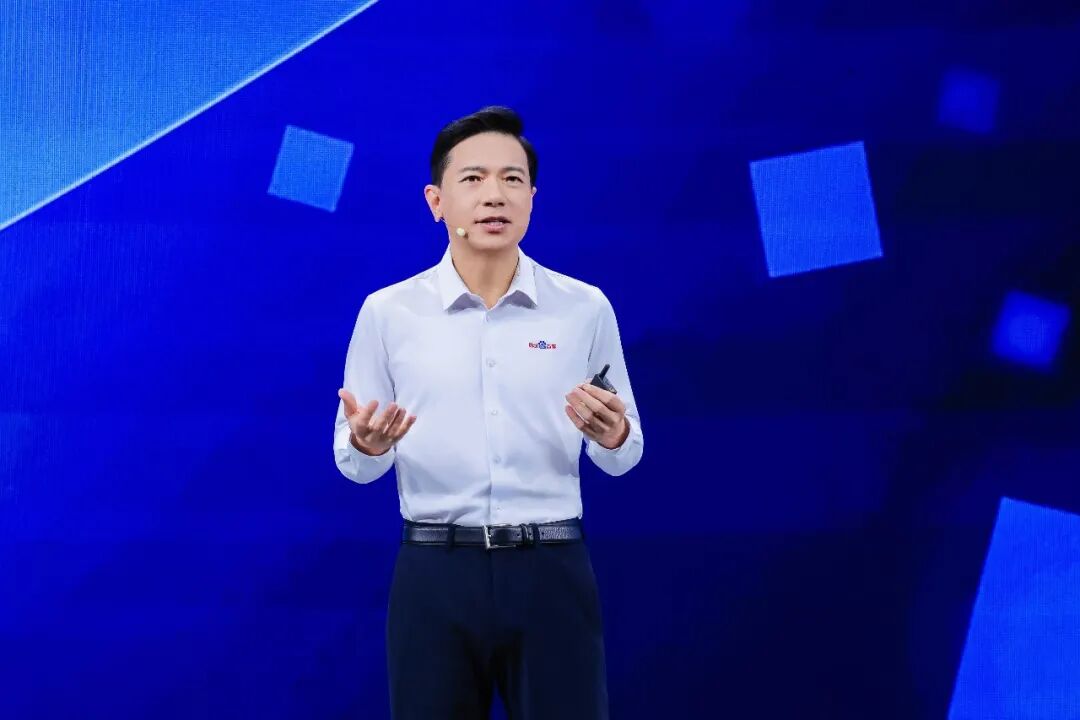
Let one person's experience become the capability of the entire organization.
/
In 1985, economic historian Paul David published an article that would be cited repeatedly thereafter, titled "The Dynamo and the Computer." In it, he raised an uncomfortable fact: electricity entered factories in the 1880s, yet American manufacturing productivity did not truly take off until the 1920s.
During the three or four decades in between, factory owners did only one thing: they replaced the steam engine with an electric motor and installed it in the very spot where the steam engine had stood. The central drive shaft still turned, the belts remained as before, and the machines were still arranged in a circle around that shaft. In David's words, this was "changing the power source, not the factory."
The benefits of electricity were thus more than half wasted. It was not until the generation of factory owners in the 1920s began redrawing plans on empty land—single-story factory buildings, machines arranged by process, each machine equipped with its own small motor, and "unit drive" replacing central transmission—that the productivity curve suddenly turned upward.
More than forty years later, this passage can be moved almost verbatim into the AI industry.
The version Li Yanhong gave at Baidu World 2026 on November 12 was this: AI is the new electricity, and the intelligent organization is the new factory of the AI era. "Swapping in a new AI motor is only the starting point; redesigning the new factory is the watershed."
This metaphor is not new, and it was not delivered in a fancy way. But its weight was cashed out at this conference: chips, cloud, models, agents, and autonomous vehicles—what was released across these five layers almost all amounted to fitting parts for this "new factory." The rhetoric holds together because there is engineering behind it.
And before this, the industry was indeed stuck in the phase of "changed the motor, output did not rise."
In July 2025, MIT's Project NANDA released "The GenAI Divide," based on 150 executive interviews, 350 employee surveys, and 300 public deployment cases. It gave a number: 95% of enterprise-grade generative AI pilots produced no measurable financial return, and only about 5% truly entered production environments. Yet the pilot conversion rate of general-purpose tools like ChatGPT was as high as 83%—but what it improved was individual efficiency, not the enterprise's P&L.
The line in the report was almost cutting: the model can run; it is the organization that cannot run.
That sentence was the most expensive lesson the entire industry learned over the past two years, and it is also the question Baidu truly wanted to answer.
01 What Was Missing Was Never the Model
In the past two years, enterprises have approached AI more like "buying tools": procure a system, a batch of accounts, a few million tokens, and then wait for benefits to grow on their own.
The MIT report listed the reasons for failure very concretely: most projects stopped at "a demo that can run," and fell apart as soon as they touched real data, production environments, and organizational responsibility. In other words, the bottleneck was not whether the model was smart enough, but that no one was willing to take responsibility for "the results the model produces."
This is precisely an organizational problem.
On this judgment, Baidu was one of the companies that acted half a step earlier. At the Create conference in May 2026, Li Yanhong proposed DAA—"daily active agents"—and gave a statement that was quite jarring at the time and is increasingly accepted now: tokens only represent cost, not benefit; they measure input, not output.
The weight of this statement lies in the fact that it pointed out the industry's most common illusion: treating call volume as value. How many tokens a platform burns every day only shows how much money it spent; how many agents truly enter processes, execute tasks, and deliver results every day is what shows what it earned.
Moving the yardstick from the "input side" to the "output side" was the most easily overlooked calibration in this round of AI competition. Interestingly, half a year later, more and more companies in the industry began discussing metrics such as "agent penetration rate" and "task completion rate"—a path that coincides with DAA.
A company that proposes a new ruler may not always hold that ruler. But at least on this step, Baidu was looking in the right direction.
"Three Principles of Organizational Evolution": break job boundaries, precipitate tacit knowledge, and design process closed loops.
None of these three sounds new. They correspond respectively to three classic propositions in management studies, which together are more than three hundred years old. What is truly new is their cost.
The source of "breaking job boundaries" is 1776. The first chapter of Adam Smith's The Wealth of Nations is about the pin factory: one person working independently could not make a single pin in a day; divided into eighteen processes, ten people could make forty-eight thousand pins in a day. Division of labor is the starting point of modern management, and jobs are the product of division of labor and the bricks of bureaucracy.
Li Yanhong put it bluntly: jobs are the unit of the industrial age, tasks are the unit of the intelligent age, and the future organization is a network of tasks. "Jobs will not disappear, but they will converge. In the future, there will roughly be two types of jobs: one is Builder, responsible for creating new things; the other is Seller, responsible for communication and connection between people, making others develop emotions toward you and build trust."
Changing the organization from a "job tree" to a "task network" is an idea that has existed in management academia for at least thirty years. Agile organizations, Amoeba management, project-based systems, and platform organizations all tried it, and most failed at the same place: the cost of task scheduling was too high. Assigning work, aligning, acceptance, and review all relied on people, and the coordination cost of a task was often higher than the task itself.
AI, for the first time, brought the marginal cost of "scheduling" close to zero. This is the first time an old idea has obtained the physical conditions for realization.
The Builder/Seller dichotomy is somewhat crude; it omits middle positions such as compliance, finance, and supply chain that are neither creative nor sales. But it hit something very real: when execution is taken over by AI, the remaining value of people comes down to two things—defining problems and building trust. The former determines what to do, and the latter determines whether others believe in what you do. These two things happen to be impossible to outsource to models.
The source of "precipitating tacit knowledge" is 1966. Michael Polanyi wrote in The Tacit Dimension a sentence quoted to death: we know more than we can tell. Later Ikujiro Nonaka turned it into the SECI model, and knowledge management became a prominent discipline in the 1990s.
Then it was almost completely wiped out. The reason was not that the theory was wrong, but that the arithmetic was wrong: making one person's tacit experience explicit was extremely costly; the benefit went to the company, and the workload went to the individual. All knowledge management projects died on this incentive misalignment.
Li Yanhong's solution was to turn this into agents and Skills. Baidu has already accumulated more than 20,000 organizational Skills internally and built 4,300 Workspaces. "Let one person's experience become the capability of the entire organization."
This is the most solid of the three principles. If these two numbers hold up, it means that "explicitation" has for the first time changed from an extra thing to an incidental thing: employees are not writing documents, but tuning agents, and the tuning process automatically leaves traces. The mechanism has changed, and only then can the incentive misalignment be untied. This is the hardest piece of information at this launch event, closer to the original meaning of the "new factory" than any model parameter.
"Designing process closed loops" is the oldest. Measurable plus Looping equals continuous evolution, which translated is the Deming cycle: Plan, Do, Check, Act. Shewhart in the 1930s, Deming in the 1950s, and Japanese manufacturing took off because of it.
Old as it is, PDCA has remained "the manager's self-awareness" for the past eighty years, relying on people remembering to check and being willing to review. The premise for it to truly become an automatic loop is objective measurement. This also explains why Baidu is so persistent about metrics: a closed loop needs a ruler that does not lie; otherwise, the faster it turns, the farther it deviates.
Taken together, the three are actually one sentence: the dilemma of management studies over the past hundred years is that "everyone understands the principles, but no one can do it"; what AI does is push down the cost of the part that "cannot be done."
Old principles have become cheap for the first time, and that is why they deserve to be taken seriously.
02 37,000 Agents and an Industry-Wide Organizational Absorption
The three principles are not empty talk; Baidu conducted an experiment using internal data.
Over the past year, Baidu's internal daily active agents (DAA) rose from an average of 5,000 per day to 37,000, more than six times; the number of "effective tasks" completed by agents rose from 84,000 per week to more than 1 million per week, eleven times; a total of 4,300 Workspaces were built, and more than 20,000 organizational Skills were accumulated.
These three sets of numbers point to three things.
First, "people finding tools" began to become "tasks finding agents." From 5,000 to 37,000, what increased was not the number of tools, but the task nodes truly dispatched to do work every day. Second, "individual efficiency improvement" began to leave process traces. The value of 4,300 Workspaces is not in the number, but in that they are reusable containers. Once a type of task has been run, the second time does not start from zero. Third, "experience in the head" began to become "experience on the platform." Twenty thousand Skills means twenty thousand ways of doing things that originally existed only in someone's hands were written into something others could also call.
These three things happen to correspond to the three principles.
What needs to be clarified as a boundary is this: these data all come from inside Baidu, and validation by external customers is still on the way. A methodology running smoothly in one's own home and running smoothly at thousands of customer sites are separated by a very wide gap, and this is probably the progress most worth watching over the next two years.
But this path is not lonely.
From July to September 2026, within two months, almost all major tech companies completed the same thing: absorbing scattered AI office products into a single entrance. According to reports by media including Jiemian News, Tencent merged QClaw into the department where WorkBuddy is located; ByteDance merged the Feishu product team into Doubao, established the "Creativity Service Platform," and released "Doubao Work" on August 25; Alibaba integrated three agents—QoderWork, MuleRun, and Wukong—into Qianwen Office; Huawei listed Xiaoyi Work on the app market on September 24; Baidu merged dodo into Baidu Dazi.
Internal horse racing ended, and a single entrance was established. The reason is not complicated: there can only be one entrance for AI office, and multiple entrances equal no entrance.
What is more worth noting is that this round of absorption was superficially product integration but substantively organizational adjustment: reorganizing several teams that had been fighting separately into a line that can be responsible for results. When almost all companies are touching their organizations, it shows that this is not one company's self-moving sentiment.
The difference lies in the wording. Others gave announcements; Baidu gave a methodology, plus a set of metrics. The cost of giving a methodology is being measured by words. The benefit is that it has a chance to become the industry's standard language.
03 Adding a Piece of "Trust Infrastructure" to the Model Market
If the three principles are the "argument," then the Token Exchange is the most concrete "proof" at this launch event.
Li Yanhong gave a very straightforward observation: in the first nine months of this year, new models were released almost every day, sometimes several in one day. But a large number of token relay stations are not responsible for model effects and service stability. "The same model, some expensive and some cheap, sources are all over the place, and quality varies. After all the choosing, you still are not at ease and do not dare to use it."
This is not a complaint; it is a true portrayal of the model middleman business over the past two years: thin margins, light responsibility, poor reputation. People reselling tokens do not bear the consequences, and people buying tokens have no way to verify.
And the price of this business has already been beaten to the bottom. In May 2024, the input price of the Doubao general model Pro-32K was set at 0.8 yuan per million tokens; six days later, Alibaba pushed Qwen-Long down to 0.5 yuan, Baidu announced that day that two models would be free, and Tencent followed afterward.
The price war solved the cost problem, not the trust problem. When tokens become as cheap as tap water, the buyer's new pain point shifts: it is not that you cannot afford it, but that you do not know which one to buy and whether it will be stable after purchase.
The answer from the Token Exchange targets precisely this pain point: verification plus credit reporting.
Verification handles the present: model fingerprint comparison, capability testing, performance and availability testing, checking "whether what you get this time is right"; credit reporting handles the long term: regular sampling and dial testing, full-link real-time monitoring of calls, building credit ratings for model providers, recording "whether this provider has been stable in the past." There is also blockchain attestation.
Li Yanhong likened it to a stock exchange: an exchange draws quality companies to list and helps investors discover good companies; the Token Exchange gathers good models and good suppliers and lets enterprises and individuals conveniently buy trustworthy tokens.
One month after launch, more than 100 supply resources had joined, daily average calls exceeded 50 million, and daily average tokens called exceeded 700 billion.
This is Baidu's move this year that most resembles "infrastructure." What it sells is not models, but reduced selection costs. In a market with excess model supply and uneven quality, "trustworthy" is indeed a scarce commodity, and whoever turns that scarce commodity into a standard gains pricing power. And that position is far more valuable than releasing another large model.
For an exchange to stand firm, two rules still need to be established.
The first is about neutrality. Baidu itself is a model supplier, and ERNIE 5.5 Flash also has to be sold in this marketplace. The best solution is not to avoid it, but to place ERNIE in the position of an "ordinary listing party," subject to the same sampling inspections and the same ratings, and even to disclose its own credit score. The credibility of an exchange often comes from how strict it is with its largest seller.
The second is about openness. If credit reporting capability serves only its own transactions, it is just a premium shelf; only if it becomes a publicly verifiable public good that buyers can use, third parties can use, and regulators can use, can it grow into the industry's verification standard. The technical threshold for this is not high; what is difficult is being willing to hand over the capability.
As for commissions, the logic is actually very clear: as unit prices approach zero, the spread disappears, and money can only be made from "guarantee" and "service." This is not a retreat; it is an upgrade. From selling resources to selling rules.
04 An Underestimated Judgment
For the three principles to land, there must be something to carry them. The carriers Baidu brought out are four agents.
Dazi is the entrance. Over the past quarter, it was the general agent with the fastest growth; after more than 160 iterations in half a year, 90% of its code and 50% of its external communication materials were generated by Dazi itself. This time it was upgraded into a unified entrance connecting Baidu's full range of professional agents, and fully opened the Harness engine and Agent API.
"The Dazi team is also a practitioner of the three principles of organizational evolution." At first hearing, this sounds like circular self-justification: using the achievements of one agent to prove that the methodology guiding this agent is correct. But it at least shows one very real thing: this set of things is actually running inside Baidu, not just on PPT.
More worth watching is the move to open Harness. Harness is the reins, the layer of engineering that harnesses models into business processes: tool calls, permissions, state, rollback, auditing. Whether an agent can do work depends 80% on this layer, not on the model itself. Handing over the reins is equivalent to publicly admitting that the threshold is not in the model, but in "how to tie the model into the process."
This and the "process closed loop" in the three principles are two ways of saying the same thing. The only difference is that the closed loop used to turn only within one's own home, and now others are allowed to connect in and turn together.
Yijing is content production capacity. This time it launched "Short Comic Drama Studio," covering a chain from creativity, script, and storyboarding to finished film. Creators can one-click localize the plot, characters, and scenes of proven works and directly target overseas markets; based on the self-developed video generation model, the cost is reduced to 0.2 yuan per second. The segment shown at the event, the digital human Xijiajia interviewing Li Yanhong, was generated by Yijing.
Kuku is knowledge production capacity. Kuku, jointly launched by Baidu Wenku and Baidu Netdisk, plus the overseas version KOOKO, is backed by 1.8 billion pieces of professional content, 750 million Chinese and English documents, and a million-level expert network. This is the asset in Baidu's hands that looks least like AI and most like a moat.
Famou is decision-making production capacity. After upgrading to 3.0, it faces complex tasks such as production operations, business strategy, and industrial R&D, continuously self-evolves, and is responsible for the final business indicators of industrial tasks. Its customers already cover 25 of China's 41 major industrial categories.
The four agents correspond to four types of production capacity: entry, content, knowledge, and decision-making. What they have in common is that they all sell results rather than tools, which is exactly the dividing line between intelligent organizations and tool procurement.
One layer further down is chips and cloud.
ERNIE 5.5 Flash preview: total parameter count 280 billion, 14 billion parameters activated per token, supporting a maximum context of 1 million tokens; the official statement says it performs prominently in programming, 3D modeling, knowledge work, and content creation, achieves competitive scores in benchmarks such as Terminal-Bench and AutomationBench, and maintains extreme decoding speed. Also released at the same time were the ERNIE Lightning deep-thinking model and the ERNIE Yijing micro-expression large model. Both application models have been launched on Baidu AI Cloud Qianfan platform and APIs are open to enterprise customers.
On the computing power side, Baidu AI Cloud released the Tianchi 1024-card super node; Kunlun Core M100 has been listed as scheduled, focusing on extreme cost-effectiveness, and the flagship M300 will be launched next year, achieving comprehensive leaps in computing power, storage, and interconnection.
This configuration is a typical "load-bearing wall" approach: models are responsible for capability, super nodes for scale, and self-developed chips for cost. Only with all three together does one qualify to talk about a "factory building."
Its industry position is not bad either. According to Sullivan's statistics on China's full-stack AI cloud market in 2025, Alibaba Cloud ranked first with 40.1%, Baidu second with 16.6%, and Volcano Engine third with 13.4%. In vertical industries, Baidu AI Cloud has taken several first places: IDC data shows that it ranks first in China's financial industry generative AI platform and application solutions market with a 16.6% share and has maintained the lead for two consecutive years; it also ranks first in sub-markets such as banking generative AI solutions and financial industry agent scenario applications; its AI gaming cloud market share is 51%, and embodied intelligence cloud 29.55%.
Second in the general market and first in vertical industries—this is a very typical "dislocation competition" position: do not compete with the largest opponent on total volume, but first thoroughly penetrate the industries willing to pay.
Financially, the cost of "building factory buildings" has also become visible. In the second quarter of 2026, Baidu's total revenue was 31.3 billion yuan; traditional business revenue was 10.4 billion yuan, down 23% year on year; core AI new business revenue was 12.5 billion yuan, up 25% year on year, accounting for half of general business revenue; among it, AI cloud infrastructure was 7.3 billion yuan, up 50% year on year, GPU cloud grew 283%; AI application revenue was 2.5 billion yuan.
New business has already reached half, but the increment has not yet fully offset the contraction of the old business. This is the common situation of all transforming companies, and it is also where the real weight of the phrase "redesign the factory building" lies. The money to design the factory building has to come from the old factory building. "Today's embodied intelligence is roughly equivalent to the development level of autonomous driving around 2016."
2016 was the year Waymo began small-scale manned trial operations in the United States, and also the year domestic autonomous driving was still running demos in parks. Pushing embodied intelligence back ten years is a pricing of the entire track: it shows both that Apollo Go has already run for "ten years" and that humanoid robots are still ten years away from mass production.
In a track that advances its narrative by "months," not many people are willing to make judgments by "ten years." Over the past two years, humanoid robots have had new videos, new demos, and new financing every month; but what truly determines whether they can be commercialized is cost, regulation, and operating radius, all three of which are measured in years.
Apollo Go's report card is: covering 28 cities globally, with autonomous driving mileage exceeding 350 million kilometers, already fully driverless commercial operations in Dubai and Abu Dhabi, and working with the Shenzhou Car Rental team to combine traditional self-driving travel with autonomous driving, creating the world's currently only "driverless car self-driving tour."
This model sounds like a marketing gimmick, but it is actually a question on the operating ledger: driverless cars have high per-vehicle costs and limited operating radius, and only in "long-distance plus multiple points" scenarios can labor savings offset depreciation. Tourist cities happen to be exactly this kind of scenario.
Translating technological capability into an operating ledger is harder than the technology itself, and also closer to the original meaning of "asset-light."
Back to the question at the beginning: replace the motor, or replace the factory building.
Li Yanhong's answer is that intelligent organizations will usher in three major opportunities: asset-light operations, building new moats, and creating and discovering new markets. "Now is the moment to drive the intelligent evolution of organizations."
The odds of this judgment are not low. The dividends of every general-purpose technology revolution ultimately fall to "the organizations that know how to use it," not "the companies that build it." Electricity was like this, the internal combustion engine was like this, and computers were like this.
But compound interest must be settled by fiscal year. Three observation points are indispensable.
First, can it be externalized. Organizational capability is internal strength. If internal strength does not become a product, it is only a cost advantage, and a cost advantage that cannot be priced. Baidu already has four windows in hand: Token sells credit, Dazi sells Harness, Yijing sells production capacity, and Famou sells "responsibility for business indicators." Whether the four windows open depends on the proportion of external revenue contributed by these four next year.
Second, can it enter the income statement. The benchmark for the three principles is that 95% from MIT. If two years later customers can clearly say, "By using your agent, I saved this many people, reduced this many errors, and became this many days faster," then the intelligent organization has changed from internal management into a commercial moat; if they cannot say it clearly, it is still just a better set of internal management.
Third, can it be delivered in market share. Companies with high organizational efficiency should ultimately obtain more cloud revenue, more calls, and more industry positions. Baidu has already made several vertical industries—finance, gaming, and embodied intelligence—number one, and the next question to answer is where it can stand in the general market.
The second half of David's article has an even more piercing detail: productivity really took off in the 1920s not entirely because factory owners had figured it out, but because the old factory buildings had reached the age when they should be demolished. The new generation of factory owners drew their plans on empty land; they had no central drive shaft to accommodate.
Baidu chose to modify the structure within the old factory building. This is much harder than empty land, but history also gives another hint: the companies that truly reaped the dividends of general-purpose technology often did not wait for the new factory building to be completed before acting, but began to change while the old factory building was still running.
"Let one person's experience become the capability of the entire organization." If this sentence can truly be implemented, its returns will not appear in this year's financial report, but in the next cycle. [End]
-
![]()
What Is Astigmatism, Really? Why Tangential and Sagittal Foci "Go Their Separate Ways"
-
![]()
Gree Electric's Performance Weighed Down by Soaring Copper Prices: Will Dong Mingzhu Unveil a "Big Move" by Year-End?
-
![]()
AI R&D Doubles in Speed as Anthropic Redacts Most of a 100-Page Report
-
![]()
Crown New Materials to Inject RMB 228 Million into Zhejiang Optical Film Project
-
![]()
Gaize Technology Officially Announces Takeover of Entire Japanese Optical Powerhouse Plant: Can It Translate Into Production Capacity?
-
![]()
Baidu Begins Building Factories
-
Hong Kong Listed Company Huaxia Culture Technology Enters AI Sector with Mid-Term Profit Alert Exceeding HKD 900 Million
-
![]()
NXP Earnings: Net Income Hits $884 Million as Automotive Chip Growth Lags at 13%