Huang Steps Down: Nvidia Loses Its Soul—So Why Should Chinese Assets Pay the Price?
 11/16 2026
 449
On November 12, Jensen Huang resigned as president, CEO, and director of Nvidia, with CFO Colette Kress serving concurrently as interim CEO.
That day Nvidia opened lower and closed higher, ultimately falling 4.3%—but Alibaba fell 7.1%, GDS dropped 11.4%, and Nebius plunged 16.8%, falling even harder than the main player.
Beyond the stylistic difference in leadership change (the aggressive Huang vs. the conservative CFO), which may slow the pace of AI investment expansion,
a more serious expectation is now playing out: the siege against Huang is only the starting gun, and the possible real purpose is to clear obstacles for reviving a bill that has been lying in the Senate for almost a year—the Remote Access Security Act (RASA).
What bearish funds are calculating here is not just how much China revenue Nvidia will lose, but the shrinking of the entire open-source ecosystem pie.
I. What Is RASA?
First, let's understand what RASA is and exactly what it restricts.
Current export controls govern whether chips can be shipped into China—a restriction on purchases of physical equipment.
But the loophole is that chips can remain in overseas data centers while Chinese customers lease remote use through cloud services and bare-metal services. What RASA wants to do is count this kind of remote access as an export, put it under the Commerce Department's jurisdiction, and treat it as subject to equivalent restrictions.
As of now, the RASA bill is still stalled, and the Senate and House versions differ, with the Senate version being tougher:
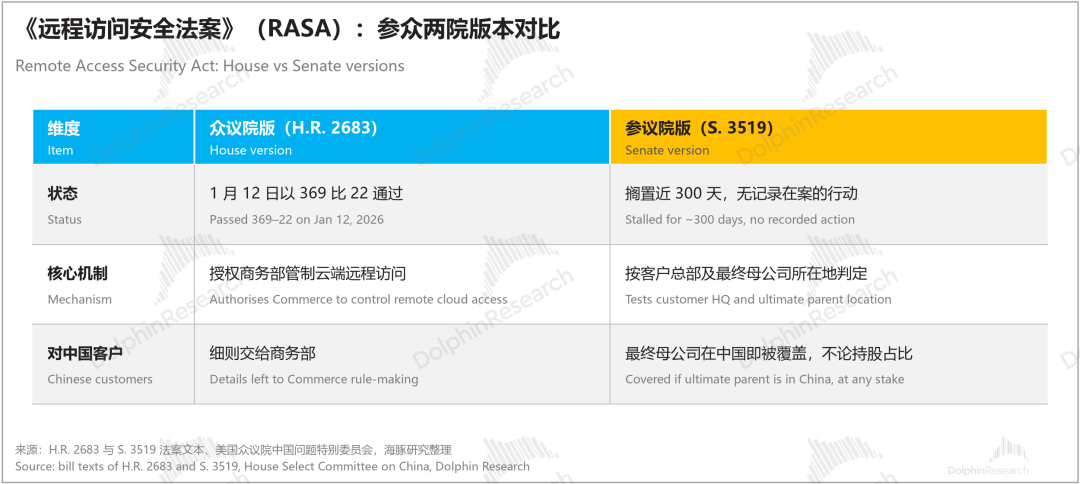
Although RASA did not come into being because of Huang's scandal this time, this incident clearly gave it new political momentum. Therefore, it is hard not to suspect that the real target lies elsewhere: first came the willingness to push RASA, and then Huang's scandal was exposed.
At the same time as Huang's scandal was exposed, more political forces are also testing the waters:
1) Beyond RASA, the details of restrictions have already advanced. According to The Information, in late October the White House demanded that a clause be added to the AI Overwatch Act requiring the Commerce Department to close the remote access loophole; this bill has already been written into the Senate version of the National Defense Authorization Act and is expected to pass before January next year.
Dolphin Research sorts it out as follows:
a. RASA grants the Commerce Department statutory authority to regulate overseas remote cloud computing power (authorizing legislation);
b. The AI Overwatch Act goes further by requiring Congress to directly task the Commerce Department with formulating specific restrictive rules (stipulating the necessity and details of regulation) and enforcing them.
2) There are already signs of Nvidia making concessions. In early November, media reported that Nvidia required non-Chinese customers to account for at least 51% of its cloud service provider customers. Although this is a supplier clause set by Nvidia itself and not the result of direct legal constraints, it shows the company is already preparing for the worst-case scenario.
During the same period, Oracle was also reported by the media to have canceled a 7 billion AI chip leasing order from Tencent.
3) Huang, the biggest opponent, has left the stage. Commerce Department officials once said that Nvidia was especially forceful in its persuasion and lobbying on RASA, while congressional consensus on restricting chips to China is strengthening. Therefore, Huang's resignation removes an important obstacle on the path to advancing remote computing power regulation.
II. Will Chinese IDCs, Major Chinese Cloud Companies, and Nvidia All Be Hurt?
1. The small account of short-term performance: a significant impact on Nvidia's revenue
The latest financial report shows that China (including Hong Kong) as a share of Nvidia's revenue has fallen from a peak of 28% to 8% (only lawful revenue remains). But the key to this trouble is the remote AI computing power in Southeast Asia and even Taiwan and Japan used by Chinese customers:
(1) Nvidia's revenue billed to Singapore once jumped from a 10% share in 2023 to 20%–22% at one point in 2025, while during the same period China's (including Hong Kong) revenue share fell to 5%.
After the FY3Q26 (second quarter of 2025) basis adjustment (from billing by customer location to billing by end-customer location and shipping location), Singapore became so small that it was merged into other regions.
Nvidia explained at the time that customers were only using Singapore for centralized billing, and the products were almost all shipped elsewhere (99% of orders came from U.S. customers).
(2) The latest FY2Q27 (second quarter of 2026) financial report disclosed that revenue from China's Taiwan region was 26.985 billion, accounting for 28%, while the previous quarter was only 14.7%—a jump of another 14 percentage points.
The company noted that more complete-machine transactions were settled through Taiwanese ODMs (Hon Hai, Quanta, Wistron, etc.) rather than cloud companies purchasing directly from Nvidia, and 86% of Taiwan revenue came from end customers in Europe and the United States.
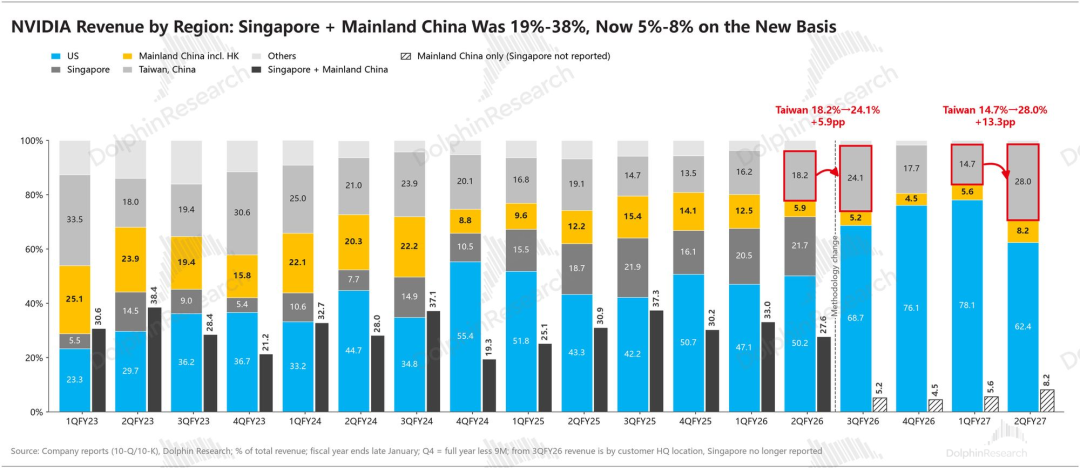
Dolphin Research makes a rough calculation: before the basis change in 2Q26FY, the combined share of Singapore and China (including Hong Kong) basically fluctuated between 20–30%.
After sales restrictions to China, although some revenue was lost, China's share fell from 20% to 6%, and most of that 14 percentage point share—about 10 points—was recovered through the Singapore channel.
In addition, after the basis change, Taiwan's share saw intermittent jumps, rising 6 percentage points in 3Q26FY, then recovering, and then jumping 13 percentage points again in 2Q27FY.
Here The New York Times believes that Megaspeed obtained nearly 5 billion in chip purchases precisely through Nvidia server partner channels (48 billion in purchases over the year and a half from FY25 Q2 to FY26 Q4), billing directly in Singapore in earlier years and later through Taiwanese ODMs.
According to New Street estimates, if remote cloud computing power demand is cut off, the impact on Nvidia's revenue would not just be the less than 3 billion annualized obtained by Megaspeed (only 0.1% of revenue), but as much as 40 billion, or 10% of revenue demand.
The market expects a 10–30% channel revenue loss in fiscal 2027. Using the median of 20%, and assuming new demand can immediately fill half of it, this is actually roughly consistent with Dolphin Research's rough calculation above of about 10 points of China share.
This is significantly more severe than the pre-RASA assumption of investigating and cutting off commercial activities such as renting cards in Southeast Asia, which was expected to reduce revenue by more than 6 billion (New Street estimated that chip hardware transshipment plus offshore leasing accounted for 4%, that is, of 16 billion in revenue, 60% was taken by cloud companies, leaving a 40% gap, or 1.6%).
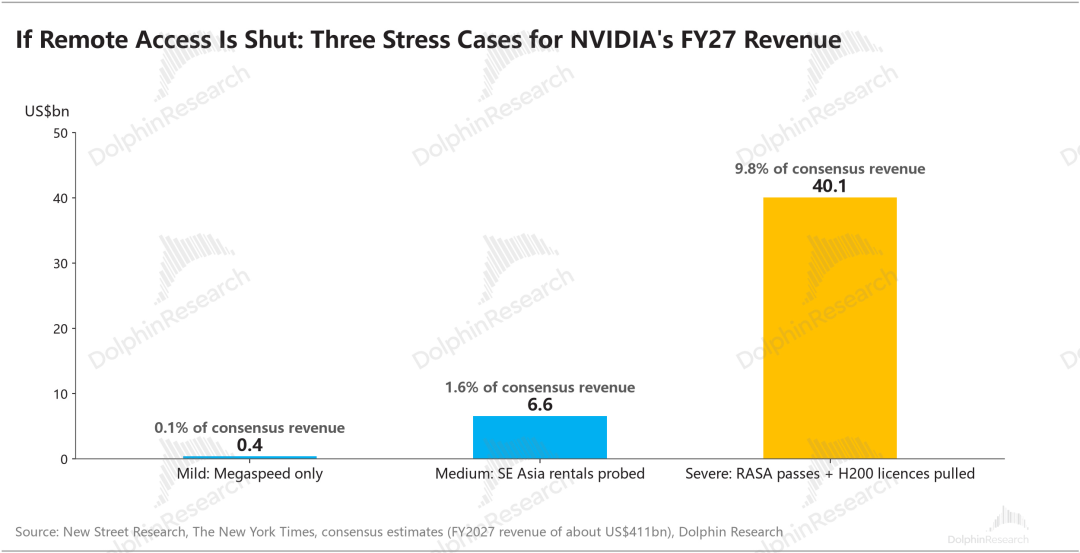
Dolphin Research believes that under the worst third-tier assumption: at a time when CoWoS is still tight and computing power demand is exploding, the gap seems likely to be filled by other demand, but this will inevitably affect the trend of future demand—that is, Nvidia's growth guidance:
With Nvidia's Q3 financial report about to be released, will next year's 70% growth rate be adjusted? Even if it can be met in 2027, is it brought about by demand being pulled forward from after 2028?
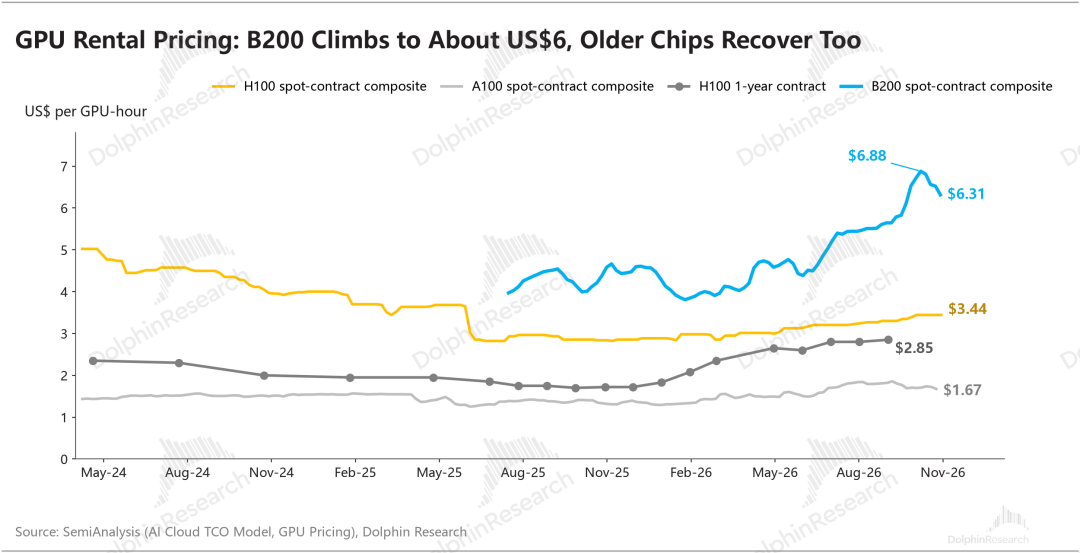
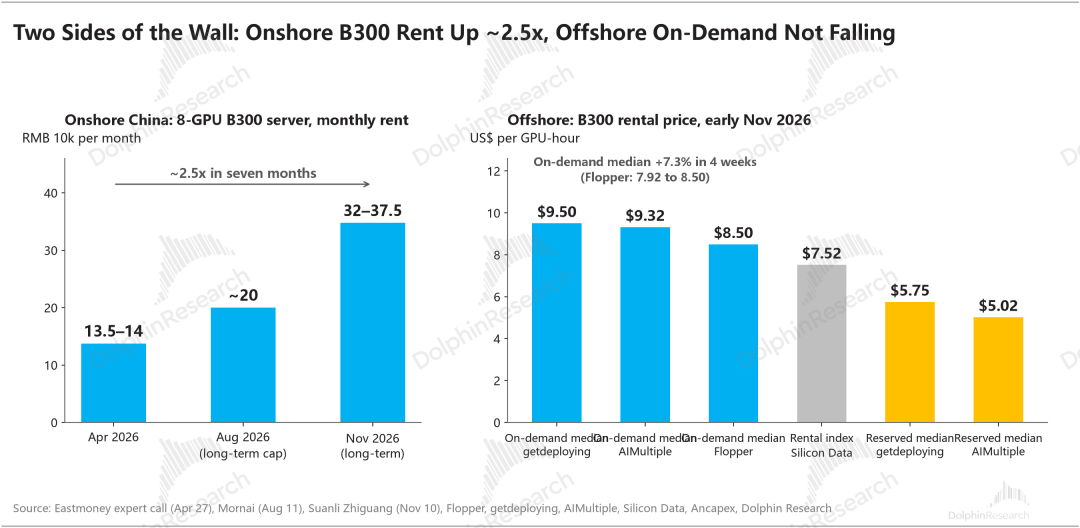
On GPU server rental prices tracked by SemiAnalysis, B200 has been declining since late October, but B300 rents remain firm—especially in restricted China, where they rose 2.5 times in half a year.
III. The Big Account of the Open-Source Ecosystem: The Logic of 'Piracy Cultivates Users' Breaks Down
Using overseas remote cloud platforms to provide high-end computing power services is the key core of the open-source ecosystem logic Nvidia has been telling.
Over the past year, with the prosperity of the open-source ecosystem led by Chinese large models, Huang has repeatedly voiced support and personally contributed to the open-source ecosystem, especially with a rather tight series of moves in 2026:
a. In July, posted on X publicly supporting open source;
b. In August, was reported to be developing a trillion-parameter open-source model Nemotron 4;
c. In September, announced the acquisition of Hugging Face;
d. Most recently in October, at a forum in Singapore, praised Chinese open-source models such as DeepSeek, Kimi, and GLM for their outstanding performance.
Pushing open source rather than closed source is beneficial to Nvidia in the long run. Open source turns scarce goods into cheap goods; the cheaper the model, the more customers, and the greater the GPU demand.
Moreover, compared with closed-source leaders dominating the ecosystem, open-source models allow small and medium-sized enterprises and sovereign projects to train and deploy models themselves, dispersing Nvidia's customer structure so that Nvidia can maintain relative bargaining power.
Therefore, the open-source ecosystem will greatly ease Nvidia's customer concentration and thereby reduce the long-term risk brought by customers developing their own chips.
In fact, Huang's strategic thinking is essentially somewhat similar to Microsoft's old logic of piracy cultivates users: Chinese users will use pirated versions anyway, so it is better to let them use Windows, build the habit, and then slowly collect money. Therefore, the moat is not the genuine Windows disc, but the habit and the ecosystem.
Nvidia's counterpart is GPU and CUDA: in the mainstream and on the surface, high-end GPUs are banned, but through remote cloud services a certain unspoken opening has been left for Chinese customers, keeping frontier training within Nvidia's chip system. And through this opening, the R&D progress of Chinese open-source models can also be clearly observed.
One sentence Huang has repeated over the years is: rather than forcing Chinese developers into the Huawei ecosystem, it is better to let them continue using the U.S. technology stack. Remote computing power in overseas data centers is objectively cultivating developer habits.
However, on further comparison, there are still differences, and this also leads to China's stronger willingness and faster actions in advancing domestic AI chips:
(1) For Microsoft's pirated Windows, most Chinese customers did not pay, so dependence was stronger. But for Nvidia's remote cloud computing power, Chinese customers still have to pay an expensive fee, giving them a cost incentive to develop domestic alternatives.
(2) When Microsoft adopted that strategy, there was no compliance risk—only a business choice between short-term cash collection ability and long-term money-making potential; while Nvidia directly faces U.S. national security pressure and bears political and legal risks;
(3) Microsoft's Windows had strong lock-in on file formats and software compatibility, but on the AI chip side, developers write PyTorch and use PyTorch to call CUDA, so the threshold for switching hardware is declining, and Chinese customers, whether regulators or within the industry, are continuously pushing domestic replacement.
Therefore, the half-life of the cultivate users approach in the AI era is far shorter than in the Windows era. And the U.S. government's push for RASA is an even more precise strike against this approach.
IV. Short-Term Benefit for Closed Source, but Open Source May Split into Two Hardware Stacks
If even remote use is no longer allowed, then leading Chinese open-source models can only prioritize adaptation to domestic chips faster. Although this is already happening, it must be admitted that Chinese AI chips are insufficient in both performance and capacity to meet the training and inference needs of frontier models:
(1) Zhipu GLM-5 was adapted to 7 domestic accelerators from day one;
(2) DeepSeek open-sourced the inference kernel on Ascend for V4 Pro;
(3) Meituan said LongCat 2.0 was fully pretrained on Ascend 910B.
Viewed separately, even if performance is beginning to catch up and narrow the gap, in terms of the most urgent quantity, domestic cards simply cannot absorb it in the short term:
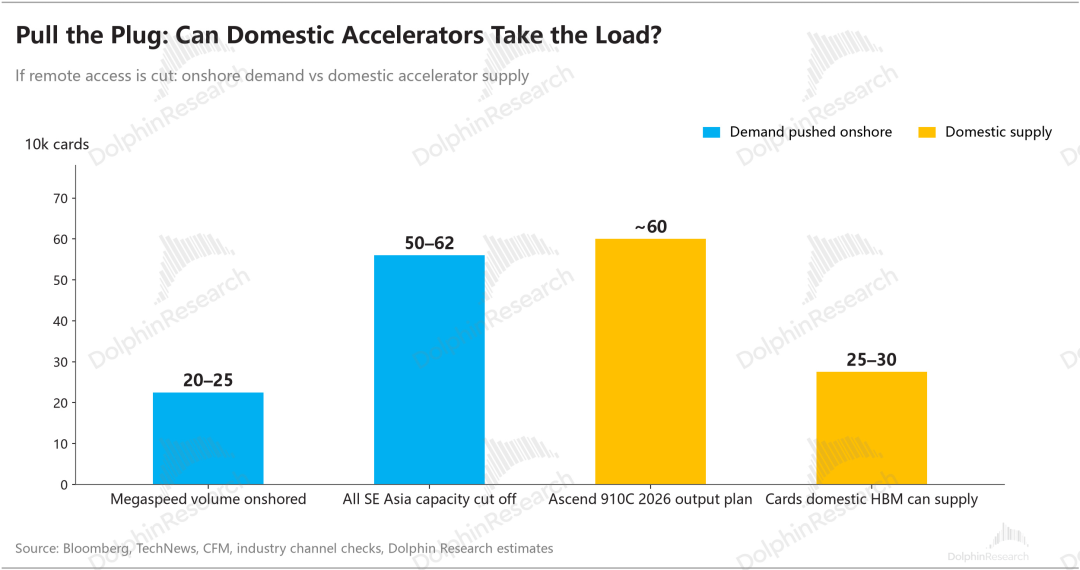
Southeast Asia's 790,000 H100s, converted at 2.8 times B300/H100, are equivalent to 280,000 B300 cards. If all supply is cut off, then under equivalent computing power, the demand flowing back to Huawei Ascend 910C would be about 500,000–620,000 cards, close to Ascend 910C's planned output of about 600,000 units this year;
But the more serious bottleneck is HBM. Chinese memory makers' HBM this year is only enough to make about 250,000–300,000 finished cards. That is to say, the HBM gap needed for the 300,000 finished cards here will most likely be supplied by overseas HBM previously locked in or obtained through other channels.
Summary: Chinese CSPs + models may be badly hurt in the short term; Nvidia's position weakens in the long term
Huang's resignation + RASA's advancement, the short-term effect is not that China can only use domestic cards, but that China cannot use cards: existing capacity keeps running, incremental supply is choked off, and gray channels become more expensive.
With overseas channels locked by policy, demand is squeezed back home, which is equivalent to domestic computing power being assigned certain demand by policy. But for China:
a. For Chinese cloud vendors (such as Alibaba) and upstream IDC centers, capacity cannot be built, cloud business revenue and overseas paths are gone, customer training service pressure rises; domestic cards cannot even satisfy inference demand.
Alibaba stands to be hit especially hard. Even setting production capacity aside, if procurement shifts entirely to domestic sources, it is far from clear how far Huawei is actually willing to go in supplying Alibaba—or in what volumes.
b. For model developers, the story has shifted in much the same way: Chinese frontier model makers can no longer tout CUDA operator optimization as a selling point, and may even have to go further and deny that they use NVIDIA cards at all—switching their pitch to being "native to domestic stacks," while also absorbing the extra costs that come with inferior performance.
The end result is an open-source world split into two hardware camps, Chinese and American: one built around CUDA, the other around Chinese computing platforms such as Ascend.
And for NVIDIA:
a. RASA's real loss is a long-term one. NVIDIA relies on open source to hedge against in-house development by its largest customers, and one of the most active forces in open source sits in China. Once that cable is cut, the feedback loop breaks—and the beneficiaries are Ascend, along with AMD and those big customers building their own chips (Google, Amazon, Meta, and others).
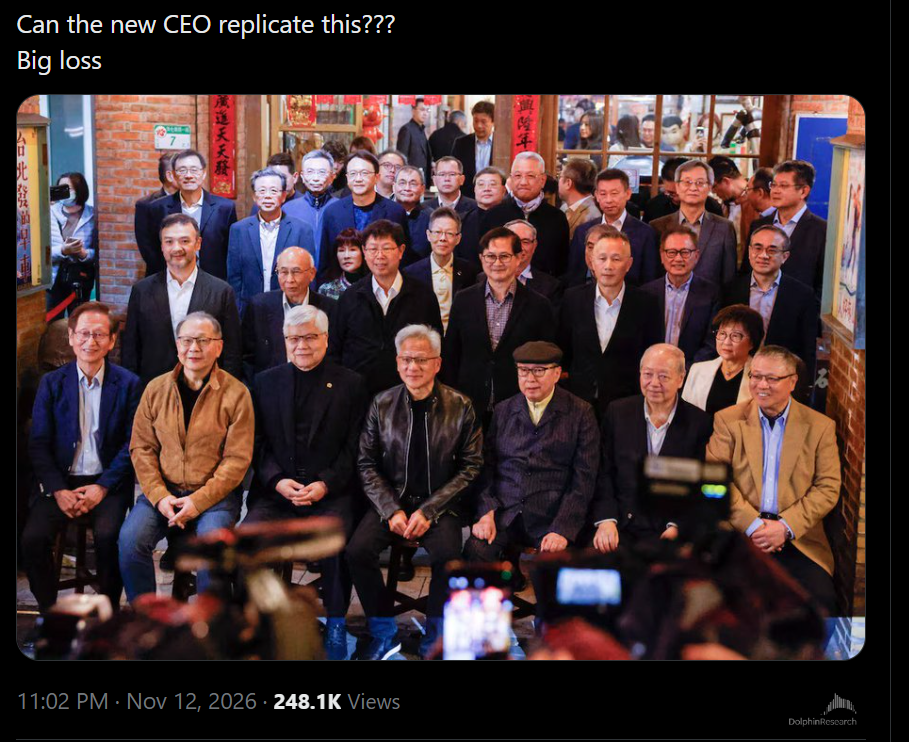
b. A change at the top compounds the risk. Open source is a classic founder-style long-term bet: it doesn't make money and is hard to quantify. Only a leader like Jensen Huang—with absolute authority and long-term strategic vision—could keep pushing it forward for years, just as he did with CUDA. CFOs, by contrast, tend to be conservative; how much appetite would an outside professional manager brought in as CEO have for advancing an open-source ecosystem? The first casualty would be the company's own open-source model, Nemotron, which is not only behind technologically but also unprofitable—and may be the first thing to go.
NVIDIA without Jensen Huang would be like a body without its soul, and the resulting risk and loss of value simply cannot be measured accurately: not only the long-term growth vision of the open-source ecosystem described in this article by Dolphin, but also, from a short- and medium-term perspective, the special CEO-to-CEO cooperation along the industry chain (for example, locking in critical HBM and CoWoS capacity).
- END -
// Reprint authorization
This is an original article by Dolphin Research. Authorization is required for reprinting.
// Disclaimer and general disclosure notice
This report is intended only for general, comprehensive data use—for general reading and data reference by users of Dolphin Research and its affiliates—and does not take into account the specific investment objectives, investment product preferences, risk tolerance, financial situation, or special needs of any recipient. Investors must consult independent professional advisers before making any investment based on this report. Anyone who makes investment decisions based on the use of or reference to the content or information mentioned in this report does so at their own risk. Dolphin Research shall not be liable for any liability or loss that may be directly or indirectly caused by the use of the data contained in this report. The information and data in this report are based on publicly available materials and are for reference only. Dolphin Research strives for, but does not guarantee, the reliability, accuracy, and completeness of the relevant information and data.
The information mentioned or views expressed in this report may not, under any jurisdiction, be treated as or regarded as an offer to sell securities or an invitation to buy or sell securities, nor do they constitute advice, inquiry, or recommendation regarding the relevant securities or related financial instruments. The information, tools, and materials contained in this report are not intended or planned for distribution to citizens or residents of any jurisdiction where such distribution, publication, provision, or use would conflict with applicable laws or regulations, or would require Dolphin Research and/or its subsidiaries or affiliates to comply with any registration or licensing requirements in that jurisdiction.
This report reflects only the personal views, opinions, and analytical methods of the relevant creators and does not represent the position of Dolphin Research and/or its affiliates.
This report is produced by Dolphin Research, and the copyright belongs solely to Dolphin Research. No institution or individual may, without the prior written consent of Dolphin Research, (i) produce, copy, reproduce, reprint, forward, or otherwise make any form of photocopy or reproduction in any way, and/or (ii) directly or indirectly redistribute or transfer it to other unauthorized persons. Dolphin Research reserves all related rights.
-
![]()
Robot Vacuum Makers Go Global: After Taking the Top Market Share, Where Did the Money Go?
-
![]()
From "Baidu It" to "Doubao It" — A Change in More Than Method
-
![]()
Huang Steps Down: Nvidia Loses Its Soul—So Why Should Chinese Assets Pay the Price?
-
![]()
Secures Nearly 100 Million Yuan in Financing! How Does This Company Integrate Optics into Packaging?
-
Production Set to Begin Early Next Year: Lanyu Vision's 4.5-Million-Square-Meter New Plant Successfully Capped
-
![]()
It's Almost Over! October China Fuel Vehicle Sales Released: Sales of Numerous Classic Family Sedans Plummet
-
Car Quality Network: Q3 Service Complaints Jump 55.6% QoQ, with Transaction Segment Driving the Surge
-
In the Era of Intelligent Organizations, What Kind of AI Cloud Do Enterprises Need?