It's Almost Over! October China Fuel Vehicle Sales Released: Sales of Numerous Classic Family Sedans Plummet
 11/16 2026
 513
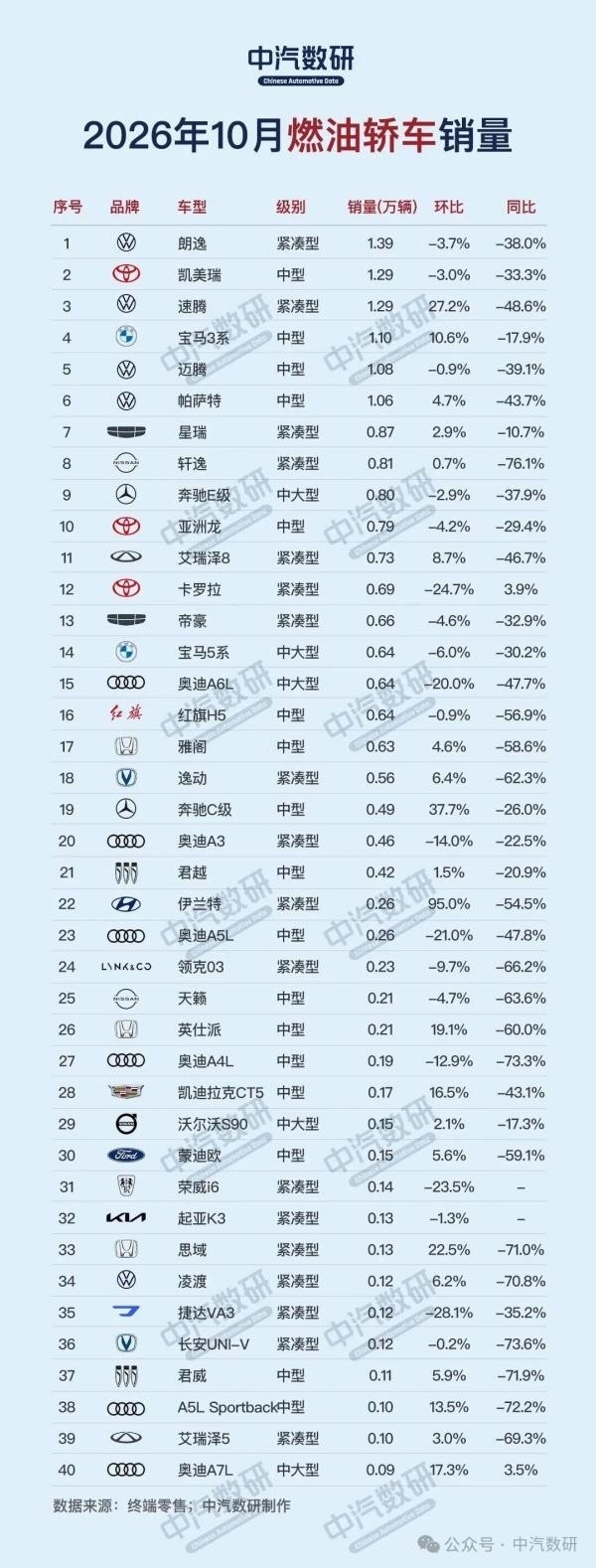
Fast Technology News, November 16: Recently, China Auto Data Research released the October 2026 fuel sedan sales rankings.
Against the overall downward trend of the fuel vehicle market, the fuel sedan segment shows a divergent trend: the top of the list is still dominated by a number of joint-venture family sedans, while models at the bottom of the list show prominent sales shrinkage, with declines significantly higher than those in the fuel SUV category.
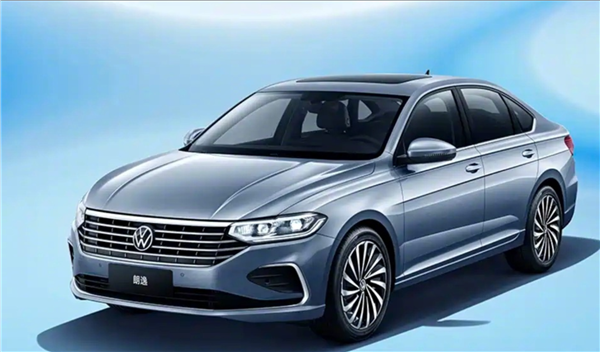
Specifically, looking at the list, the Volkswagen Lavida held the top spot in fuel sedan sales with 13,900 units, but still fell 38% year-on-year. The Camry and Sagitar followed closely, both with sales of 12,900 units; among them, the Sagitar rebounded month-on-month, but its year-on-year decline was close to 50%.
The BMW 3 Series, Magotan, and Passat ranked fourth to sixth respectively. Although the top models remain the main force in the market, almost none of them escaped year-on-year declines.
Among self-owned brand models, Xingrui performed impressively, entering seventh place on the list with 8,700 units. Arrizo 8, Emgrand, Eado, and other self-owned fuel sedans also remained steadily on the list, continuing to hold a place in the fuel segment.
By comparison, the most prominent declines were seen in a number of established family sedans. The former "king of family sedans" Sylphy sold only 8,100 units in October, plunging 76.1% year-on-year, with its ranking falling to eighth place.
In addition, models such as the Audi A4L, Changan UNI-V, Honda Civic, and Volkswagen Lamando all saw year-on-year declines exceeding 70%, while popular models such as the Accord, Teana, and Lynk & Co 03 also experienced sharp year-on-year declines.
Across the entire list, only two models, the Corolla and Audi A7L, achieved positive year-on-year growth, which was particularly rare amid the broad decline. Luxury fuel sedans were likewise unable to remain unaffected: the Mercedes-Benz E-Class, BMW 5 Series, and Audi A6L, three mainstream mid-to-large luxury sedans, all saw their sales decline year-on-year.
Today, new energy models continue to seize market share in family sedans, and the living space for fuel sedans keeps shrinking. Even though top models rely on long-accumulated reputation and terminal discounts to stabilize their base, the sharp drop in sales of a large number of classic fuel family sedans also reflects the overall shrinking trend of the fuel sedan market, and the transformation pressure on traditional fuel vehicles continues to intensify.
-
![]()
Robot Vacuum Makers Go Global: After Taking the Top Market Share, Where Did the Money Go?
-
![]()
From "Baidu It" to "Doubao It" — A Change in More Than Method
-
![]()
Huang Steps Down: Nvidia Loses Its Soul—So Why Should Chinese Assets Pay the Price?
-
![]()
Secures Nearly 100 Million Yuan in Financing! How Does This Company Integrate Optics into Packaging?
-
Production Set to Begin Early Next Year: Lanyu Vision's 4.5-Million-Square-Meter New Plant Successfully Capped
-
![]()
It's Almost Over! October China Fuel Vehicle Sales Released: Sales of Numerous Classic Family Sedans Plummet
-
Car Quality Network: Q3 Service Complaints Jump 55.6% QoQ, with Transaction Segment Driving the Surge
-
In the Era of Intelligent Organizations, What Kind of AI Cloud Do Enterprises Need?