The Year Computing Power Was Tightest: Baidu's Full-Stack Bet Begins to Pay Off
 11/17 2026
 517
Baidu's second growth curve has already outpaced its first
Author | Dingshan
Editor | Xiaobai
Image | AI-generated
Produced by | Emphasize Next
On the evening of November 16, Baidu released its Q3 2026 financial report. Excluding iQIYI, Baidu's general business revenue came in at 25 billion yuan, up 1% year-on-year—returning to positive growth after a year-on-year decline in the second quarter.
The 1% figure itself is modest; what matters is its composition. In the third quarter, Baidu's core new AI business revenue reached 13.2 billion yuan, up 37% year-on-year, and its share of general business revenue climbed from 39% a year earlier to 53%, while the share of online marketing revenue fell to 48%.
Core revenue has shifted to a different source, yet the total pie has not shrunk. This is the hardest stretch of any large company's transformation. No matter how fast the new business grows, as long as it cannot fill the gap left by the old business, the financial statements will keep trending downward. Baidu's third-quarter figures show that its new engine can already offset the decline of the old business.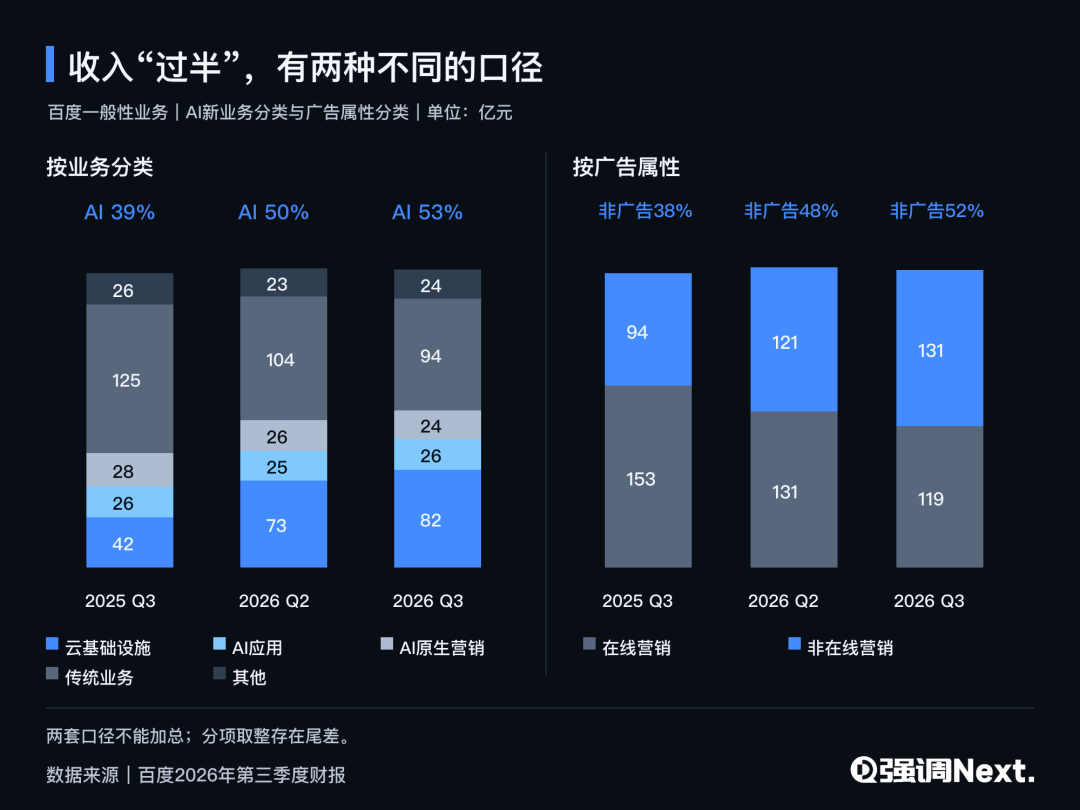
The new engine is now generating incremental growth
Financial report data shows that Baidu's new AI business generated 3.6 billion yuan more than in the same period last year, while traditional businesses decreased by about 3.1 billion yuan over the same period. The increment from new businesses is already enough to cover the decline of the old ones. Among them, Intelligent Cloud infrastructure revenue was 8.2 billion yuan, up 94% year-on-year and 11% quarter-on-quarter, making it the main source of growth this quarter.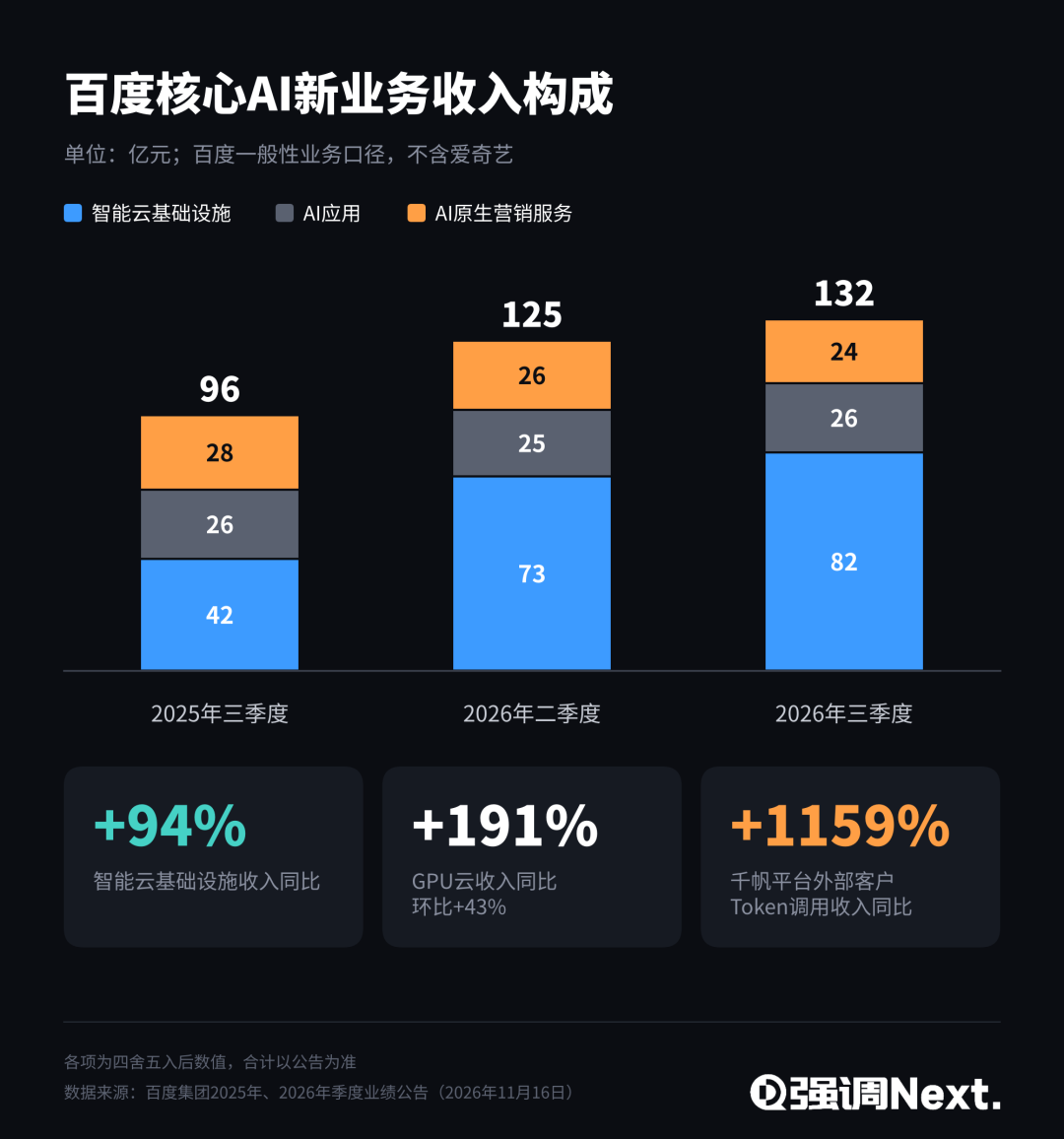
This shift happened quickly. A year ago, Baidu disclosed AI business revenue separately for the first time, at about 9.6 billion yuan, accounting for less than 40% of general business. Four quarters later, it already supports more than half.
The quality of growth is equally critical. The financial report noted that in the third quarter, the customer base of Intelligent Cloud infrastructure became more diverse, customer prepayments increased, and contracts continued to shift toward longer terms. For the cloud business, prepayments and long-term contracts mean higher visibility of demand: customers are not temporarily scrambling for a batch of computing power, but incorporating Baidu into their production plans for the coming years.
Like all major companies, Baidu's transformation comes with costs. In the third quarter, Baidu's general business gross margin was about 39.4%, lower than 47.3% in the same period last year. This is a structural change brought about by a higher share of computing power business and increased depreciation.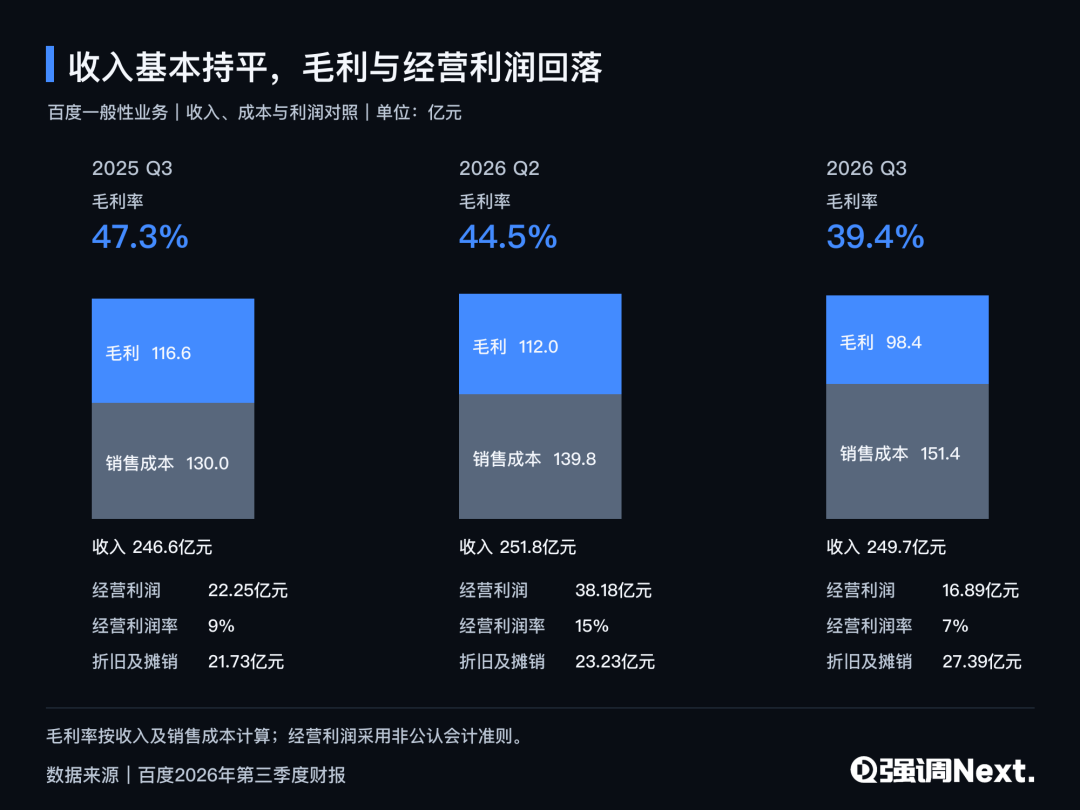
Globally, this is a common feature of the current AI infrastructure cycle: the combined capital expenditure of Microsoft, Google, Amazon, and Meta in the third quarter was about 201.9 billion US dollars, already exceeding their operating cash flow for the same period, and Google's single-quarter free cash flow was -9.1 billion US dollars.
By comparison, Baidu's pace of investment is more prudent: third-quarter capital expenditure (excluding iQIYI) was 7.3 billion yuan, lower than 11.4 billion yuan in the second quarter, and the free cash flow gap narrowed from 8.27 billion yuan to 4.69 billion yuan. Chief Financial Officer He Haijian said in the financial report that Baidu will continue to adopt a prudent capital allocation strategy and clearly focus on investment returns.
In the year computing power was tightest, the full stack begins to pay off
2026 is a year of concentrated explosion in China's computing power demand. In March this year, China's average daily Token calls exceeded 140 trillion; demand growth outpaced supply, and Sinolink Securities summarized this year as "full-chain inflation" in the computing power industry chain. In such a market, manufacturers that can stably deliver computing power can be the first to turn demand into revenue.
Baidu's figures confirm this. Third-quarter GPU cloud revenue grew 191% year-on-year and 43% quarter-on-quarter; Token call revenue from external customers on the Qianfan platform grew 1,159% year-on-year. In terms of growth rate, Baidu Intelligent Cloud infrastructure's 94% growth was higher than Alibaba Cloud's 45% external commercialization revenue growth in the previous quarter, although there is still a gap in scale between the two.
What supports this round of growth is Baidu's chip layout that began more than a decade ago. After Nvidia's H200 was approved for export to China in January this year, Bernstein still expected Nvidia's share in China to fall from 66% in 2024 to single digits this year, and TrendForce expected domestic solutions to take nearly 90% of China's high-end AI chip market this year.
Kunlun Chip is one of the main participants in this round of domestic substitution: 116,000 units shipped in 2025, tied with Cambricon for third among domestic players; a 30,000-card cluster has been lit up; and in China Mobile's inference-oriented computing equipment procurement, it won 70%, 70%, and 100% shares in the three packages respectively. The financial report shows that M100, optimized for large-scale inference, is expected to be ready for mass production by the end of this year, and M300, oriented toward training, will be launched in 2027.
The value of self-developed chips is even clearer in comparison with overseas peers. US computing power cloud provider CoreWeave's third-quarter revenue grew 168% year-on-year, but it must purchase chips from Nvidia and still posted a net loss of 709 million US dollars for the quarter. Baidu's "chip-cloud-model-agent" is a complete chain from chips, cloud, and models to agents, where each layer can reduce costs for the layer above, and profits from the chip segment can remain within the system. Kunlun Chip is advancing an A+H dual listing, and the value of this long-term investment will also be reflected more clearly in the capital market.
Search is actively shifting gears
AI-native marketing services revenue in the third quarter was 2.4 billion yuan, underperforming the other two AI businesses overall. One reason Baidu gave in its financial report is that during the AI search transformation, it strategically prioritized improving user experience rather than short-term monetization.
This is the common path for search AIization: first change the product experience, then rebuild the monetization method. Google similarly acknowledged in the third quarter that the monetization rate of AI Mode is temporarily lower than traditional search, but it continues to expand the coverage of AI Mode and has begun pushing AI Mode ads to more countries. Baidu's choice at this moment is consistent with that.
From the product side, the transformation has already produced visible progress. Baidu integrated Wenxin Assistant into the main entrance of the Baidu App and officially disclosed that Wenxin Assistant's monthly active users have exceeded 200 million; in September this year, the AI daily active penetration rate of Baidu Wenku and Baidu Netdisk increased by 60.7% year-on-year; the production cost of Baidu Yijing's ultra-realistic digital human dropped by about 80% compared with the fourth quarter of last year; the general work agent Baidu Dazi DuMate integrates the capabilities of the internal office agent dodo, the programming assistant Wenxin KuaMa, and the no-code platform Miaoda, covering more tasks with one agent.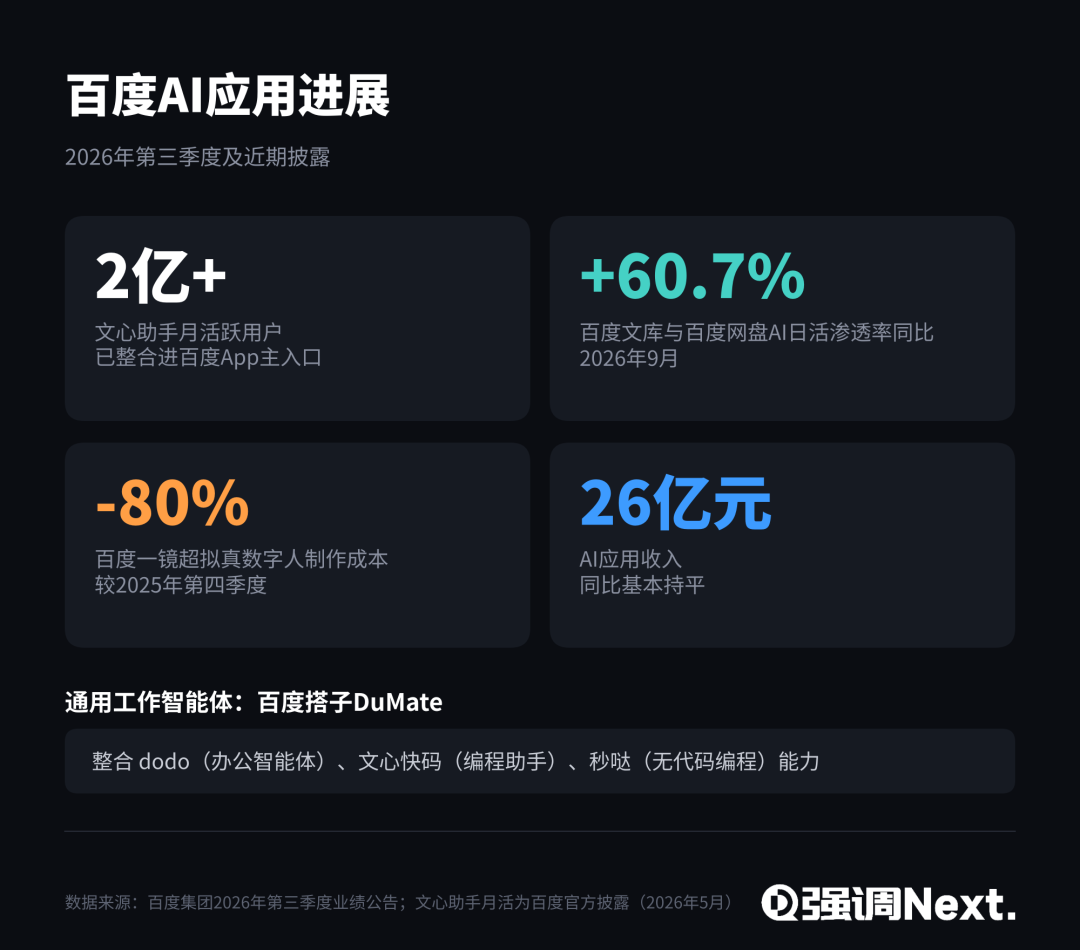
User habits are migrating toward AI assistants across the entire industry. Baidu App's monthly active users were 604 million in September, still one of the largest information entrances in China. There is no shortcut to search transformation, and Baidu has clearly chosen the former between user experience and short-term revenue.
Occupying the ecological niche of the next stage in advance
If computing power is Baidu's current source of growth, then several recent actions point to its position in the next stage.
At the Baidu World Conference on November 12, Baidu launched the large model trading platform "Ciyuansuo," which Robin Li called "the exchange for large models." The platform focuses on "verification" and "credit reporting," verifying resources through model fingerprint comparison, capability and performance testing, and establishing credit ratings for model providers. Robin Li mentioned that in the first nine months of this year, almost every day more than one new model was released, and it is difficult for enterprises to judge which model and which supplier are reliable.
After one month of trial operation, Ciyuansuo has more than 100 supplier resources onboarded, with average daily calls exceeding 50 million and average daily Token calls exceeding 700 billion. As models become more numerous and increasingly resemble standardized commodities, the step of helping buyers judge "which one is trustworthy" will become increasingly important, and this is exactly the capability Baidu has accumulated since the search era.
At the model level, Wenxin 5.5 Flash Preview released on November 11 has 280 billion total parameters and 14 billion activated parameters, supports a 1 million Token context, and its weights will be open-sourced before November 25; on the Code Arena WebDev leaderboard, it ranks second among global open-source models. Open sourcing makes it easier for Wenxin to enter developers' workflows and echoes the open positioning of Ciyuansuo.
At the application layer, the one that has already reached scale is Apollo Go. As of October, Apollo Go covered 30 cities worldwide, with cumulative autonomous driving mileage exceeding 390 million kilometers, including about 34 million kilometers in the third quarter alone. Fully driverless orders in Shenzhen grew by about 170% quarter-on-quarter, the fully driverless commercial fleet in Dubai doubled, and in London it partnered with Uber and Lyft for open-road testing. Globally, platforms that can simultaneously advance fully driverless operations in China, the Middle East, and Europe are among the few.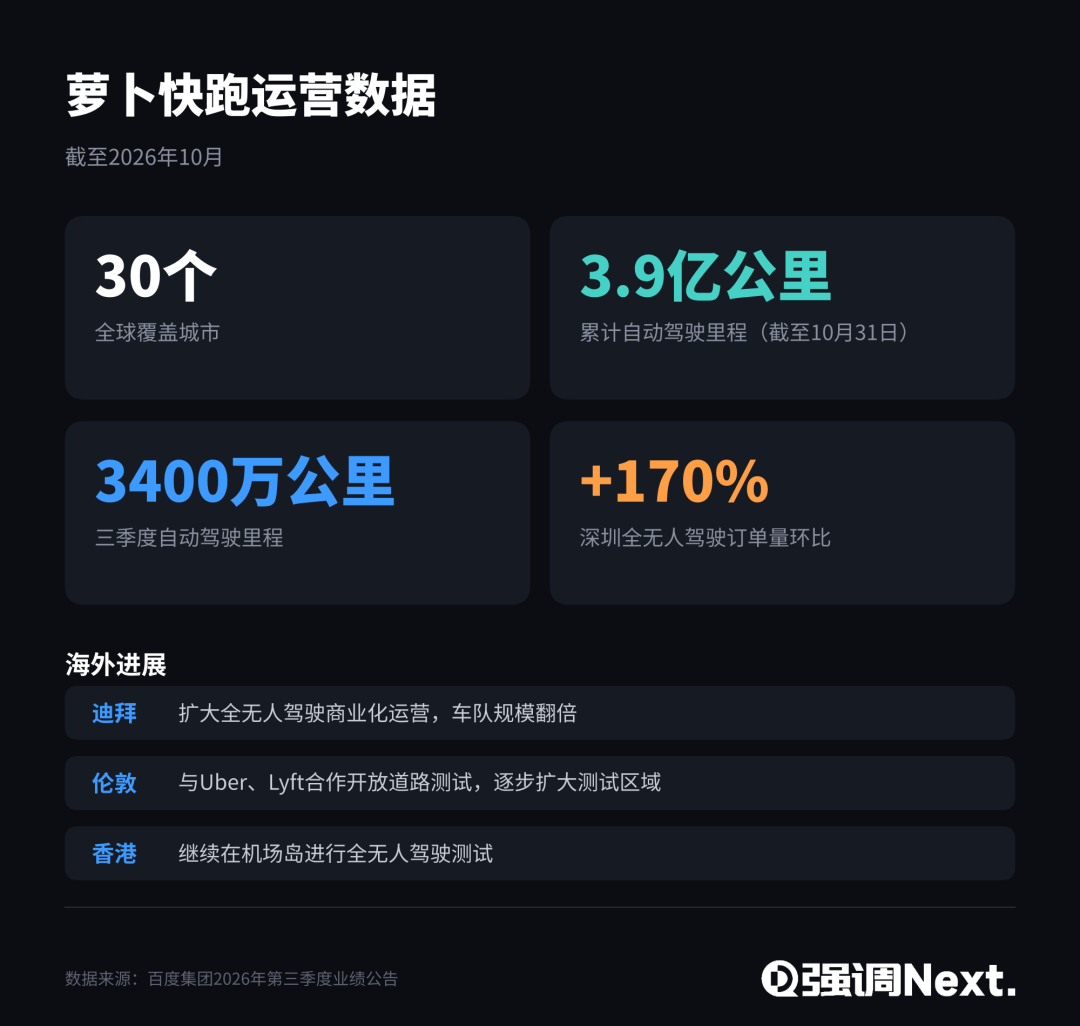
At the same time, Baidu is also increasing shareholder returns. Since the beginning of the first quarter of 2026, Baidu has returned 373 million US dollars to shareholders through buybacks and expects to announce its first dividend before the end of the year. As of the end of September, Baidu's total cash and investments were 276.6 billion yuan, enough to support a relatively long investment cycle.
For Baidu, the yardstick for measuring transformation is changing. In the past, the market cared about how many stories AI told; now it looks at how much revenue AI accounts for. The figure of 53% means that this company can already define itself by the rhythm of its new business. Note: The data in this article comes from public materials and does not constitute investment advice.
- END -
-
![]()
AR Anti-Reflection Coating: "Reduce Reflection, Increase Transmission" — But the Essence Is Systems Engineering
-
![]()
The Year Computing Power Was Tightest: Baidu's Full-Stack Bet Begins to Pay Off
-
![]()
Metalenz Acquires Israeli Startup PxE Imaging to Advance Optical Metasurface Technology
-
![]()
Business Focus: Optical Giant ams OSRAM Posts €829 Million in Q3 2026 Revenue
-
Jet Fuel Price Surge Inflates Costs, Net Profit Falls Over 20%; Spring Airlines Issues 10 Billion Yuan in Bonds to Fund 27.6 Billion Yuan Aircraft Purchase
-
![]()
A $5 Trillion Foreign Trade Hub Hosts a Landmark Gathering of Chinese and Global Titans
-
Baidu's AI Revenue Tops 50% for the First Time, Yet Shares Hit Record Low—Baidu Is Still Essentially Selling Computing Power
-
![]()
China's 6G Communications Breakthrough: Q/V-Band Experiment Hits 27Gbps, Setting New Domestic Record